Blog Article
Ryan Silverfield Is 3-12 On The Road Against Winning Teams. Arkansas Just Asked Him To Win At Georgia, LSU, Texas, And Texas A&M.

Ryan Silverfield is a high-floor stabilizer hire for Arkansas.
He’ll almost certainly get the Razorbacks back to bowl eligibility and competent, week-in/week-out SEC football. His Memphis track record – 50-25, bowl games every year, back-to-back double-digit-win seasons – shows he knows how to build and maintain a program.
But nothing in his profile screams “SEC title contender.” And the data suggests Arkansas just hired a coach whose ceiling is 7-8 wins in a league where that gets you fired.
The Numbers
Silverfield’s career record looks solid on the surface. But the splits tell a different story.
Silverfield at Memphis (Career)
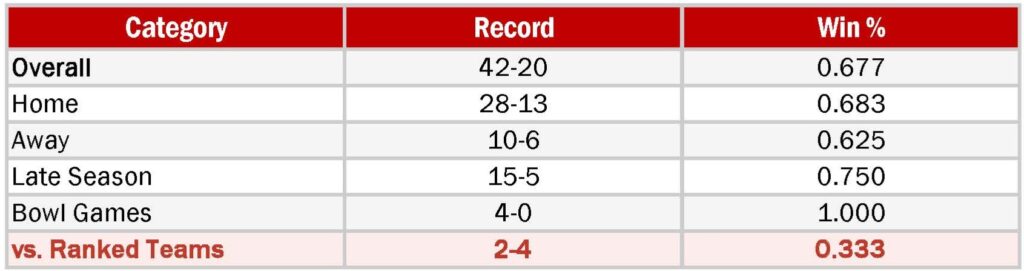
The bowl record is perfect. The late-season numbers are strong. But look at the bottom row: 2-4 against ranked teams. That’s a .333 win rate when games matter most.
The Schedule Cliff
This is where the data gets uncomfortable. Every single season at Memphis, Silverfield coached against a negative strength of schedule. Every season at Arkansas – even in Pittman’s worst years – featured a positive.
Strength of Schedule Comparison
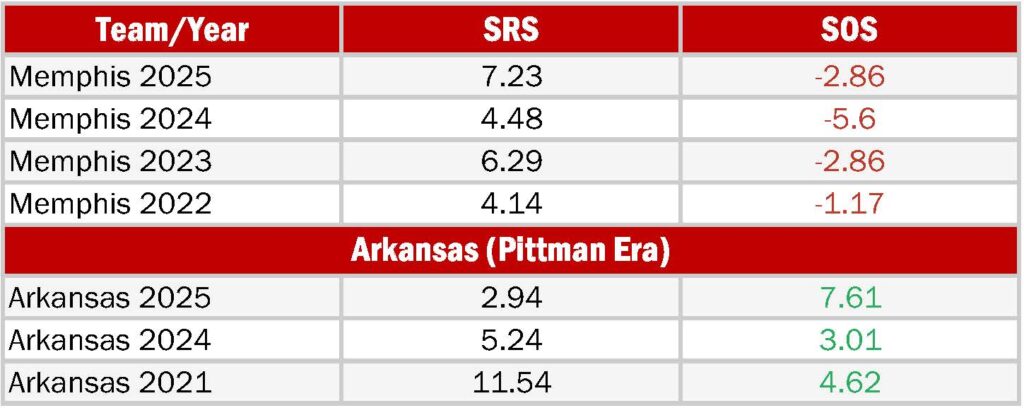
That’s an 8-10 point swing in schedule difficulty. Silverfield has never navigated a positive strength of schedule. Now he walks into the SEC West, where Georgia, LSU, Tennessee, Texas, and Texas A&M are all on the schedule.
He won .677 against weak competition. What happens when every week is a test?
The AAC Problem
Here’s the detail that haunts this hire: Silverfield never won an AAC Championship.
Mike Norvell won one before leaving for Florida State. Silverfield inherited a stable program with solid G5 resources and continuity, and never broke through. His best teams (2023, 2024) finished 6-2 in conference play both years. Good. Not great. Never the best.
That hints at a coach who reliably gets you to “good and organized” but hasn’t shown evidence of consistently punching above his resource level. In the AAC, that meant no title. In the SEC, it likely means a ceiling of 7-8 wins.
The Fan Reaction
Arkansas fans didn’t just express disappointment. They protested.
Razorback fans organized an on-campus protest at the Jones Center the day the hire became public—a rarity even by SEC drama standards. Social media reaction was brutal: “Such a 6-7 hire” became the instant meme. National observers piled on. Rival fanbases mocked the move.
The core complaints:
- Going 8-4 in the AAC gets you an SEC job?
- Memphis never won a conference title under Silverfield despite strong resources
- Memphis fans openly celebrated his departure—and that’s who Arkansas hired?
- Yurachek asked for major booster commitments, missed on bigger targets, then settled late
Compare this to James Franklin at Virginia Tech: protests = zero, fan sentiment = cautiously optimistic, narrative = “boss move.” Silverfield walks into Fayetteville with the shortest leash of any new hire in this cycle.
The Memphis Tell
Want to know what Memphis fans think? They’re celebrating.
Local Memphis media describe Tiger fans as “relieved” Silverfield left on his own rather than forcing an awkward firing decision. Message board comparisons to Josh Pastner – likable, professional, solid floor, limited ceiling – capture the mood perfectly.
The Memphis framing: “Good man, good coach, but not the guy to take us to the next level.” When your own fanbase is thanking you for leaving, that’s a data point.
The Bottom Line
Silverfield’s realistic outcome at Arkansas:
- Years 1-2: 6-7 wins, bowl eligibility, stabilized culture
- Years 3-4: 7-8 wins with an occasional shot at 9 if the schedule breaks right
- Ceiling: Occasional 8-9 win seasons; unlikely to be a consistent SEC contender
That makes him a defensible hire for an AD who wanted stability and professionalism after the Pittman disaster. But it also explains why the reception has been so harsh, and why this move will be judged harshly if the on-field turnaround isn’t obvious by Year 2.
High floor. Low ceiling. Short leash.
Arkansas traded the uncertainty of another developmental hire for a known quantity. The problem is, everyone knows what that quantity is, and the SEC doesn’t grade on a curve.