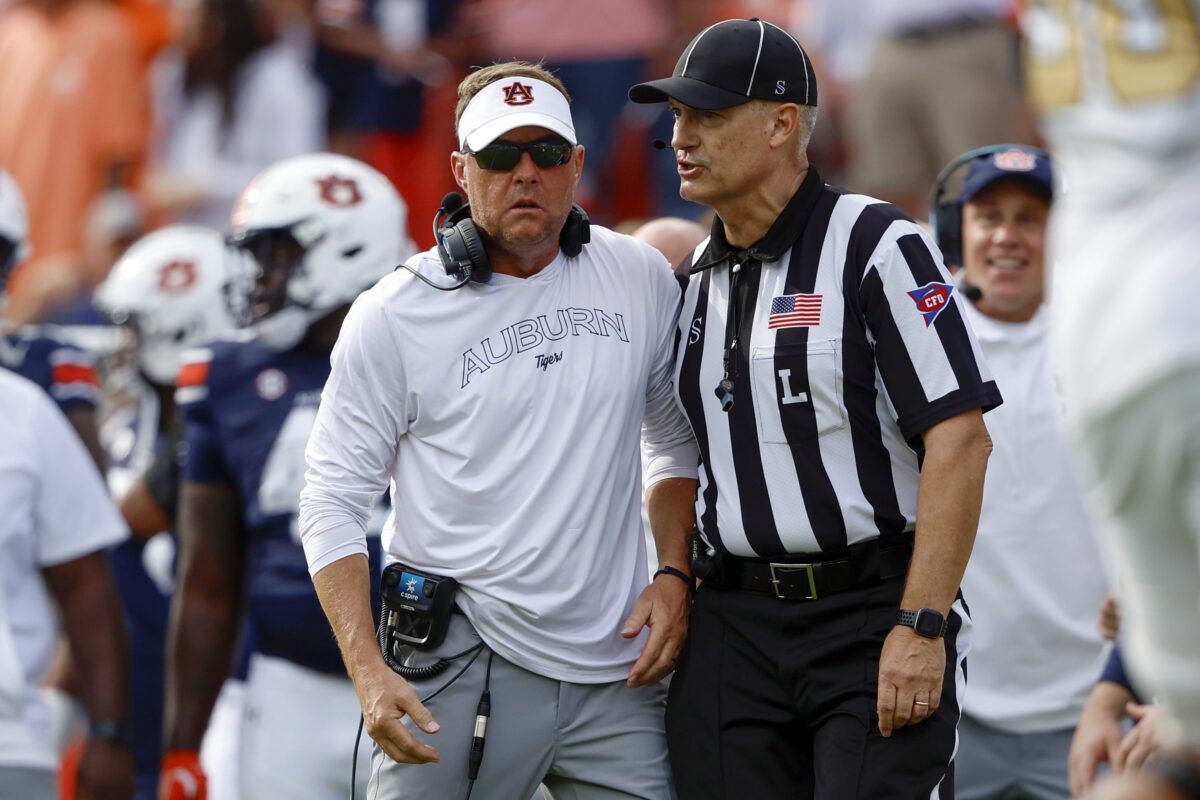
Two Hot Seat Coaches Meet At Auburn: One Will Buy Time, The Other Runs Out Of Runway

This isn’t just another SEC game.

This is a referendum on two coaches fighting for their jobs. Mark Stoops sits at #16 on the Coaches Hot Seat rankings (and trending in the wrong direction). Hugh Freeze checks in at #5, which means every single game is an audition for next season.

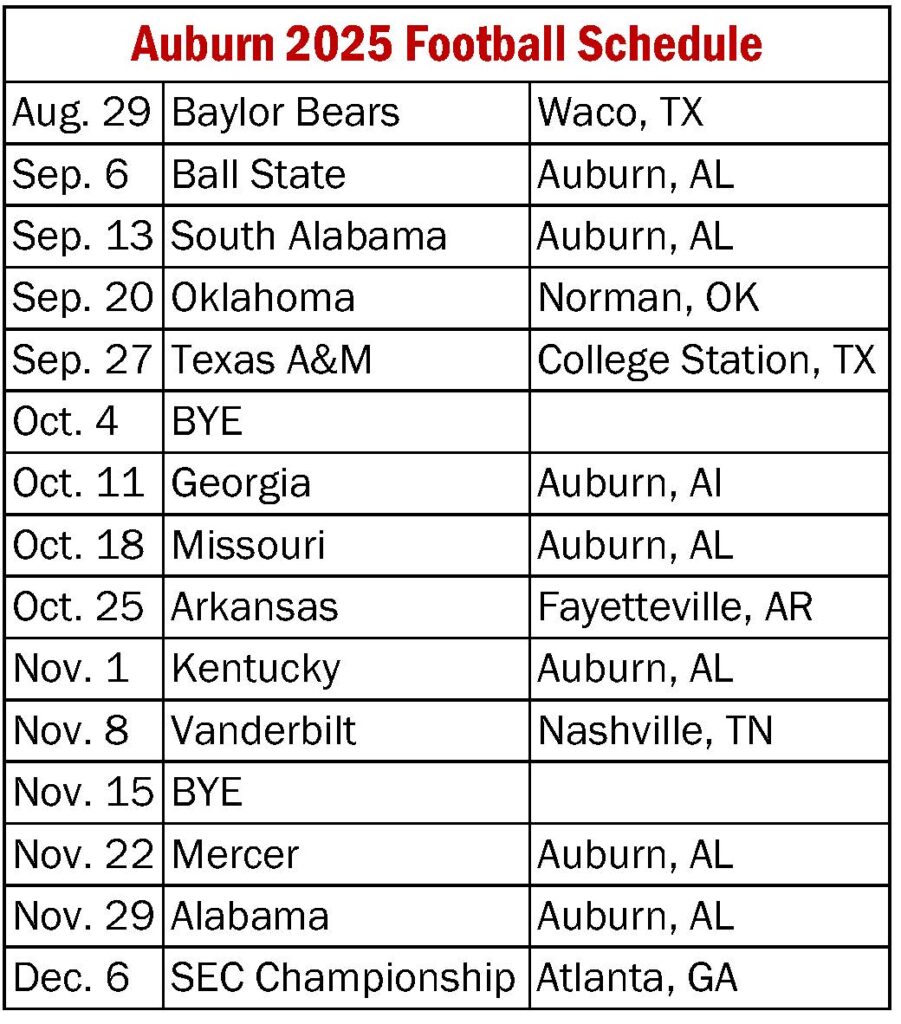
Auburn hosts Kentucky at Jordan-Hare Stadium, and one of these coaches is going to walk away with some much-needed breathing room. The other? He’s going to feel the heat cranking up to uncomfortable levels. One coach survives this weekend. The other watches his seat get hotter.

Let me break down why this game matters more than the talking heads on ESPN will tell you.

The Stakes Are Ridiculous

Mark Stoops has one of the biggest buyouts in college football history.

Kentucky isn’t just paying him to be mediocre – they’re paying him an insane amount of money they can’t afford to get out of. And what has he delivered in 2025? An 0-5 record in SEC play. Zero wins against conference opponents.

That’s a pattern, not a slump

Meanwhile, Hugh Freeze is sitting at #5 on the hot seat, and Auburn fans are already questioning whether he’s the answer. The Tigers are 1-4 in SEC play, which isn’t great, but it’s also not catastrophic. A win against Kentucky doesn’t just improve his record; it moves him down the rankings and buys him real equity with the boosters.

This is coaching survival mode, and both guys know it.

Let’s Talk Numbers (Because They Don’t Lie)

If you’re a bettor or just someone who likes to understand how football works, the stats tell you everything you need to know.

Kentucky’s offense is barely functional against SEC defenses:

  • 24.1 points per game overall, but only 19.4 against SEC opponents
  • Just 121.6 rushing yards per game in SEC play (their ground game gets completely shut down)
  • When you can’t run, you become one-dimensional, and when you’re one-dimensional against good defenses, you lose

Auburn’s defense is where they have Kentucky beat:

  • Just 21.1 points allowed per game
  • Best run defense in this matchup, opponents average only 84.1 rushing yards
  • Kentucky’s weakness meets Auburn’s strength and that’s the ballgame

But here’s where it gets interesting:

Auburn’s offense isn’t exactly lighting the world on fire either. They’re balanced, 170 passing yards, 170 rushing yards per game. But in SEC play, those numbers crater. The difference? Auburn doesn’t turn the ball over. They average just 0.5 turnovers per game compared to Kentucky’s 1.6.

In close games, that margin is everything.

The Matchup That Decides Everything

Here’s the reality:

Kentucky cannot run the ball against Auburn’s front seven. That’s not opinion, that’s what the numbers tell us. When Kentucky is forced to throw on every down, their offensive line breaks down, their quarterback gets pressured, and the whole operation falls apart.

Could Kentucky exploit Auburn’s secondary?

Auburn’s been vulnerable through the air, they’re allowing 234.4 passing yards per game. But Kentucky hasn’t shown the ability to exploit that kind of weakness all season. Their passing game improves against MAC teams and collapses against SEC defenses.

There’s no reason to believe this week will be different.

By the Numbers: Complete Matchup Breakdown

If you want to bet this game, or understand who actually has the advantage, here’s the tale of the tape:
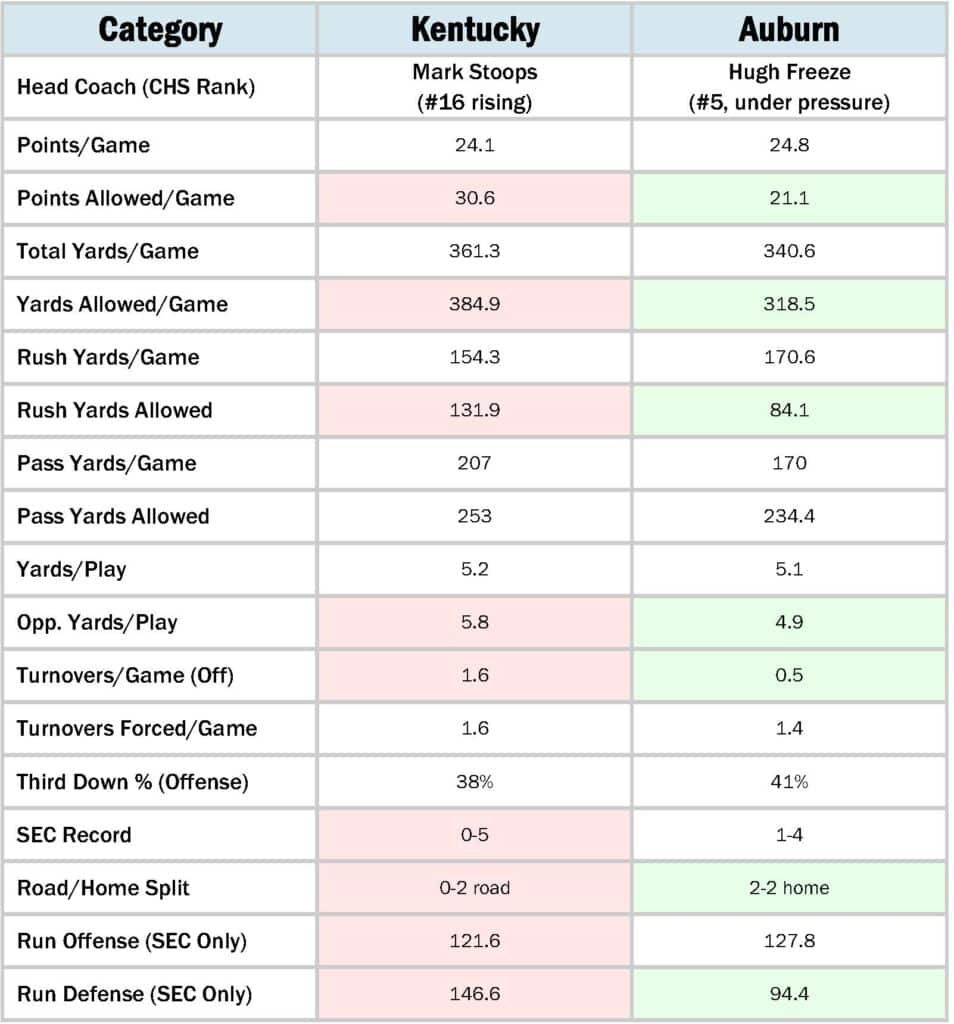
Auburn holds decisive advantages in the categories that matter most.

The X-Factor You’re Not Thinking About

Home-field advantage matters.

Auburn’s home splits show they gain approximately 20 yards and 4 points per game at Jordan-Hare Stadium. Kentucky is 0-2 on the road this season. They can’t win away from Lexington. The math is simple: Auburn plays better at home, and Kentucky falls apart on the road.

Here’s what that means for this game:

Auburn’s offensive line will control the line of scrimmage against Kentucky’s weak front seven. The Tigers will run the ball down Kentucky’s throat in the fourth quarter when the Wildcats’ defense is gassed. Kentucky won’t be able to match that physicality. They haven’t been able to all season.

This is where games are won and lost.

The Bottom Line

Auburn wins by 7-10 points.

Predicted score: Auburn 27, Kentucky 17

This isn’t rocket science. Auburn’s run defense shuts down Kentucky’s already-struggling ground game. Kentucky becomes one-dimensional. Auburn’s balanced offense exploits a weak Kentucky defense. The Tigers control time of possession and wear down the Wildcats in the second half.

The coaching implications are massive:

Hugh Freeze gets a much-needed win and some breathing room on the hot seat. Mark Stoops watches his seat get even hotter as Kentucky falls to 0-6 in SEC play. One coach buys himself time. The other runs out of runway.

For Kentucky to pull off the upset, they’d need:

  • Their passing game to suddenly become elite
  • Auburn to commit multiple turnovers
  • A complete defensive transformation

None of those things is happening.

The Bigger Picture

This is what college football has become in 2025.

Every game is an evaluation. Every loss adds weight to the hot seat. Coaches like Mark Stoops and Hugh Freeze aren’t just competing against each other—they’re competing against impossible expectations, impatient boosters, and the reality that one bad season can end a career.

Kentucky vs Auburn isn’t just about which team wins—it’s about which coach survives. And when you look at the numbers, Auburn has every statistical advantage. The Tigers should win this game comfortably.

Auburn 27, Kentucky 17.
No related posts found.

LOAD MORE BLOG ARTICLES

Hugh Freeze Has 2 Games To Save His Job At Auburn. Here’s Why Saturday Night’s Matchup Against #10 Georgia At Jordan-Hare Stadium Is Game 1 Of His Final Stand

7:30 PM EDT. Jordan-Hare Stadium. Lights. Chaos. Everything on the line.

This isn’t just another SEC game.

This is Hugh Freeze fighting for his job. This is Auburn desperate for relevance after back-to-back losses. This is Georgia trying to stay in the playoff hunt on the road, at night, in one of the most dangerous venues in college football.

Let me break down exactly what’s about to happen.


The Numbers Don’t Lie (But Jordan-Hare At Night Doesn’t Care)

Georgia is the better team on paper.

Georgia’s Offensive Dominance:

  • 438.6 yards per game (96.4 more than Auburn)
  • 34.6 points per game
  • Perfectly balanced: 231.8 passing, 206.8 rushing
  • 3.2 rushing touchdowns per game
  • 24.8 first downs per game

Auburn’s Offensive Struggles:

  • 342.2 yards per game (bottom-tier SEC)
  • 27.6 points per game
  • Anemic passing: 173.2 yards, 1.0 TD per game
  • Only scored 10 points at Texas A&M

Georgia should win by double digits.

But here’s what the stats don’t tell you: Auburn at night in Jordan-Hare has produced some of the most inexplicable upsets in college football history. The “Kick Six” against Alabama. Stunning wins over LSU, Georgia, and other powerhouses who had no business losing.

Strange things happen here after dark.


What To Watch: Georgia With The Ball

Can Auburn’s elite run defense hold?

This is the marquee matchup of the game. Auburn allows only 82 rushing yards per game at 2.7 yards per carry. That’s legitimately elite. But Georgia rushes for 206.8 yards per game at 4.8 yards per carry with over 3 rushing touchdowns per game.

Something’s gotta give.

If Auburn stacks the box to stop the run, Georgia will torch them through the air. If they play honestly, Georgia will run them over. There’s no good answer for Auburn’s defensive coordinator.

The balance problem Georgia creates:

Georgia doesn’t just beat you one way. They beat you every way. 231.8 passing yards per game. 206.8 rushing yards per game. Perfectly balanced, impossibly difficult to defend.

Auburn has to pick its poison.

In a night game where crowd noise makes communication difficult, Georgia’s ability to run the ball becomes even more valuable. No audibles needed. Just line up and impose your will.

Watch the first down battle:

Georgia averages 24.8 first downs per game. Long, methodical drives that keep Auburn’s defense on the field and completely gassed by the fourth quarter.

If Georgia controls the clock and sustains drives, Auburn’s offense won’t get enough possessions to keep pace. And with Auburn averaging only 27.6 points per game, they need every possession they can get.

Can Georgia handle the noise?

Here’s Georgia’s biggest weakness: 40.8 penalty yards per game. False starts. Holding calls. Drive killers.

Now put them on the road, at night, in one of the loudest stadiums in America. Communication becomes nearly impossible. The crowd will be absolutely deafening on every Georgia snap.

If Georgia beats itself with penalties, Auburn has a chance.


What To Watch: Auburn With The Ball

Can Auburn throw the football at all?

This is the existential question for Hugh Freeze’s offense.

173.2 passing yards per game. Only 1.0 passing touchdown per game. Those are borderline FCS numbers in the modern SEC. You cannot win big games with that level of offensive production.

Georgia’s pass defense allows 231.2 yards per game, which means Auburn should be able to exploit it through the air. But “should” and “can” are two very different things.

If Auburn comes out scared and conservative in the passing game, they have no chance. If Hugh Freeze opens up the playbook and takes shots downfield, they might be able to keep Georgia honest enough to run the ball effectively.

The ghost of Texas A&M:

Auburn scored 10 points at Texas A&M. Ten.

That performance haunts everything about this game. Can Auburn’s offense show up when it matters most? Or will they shrink under the pressure and the lights?

The first quarter will tell you everything you need to know.

Ball security is victory:

Auburn’s best stat: 0.2 turnovers per game. Elite ball security. Georgia commits 1.4 turnovers per game.

If Auburn takes care of the football and Georgia coughs it up twice, suddenly you’ve got short fields and momentum shifts. That’s how upsets happen.

One Auburn turnover probably ends the game. Zero Auburn turnovers gives them a legitimate puncher’s chance.

Time of possession will decide this:

Auburn averages 342.2 total yards per game. That’s not enough to win a shootout.

So they have to shorten the game. Long, grinding drives that keep the clock moving and Georgia’s explosive offense on the sideline. Lean on the run game (169 yards per game, 2.4 TDs). Control the tempo.

If Auburn gets into a track meet, they lose by three touchdowns.

Hugh Freeze’s bag of tricks:

When coaches are fighting for their jobs at home under the lights, desperation breeds creativity.

Watch for fake punts, trick plays, ultra-aggressive fourth down calls. Hugh Freeze knows conventional football won’t beat Georgia. He needs chaos, misdirection, and a little bit of magic.

At night, Jordan-Hare is the perfect stage for desperation to become brilliance.


What Each Team Brings To This Party

Georgia’s Advantages:

  • Superior talent across the board
  • Balanced, explosive offense that can beat you any way
  • Already won at #15 Tennessee (proven road warriors)
  • Playoff desperation creates focus
  • Better coaching, better depth, better everything

Georgia’s Vulnerabilities:

  • Turnover prone (1.4 per game)
  • Penalties on the road in hostile environments
  • Might overlook Auburn after beating Kentucky
  • Playing at the most dangerous venue in America

Auburn’s Advantages:

  • Home field at night (worth 10-14 points in chaos)
  • Elite ball security (0.2 turnovers per game)
  • A stout run defense that can slow Georgia down
  • Nothing to lose, everything to gain
  • Desperation creates superhuman effort

Auburn’s Vulnerabilities:

  • Offensive ineptitude (96.4 fewer yards per game than Georgia)
  • Can’t throw the football consistently
  • Two-game losing streak in SEC play
  • The talent gap is real and significant

The matchup heavily favors Georgia.

But the environment heavily favors chaos. And chaos is Auburn’s best friend.


Final Score Prediction: Georgia 31, Auburn 20

But here’s what you need to understand.

This prediction is based on logic, statistics, and talent evaluation. Georgia is the better team. They should win.

But night games at Jordan-Hare Stadium don’t follow logic.

Here’s how I see it unfolding:

First Quarter: 7-7. Auburn comes out absolutely possessed. The crowd is deafening. Georgia struggles with false starts and communication. Auburn feeds off the energy.

Second Quarter: 17-13 Georgia. Talent starts to show, but Auburn refuses to fold. A trick play or defensive turnover keeps them within striking distance. Jordan-Hare is absolutely electric at halftime.

Third Quarter: 24-20 Georgia. Back and forth. Every Georgia score gets answered. The crowd never sits down. Auburn is in this thing.

Fourth Quarter: 31-20 Georgia. Superior depth and offensive firepower finally create separation. Auburn’s limited offense can’t generate enough to keep pace over 60 minutes.

That’s the logical outcome.

But don’t be shocked if Auburn wins outright. I give them a legitimate 30-35% chance to pull the upset. That’s not “Auburn might get lucky.” That’s “Auburn has a real path to victory if a few things break their way.”

Georgia fumbles twice. Hugh Freeze calls the game of his life. The crowd forces three false starts at crucial moments. Auburn’s defense gets a pick-six.

Suddenly, it’s 27-24 Auburn with 5 minutes left, and Georgia is shell-shocked.

It can happen. It has happened. This is Jordan-Hare at night.


What This Means For Hugh Freeze

If Auburn loses 31-20:

On paper, it looks “respectable.” A competitive home loss to #10 Georgia.

But Auburn fans won’t see it that way. They’ll see an offense that still can’t score more than 20 points against quality competition. They’ll see a wasted opportunity on the biggest stage with the entire fanbase behind them.

Top 5 hot seat status: Confirmed.

If Auburn wins:

Season saved. Freeze becomes an overnight hero. The “Hugh Freeze can’t win the big one” narrative gets torched. Suddenly, that top 5 hot seat talk disappears.

Until the subsequent loss.

The reality:

This game will define Hugh Freeze’s Auburn tenure one way or another. Win, and he buys himself a full season of goodwill. Lose, and the whispers become screams.


The Bottom Line

Georgia should win.

But Auburn, at home, at night, with everything on the line and nothing to lose, is the most dangerous version of Auburn that exists.

The smart money is on Georgia by 7-9 points.

The fun money is on Auburn and chaos.

See you Saturday night.

No related posts found.

LOAD MORE BLOG ARTICLES

Auburn Football 2025 Season Preview: Hugh Freeze’s Make-or-Break Season Arrives

The Pressure is On

Auburn head coach Hugh Freeze enters his third season on the Plains under intense pressure. After back-to-back losing campaigns in 2023 and 2024, the Tigers have overhauled their roster through both recruiting and the transfer portal. Auburn now boasts a former five-star quarterback transfer, back-to-back top-10 recruiting classes, and experienced impact players from the portal. The pieces are in place — now the program has to start winning games. Auburn’s Hugh Freeze is running out of time.

After two straight losing seasons at Auburn, the Tigers head coach faces the most critical year of his tenure on the Plains. Everything that could be upgraded has been upgraded. The quarterback room features a former five-star transfer. The roster is loaded with blue-chip talent from back-to-back top-10 recruiting classes. The transfer portal has been pillaged for immediate impact players.

But none of that matters if Auburn can’t win football games.

The 2025 season isn’t about potential anymore—it’s about production. And for Freeze, it’s about survival in the unforgiving world of SEC football.

Jackson Arnold Solves Auburn’s Biggest Problem

Auburn’s quarterback situation has been solved.

Oklahoma transfer Jackson Arnold brings the exact skill set that Hugh Freeze’s offense demands: dual-threat ability, RPO mastery, and a cannon for an arm. Arnold isn’t just an upgrade—he’s a complete transformation of what Auburn can do offensively.

His 2024 numbers at Oklahoma tell only part of the story:

  • 1,421 passing yards, 12 touchdowns, 3 interceptions
  • 444 rushing yards, 3 touchdowns
  • 131 rushing yards in upset win over No. 7 Alabama

“The fit he is for our offense and Auburn, I couldn’t be more excited,” Freeze said. “He’s a dual-threat guy who understands the RPO system extremely well and throws the deep ball extremely well.”

Arnold struggled at Oklahoma due to receiver injuries and the presence of three different offensive coordinators in one season. At Auburn, he’ll have stability, weapons, and a system designed to capitalize on his strengths.

This is the quarterback Auburn has been searching for since Cam Newton left the Plains.

The Transfer Portal Became Auburn’s Salvation

Auburn attacked the transfer portal like their program depended on it.

Because it did.

The Tigers identified every weakness from 2024 and found proven solutions in the portal. Offensive line struggles? Virginia Tech’s Xavier Chaplin and USC’s Mason Murphy arrive with starting experience. Receiver depth issues? Georgia Tech’s Eric Singleton Jr. brings elite production and versatility.

The defensive side received similar treatment:

  • MAC Defensive Back of the Year Raion Strader
  • Experienced linebacker Caleb Wheatland
  • Multiple defensive backs with Power Five starting experience

Auburn brought in 19 transfers while losing 23 players to the portal. However, the key difference lies in this: most departures weren’t regular contributors, whereas most additions had starting experience.

This wasn’t roster management—this was strategic reconstruction.

Elite Recruiting Finally Pays Dividends

Auburn’s recruiting renaissance under Hugh Freeze has been impossible to ignore.

Back-to-back top-10 recruiting classes have fundamentally changed the talent level on the Plains. The 2025 class ranks No. 6 nationally and includes:

  • Five-star quarterback Deuce Knight
  • Five-star edge rusher Jared Smith
  • A majority of Alabama’s top prep prospects
  • Multiple ESPN 300 contributors across all positions

“I inherited a program that didn’t have a top-25 recruiting class for 4 years,” Freeze acknowledged. “You’re not going to win in this league [with that]. We’ve now had 2 full recruiting classes, both top-10.”

The talent gap that existed between Auburn and SEC powers has been closed through recruiting. Now comes the harder part: developing and deploying that talent effectively.

Defense Gets Rare Continuity

Here’s something Auburn hasn’t had in years: defensive coordinator stability.

D.J. Durkin returns for his second season leading the defense, providing continuity in a program that has cycled through coordinators at breakneck speed. The 2024 defense showed flashes of dominance when healthy, averaging 7 tackles for loss and 2.3 sacks per game.

The secondary remains Auburn’s defensive strength:

  • Experienced starters Kayin Lee and Kaleb Harris return
  • Transfer addition Raion Strader brings All-MAC credentials
  • Depth improved through recruiting and portal additions

Auburn must replace five of its top seven tacklers, but the combination of returning talent and strategic additions provides optimism for significant improvement.

The defense has the pieces—now Durkin gets an entire season to implement his system without major personnel overhauls.

The Schedule Helps Auburn

Auburn’s 2025 schedule is the most favorable they’ve seen in years.

Ranked 15th nationally in strength of schedule and 12th in the SEC, the Tigers avoid some of the conference’s most dangerous programs while their most significant challenges at Jordan-Hare Stadium.

Key scheduling advantages:

  • Alabama and Georgia both visit Auburn (historically better for the Tigers in odd years)
  • No matchup with Texas, the SEC’s most dominant program
  • Manageable non-conference slate to build momentum
  • Oklahoma visit provides revenge game opportunity against Arnold’s former team

“I feel a lot better than I have about our talent, our size, athleticism, and depth,” Freeze shared. “I still believe we need one more [signing] class to get to where we need to be, but I don’t sense any panic.”

The schedule provides Auburn with realistic paths to 7-8 wins if the talent translates into performance.

Hugh Freeze’s Job Depends on One Thing

Bowl eligibility isn’t a goal for Auburn in 2025—it’s a requirement.

“I’m not a fool, I think we’ve got to go to a bowl game,” Freeze said publicly. This represents the minimum acceptable outcome after two years of elite recruiting and massive roster investment.

The pressure couldn’t be more obvious:

  • Two straight losing seasons
  • Back-to-back years missing bowl games
  • Massive financial investment in roster construction
  • Fan patience is completely exhausted

Freeze’s track record suggests confidence in reaching this baseline. In 12 seasons as an FBS head coach, he’s failed to win six games only twice: his final year at Ole Miss and his second year at Auburn.

But Auburn hasn’t just invested in talent—they’ve invested in Freeze’s vision. If that vision doesn’t produce wins in 2025, both will be replaced.

The Areas That Will Define Success

Auburn’s 2025 season will be determined by improvement in specific areas.

Red zone efficiency was a key factor in the Tigers’ struggles in 2024, ranking 122nd nationally in touchdown percentage. Arnold’s dual-threat ability and upgraded receivers should immediately address this critical weakness.

Special teams ranked 84th nationally in SP+ efficiency, consistently hurting field position and momentum. New specialists and renewed emphasis represent clear priorities.

Turnover margin must improve after Auburn averaged 1.8 giveaways while forcing only 1.1 takeaways per game. Arnold’s decision-making will be crucial in flipping this equation.

These aren’t complex problems—they’re execution issues that talent alone should be able to solve.

What Success Looks Like

Vegas set Auburn’s win total at 7.5 games, reflecting cautious optimism about the program’s trajectory.

ESPN’s SP+ model projects Auburn to rank No. 25 overall, with an average of 6.9 wins. The defense is projected to rank 19th nationally, while the offense is projected to rank 48th. These numbers suggest a team capable of bowling with upside for more.

Realistic 2025 benchmarks:

  • Bowl eligibility (minimum acceptable outcome)
  • Competitive showings against Alabama and Georgia at home
  • Road victory against Oklahoma or Texas A&M
  • Establishing clear program momentum for 2026

The talent is there. The schedule cooperates. The expectations are clear.

Now, Auburn has to win football games.

The Bottom Line: No More Excuses

Auburn enters 2025 with everything necessary for success.

The quarterback position has been upgraded with a proven dual-threat transfer. The skill positions feature elite recruiting and portal additions. The defense returns key contributors while adding impact players for depth.

The schedule provides legitimate opportunities for 7-8 wins. The roster construction represents a substantial financial investment in immediate success.

Hugh Freeze has spent two years building this foundation. The 2025 season will determine whether he can coach at the level he recruits, or whether Auburn needs to find someone who can.

The excuses have been exhausted. The expectations are crystal clear. The pieces are in place.

Time to find out if Hugh Freeze can turn all this potential into actual victories.

The Next Billion Dollar Game

College football isn’t just a sport anymore—it’s a high-stakes market where information asymmetry separates winners from losers. While the average fan sees only what happens between the sidelines, real insiders trade on the hidden dynamics reshaping programs from the inside out.

Our team has embedded with the power brokers who run this game. From the coaching carousel to NIL deals to transfer portal strategies, we’ve mapped the entire ecosystem with the kind of obsessive detail that would make a hedge fund analyst blush.

Why subscribe? Because in markets this inefficient, information creates alpha. Our subscribers knew which coaches were dead men walking months before the mainstream media caught on. They understood which programs were quietly transforming their recruiting apparatuses while competitors slept.

The smart money is already positioning for 2025. Are you?

Click below—it’s free—and join the small group of people who understand the real value of college football’s new economy.

No related posts found.

LOAD MORE BLOG ARTICLES

The Not-So-Sweet Survival Guide: College Football’s Week 11 Hot Seat Rankings

It’s college football’s week 11 – that special time of year when athletic directors start pricing golden parachutes. At Arkansas, Sam Pittman (#1) watches Jaxson Dart throw for 515 yards against his defense and wonders if those moving trucks outside his office are just passing through . In Birmingham, Trent Dilfer (#2) has mastered the art of making UAB worse than “freakin’ Alabama,” while Temple’s Stan Drayton (#3) costs more per loss than some entire Group of Five coaching staffs.

Our Hot Seat Rankings start with these 10:

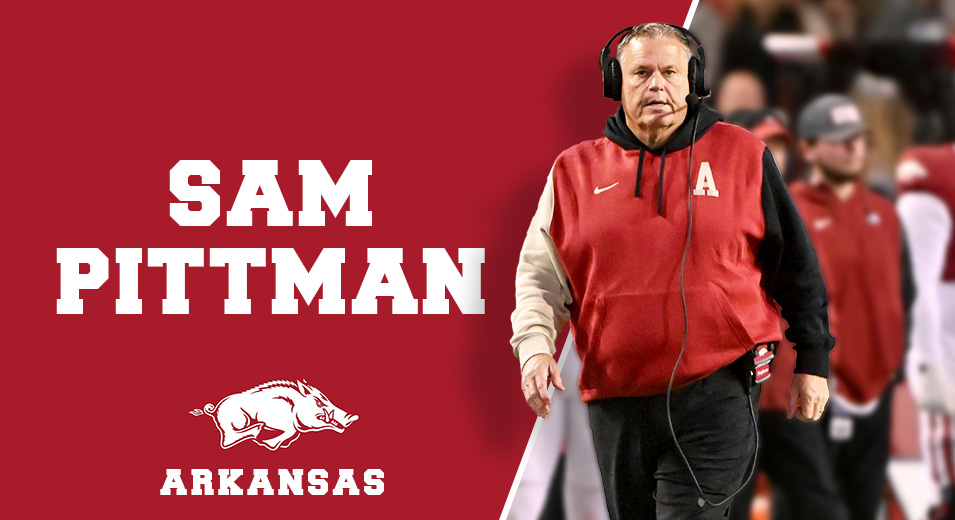
1. Sam Pittman – Arkansas

In the statistical carnage that was Ole Miss’s 63-31 dismantling of Arkansas, two numbers stood out like neon signs above a desperate Vegas casino: 515 and 6. That’s how many yards and touchdowns Jaxson Dart threw without a single interception—a feat no SEC quarterback had ever managed. His favorite target, Jordan Watkins, turned eight catches into 254 yards and five touchdowns, the efficiency that makes defensive coordinators contemplate career changes.

Lane Kiffin, college football’s resident chaos merchant, couldn’t resist twisting the knife with a post-game quip about airport tarmacs—a particularly cruel jab given that Sam Pittman might soon be familiar with them himself. In the merciless accounting of college football, Pittman’s seat isn’t just hot; it is approaching nuclear fusion.

2. Trent Dilfer – UAB

On Saturday, UAB’s Kam Shanks and Jalen Kitna shattered school records in a 59-21 victory over Tulsa that felt less like a breakthrough and more like a beautiful funeral. The numbers were staggering: Shanks’s 311 all-purpose yards, Kitna’s 404 passing yards, and six touchdowns—the statistics that usually save coaching careers. But in Birmingham, where Trent Dilfer has managed to transform a conference champion into a 2-6 cautionary tale, even victory feels like defeat.

The real story isn’t in Saturday’s box score—it’s in Dilfer’s infamous “It’s not like this is freakin’ Alabama” quip, the kind of comment that makes boosters reach for their checkbooks and their phones simultaneously. In less than two years, he’s taken Bill Clark’s ascending program—six straight winning seasons, two conference titles—and performed the sort of dismantling usually reserved for failed hedge funds or terminated football programs, something Birmingham knows too well.

The irony? Dilfer’s still collecting his $1.3 million salary while his team plays like they’re working for minimum wage against real competition. In the economics of college football, that’s the kind of inefficiency that doesn’t survive long—even with Mark Ingram in charge.

3. Stan Drayton – Temple

In the economics of college football, Temple University has managed to create a case study in how not to allocate resources. They’re paying Stan Drayton—a career running backs coach—$2.5 million annually to perform heart surgery. At the same time, Florida Atlantic handed Tom Herman the same job for the price of a luxury sedan. It’s the kind of financial decision that would have kept the late Lew Katz up at night, pacing his private jet’s cabin, checkbook in hand.

The cruel mathematics of Temple’s predicament reveals itself in two numbers: 55-0, the score by which SMU dismantled the Owls on national television, and $7.5 million, the remaining cost of Drayton’s contract. In a different era, when Temple had its own version of a Wall Street activist investor in Katz, this market inefficiency would have been corrected by Monday morning. But his son Drew, now on the Board of Trustees, treats the family fortune like a conservative bond portfolio—safe, steady, and utterly useless for the kind of radical intervention Temple football requires.

The tragedy isn’t just in losing—everyone loves Drayton the Man. It’s watching a university bet its football future on a position coach while having no hedge against failure. In North Philadelphia, where campus security costs outweigh football aspirations, they’re learning that love doesn’t show up in the win column.

4. Billy Napier – Florida

For three hours and fifty-six minutes on Saturday, Billy Napier lived in an alternate universe where Florida football still mattered. His Gators, held together with duct tape and populated partly by what appeared to be a local moving crew (they’d shown up early, anticipating a blowout), had somehow matched the mighty Georgia Bulldogs punch for punch. The score sat at 20-20, and Napier could almost feel his seat temperature dropping from nuclear to merely scalding.

But Georgia, like a cat toying with an injured mouse, was merely setting up the punchline. Carson Beck had thrown three interceptions, seemingly playing to Florida’s level, until you realized it was all part of the script. In four brutal minutes, the Bulldogs engineered a 75-yard drive, snatched an interception, and scored again—transforming what could have been Napier’s career-saving upset into just another SEC cautionary tale.

The cruelest part? Those last four minutes proved that the previous 56 had been merely Georgia’s idea of performance art, a masterclass in giving false hope to the doomed.

5. Dave Aranda – Baylor

At Baylor, Dave Aranda’s job security has behaved like a volatile tech stock—swooning early, rebounding late, and keeping traders guessing. After opening 2-4 with wins against only Air Force and something called Tarleton State, Aranda’s position looked about as secure as a crypto wallet password. But in the fluid market of college football coaching, even the most bearish positions can reverse course.

Two consecutive wins against Texas Tech and Oklahoma State have performed the kind of market correction usually reserved for Federal Reserve announcements. The remaining schedule—TCU, West Virginia, Houston, and Kansas, none currently above .500—looks less like a gauntlet and more like a carefully curated path to bowl eligibility. “Six wins and he’s back,” whispered one industry insider, with the kind of certainty usually reserved for insider trading tips.

The irony? Aranda, the defensive genius who once commanded premium value in the coaching marketplace, finds his future tied to the most basic of metrics: win six games or clean out your office. In Waco, where faith and football intersect with ten-figure endowments, salvation comes from a .500 record.

6. Sonny Cumbie – Louisiana Tech

In Huntsville, Texas, on a Tuesday night that felt more like a Samuel Beckett play than a football game, Sonny Cumbie’s Louisiana Tech team managed to lose 9-3 while winning almost every statistical category that matters. They outgained Sam Houston 312-268, held a rushing attack that averaged 200 yards per game to just 105, and forced two turnovers. By any rational measure, they should have won. But college football, like tragedy, follows its peculiar logic.

The box score reads like a hedge fund’s risk assessment report gone wrong: four turnovers, two turnovers on downs, and three points to show for it all. Twice, the Bulldogs penetrated within the 5-yard line in the fourth quarter alone, finding new and creative ways to self-destruct each time. This kind of performance makes athletic directors update their coaching search firms’ contact information.

The cruel irony? Cumbie’s defense played well enough to win a conference championship game. Instead, they watched their offense turn the red zone into a haunted house, fumbling away what little hope remained of salvaging their season. At 3-5, with Jacksonville State looming, Cumbie finds himself selling the one commodity no one in college football wants to buy: moral victories.

7. Joe Moorhead – Akron

Joe Moorhead’s return to Akron had all the elements of a classic homecoming story—the prodigal coordinator returns, older and wiser, ready to transform his former program. It was the kind of narrative Hollywood makes movies about. Instead, it’s become a documentary about entropy: two straight 2-10 seasons, with 2023 following the same inexorable path toward dysfunction.

Saturday’s 41-30 loss to Buffalo reads like a physics problem where all the equations work backwards. The Zips outgained Buffalo 452-390, dominated through the air 378-210, and won the third-down battle 43% to 23%. Ben Finley threw for 378 yards and four touchdowns—numbers that in any rational universe translate to victory. But Akron, like a time traveler who can only arrive after the critical moments have passed, spotted Buffalo a 38-7 lead before remembering how to play football.

The cruel irony? Moorhead was supposed to be the sure thing—the experienced head coach, the familiar face, the proven winner. Instead, he’s become living proof that in college football, like quantum mechanics, observation changes the outcome. In Akron, where they’ve spent decades trying to solve the equation of relevance, they’re learning that even the smartest professors sometimes fail the final exam.

8. Mark Stoops – Kentucky

Mark Stoops has achieved something that should be impossible in the physical universe of college football: becoming Kentucky’s all-time winningest coach (73 victories) while simultaneously watching his support evaporate like bourbon at a tailgate. It’s the kind of contradiction that makes quantum physicists scratch their heads—how can someone be the most successful coach in school history and a source of fan rebellion?

The 2024 season opened like a Southern Gothic novel—high expectations, veteran talent, and a schedule that read like a list of ancient curses. By week two against South Carolina, the plot had turned dark: the offensive line collapsed like a condemned building, and fans who’d once praised Stoops’ program building started treating his flirtation with Texas A&M like a betrayal in a Faulkner story.

The cruel irony? In a state where basketball championships are measured like bourbon vintages, Stoops made football matter. He turned seven straight bowl games into an expectation rather than a miracle. As whispers suggest he might walk away, Kentucky faces a terrifying question: What if their greatest football coach ever was also their last chance at sustained relevance? In Lexington, where basketball season can’t start soon enough, they learn that success and satisfaction rarely arrive in the same bottle.

9. Hugh Freeze – Auburn

In the Gothic horror story that is Auburn football, Hugh Freeze has managed to accomplish something previously thought impossible: making Jordan-Hare Stadium about as intimidating as a petting zoo. The latest chapter? A 17-7 loss to Vanderbilt that read less like a football game and more like an exorcism gone wrong—except the demons won.

The numbers tell a story of decay that would make Edgar Allan Poe proud: 4-10 against SEC opponents since his arrival, an offense that treats the end zone like it’s radioactive, and a fan base discovering that their traditional autumn rituals of victory have been replaced by something far more sinister: mediocrity. They’re not just losing; they’re losing to Vanderbilt at home, the kind of plot twist that makes Stephen King seem unimaginative.

The cruel irony? After enduring what they called “the worst coach in SEC history, ” Auburn hired Freeze to be their savior.” Now, as Freeze watches his quarterback Payton Thorne perform weekly reenactments of college football’s greatest disasters while Jarquez Hunter stands idle on the sideline, they learn a painful lesson: sometimes the cure can feel worse than the disease. On the Plains, where “War Eagle” once struck fear into visitors, they discover that not all resurrection stories have happy endings.

10. Lincoln Riley – USC

Lincoln Riley’s USC experiment has begun to resemble a Silicon Valley startup in freefall—the kind where the CEO starts banning journalists, restricting information flow, and contemplating whether to return the deposit on the party clown. The numbers tell the story of this implosion: 5-11 in their last 16 games, a stark reversal from the 17-3 start that had USC boosters dreaming of their next Pete Carroll.

Saturday’s 26-21 loss to Washington felt less like a football game and more like a hedge fund’s last trading day. Miller Moss threw three interceptions, each one driving down USC’s stock price a little further. The remaining schedule—Nebraska, UCLA, Notre Dame—looms like a series of margin calls. A bowl game, once considered a foregone conclusion in the Riley era, now feels about as sure as a cryptocurrency recovery.

The tragedy isn’t just in the losing—it’s in watching Riley transform from offensive genius to besieged executive. We expect his next move to come straight from his Oklahoma playbook: painting the windows black in Heritage Hall and the McKay Center. In L.A., where style points count double, Riley’s program has become something worse than unsuccessful: It’s become uncool.

Check out our complete list here. Share your thoughts here.

No related posts found.
VISIT OUR SHOP [COMING SOON]

LOAD MORE BLOG ARTICLES

College Football’s Hot Seat Rankings: Your Voice Matters

The 2024 college football season has been a rollercoaster of expectations and disappointments, and no one knows this better than the fans. As we enter the final stretch, it’s time for you to weigh in on which coaches are feeling the heat and which ones might need to update their résumés. Your voice matters – cast your vote here.

Why Your Vote Matters Now

The landscape of college football has shifted dramatically this season. We’re seeing traditional powerhouses struggle, unexpected collapses, and fan bases growing increasingly restless. From Happy Valley to Los Angeles, from The Plains to The Hill, passionate fans question whether their programs are heading in the right direction.

The Notable Names:

James Franklin, Penn State

The numbers tell a story that Penn State fans know all too well: 13-26 against AP Top 25 teams, 3-18 against Top 10 teams, and a painful 1-10 record against Ohio State. The same old story played out in a year when the playoffs seemed within reach. Is being “good” good enough for Happy Valley?

Lincoln Riley, USC

Making $10 million per year comes with expectations, and at 4-5 (2-5 in conference play), Riley’s Trojans are in danger of missing a bowl game entirely. The shine from that 11-3 first season is fading fast, and the remaining games against Nebraska, UCLA, and Notre Dame could define his future.

Hugh Freeze, Auburn

When Vanderbilt becomes your latest disappointment in a season full of them, questions arise. Freeze’s Tigers are matching the identical SEC records that got his predecessor fired, and while recruiting rankings look promising, the on-field product tells a different story. That “snake oil salesman charm” might need more than future promises to satisfy the Auburn faithful.

Sam Pittman, Arkansas

Giving up 63 points at home to Ole Miss might be the final straw. When your head coach admits you got “out-played, out-coached, and out-physicaled,” it’s hard to maintain confidence. The question isn’t whether Pittman can get you to 6-6; it’s whether that’s enough for a program with Arkansas’s history.

Other Hot Seats to Watch

  • Ryan Walters (Purdue): A potential 1-11 season looms
  • Mike Norvell (Florida State): Last year’s ACC title might buy time, but 2024’s 1-7 conference record burns
  • Brent Pry (Virginia Tech): That 1-11 record in one-score games isn’t winning any favor
  • Kevin Wilson (Tulsa): Losing 45-7 at halftime to a previously 1-6 UAB team speaks volumes
  • Sonny Cumbie (Louisiana Tech): Three straight losing seasons could spell doom

Make Your Voice Heard

Now it’s your turn. Whether you’re a frustrated fan looking to send a message or a satisfied supporter wanting to back your coach, your vote matters. The temperature on these hot seats changes weekly, and your input helps shape the conversation about the future of these programs.

Cast your vote now and let these coaches know exactly where they stand. After all, in college football, the court of public opinion can be just as impactful as the scoreboard.

No related posts found.

LOAD MORE BLOG ARTICLES

Week 5 Flashpoints: Auburn’s Struggles, Mack Brown’s Moment, and Nebraska’s Setback

Week 5 Coaches Hot Seat rankings will be posted on Tuesday morning – stay tuned!

The Auburn Abyss: Hugh Freeze’s Nightmare Continues

Auburn, a once-proud program, now resembles a sinking ship, rudderless and taking on water fast. Hugh Freeze, the captain brought in to right the vessel, seems to be steering it straight into an iceberg. The latest loss, a miserable 24-14 home defeat to Arkansas, marked the fourth in six games at Jordan-Hare. Quarterbacks Hank Brown and Payton Thorne looked more like lost freshmen than seasoned leaders, and the offense sputtered and coughed its way to a humiliating defeat.

The numbers paint a grim picture. Auburn is winless against Power 5 opponents this year, with a dismal 6-19 record in their last 25 matchups. The last time they tasted victory against a winning Power 5 team? Halloween weekend of 2021. It’s a haunting statistic that hangs over Freeze like a specter.

His tenure at Liberty ended with a whimper, as he dropped four straight, including a shocking loss to New Mexico State. Now at Auburn, he’s lost 10 of his first 16 games against FBS competition, with another embarrassing loss to, you guessed it, New Mexico State. It’s a pattern of futility that’s becoming all too familiar.

Mack Brown’s Mea Culpa: A Coach on the Brink

The scene in Chapel Hill was nothing short of surreal. Mack Brown, a coaching legend, stood at the podium after his Tar Heels were eviscerated 70-50 by James Madison. The Dukes racked up a staggering 611 yards of offense, and the 70 points they scored were the most ever surrendered by a UNC defense.

Brown, usually the picture of Southern charm, was uncharacteristically blunt. “Embarrassing day, shocking day,” he lamented. “You shouldn’t be at North Carolina and lose to a Group of Five team, period.” His defense, he admitted, looked “awful,” riddled with communication breakdowns and missed tackles.

But his post-game admission sent shockwaves through the college football world. In a moment of raw emotion, he confessed to asking his players if he should resign. It was a stunning revelation, a coach questioning his leadership in the face of such a devastating loss.

He later backtracked, acknowledging he put his players in an unfair position. “I’m supposed to be a leader,” he said, “and probably the worst things I’ve ever said in my life are after losses.” But the damage was done. The image of a Hall of Fame coach teetering on the edge of resignation will linger.

Nebraska’s Setback: Old Habits Die Hard

In Lincoln, the Huskers’ loss to Illinois felt like a punch to the gut. It was a game they could have, should have won. But late mistakes, crucial penalties, and a disastrous overtime performance doomed them to another frustrating defeat.

The offense, while showing flashes of brilliance, struggled to find consistency. The offensive line, a perennial concern, once again underperformed. Special teams blunders cost them dearly. And the defense, which was supposed to be the backbone of the team, looked uncharacteristically shaky.

There were bright spots, to be sure. Dylan Raiola, the young quarterback, showed poise and promise. Wide receivers Isaiah Neyor and Jahmal Banks made some spectacular catches. And the defense, despite its struggles, forced key turnovers.

But it wasn’t enough. The Huskers left the field with a bitter taste in their mouths, knowing they had let one slip away. The 400th consecutive sellout at Memorial Stadium felt like a hollow celebration.

The Road Ahead

As the dust settles on another wild weekend of college football, the questions linger. Can Hugh Freeze salvage Auburn’s season, or is he destined to join the ranks of failed coaching hires? Will Mack Brown’s mea culpa galvanize his Tar Heels, or will the scars of that James Madison loss prove too deep? And can Nebraska shake off its old habits and find a way to win the close games?

Only time will tell. But one thing is sure: the drama, the heartbreak, and the unexpected twists and turns that make college football so captivating are far from over. The coaches’ hot seat is burning brighter than ever, and the stakes have never been higher.

No related posts found.

LOAD MORE BLOG ARTICLES