
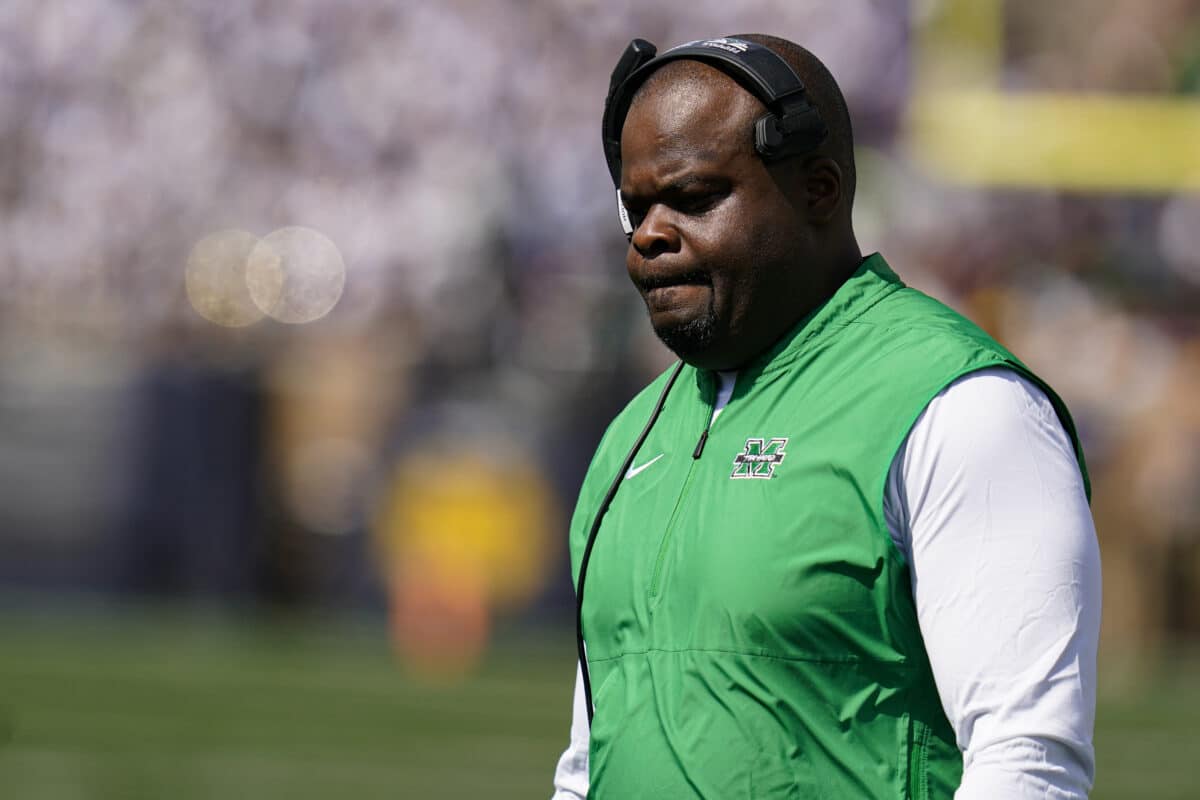
Charles Huff Took Southern Miss From 1-11 to 7-5 In One Season. Now He’s At Memphis—His Third Job In Three Years.

Charles Huff fixes broken programs.

That’s the value proposition Memphis is buying. Not a recruiter who needs five years to build his guys. Not a developmental coach who grows freshmen into seniors. Huff is a fixer — a guy who walks into a disaster, flips the portal, resets the culture, and delivers wins fast.

The pattern is clear now.

And if you’re trying to understand what Memphis is getting (and what they’re risking), you need to see how the pattern repeats.


The Southern Miss Fix: 1-11 to 7-5 In One Year

Huff inherited a catastrophe.

  • Zero Sun Belt wins in 2024.
  • Out of most games by halftime.
  • A program with no pulse.
  • One year later: 7-5, bowl eligible, in division-title contention deep into November.
  • That six-win jump was one of the largest single-season improvements in FBS.

Here’s how he did it:

Turnover Margin

Through 10 games, Southern Miss forced 25 turnovers while committing only 12. That’s a +1.30 margin per game — top three nationally. Those takeaways produced 61 points and shortened the field for an offense still finding its footing.

Portal reconstruction.

Huff didn’t try to develop the 1-11 roster. He replaced it. New faces, new expectations, new standards. The veterans who stayed had to buy in or get out.

Defensive identity.

Coordinator Jason Semore’s unit was top-tier in red-zone defense and strong against the run. The offense didn’t need to be special. It just needed to not lose games.

Close-game composure.

The 2024 team was routinely outclassed and out of games early. The 2025 team finished. Multiple tight conference wins late in the year.

  • Huff talked about confronting the “scar tissue” of the previous season.
  • His team played like they believed him.
  • But here’s the tension in the splits:
  • Late-season record at Southern Miss: 1-3 (.250).
  • The turnaround was real. The finish wasn’t. After starting 6-2, Southern Miss dropped three of their last four.

And then Huff left.


The Marshall Fix: 32-20 With A Top-10 Upset

Southern Miss wasn’t the first time.

Huff arrived at Marshall in 2021 with a Saban pedigree and a recruiting reputation. Four years later, he left with a 32-20 record, a Sun Belt title, and the signature win of his career: a road upset of #8 Notre Dame in 2022.

The splits tell the story of a coach who built something real:

  • Late-season record: 12-5 (.706)
  • Road record: 13-6 (.684)
  • Bowl record: 1-2

Marshall under Huff wasn’t elite. Advanced metrics rated them as respectable but not dominant at the G5 level. But they were consistently competitive, consistently bowling, and occasionally dangerous.

  • The late-season finishing that disappeared at Southern Miss? It was there at Marshall.
  • The difference: he had four years to build it.

Then he left for Southern Miss.


The Memphis Play: Same Playbook, Bigger Stage

This is a different setup than Marshall or Southern Miss.

Huff isn’t walking into a crater. Memphis went 8-4 in 2025, climbed as high as #22 in the polls, and returns a relatively healthy roster. Ryan Silverfield left for Arkansas. Reggie Howard handled the bowl.

The bones are there.

Huff is attacking it the same way anyway.

The portal haul is already significant:

  • Air Noland (QB, South Carolina) — former blue-chip, 3,500-yard passer, projected starter
  • Dallan Hayden (RB, Colorado) — ex-Ohio State signee with Big Ten/Big 12 experience
  • J’Mond Tapp (EDGE, Southern Miss) — All-Sun Belt, 70 tackles, 7.5 sacks
  • Michael Montgomery (LB, Southern Miss) — All-Sun Belt, knows Semore’s system
  • Ian Foster (DB, Southern Miss) — All-Sun Belt, ball production in the secondary

He’s importing proven production to raise the talent ceiling immediately.

Same playbook. Same urgency.

The staff reflects it too. Kevin Decker comes from Old Dominion, where his offense averaged 460+ yards per game with tempo and spread concepts. Jason Semore followed from Southern Miss to run the defense. Ben Ashford, Huff’s long-time strength coach, is the culture anchor.

Everything is built for Year 1 impact.


The Risk: Three Jobs In Three Years

Here’s what Memphis is betting against:

Charles Huff has never stayed anywhere long enough to see what happens after Year 4.

This is his third head job in three years. Marshall to Southern Miss to Memphis — each time chasing a bigger opportunity, each time leaving before the program had to answer harder questions about depth, development, and sustained excellence.

The turnaround pattern is proven.

The sustainability pattern doesn’t exist yet.

At Marshall, he built something and left before the conference-title team had to defend it. At Southern Miss, he engineered a miracle year and left before finding out if it was a mirage. Now at Memphis, he inherits an 8-4 roster and a program with CFP aspirations in a realigning AAC.

The questions he has to answer:

  • Can he win when he’s not the underdog?
  • Can he develop a roster instead of just replacing one?
  • Can he stay?

The splits say Huff is a .609 coach who wins on the road, finishes strong at his longer stops, and hasn’t proven much against ranked opponents or in bowl games.

The narrative says he’s an elevator.

But elevators go both directions.

Memphis is betting he keeps going up.

They’re also betting he doesn’t get off at the next floor.

No related posts found.

LOAD MORE BLOG ARTICLES

The Great Coaching Correction of 2024

In the high-stakes college football casino, the usual season-end trading frenzy has given way to something more unusual: fiscal restraint. We’re calling it “The Great Coaching Correction of 2024.” You see, athletic departments across the country are staring down a triple-witching hour of financial obligations that would make even a seasoned hedge fund manager break into a cold sweat: massive coaching buyouts, the impending $20 million House settlement expense per school, and another estimated $20 million (first year) hit from revenue sharing with athletes. Suddenly, the market for coaching talent is behaving less like cryptocurrency in 2021 and more like banks during a Federal Reserve stress test.

Billy Napier, Florida

Consider Billy Napier at Florida, a case study in modern football economics. In a world where 70% of Florida’s NIL payments flow to underclassmen—a stat that would make any Wall Street analyst question the business model’s sustainability—Napier has somehow convinced his CEO, Scott Strickland, to double down on their position. It’s the contrarian bet that either makes or ends careers. The market had priced Napier for failure after the Miami and Texas A&M disasters, but like a value investor spotting hidden assets, Strickland saw something others missed: stability in chaos. Or perhaps more accurately, he saw the price tag of starting over.

Napier’s Change Meter: Ice Cold

Sam Pittman, Arkansas

Meanwhile, Sam Pittman presents a different sort of market inefficiency in Arkansas. At 62, with a hip that’s giving out, he’s like an aging blue-chip stock with solid fundamentals but questionable long-term prospects. The twist? This comes courtesy of Jackson Collier of the Hardwood Hawgs Podcast – hidden in plain sight in his contract is a provision that would make any compensation committee blush: hit seven wins, including a bowl game, and trigger an automatic extension and raise. This incentive structure would make even the most hardened private equity executive wonder about governance. Let me repeat that – if he gets to seven wins – LA Tech plus one other, including the bowl – he gets a raise and extension. Completely doable.

Pittman’s Change Meter: Cool

Dave Aranda, Baylor

But the real arbitrage play is happening in Waco, Texas, where Dave Aranda’s job security has behaved like a volatile tech stock—swooping early, rebounding late, and keeping traders guessing. After opening 2-4 with wins against only Air Force and something called Tarleton State, Aranda’s position looked about as secure as a crypto wallet password. Yet here he is, three wins later, trading above his September lows on volume. His contract runs through 2029, and in this bear market for buyouts, that’s starting to look less like a liability and more like a forced diamond-hands strategy. If he is a smidge above .500, he stays.

Change Meter: Lukewarm trending cool

Charles Huff, Marshall

The distressed assets division brings us to Marshall’s Charles Huff, a coach whose contract is expiring like a soon-to-mature junk bond. At 27-20 over four seasons, including a telling 5-1 against non-Power Four competition this year, Huff’s position looks like a classic case of a middle-market firm unable to compete with the more prominent players. The smart money is betting on a change, though in this capital-constrained environment, even obvious moves come with additional scrutiny.

Huff’s Change Meter: Hot

Kevin Wilson, Tulsa

Then there’s Kevin Wilson at Tulsa, running a program performing like a penny stock in a bear market. When your highlight reel consists of a single comeback win against UTSA and a victory over 3-5 Louisiana Tech, you’re trading in territory usually reserved for companies about to be delisted. At 5-14 in two seasons, Wilson—a former blue-chip coordinator at Ohio State and Oklahoma—has turned premium pedigree into discount-bin performance.

Wilson’s Change Meter: Hot

Trent Dilfer, UAB

The most fascinating short position in the market might be Trent Dilfer at UAB. In less than two years, he’s taken Bill Clark’s ascending program—six straight winning seasons, two conference titles—and performed a dismantling usually reserved for failed hedge funds. His now-infamous “It’s not like this is freakin’ Alabama” quip reads like a CEO dismissing disappointing earnings by saying, “We’re not Apple.” The market rarely forgives such hubris, but at a $4.1 million buyout, the cost of forgiveness in this economy starts to look like a luxury good.

Dilfer’s Change Meter: Hot to Warm

Don Brown, UMass

At the extreme end of the risk spectrum sits Don Brown at UMass, whose position has moved from “distressed asset” to “complete write-off.” The market has spoken, and this particular security is being delisted.

Brown’s Change Meter: Scorching

High Profile, Power 4 Rumored Hot Seats

However, perhaps the most telling indicator comes from the “too big to fail” institutions—Florida State, USC, Oklahoma, Nebraska—where the Mike Norvells and Lincoln Rileys of the world operate with the kind of security usually reserved for government bonds. These programs have determined that stability, even at a premium, is preferable to the volatility of the coaching free agency market, especially with the looming costs of settlements and revenue sharing casting shadows over their balance sheets.

Change Meter: Ice Cold

Ultimately, college football’s coaching market operates with all the efficiency of a teenager with their first credit card. It overreacts to both success and failure, frequently misprices assets, and occasionally makes moves that would make a bankruptcy lawyer blush. But like all markets, it eventually finds its level—even if that level involves paying millions to make someone go away. This year, though, a cold dose of fiscal reality has tempered the usual irrational exuberance. When your industry is staring down $40+ million in new mandatory expenses, even the most trigger-happy athletic director thinks twice about adding another eight-figure buyout to the books.

No related posts found.

LOAD MORE BLOG ARTICLES