Alabama Football 2025 Season Preview: The Year Everything Must Come Together

Alabama football’s 2025 season will define Kalen DeBoer’s tenure.

After a 9-4 debut that fell short of Alabama’s championship standards, the second-year head coach faces immense pressure to return the program to playoff contention. The message from the college football world is crystal clear: another disappointing campaign won’t be tolerated in Tuscaloosa.

As one anonymous SEC coach told Athlon Sports, “Going 9-4 isn’t going to be tolerated at Alabama for very long. The expectations define this place.”

The Foundation Exists, But the Cracks Are Showing

Alabama’s 2024 season revealed a program caught between elite talent and inconsistent execution.

The numbers tell the story of a team that dominated at home but struggled when it mattered most:

  • 7-0 at home, averaging 472 yards and 42.3 points per game
  • 2-3 on the road, averaging just 353.8 yards and 19.6 points per game
  • 2.5 turnovers per game in losses vs. 1.2 turnovers per game in wins
  • Critical giveaways cost them against Vanderbilt, Tennessee, Oklahoma, and Michigan

Expert Cody Goodwin from Bama247 put it bluntly: “Gotta make the playoffs. They did not make the playoffs last year. You can’t leave it up to chance like that. You gotta find a way to drive the hammer home.”

The talent was there, but the results weren’t.

The Quarterback Question That Changes Everything

Everything hinges on one position.

Jalen Milroe’s departure leaves a massive void after his 36 total touchdowns and 3,570 scrimmage yards in 2024. As that anonymous SEC coach noted, “The biggest question will be quarterback, obviously.”

Three quarterbacks will battle for the starting job:

  • Ty Simpson: Third-year player with the most experience in the system
  • Austin Mack: Washington transfer who followed DeBoer but has limited game action
  • Keelon Russell: Five-star freshman ranked as the No. 1 player in the country by Rivals

Russell represents the most intriguing option. The Duncanville, Texas native threw for 4,177 yards and 55 touchdowns with just four interceptions as a senior. According to 247Sports, Russell ranks as the highest-rated recruit to ever sign with Alabama.

DeBoer made his expectations clear: “I think a lot of it is, we want that playmaker. We want that guy. I don’t want just a game manager out there.”

The quarterback competition will determine Alabama’s ceiling.

Strategic Roster Building Through the Portal

Alabama attacked their weaknesses with surgical precision.

Rather than chasing stars, the Crimson Tide made calculated additions to address specific problems from 2024:

  • Colorado LB Nikhai Hill-Green: Second-leading tackler at Colorado with 82 stops
  • Texas A&M G Kam Dewberry: Proven guard to shore up offensive line depth
  • Four-star OT recruits Jackson Lloyd and Mal Waldrep: Future building blocks

The offensive line received particular attention after allowing 25 sacks in 2024. Alabama’s inability to protect the quarterback and establish consistent rushing on the road directly contributed to their most devastating losses.

“He’s got an opportunity to make a pretty big impact this season,” Goodwin said about Hill-Green. “He offers a lot in the way of speed. He’s a pretty sure tackler.”

This wasn’t roster building for the sake of it—this was problem-solving.

A Schedule That Demands Immediate Excellence

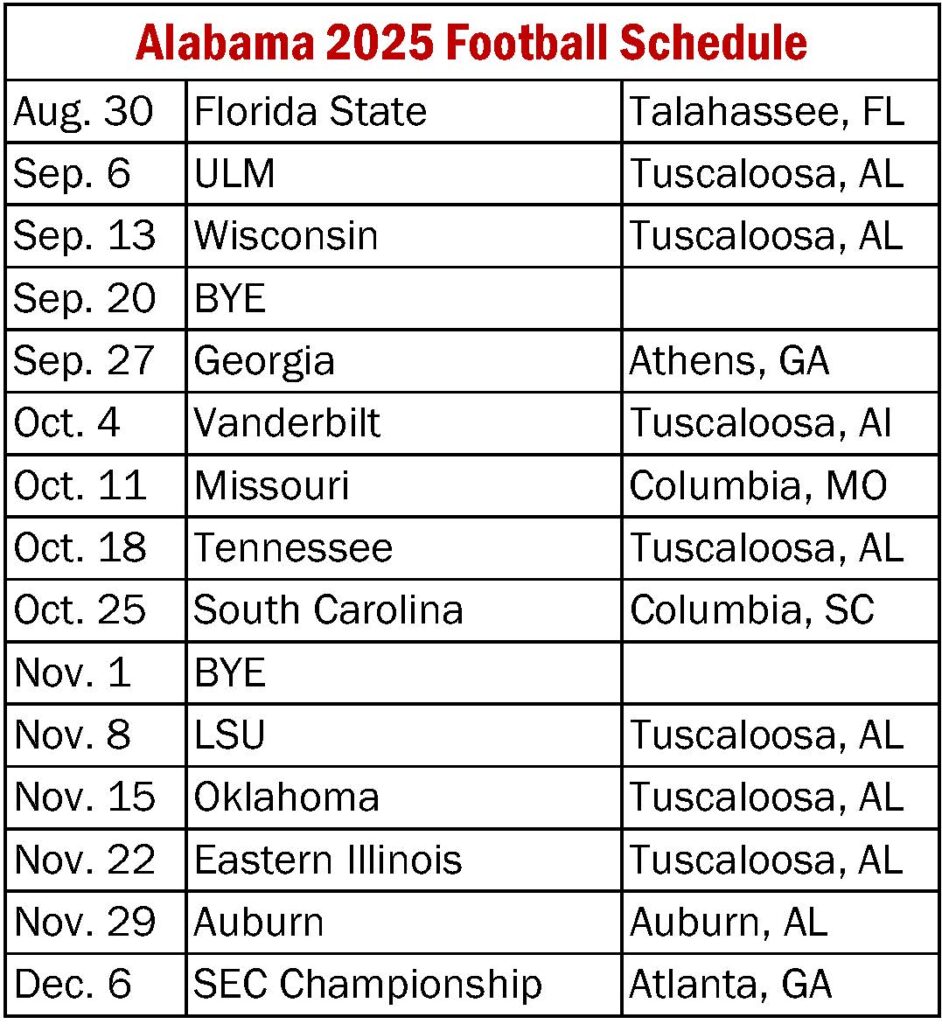
The 2025 schedule will test every improvement Alabama has made.

Opening at Florida State on August 30 marks the first time Alabama begins a season on the road since the 2020 season. But the real test comes three weeks later at Georgia on September 27.

FOX Sports analyst Joel Klatt explained the stakes: “This is a huge early test for Kalen DeBoer in year two. If Bama wins by the way, there’s a bunch of winnable games after this.”

The schedule breakdown reveals both opportunity and danger:

Key Home Games:

  • LSU (November 8)
  • Oklahoma (November 15)
  • Tennessee (October 18)

Critical Road Tests:

  • Florida State (August 30)
  • Georgia (September 27)
  • South Carolina (October 25)
  • Auburn (November 29)

Alabama holds a 10-game home winning streak against Tennessee dating back to 2003. The Iron Bowl at Auburn presents a chance to win three consecutive games at Jordan-Hare Stadium for the first time in series history.

Every game matters when playoff selection is on the line.
Defensive Identity Under Kane Wommack

The defense showed flashes of dominance but needs to finish plays.

Alabama forced 28 takeaways in 2024, ranking sixth nationally with 18 interceptions. However, they managed just 25 sacks and failed to score a single non-offensive touchdown despite creating numerous opportunities.

Key returners provide hope for improvement:

  • LB Deontae Lawson: 76 tackles, 4 pass deflections, 2 sacks before injury
  • LB Justin Jefferson: Veteran presence and proven tackler
  • Transfer LB Nikhai Hill-Green: Speed and sure tackling from Colorado

The defensive line must replace significant production while integrating elite recruiting talent. Five-star defensive end prospects and four-star edge rushers provide optimism for improved pass rush in Wommack’s second season.

Creating turnovers is great—turning them into points is better.

Championship Expectations and Playoff Pressure

The mandate couldn’t be clearer.

Alabama enters 2025 with the third-best odds (+500) to win the SEC Championship according to FanDuel Sportsbook. More importantly, they face immense pressure to secure a spot in the expanded 12-team College Football Playoff after missing the inaugural field.

ESPN’s SP+ projects approximately 9.5 wins for Alabama, suggesting a team capable of playoff contention with upside for more. But projections mean nothing without execution.

Historical precedent supports optimism:

  • Four of Alabama’s five national championship coaches improved in year two
  • Only Frank Thomas regressed (9-1 to 8-2) before winning the title in 1934
  • DeBoer’s track record suggests confidence in reaching baseline expectations

As DeBoer acknowledged, “Now we understand what this place is all about. All together, the relationships now are there with our players; we can just really take it to the next level.”

Making the playoffs isn’t just a goal—it’s a requirement.

The Bottom Line: No More Excuses

Alabama’s 2025 season represents the ultimate referendum on Kalen DeBoer’s vision.

The talent is undeniable. The recruiting momentum is strong. The schedule provides opportunities for statement victories. But as that anonymous SEC coach reminded us, “this is a new era. Bama’s not a surefire lock every season.”

DeBoer has had two years to build his foundation. He’s made strategic additions through recruiting and the portal. He’s identified and addressed the specific weaknesses that cost Alabama in 2024.

Now comes the hardest part: proving it works when everything is on the line.

For Kalen DeBoer and Alabama football, 2025 isn’t just another season—it’s the year everything must come together.

The Next Billion Dollar Game

College football isn’t just a sport anymore—it’s a high-stakes market where information asymmetry separates winners from losers. While the average fan sees only what happens between the sidelines, real insiders trade on the hidden dynamics reshaping programs from the inside out.

Our team has embedded with the power brokers who run this game. From the coaching carousel to NIL deals to transfer portal strategies, we’ve mapped the entire ecosystem with the kind of obsessive detail that would make a hedge fund analyst blush.

Why subscribe? Because in markets this inefficient, information creates alpha. Our subscribers knew which coaches were dead men walking months before the mainstream media caught on. They understood which programs were quietly transforming their recruiting apparatuses while competitors slept.

The smart money is already positioning for 2025. Are you?

Click below—it’s free—and join the small group of people who understand the real value of college football’s new economy.
No related posts found.

LOAD MORE BLOG ARTICLES

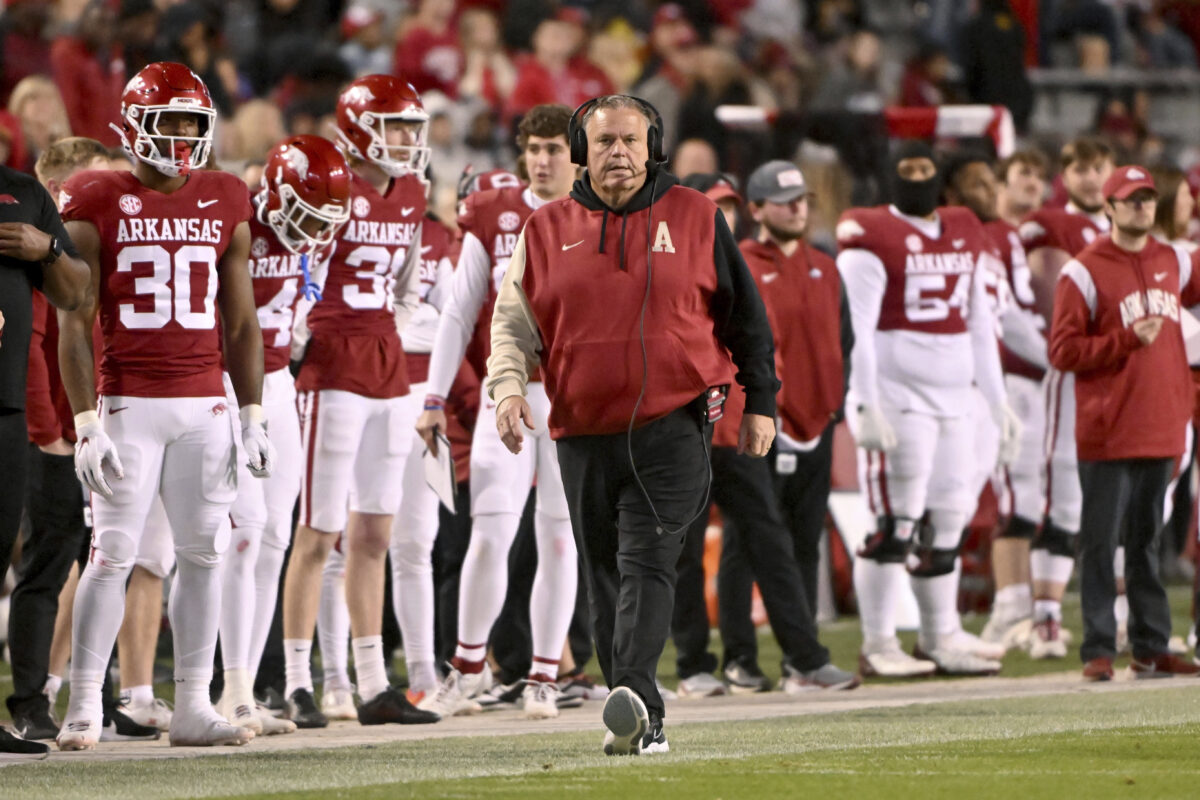
Arkansas Football 2025 Season Preview: Sam Pittman’s Survival Test Begins Now

Sam Pittman is coaching for his job.

After five seasons in Fayetteville, the Arkansas head coach finds himself in an impossible position. He’s 30-31 overall and 14-28 in SEC play. ESPN senior writer Adam Rittenberg placed Pittman in the “Can’t backslide” tier on his coaching hot seat rankings, writing that “Pittman is just 30-31 and 14-28 in SEC play, and might need to match or exceed his 2024 output to secure his spot for 2025.”

The math is simple: another mediocre season equals a coaching change. The 2025 season is no longer about potential. It’s about survival.

The Quarterback Question Gets Answered

Taylen Green is coming back.

The most important decision Arkansas made this offseason was retaining its 6-foot-6 dual-threat quarterback for his senior season. “I’m deeply thankful to God for putting me in the position I am today,” Green wrote in a social media post announcing his return. “I appreciate everything Coach Pittman has done for me over the last year.”

Green’s 2024 numbers tell the story of untapped potential:

  • 3,756 total yards of offense (second in program history)
  • 3,154 passing yards and 15 touchdowns
  • 602 rushing yards and 8 rushing touchdowns
  • 9 interceptions and 5 fumbles lost

That turnover problem? It’s the difference between mediocrity and breakthrough. Green acknowledged this heading into spring practice: “It starts with the film room and getting on the same page, getting on the same mode of understanding why I made the decision.”

The quarterback room behind Green remains thin. Redshirt freshman KJ Jackson appears positioned as the primary backup, with true freshman Madden Iamaleava providing depth. Green’s health becomes paramount to everything Arkansas hopes to accomplish.

Complete Roster Reconstruction Through the Portal

Arkansas lost over 20 scholarship players to the transfer portal.

They responded by bringing in what Rivals ranks as the eighth-best transfer class in the nation. The departures included every major contributor from the receiving corps, creating the most dramatic roster overhaul in college football.

The numbers tell the story:

  • Lost Andrew Armstrong (1,140 yards receiving)
  • Lost Isaac TeSlaa, Isaiah Sategna, and Luke Hasz
  • Added 7 transfer receivers and 3 high school recruits
  • Targeted the offensive line after allowing 2.1 sacks per game
  • Reinforced defensive line and secondary through the portal

The receiver situation got complicated. According to ActionNetwork’s Collin Wilson, “the wide receiver unit came to Bobby Petrino and Sam Pittman after the season and said, ‘Taylen Green’s got to go or we’re out of here.'” The coaching staff publicly backed Green and moved forward with complete reconstruction.

This wasn’t just roster management. This was program surgery.

Defense Demands Immediate Improvement

The 2024 defense was historically bad by Arkansas standards.

They allowed 25.0 points and 376.1 yards per game while finishing with a minus-eight turnover margin. The unit struggled particularly against elite passing offenses, exemplified by allowing 562 yards to Ole Miss in a 63-31 loss.

The pass rush problems were glaring:

  • Only 26 sacks in 13 games (2.0 per game)
  • Ranked 13th in the SEC in quarterback pressure
  • Lost pass rush specialist Landon Jackson to transfer
  • Must replace five of the top seven tacklers

Defensive coordinators Travis Williams and Marcus Woodson return for their third season, providing scheme continuity. The linebacker corps remains solid with returning contributors. But the defensive line and secondary feature multiple new faces who must gel quickly.

Special teams ranked 84th nationally in efficiency. In a conference where games are decided by three points and missed kicks end seasons, that’s unacceptable.

The Schedule From Hell Awaits

Arkansas faces three College Football Playoff teams from 2024.

Notre Dame, Texas, and Tennessee all made the playoffs. Both games against the Volunteers and Longhorns will be on the road. Arkansas heads to Austin “for the first time since 2008 and just the third time since leaving the Southwest Conference.”

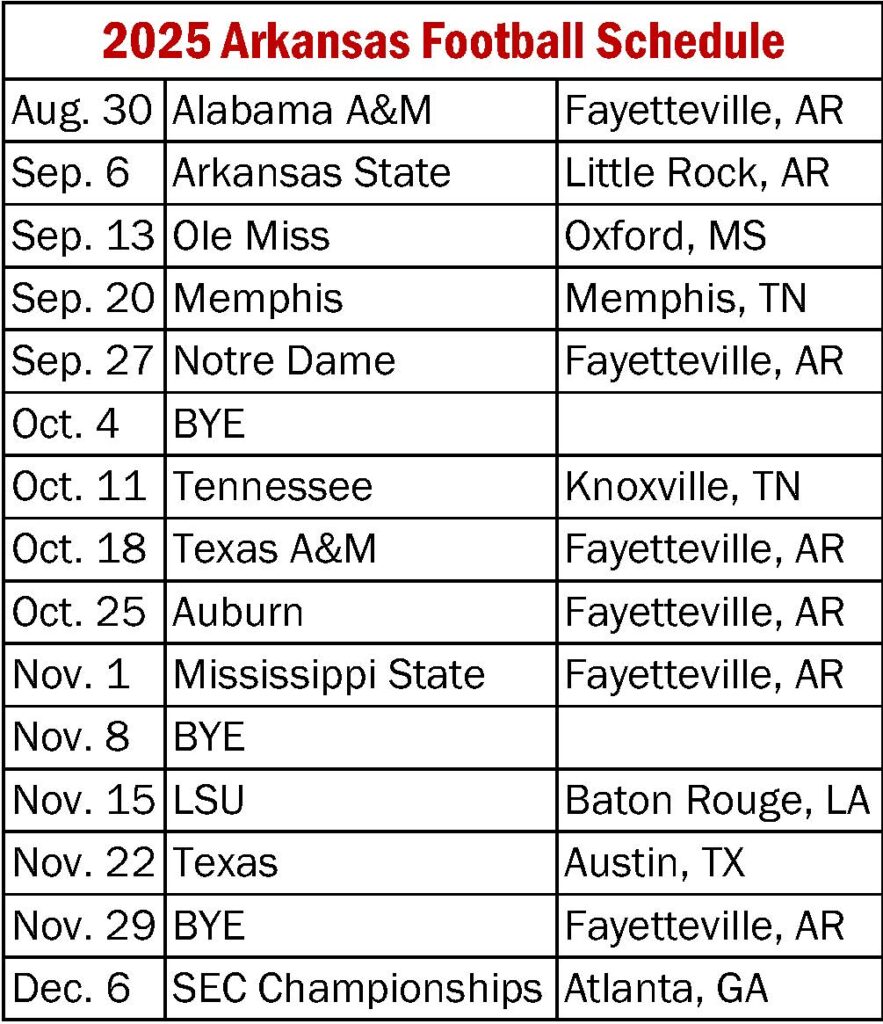
The early-season gauntlet looks brutal:

  • August 30: Alabama A&M (home)
  • September 6: Arkansas State (Little Rock)
  • September 13: at Ole Miss
  • September 20: at Memphis
  • September 27: Notre Dame (home)

October and November offer no relief. Road games at Tennessee, LSU, and Texas. Home contests against Texas A&M, Auburn, Mississippi State, and Missouri that offer opportunities but zero margin for error.

This schedule doesn’t take into account your rebuilding project. It will expose every weakness and punish every mistake.

Recruiting Shows Promise, Development Remains Key

The 2025 recruiting class ranks 27th nationally.

That represents solid progress in talent acquisition under Pittman. The class features 24 commitments, including several players expected to compete for immediate playing time. Combined with transfer portal additions, Arkansas created depth across multiple position groups.

Bobby Petrino enters his second season as offensive coordinator with increased familiarity with the system. As Sports Illustrated’s Andy Hodges reported, Petrino stated regarding Green: “Taylen knows the offense. He’s much more comfortable in it.”

This continuity matters more than people realize:

  • Second year in Petrino’s complex system
  • Established relationships between the quarterback and the coordinator
  • Proven track record of offensive improvement in year two
  • Reduced learning curve for skill position players

The academic excellence continues under Pittman, with the program maintaining high classroom standards while competing at the highest level. This provides recruiting advantages that extend beyond wins and losses.

Cultural Foundation Under Pressure

Here’s something most people don’t realize about Sam Pittman.

As College Football News noted, “Hand raised high, who else didn’t think in any possible way that Sam Pittman would be the third-longest-tenured head coach with his current SEC team? Kirby Smart has been around the longest with Georgia, Kentucky’s Mark Stoops is second, and Pittman is tied with Missouri’s Eli Drinkwitz and Lane Kiffin of Ole Miss for third.”

That tenure provides both advantages and pressure. The familiarity with SEC competition creates recruiting and operational benefits. But the lack of sustained success relative to program expectations increases scrutiny.

Green’s leadership development becomes crucial with significant roster turnover. As he noted regarding his role with new players: “Coaches aren’t out there when we’re throwing, so I’ve got to tell them the depth and when to cut.”

Veteran presence matters when everything else is new.

Success Metrics and Realistic Expectations

Vegas set Arkansas’s win total at 5.5 games.

That reflects the brutal combination of schedule strength and roster reconstruction. Bowl eligibility represents the baseline expectation, with six wins likely necessary for Pittman to survive.

But success extends beyond wins and losses:

  • Turnover margin improvement from minus-eight
  • Red zone efficiency increases from 58% touchdown rate
  • Defensive pressure generation to replace Landon Jackson
  • Competitive performances against ranked opponents

The key question isn’t whether Arkansas can compete with Alabama and Georgia. The key question is whether they can consistently beat the teams they’re supposed to beat while stealing one or two they’re not supposed to win.

Close games against ranked teams and improved efficiency in critical situations would demonstrate program progress even if the overall record remains modest.

The Bottom Line: Progress or Replacement

Arkansas football stands at a crossroads.

The combination of quarterback continuity, strategic roster additions, and coaching staff stability creates the framework for improvement. However, the brutal schedule and elevated expectations leave minimal room for growing pains.

Pittman’s survival depends on demonstrating clear progress while navigating one of college football’s most challenging schedules. The pieces exist for modest success, but execution under pressure determines everything.

For Arkansas, 2025 represents both opportunity and ultimatum.

The foundation exists for competitive football, but translating potential into victories remains the ultimate test for a program that has experienced too many seasons of unfulfilled promise. Sam Pittman is coaching for his job, and everyone in Fayetteville is aware of it.

The Next Billion Dollar Game

College football isn’t just a sport anymore—it’s a high-stakes market where information asymmetry separates winners from losers. While the average fan sees only what happens between the sidelines, real insiders trade on the hidden dynamics reshaping programs from the inside out.

Our team has embedded with the power brokers who run this game. From the coaching carousel to NIL deals to transfer portal strategies, we’ve mapped the entire ecosystem with the kind of obsessive detail that would make a hedge fund analyst blush.

Why subscribe? Because in markets this inefficient, information creates alpha. Our subscribers knew which coaches were dead men walking months before the mainstream media caught on. They understood which programs were quietly transforming their recruiting apparatuses while competitors slept.

The smart money is already positioning for 2025. Are you?

Click below—it’s free—and join the small group of people who understand the real value of college football’s new economy.
No related posts found.

LOAD MORE BLOG ARTICLES

Here’s Why Oklahoma’s Brent Venables Is About To Get Fired (And It’s Not What You Think)

Everyone thinks they know what’s happening in Norman.

They don’t.

This Is What Happens When You Try To Live Someone Else’s Legacy

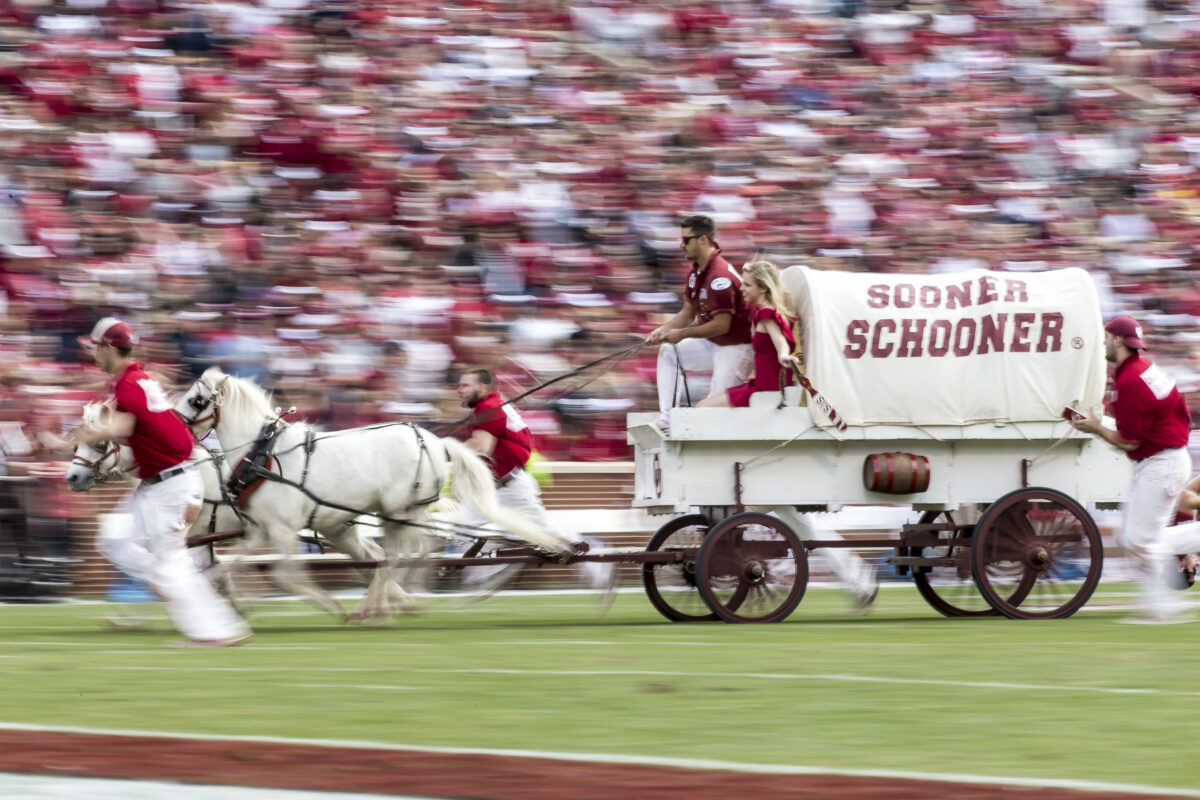
Oklahoma didn’t hire Brent Venables to be the next Bob Stoops or Lincoln Riley.

But that’s exactly what everyone expects him to be. Bob Stoops restored glory in two years. Lincoln Riley inherited greatness and delivered playoff seasons with Heisman quarterbacks—Baker Mayfield, Kyler Murray, and Jalen Hurts. These aren’t just names; these are monuments to what Oklahoma football used to represent.

Venables knew this when he took the job.

The SEC Doesn’t Care About Your Participation Trophies

History gives you banners—not victories.

Their SEC debut finished 6–7, with echoes of frustration, as scoreboards rarely showed domination. They weren’t just losing, they were getting outclassed by teams built for speed, power, and grit week after week. This isn’t the Big 12 anymore, where you could survive recruiting misses or down weeks.

The SEC punishes every mistake.

In the Big 12, you could survive:

  • A few recruiting misses
  • A down week and still win your division
  • Occasional lapses in execution

The SEC punishes every mistake. One bad quarter against LSU or Alabama can erase months of preparation.

Venables faces eight projected Top 25 opponents in 2025: Michigan, LSU, Texas, Alabama, and Tennessee. These aren’t just games on a schedule.

These are programs that measure their success by crushing teams exactly like Oklahoma.

When Your Offense Can’t Score, Nothing Else Matters

24 points per game in 2024.

Their lowest since the 1990s, a stark contrast to the Stoops and Riley eras when offensive fireworks weren’t hoped for, they were expected. A stagnant attack means drives stall, frustration builds, and even solid defense can’t save your season.

This is why Venables brought in Ben Arbuckle as offensive coordinator.

Defense Wins Championships (But Not Alone)

Venables carved his name as Clemson’s defensive architect.

His Oklahoma defenses showed real improvement in 2024, with a mark of just over 21 points per game, a top-third mark in the SEC. However, when your offense sputters, defensive stops create more pressure. Venables has begun calling defensive plays himself, betting on his strengths for survival, yet in the SEC, that’s not enough.

You can’t defend your way to championships when everyone else has elite talent on both sides.

The Transfer Portal Is Oklahoma’s Last Hope

Championship teams don’t just reload.

They evolve. Oklahoma attacked the 2025 offseason with desperation disguised as urgency. The transfer portal delivered:

  • New offensive linemen
  • Defensive backs
  • Skill weapons

Arbuckle is reengineering the offense, searching for any combination that can score with efficiency and speed. At quarterback, the job is wide open. They’re not chasing ghosts like Mayfield or Hurts anymore.

The pressure is on, and the storyline hasn’t been written.

But here’s what no one talks about: every SEC program is fighting for the same elite athletes. Stoops and Riley won because they recruited SEC-level talent before joining the conference.

Now, Oklahoma is playing catch-up in an arms race.

This Is What Desperation Looks Like At The Highest Level

National outlets—including 247Sports—rank Venables as college football’s most embattled coach entering 2025.

Vegas sportsbooks project the Sooners to finish in the middle tier of the SEC. Job security is a myth at this level. Athletic director Joe Castiglione has put the pieces in place.

The fans are demanding results, not explanations.

Anything less than a winning season, given the resources and tradition, could end Venables’ tenure. This isn’t speculation.

This is reality.

Here’s What Has To Happen (And Why It Probably Won’t)

Oklahoma must:

  • Score 30+ points per game
  • Beat Texas in Dallas
  • Compete physically every week in the SEC
  • Build depth everywhere on the roster

A 7–5 or 8–4 record in 2025 may not match the glory years, but it would prove the Sooners are trending upward.

Anything less? The program will be searching for its next leader.

The Truth About Greatness

Greatness at Oklahoma isn’t negotiable.

It never has been. Brent Venables has one chance to deliver, one schedule to prove his worth, and one fanbase to restore. Every drive, every play, every lineup decision will be scrutinized.

Because in Norman, nobody gets remembered for coming close.

The clock is ticking, and everyone knows it.

The Next Billion Dollar Game

College football isn’t just a sport anymore—it’s a high-stakes market where information asymmetry separates winners from losers. While the average fan sees only what happens between the sidelines, real insiders trade on the hidden dynamics reshaping programs from the inside out.

Our team has embedded with the power brokers who run this game. From the coaching carousel to NIL deals to transfer portal strategies, we’ve mapped the entire ecosystem with the kind of obsessive detail that would make a hedge fund analyst blush.

Why subscribe? Because in markets this inefficient, information creates alpha. Our subscribers knew which coaches were dead men walking months before the mainstream media caught on. They understood which programs were quietly transforming their recruiting apparatuses while competitors slept.

The smart money is already positioning for 2025. Are you?

Click below—it’s free—and join the small group of people who understand the real value of college football’s new economy.
No related posts found.

LOAD MORE BLOG ARTICLES

Vanderbilt Football 2025: The Year Everything Changes

Vanderbilt football is about to prove that 2024 wasn’t a fluke.

The Commodores shocked college football last season with their first winning record since 2013, capped by a bowl victory that had Nashville celebrating like they’d won the national championship. Now comes the real test: can they do it again?

The answer lies in understanding what makes this program different from every other SEC bottom-feeder that has enjoyed a brief moment in the sun before crashing back to earth.

The Foundation That Won’t Crack

Diego Pavia isn’t just returning for his final season.

He’s returning as the most proven dual-threat quarterback in the SEC, a player who accounted for 3,094 total yards and 28 touchdowns while throwing just four interceptions in 2024. His 143.5 passer rating wasn’t a statistical accident. It was the result of a quarterback who understands how to manage games, create explosive plays, and deliver when everything is on the line.

Pavia was selected the league’s first-ever Newcomer of the Year, presented to the league’s top player who had not previously competed in the SEC and was not eligible for Freshman of the Year, according to the official Vanderbilt athletics website.

But here’s what makes his return even more valuable:

  • He’s publicly declared Vanderbilt’s intent to “run Tennessee”
  • He’s already proven he can beat the best teams in the country (see: Alabama upset)
  • He brings the kind of swagger that transforms program culture

Joining Pavia is All-SEC tight end Eli Stowers, who became the first Vanderbilt offensive player to earn first-team All-SEC honors since 2013 after catching 49 passes for 638 yards and five touchdowns.

This isn’t just talent returning—it’s proven, battle-tested production.

The Defense Gets Serious About Stopping People

Vanderbilt’s defense allowed 376.5 yards per game in 2024, which sounds terrible until you realize where they started.

The unit jumped from 126th to 50th in scoring defense and from 104th to 52nd in rushing defense during the 2024 season. That’s not incremental improvement—that’s a complete transformation of identity.

Now they’re doubling down on that progress:

  • Steve Gregory promoted to full defensive coordinator after proving his system works
  • Pass rush specialist Will Smart added to maximize pressure packages
  • Nine defensive starters returning, including linebacker Bryan Longwell (89 tackles) and the Fontenette-Capers pass rush duo (16 combined sacks)

The transfer portal reinforcements tell the story of a program that knows exactly what it needs:

  • Safety CJ Heard from Florida Atlantic brings proven playmaking ability
  • Defensive linemen Mason Nelson (Western Michigan), Jaylon Stone (Miami-OH), and Clinton Azubuike (Northern Arizona) add crucial depth
  • Secondary additions Jordan Mathews (Tennessee) and others address coverage concerns

This isn’t hope-based roster building—it’s surgical improvement of specific weaknesses.

The Schedule That Will Define Everything

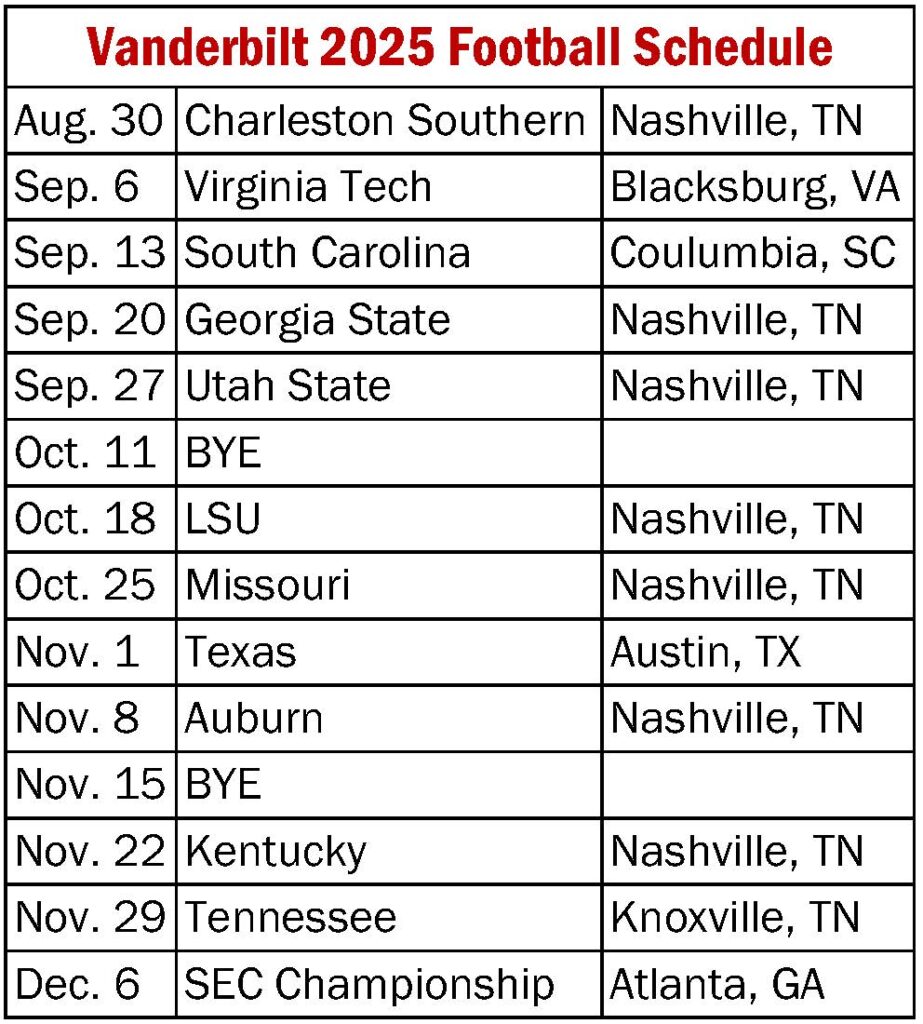
Vanderbilt will face seven opponents that reached the postseason in 2024, including College Football Playoff teams Texas and Tennessee.

This schedule doesn’t care about your feel-good story. It will expose every weakness, punish every mistake, and test whether this program has truly turned the corner or just enjoyed a brief moment of overachievement.

The critical dates that will define the season:

  • August 30 vs Charleston Southern – No trap games allowed
  • October 4 at Alabama – The revenge game, exactly 364 days after the upset
  • November 1 at Texas – First trip to Austin since 1903
  • November 29 at Tennessee – The rivalry game that could define the future

October and November will be brutal:

  • Four SEC road games at South Carolina, Alabama, Texas, and Tennessee
  • Home contests against LSU, Missouri, Auburn, and Kentucky that offer opportunities but zero margin for error
  • A November slate that could either cement their reputation or expose them as pretenders

The schedule is college football’s truth serum—and Vanderbilt is about to find out what they’re really made of.

Money Talks, and Vanderbilt Is Finally Speaking the Language

The Anchor Impact Fund has raised over $2.1 million to support athletes, but that’s not the whole story.

The real story is how Vanderbilt is using NIL strategically rather than throwing money around hoping something sticks. They’re targeting specific needs, combining competitive packages with immediate playing time, and leveraging Nashville’s unique market appeal.

Here’s why their approach works:

  • Portal-focused roster building that brought in nine starters for 2024’s breakthrough
  • Strategic targeting of undervalued transfers rather than bidding wars for five-stars
  • Emphasis on holistic development, including financial literacy and branding support

The new NCAA settlement, which allows up to $20.5 million in direct athlete compensation, will still favor programs with deeper pockets. But Vanderbilt has proven you don’t need to outspend everyone—you just need to spend smarter than everyone.

Clark Lea Isn’t Going Anywhere, and That Changes Everything

Their NIL success directly contributed to retaining players like Pavia while attracting impact transfers who might otherwise choose programs with bigger checkbooks but smaller opportunities.

Lea was the first Vanderbilt coach to be voted Coach of the Year by his peers since 2008 and the first Vandy head man to win it outright since 1982, according to Sports Illustrated’s coverage of his SEC Coach of the Year recognition.

But accolades don’t build programs—stability does.

Lea’s contract extension through 2029 provides something Vanderbilt hasn’t had in decades: continuity. His deep connection as an alumnus who played for the program creates emotional investment that transcends typical coaching arrangements.

The coaching staff tells the story of a program that values both continuity and evolution:

  • Offensive coordinator Tim Beck returns with proven success developing Pavia
  • Defensive coordinator Steve Gregory promoted after engineering dramatic improvement
  • Strategic additions like pass rush specialist Will Smart show a commitment to specialized expertise

This isn’t a coach waiting for a better opportunity—it’s a coach building something lasting.

Special Teams: The Advantage Nobody Talks About

Kicker Brock Taylor converted 85.7% of field goals and 97.5% of extra points in 2024.

In a conference where games are decided by three points and missed kicks end seasons, that reliability is worth multiple wins. Punter Jesse Mirco averaged 48.0 yards per punt, providing field position advantages that often proved decisive.

Return specialists Junior Sherrill and Martel Hight both scored touchdowns in 2024, adding explosive potential that can flip momentum in crucial moments.

Special teams excellence isn’t glamorous, but it’s the foundation of every program that consistently outperforms expectations.

The Sustainability Test

Every SEC program has good seasons—few have sustainable success.

Vanderbilt enters 2025 facing the ultimate test: can they maintain competitiveness while navigating elevated expectations, increased media attention, and the constant threat of player defections through the transfer portal?

The answers lie in their systematic approach:

  • Academic excellence (31st consecutive semester above 3.0 GPA) provides recruiting differentiation
  • Cultural foundation built on development rather than just talent acquisition
  • Strategic roster management that emphasizes fit over pure star power

Most analysts project a 6-6 record, but that projection undersells the program’s potential if defensive improvements materialize and key players stay healthy.

Bowl eligibility remains the primary goal, but consecutive winning seasons would represent program-altering achievement in a conference that has historically treated Vanderbilt as a guaranteed victory.

Why This Time Is Different

Vanderbilt football isn’t just building for 2025—they’re building for the next decade.

The combination of Pavia’s final season, strategic roster reinforcement, and coaching staff continuity creates the best foundation this program has enjoyed in over a decade. More importantly, they’ve proven they can develop culture, manage resources, and compete against elite talent.

The schedule provides zero margin for error but offers maximum opportunity for statement victories that could permanently elevate their national profile.

Success in November—particularly against Kentucky and Tennessee—won’t just validate the 2024 breakthrough. It will establish Vanderbilt as a permanent factor in SEC competition rather than an occasional disruptor.

The question isn’t whether Vanderbilt can compete in the SEC anymore.

The question is whether they can sustain that competitiveness while building toward something even greater. The 2025 season will provide the definitive answer to college football’s most intriguing sustainability question.

And for the first time in decades, the smart money is on the Commodores proving that lightning can indeed strike twice in Nashville.

The Next Billion Dollar Game

College football isn’t just a sport anymore—it’s a high-stakes market where information asymmetry separates winners from losers. While the average fan sees only what happens between the sidelines, real insiders trade on the hidden dynamics reshaping programs from the inside out.

Our team has embedded with the power brokers who run this game. From the coaching carousel to NIL deals to transfer portal strategies, we’ve mapped the entire ecosystem with the kind of obsessive detail that would make a hedge fund analyst blush.

Why subscribe? Because in markets this inefficient, information creates alpha. Our subscribers knew which coaches were dead men walking months before the mainstream media caught on. They understood which programs were quietly transforming their recruiting apparatuses while competitors slept.

The smart money is already positioning for 2025. Are you?

Click below—it’s free—and join the small group of people who understand the real value of college football’s new economy.
No related posts found.
VISIT OUR SHOP [COMING SOON]

LOAD MORE BLOG ARTICLES

Florida Gators 2025 Football Season Preview: The DJ Lagway Era Begins Now

The Florida Gators are about to find out if their future is as bright as they think it is.

After finishing 8-5 overall and 4-4 in the SEC in 2024, the Gators pulled off something that felt impossible just months earlier. They won their first bowl game since the 2019 Orange Bowl. They beat ranked teams. They made people believe again.

But 2025? That’s when the real test begins.

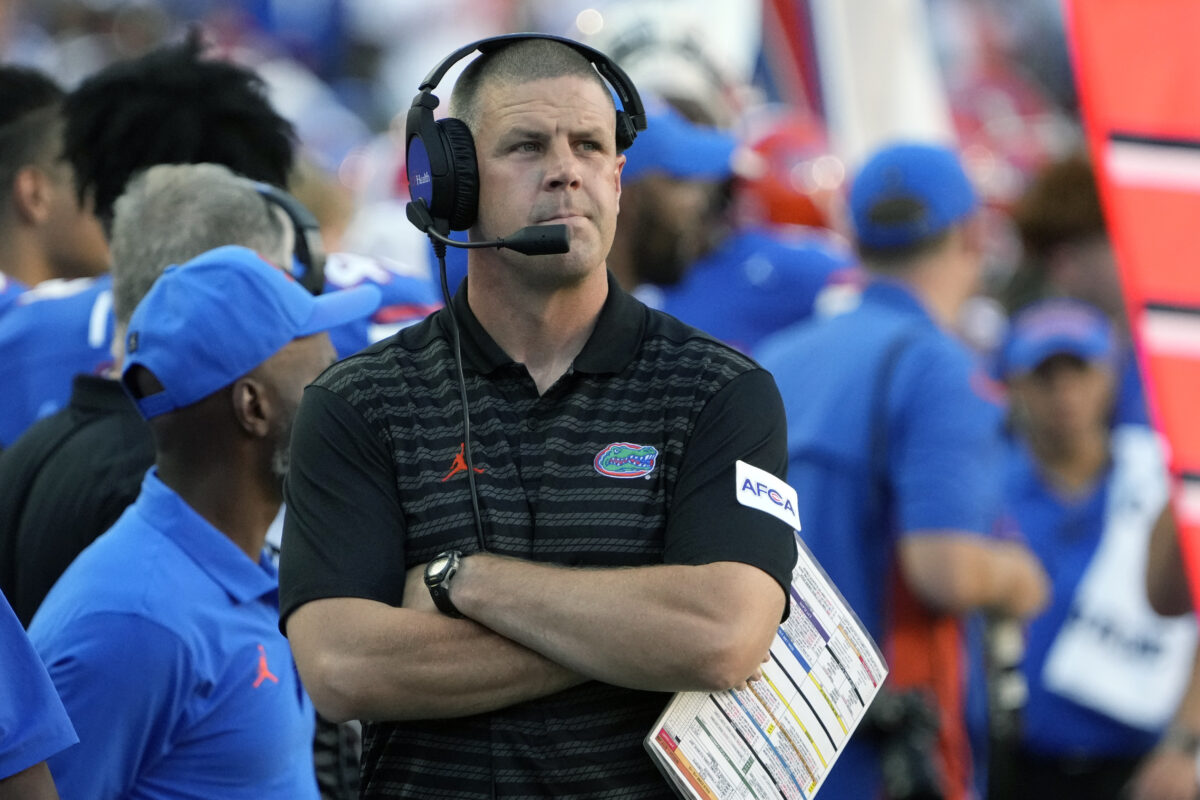
Billy Napier Just Bought Himself One More Year

Here’s what most people don’t understand about Billy Napier’s situation.

He wasn’t retained simply because he’s a great coach. The decision appears heavily influenced by DJ Lagway’s emergence and the administration’s investment in the quarterback’s potential.

Florida athletic director Scott Stricklin made this crystal clear: “As we’ve seen these past several weeks, the young men on this team represent what it means to be a Gator. Their resolve, effort and execution are evident in their performance and growth each week – building a foundation that promises greater success next season and beyond.”

Translation: Lagway’s emergence appears to be a major factor in the coaching decision.

The pressure on Napier in 2025 is enormous:

  • He’s 18-19 as Florida’s head coach
  • That’s the worst winning percentage by a Florida coach since 1949
  • Another mediocre season and the hot seat becomes an ejector seat
  • The schedule is brutal again
  • Napier knows this is his make-or-break year.

DJ Lagway Is Either Going to Save This Program or Break It

Everything about Florida’s 2025 season hinges on one person.

DJ Lagway finished his rookie season with 1,915 passing yards and 12 touchdowns, helping lead Florida to a 6-1 record in his seven starts. When he played, the Gators looked like a completely different team.

But here’s the thing nobody wants to talk about: Lagway dealt with shoulder and lower body injuries that limited his spring practice participation. He was “an extremely limited participant in the Gators’ spring practice, not even throwing in most of spring and therefore losing an opportunity for crucial reps ahead of a make-or-break season.”Everything about Florida’s 2025 season hinges on one person.

What makes Lagway special:

  • He completed 19 of his 36 deep pass attempts in 2024 for 733 yards, five touchdowns and only two interceptions
  • His 52.8 percent adjusted completion percentage on deep balls led all SEC returners
  • He was named the top deep ball passer returning for 2025 by 247Sports and Pro Football Focus
  • In his seven starts, he upset ranked LSU and Ole Miss teams

The kid has elite arm talent and ice in his veins.

  • He completed 19 of his 36 deep pass atteHe completed 19 of his 36 deep pass attempts in 2024 for 733 yards, five touchdowns and only two interceptions
  • His 52.8 percent adjusted completion percentage on deep balls led all SEC returners
  • He was named the top deep ball passer returning for 2025 by 247Sports and Pro Football Focus
  • In his seven starts, he upset ranked LSU and Ole Miss teams

The kid has elite arm talent and ice in his veins.

The problem?

If Lagway gets hurt or struggles early, this entire season falls apart. Florida doesn’t have a proven backup. They don’t have elite talent around him yet. Everything depends on a sophomore quarterback staying healthy and taking a massive leap forward.

That’s a lot of pressure for anyone, let alone a 19-year-old.

The Defense Finally Has a Plan (We Think)

Florida’s defense in 2024 was like watching a car accident in slow motion.

They allowed 376.9 total yards per game. They gave up big plays at the worst possible moments. They looked confused half the time.

So what did Florida do? They completely overhauled the coaching staff.

The defensive changes:

  • Ron Roberts promoted to full-time defensive coordinator
  • Vinnie Sunseri hired as co-defensive coordinator and safeties coach
  • New schemes are designed to reduce coverage mistakes
  • Focus on the nickel position to stop big plays

The talent is there. Defensive linemen Caleb Banks (4.5 sacks, 7 TFL) and Tyreak Sapp (7 sacks, 13 TFL) both return. They successfully retained key players who could have transferred.

But coaching changes are always a gamble. New systems take time. Chemistry has to be rebuilt.

Will it work? Nobody knows yet.

Recruiting is Finally Starting to Pay Off

Here’s the one thing Napier has consistently done well at Florida: recruit.

Florida’s 2025 recruiting class ranks in the top 10 nationally. They’re bringing in elite defensive backs, dynamic wide receivers, and impact players at positions of need.

The recruiting momentum:

  • Florida’s classes have finished 32nd, 12th and 10th since Napier arrived in late 2021
  • The 2025 class features blue-chip prospects like Ben Hanks III and Vernell Brown III
  • Many freshmen are expected to compete for immediate playing time
  • The uncertainty over Napier’s future had hurt recruiting, but his retention should help

ESPN noted: “Between defensive backs Jordan Castell, Devin Moore, Dijon Johnson, and Aaron Gates, there were four members of Florida’s 2023 class — signed at the end of Napier’s first full cycle with the program — in the Gators’ starting lineup on defense against Georgia in Week 10.”

The young talent is starting to contribute. The question is whether it’s enough to compete with Georgia, Texas, and the rest of the SEC elite.

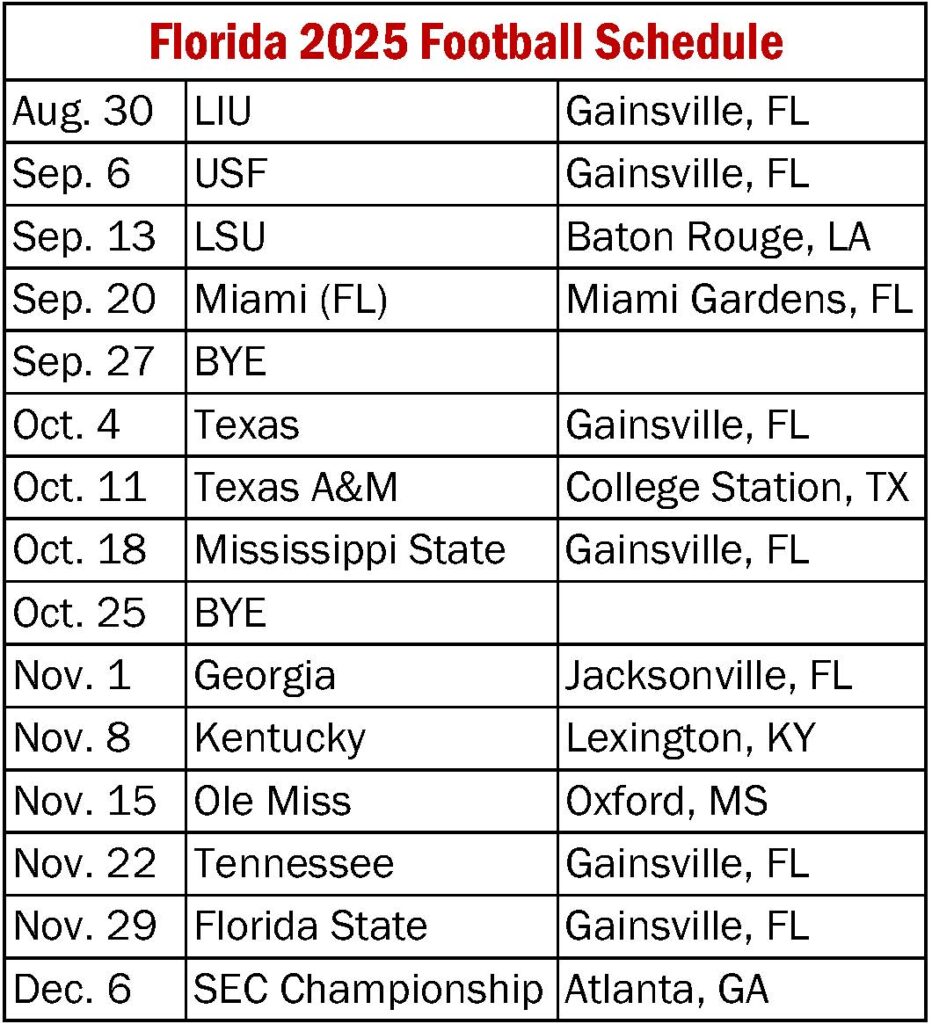
The Schedule is Absolutely Brutal (Again)

Want to know why most experts are predicting Florida finishes around .500?

Look at this schedule.

The gauntlet Florida faces:

  • Road games at LSU, Miami, Texas A&M, Kentucky, and Ole Miss
  • Home games against Texas, Mississippi State, Tennessee, and Florida State
  • Georgia at a neutral site
  • Multiple top-25 teams early in the season

ESPN’s Football Power Index projects Florida for a 6-6 regular season, ranking them 12th in the SEC. Most betting lines have the Gators’ win total between 6.5 and 7.5 games.

The early-season stretch is particularly dangerous. Florida travels to LSU in September and hosts Miami. If they stumble early, the pressure on Napier will be suffocating.

This isn’t a schedule where you can afford to have growing pains or figure things out on the fly.

What Success Looks Like in 2025

Here’s the reality most Florida fans don’t want to hear.

Success in 2025 won’t be measured solely by wins and losses. It will be measured by progress.

What progress looks like:

  • Lagway continues developing without major regression
  • The defense shows clear improvement under new coordination
  • Young players contribute immediately and show growth
  • Competitive games against ranked opponents
  • No embarrassing blowout losses

If Florida can hit those markers while winning 7-8 games, that’s actually a successful season given the schedule and where the program was two years ago.

The best-case scenario:

Lagway stays healthy and takes a massive leap. The defense improves dramatically. Florida steals a couple of games they shouldn’t win and finishes 8-4 or 9-3.

The worst-case scenario:

Lagway gets hurt early. The defensive changes don’t work. Florida struggles to win 6 games and Napier gets fired.

Most likely? Florida finishes somewhere between 6-6 and 7-5, shows clear progress, and everyone agrees the program is heading in the right direction.

The Bottom Line: This is Make-or-Break Time

Florida is at a crossroads.

They have a potentially elite quarterback. They have strong recruiting classes. They have momentum from a solid 2024 finish.

But they also have a coach on thin ice, a brutal schedule, and enormous expectations from a fanbase that’s tired of being mediocre.

The 2025 season will determine whether Florida is finally ready to compete with the SEC’s elite or if they’re destined for another few years of frustration.

DJ Lagway holds the key to everything.

The Next Billion Dollar Game

College football isn’t just a sport anymore—it’s a high-stakes market where information asymmetry separates winners from losers. While the average fan sees only what happens between the sidelines, real insiders trade on the hidden dynamics reshaping programs from the inside out.

Our team has embedded with the power brokers who run this game. From the coaching carousel to NIL deals to transfer portal strategies, we’ve mapped the entire ecosystem with the kind of obsessive detail that would make a hedge fund analyst blush.

Why subscribe? Because in markets this inefficient, information creates alpha. Our subscribers knew which coaches were dead men walking months before the mainstream media caught on. They understood which programs were quietly transforming their recruiting apparatuses while competitors slept.

The smart money is already positioning for 2025. Are you?

Click below—it’s free—and join the small group of people who understand the real value of college football’s new economy.
No related posts found.

LOAD MORE BLOG ARTICLES

Auburn Football 2025 Season Preview: Hugh Freeze’s Make-or-Break Season Arrives

The Pressure is On

Auburn head coach Hugh Freeze enters his third season on the Plains under intense pressure. After back-to-back losing campaigns in 2023 and 2024, the Tigers have overhauled their roster through both recruiting and the transfer portal. Auburn now boasts a former five-star quarterback transfer, back-to-back top-10 recruiting classes, and experienced impact players from the portal. The pieces are in place — now the program has to start winning games. Auburn’s Hugh Freeze is running out of time.

After two straight losing seasons at Auburn, the Tigers head coach faces the most critical year of his tenure on the Plains. Everything that could be upgraded has been upgraded. The quarterback room features a former five-star transfer. The roster is loaded with blue-chip talent from back-to-back top-10 recruiting classes. The transfer portal has been pillaged for immediate impact players.

But none of that matters if Auburn can’t win football games.

The 2025 season isn’t about potential anymore—it’s about production. And for Freeze, it’s about survival in the unforgiving world of SEC football.

Jackson Arnold Solves Auburn’s Biggest Problem

Auburn’s quarterback situation has been solved.

Oklahoma transfer Jackson Arnold brings the exact skill set that Hugh Freeze’s offense demands: dual-threat ability, RPO mastery, and a cannon for an arm. Arnold isn’t just an upgrade—he’s a complete transformation of what Auburn can do offensively.

His 2024 numbers at Oklahoma tell only part of the story:

  • 1,421 passing yards, 12 touchdowns, 3 interceptions
  • 444 rushing yards, 3 touchdowns
  • 131 rushing yards in upset win over No. 7 Alabama

“The fit he is for our offense and Auburn, I couldn’t be more excited,” Freeze said. “He’s a dual-threat guy who understands the RPO system extremely well and throws the deep ball extremely well.”

Arnold struggled at Oklahoma due to receiver injuries and the presence of three different offensive coordinators in one season. At Auburn, he’ll have stability, weapons, and a system designed to capitalize on his strengths.

This is the quarterback Auburn has been searching for since Cam Newton left the Plains.

The Transfer Portal Became Auburn’s Salvation

Auburn attacked the transfer portal like their program depended on it.

Because it did.

The Tigers identified every weakness from 2024 and found proven solutions in the portal. Offensive line struggles? Virginia Tech’s Xavier Chaplin and USC’s Mason Murphy arrive with starting experience. Receiver depth issues? Georgia Tech’s Eric Singleton Jr. brings elite production and versatility.

The defensive side received similar treatment:

  • MAC Defensive Back of the Year Raion Strader
  • Experienced linebacker Caleb Wheatland
  • Multiple defensive backs with Power Five starting experience

Auburn brought in 19 transfers while losing 23 players to the portal. However, the key difference lies in this: most departures weren’t regular contributors, whereas most additions had starting experience.

This wasn’t roster management—this was strategic reconstruction.

Elite Recruiting Finally Pays Dividends

Auburn’s recruiting renaissance under Hugh Freeze has been impossible to ignore.

Back-to-back top-10 recruiting classes have fundamentally changed the talent level on the Plains. The 2025 class ranks No. 6 nationally and includes:

  • Five-star quarterback Deuce Knight
  • Five-star edge rusher Jared Smith
  • A majority of Alabama’s top prep prospects
  • Multiple ESPN 300 contributors across all positions

“I inherited a program that didn’t have a top-25 recruiting class for 4 years,” Freeze acknowledged. “You’re not going to win in this league [with that]. We’ve now had 2 full recruiting classes, both top-10.”

The talent gap that existed between Auburn and SEC powers has been closed through recruiting. Now comes the harder part: developing and deploying that talent effectively.

Defense Gets Rare Continuity

Here’s something Auburn hasn’t had in years: defensive coordinator stability.

D.J. Durkin returns for his second season leading the defense, providing continuity in a program that has cycled through coordinators at breakneck speed. The 2024 defense showed flashes of dominance when healthy, averaging 7 tackles for loss and 2.3 sacks per game.

The secondary remains Auburn’s defensive strength:

  • Experienced starters Kayin Lee and Kaleb Harris return
  • Transfer addition Raion Strader brings All-MAC credentials
  • Depth improved through recruiting and portal additions

Auburn must replace five of its top seven tacklers, but the combination of returning talent and strategic additions provides optimism for significant improvement.

The defense has the pieces—now Durkin gets an entire season to implement his system without major personnel overhauls.

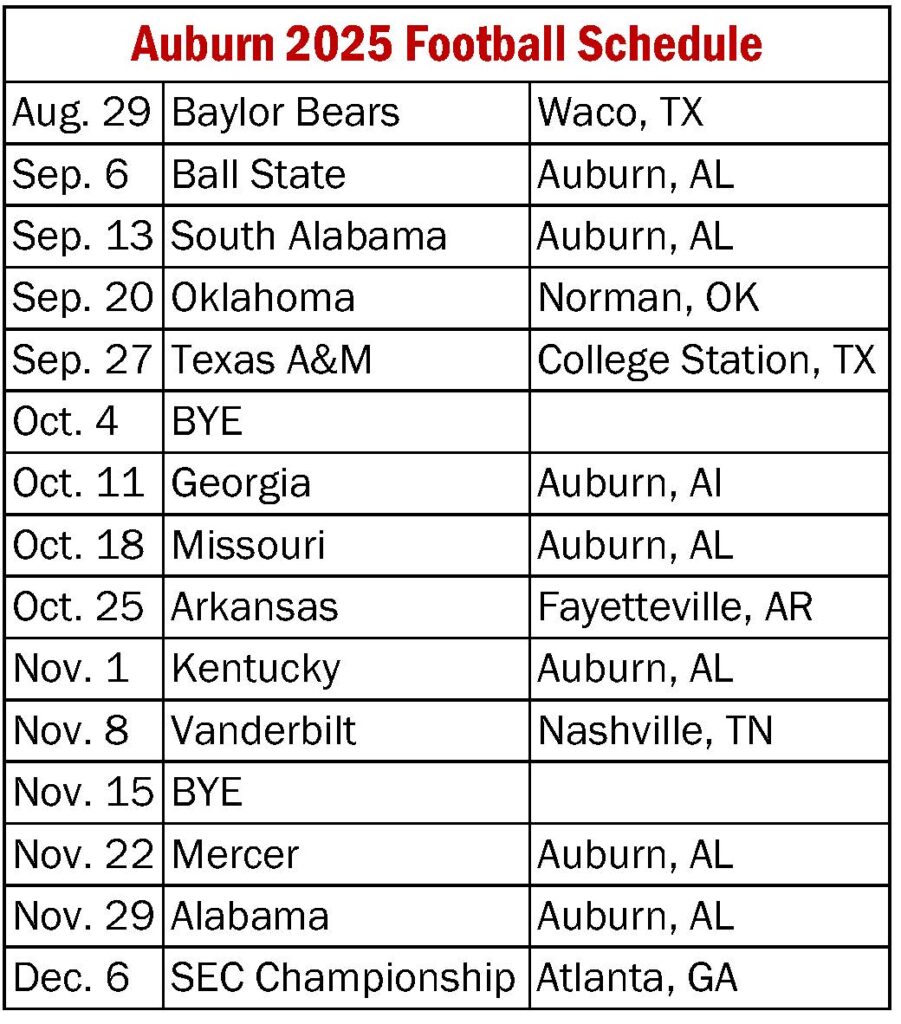
The Schedule Helps Auburn

Auburn’s 2025 schedule is the most favorable they’ve seen in years.

Ranked 15th nationally in strength of schedule and 12th in the SEC, the Tigers avoid some of the conference’s most dangerous programs while their most significant challenges at Jordan-Hare Stadium.

Key scheduling advantages:

  • Alabama and Georgia both visit Auburn (historically better for the Tigers in odd years)
  • No matchup with Texas, the SEC’s most dominant program
  • Manageable non-conference slate to build momentum
  • Oklahoma visit provides revenge game opportunity against Arnold’s former team

“I feel a lot better than I have about our talent, our size, athleticism, and depth,” Freeze shared. “I still believe we need one more [signing] class to get to where we need to be, but I don’t sense any panic.”

The schedule provides Auburn with realistic paths to 7-8 wins if the talent translates into performance.

Hugh Freeze’s Job Depends on One Thing

Bowl eligibility isn’t a goal for Auburn in 2025—it’s a requirement.

“I’m not a fool, I think we’ve got to go to a bowl game,” Freeze said publicly. This represents the minimum acceptable outcome after two years of elite recruiting and massive roster investment.

The pressure couldn’t be more obvious:

  • Two straight losing seasons
  • Back-to-back years missing bowl games
  • Massive financial investment in roster construction
  • Fan patience is completely exhausted

Freeze’s track record suggests confidence in reaching this baseline. In 12 seasons as an FBS head coach, he’s failed to win six games only twice: his final year at Ole Miss and his second year at Auburn.

But Auburn hasn’t just invested in talent—they’ve invested in Freeze’s vision. If that vision doesn’t produce wins in 2025, both will be replaced.

The Areas That Will Define Success

Auburn’s 2025 season will be determined by improvement in specific areas.

Red zone efficiency was a key factor in the Tigers’ struggles in 2024, ranking 122nd nationally in touchdown percentage. Arnold’s dual-threat ability and upgraded receivers should immediately address this critical weakness.

Special teams ranked 84th nationally in SP+ efficiency, consistently hurting field position and momentum. New specialists and renewed emphasis represent clear priorities.

Turnover margin must improve after Auburn averaged 1.8 giveaways while forcing only 1.1 takeaways per game. Arnold’s decision-making will be crucial in flipping this equation.

These aren’t complex problems—they’re execution issues that talent alone should be able to solve.

What Success Looks Like

Vegas set Auburn’s win total at 7.5 games, reflecting cautious optimism about the program’s trajectory.

ESPN’s SP+ model projects Auburn to rank No. 25 overall, with an average of 6.9 wins. The defense is projected to rank 19th nationally, while the offense is projected to rank 48th. These numbers suggest a team capable of bowling with upside for more.

Realistic 2025 benchmarks:

  • Bowl eligibility (minimum acceptable outcome)
  • Competitive showings against Alabama and Georgia at home
  • Road victory against Oklahoma or Texas A&M
  • Establishing clear program momentum for 2026

The talent is there. The schedule cooperates. The expectations are clear.

Now, Auburn has to win football games.

The Bottom Line: No More Excuses

Auburn enters 2025 with everything necessary for success.

The quarterback position has been upgraded with a proven dual-threat transfer. The skill positions feature elite recruiting and portal additions. The defense returns key contributors while adding impact players for depth.

The schedule provides legitimate opportunities for 7-8 wins. The roster construction represents a substantial financial investment in immediate success.

Hugh Freeze has spent two years building this foundation. The 2025 season will determine whether he can coach at the level he recruits, or whether Auburn needs to find someone who can.

The excuses have been exhausted. The expectations are crystal clear. The pieces are in place.

Time to find out if Hugh Freeze can turn all this potential into actual victories.

The Next Billion Dollar Game

College football isn’t just a sport anymore—it’s a high-stakes market where information asymmetry separates winners from losers. While the average fan sees only what happens between the sidelines, real insiders trade on the hidden dynamics reshaping programs from the inside out.

Our team has embedded with the power brokers who run this game. From the coaching carousel to NIL deals to transfer portal strategies, we’ve mapped the entire ecosystem with the kind of obsessive detail that would make a hedge fund analyst blush.

Why subscribe? Because in markets this inefficient, information creates alpha. Our subscribers knew which coaches were dead men walking months before the mainstream media caught on. They understood which programs were quietly transforming their recruiting apparatuses while competitors slept.

The smart money is already positioning for 2025. Are you?

Click below—it’s free—and join the small group of people who understand the real value of college football’s new economy.
No related posts found.

LOAD MORE BLOG ARTICLES

Mississippi State Football 2025 Season Preview: Bulldogs Poised for Significant Improvement Under Jeff Lebby

Jeff Lebby’s second season at Mississippi State represents the most critical juncture in recent program history.

After enduring a brutal 2-10 campaign that saw the Bulldogs finish winless in SEC play, everything about this team has been rebuilt from the ground up. The transfer portal became Mississippi State’s best friend. The recruiting class jumped into the top 30 nationally. And perhaps most importantly, the quarterback who showed flashes of brilliance before injury is coming back for another shot.

The question isn’t whether Mississippi State will be better in 2025.

The question is whether they’ll be good enough to survive one of the most punishing schedules in college football.

Blake Shapen’s Return Changes Everything

The most significant development for Mississippi State heading into 2025 is the return of quarterback Blake Shapen.

After receiving a medical hardship waiver, Shapen announced his decision to come back for a sixth season. The Baylor transfer started the Bulldogs’ first four games of 2024 before a shoulder injury ended his season prematurely. But what he showed in those four games was exactly what Jeff Lebby’s offense needed:

  • 68.5% completion percentage
  • 243.5 yards per game
  • 8 touchdowns to just 1 interception
  • 2 rushing touchdowns

“Blake’s decision to return for the 2025 season after his season-ending shoulder injury in Week 4 last year provides crucial stability,” notes former Mississippi State quarterback Jackie Sherrill.

His return isn’t just about talent—it’s about continuity in a system that desperately needs it.

The Transfer Portal Became Mississippi State’s Salvation

Mississippi State attacked the transfer portal like their program depended on it.

Because it did.

The defensive line—arguably the team’s biggest weakness in 2024—received a complete overhaul:

  • Will Whitson from Coastal Carolina (former Senior Bowl candidate)
  • Jamil Burroughs from Alabama/Miami
  • Jaray Bledsoe from Texas
  • Red Hibbler from NC State
  • Raishein Thomas from Northern Illinois

The secondary was reinforced with Old Dominion safety Jahron Manning (85 tackles, 3 interceptions in 2024) and Marian corner Dwight Lewis III. Tennessee transfer Jalen Smith brings veteran leadership to the linebacker position after Stone Blanton’s departure to the NFL.

On offense, the receiver room added six transfers, including Brenen Thompson from Oklahoma and Anthony Evans III from Georgia. Running back Davon Booth returns after leading the team in rushing, now paired with South Alabama transfer Fluff Bothwell (7.5 yards per carry in 2024).

This wasn’t just roster management—this was program reconstruction.

Recruiting Finally Shows Signs of Life

The 2025 recruiting class ranks 26th nationally.

For a program that has struggled to attract top talent, this represents massive progress. Mississippi State signed 27 players, with four four-star prospects:

  • Quarterback KaMario Taylor
  • Linebacker Tyler Lockhart
  • Edge rusher Tyshun Willis
  • Cornerback Kyle Johnson

This recruiting success reflects Lebby’s emphasis on building depth while maintaining focus on in-state prospects. The class provides both immediate contributors and long-term development pieces as the program works to close the talent gap with SEC elite programs.

The Schedule Flip Could Be a Game-Changer

Here’s what makes 2025 different: Mississippi State gets to play its toughest opponents at home.

After playing four 2024 College Football Playoff teams on the road last season, the Bulldogs welcome those same four teams to Starkville in 2025:

  • Arizona State (Sept. 6)
  • Tennessee (Sept. 27)
  • Texas (Oct. 25)
  • Georgia (Nov. 8)

The season opens with a road trip to Southern Miss (Aug. 30), then the home opener against Arizona State. Alcorn State and Northern Illinois round out the non-conference schedule before the SEC gauntlet begins.

Critical road games include Texas A&M (Oct. 4), Florida (Oct. 18), Arkansas (Nov. 1), and Missouri (Nov. 15). The traditional Egg Bowl against Ole Miss concludes the season at home (Nov. 28).

This home-and-away flip gives Mississippi State home-field advantage for their most challenging contests—and that could make all the difference.

Defense Gets a Complete Makeover

The 2024 defense was historically bad.

34.1 points allowed per game. 456.4 yards surrendered per game. Both numbers are dead last in the SEC. The defensive line couldn’t generate pressure, couldn’t stop the run, and frankly looked overmatched every Saturday.

The transformation has been dramatic. Spring practice reports indicated immediate improvement, with the revamped defensive line generating six sacks in the spring game. Safety Isaac Smith returns as the anchor after recording 127 tackles in 2024, providing veteran leadership for a unit that must improve dramatically.

The additions aren’t just about talent—they’re about changing the entire culture of a defense that got pushed around for an entire season.

Jeff Lebby Faces His Defining Moment

“What Jeff is building takes time, but the signs are encouraging,” former Mississippi State coach Jackie Sherrill said at a recent booster event. “The SEC West isn’t forgiving, but neither is standing still. The program is moving forward.”

But forward isn’t fast enough for everyone.

Lebby enters his second season under intense pressure to show tangible progress. The roster overhaul was necessary. The recruiting improvements are promising. The quarterback situation is stabilized.

Now he has to win games.

External projections place Mississippi State’s win total at approximately 4.5 games. ESPN’s FPI rankings have the Bulldogs at 52nd nationally—a notable improvement, but still far from SEC respectability.

The margin for error is razor-thin. Early momentum from non-conference victories is essential. Pulling off at least one significant SEC upset might be the difference between job security and a coaching search.

The Keys to Exceeding Expectations

For Mississippi State to surprise people in 2025, several things must happen perfectly:

  • The defensive line transformation must translate into consistent pressure and run-stopping ability
  • Blake Shapen must stay healthy and continue his efficient play
  • The offensive line must gel quickly to protect the quarterback
  • Costly turnovers and penalties (minus-six turnover margin in 2024) must be eliminated

The pieces are in place for significant improvement. The talent level is higher. The depth is better. The culture is changing.

But in the SEC, good intentions don’t win football games.

What Success Looks Like

Mississippi State doesn’t need to win the SEC in 2025.

They need to look like a program moving in the right direction. They need to be competitive in games they’re supposed to lose. They need to win the games they’re supposed to win. And they need to steal one or two that they’re not supposed to win.

Bowl eligibility would be a massive step forward. Beating Ole Miss in the Egg Bowl would erase a lot of frustration. Winning at Arkansas or Florida could provide momentum heading into the 2026 season.

Success will be measured not just in wins and losses, but in competitiveness, development, and the establishment of a sustainable program foundation.

The 2025 season represents a pivotal moment for Mississippi State football, with the potential to either validate Jeff Lebby’s vision or send the program back to the drawing board once again.

The Next Billion Dollar Game

College football isn’t just a sport anymore—it’s a high-stakes market where information asymmetry separates winners from losers. While the average fan sees only what happens between the sidelines, real insiders trade on the hidden dynamics reshaping programs from the inside out.

Our team has embedded with the power brokers who run this game. From the coaching carousel to NIL deals to transfer portal strategies, we’ve mapped the entire ecosystem with the kind of obsessive detail that would make a hedge fund analyst blush.

Why subscribe? Because in markets this inefficient, information creates alpha. Our subscribers knew which coaches were dead men walking months before the mainstream media caught on. They understood which programs were quietly transforming their recruiting apparatuses while competitors slept.

The smart money is already positioning for 2025. Are you?

Click below—it’s free—and join the small group of people who understand the real value of college football’s new economy.
No related posts found.

LOAD MORE BLOG ARTICLES

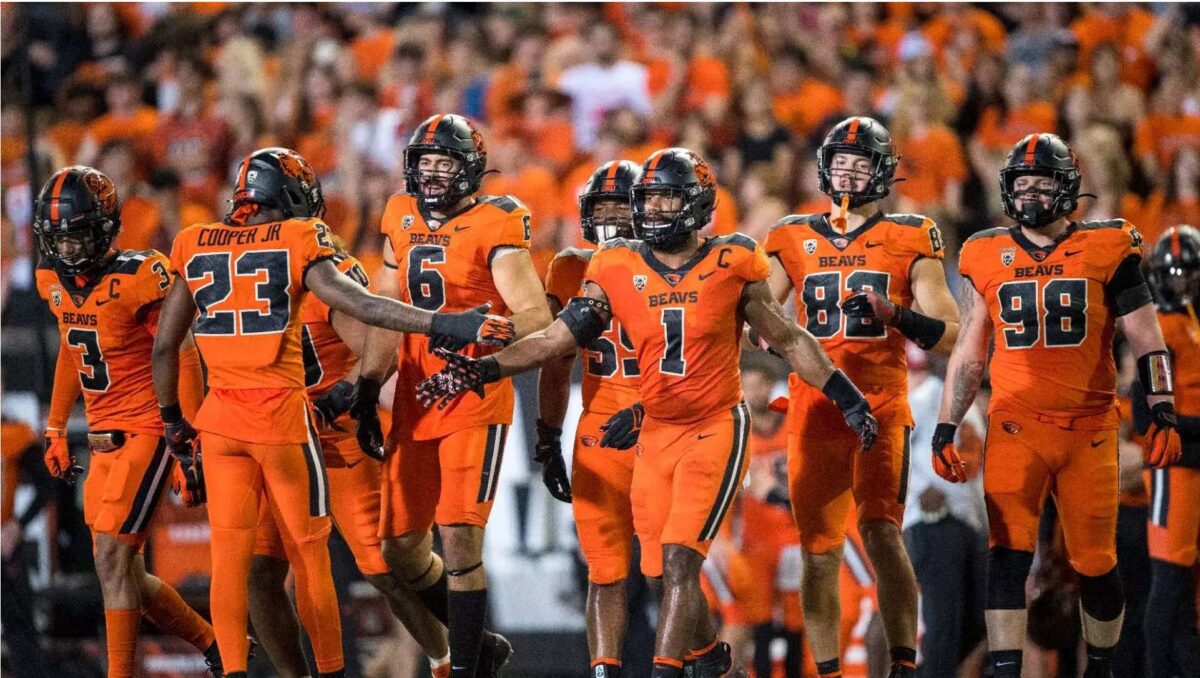
Oregon State Football 2025 Season Preview: From Chaos to Contention

The 2024 season was a nightmare for the Oregon State football team.

After enduring conference realignment chaos, coaching departures, and quarterback carousel disasters that led to a disappointing 5-7 record, the Beavers enter 2025 with something they haven’t had in years: hope. The program has made aggressive moves during the offseason to address its most glaring weaknesses while building around a foundation of returning talent that finally has a chance to shine.

The Quarterback Solution That Changes Everything

Oregon State found its answer at the most important position on the field.

Former Duke quarterback Maalik Murphy committed to the Beavers in December, bringing proven production and leadership to a position that was an absolute disaster in 2024. The numbers tell the story of just how desperate Oregon State was for help at quarterback:

  • The Beavers’ quarterbacks collectively completed just 216 of 360 passes for 2,417 yards
  • They threw seven touchdowns against 11 interceptions
  • They averaged a pathetic 201.4 passing yards per game
  • Three different quarterbacks started games, with zero providing consistent results

Murphy’s 2024 season at Duke represents everything Oregon State was missing. He led the Blue Devils to a 9-3 season and threw a school-record 26 touchdown passes, completing 254 of 421 passes for 2,933 yards with 12 interceptions. The 6-foot-5, 230-pound redshirt sophomore has two years of eligibility remaining.

“Felt like a great opportunity, and I really felt welcomed and wanted there. I was made a priority, and that’s all I could ask for. I’m excited to be a Beaver and get out there with the guys!” Murphy told ESPN about his decision to transfer to Oregon State.

Murphy alone threw nearly four times as many touchdown passes as Oregon State’s entire quarterback room combined last season.

The Supporting Cast Is Already In Place

Murphy won’t be throwing to scrubs.

Senior Trent Walker led all Oregon State receivers with 901 yards. He scored two touchdowns in 2024, providing Murphy with a proven target who served as a reliable safety valve during the quarterback chaos. Darrius Clemons, a Michigan transfer who battled through injuries, returns healthy after catching 29 passes for 292 yards and 2 touchdowns.

The depth at receiver has improved significantly:

  • Redshirt sophomore Taz Reddicks is expected to play a larger role after recording 17 catches in 11 games
  • Zachary Card played in all 12 games and can return kicks
  • David Wells Jr. provides additional depth as a redshirt sophomore

The tight end position received a massive boost with Riley Williams, a transfer from Miami who returns home to Oregon (Central Catholic HS in Portland). Williams brings experience from a high-level program and gives Murphy another reliable target.

But the real game-changer might be what’s already proven in the backfield.

Anthony Hankerson: The Foundation Everything Builds Upon

The ground game isn’t a question mark for Oregon State.

Anthony Hankerson returns after a breakout 2024 season, during which he nearly reached 1,000 rushing yards and scored 15 touchdowns. The senior running back provides the Beavers with a proven ground threat that should help balance the offense and take pressure off Murphy as he adjusts to his new system.

Oregon State averaged 189.2 rushing yards per game in 2024, actually outpacing their opponents’ 185.8 yards per game. This wasn’t the problem—it was everything else that fell apart around the running game.

Defense Gets a Complete Makeover

Last season’s defensive performance was embarrassing.

The Beavers managed just seven sacks all season, ranking dead last in FBS, while allowing nearly 30 points per game. The pass rush was so bad it became a national punchline. But the coaching staff has made substantial changes to address these glaring issues.

The defensive line transformation through the transfer portal includes:

  • Walker Harris from Southern Utah (expected starter at defensive end)
  • Kai Wallin from Nebraska (expected starter at defensive end)
  • Tevita Pome’e from Oregon (interior line anchor)
  • Tahjae Mullix from Western Carolina (additional depth)

The secondary returns some stability with sophomore Exodus Ayers, who was thrust into action as a freshman, and Kobe Singleton is expected to start if healthy. Captain Skylar Thomas anchors the safety position after leading the team with 81 tackles in 2024.

This defense has nowhere to go but up.

Schedule Reality Check

The 2025 schedule will test every improvement Oregon State has made.

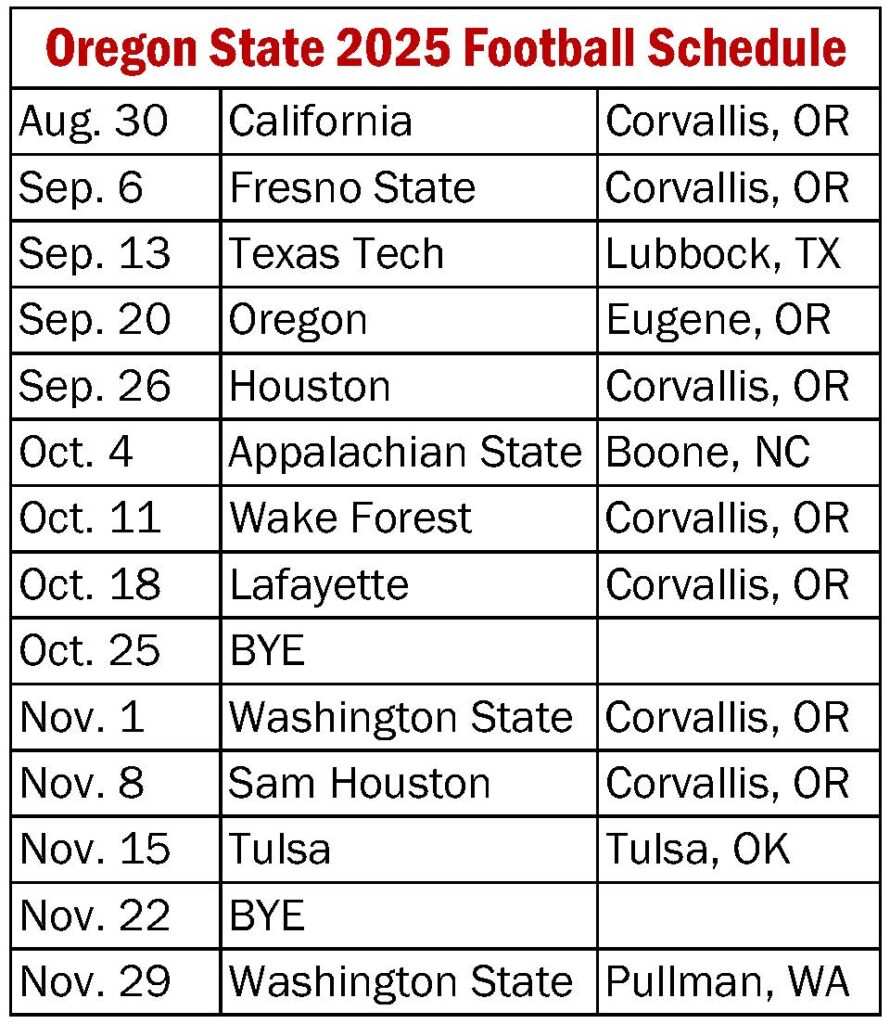
Seven home games provide some comfort, but six autonomy, five opponents create serious challenges. The slate includes demanding matchups against California, Houston, and Wake Forest at home, while road trips to Texas Tech and Oregon will provide early tests of the team’s progress.

The November dynamics are particularly interesting:

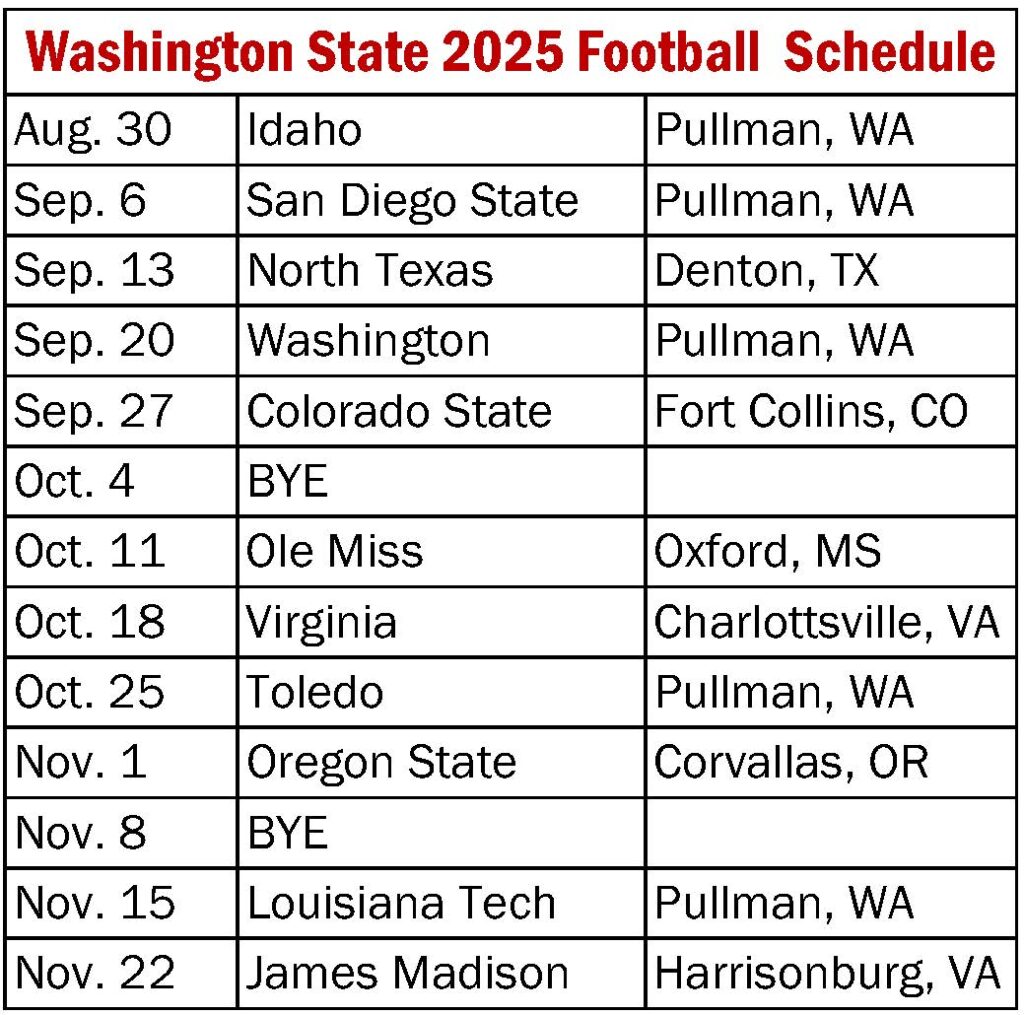
  • November 1: First meeting with Washington State (the only other Pac-12 survivor)
  • November 29: Season finale at Washington State in Pullman

These two games essentially represent the entire Pac-12 Conference, as both programs function as quasi-independent entities while maintaining their conference affiliation.

Coaching Stability Finally Arrives

Head coach Trent Bray enters his second season providing much-needed continuity.

Offensive coordinator Ryan Gunderson also returns for his second year, which should help the offense develop more consistency and familiarity with the system as Murphy settles into his role at quarterback. The coaching staff has been strengthened with five new additions, including Mark Criner as defensive quality control and Mikey Jacobsen as offensive quality control.

After years of upheaval, Oregon State finally has the coaching stability necessary to implement sustainable systems.

Transfer Portal Reinforcements Address Every Weakness

Beyond Murphy, Oregon State made strategic moves to fix its most obvious problems.

The offensive line, which struggled with protection and consistency in 2024, received reinforcements:

  • Keyon Cox from UCF
  • JT Hand from Arizona
  • Josiah Timoteo from Nevada

Defensively, the Beavers added multiple front-seven players, including linebacker Raesjon Davis from USC, in addition to the defensive line transfers. These additions offer both immediate impact potential and crucial depth for a program that has experienced significant roster turnover.

Every major weakness from 2024 has been addressed through the transfer portal.

Bowl Eligibility: The Realistic Goal That Matters

Six wins from a challenging 12-game schedule represent success for this program.

Oregon State’s ability to reach bowl eligibility will depend on three critical factors:

  • How quickly Murphy adapts to the offensive system
  • Whether the retooled defensive line can generate consistent pressure
  • How well the team navigates the demanding travel schedule that comes with their quasi-independent status

The schedule structure creates both opportunities and obstacles. Early-season games against California and Fresno State provide opportunities to build momentum, but the October stretch, featuring Appalachian State, Wake Forest, and Washington State, will likely determine bowl prospects.

A strong start could position the Beavers for their first bowl appearance since 2022.

The Bigger Picture: Program Survival and Growth

This season represents more than wins and losses for Oregon State.

After weathering conference realignment chaos, coaching changes, and massive roster turnover, the Beavers have assembled a team capable of taking meaningful steps forward. The success of 2025 will be measured in the development of sustainable systems and culture under Bray’s leadership.

Murphy’s presence at quarterback provides immediate upgrade potential, while the combination of returning players and strategic transfer additions offers hope for both short-term improvement and long-term stability.

For a program that has faced unprecedented challenges, 2025 offers an opportunity to demonstrate resilience and chart a path toward relevance in the rapidly changing landscape of college football.

The foundation has been laid, the pieces are in place, and the expectations are realistic but meaningful.

Now comes the execution that will determine whether Oregon State can transform from a program in survival mode into one capable of competing for bowl games and respect in the new era of college football.

The Next Billion Dollar Game

College football isn’t just a sport anymore—it’s a high-stakes market where information asymmetry separates winners from losers. While the average fan sees only what happens between the sidelines, real insiders trade on the hidden dynamics reshaping programs from the inside out.

Our team has embedded with the power brokers who run this game. From the coaching carousel to NIL deals to transfer portal strategies, we’ve mapped the entire ecosystem with the kind of obsessive detail that would make a hedge fund analyst blush.

Why subscribe? Because in markets this inefficient, information creates alpha. Our subscribers knew which coaches were dead men walking months before the mainstream media caught on. They understood which programs were quietly transforming their recruiting apparatuses while competitors slept.

The smart money is already positioning for 2025. Are you?

Click below—it’s free—and join the small group of people who understand the real value of college football’s new economy.
No related posts found.

LOAD MORE BLOG ARTICLES

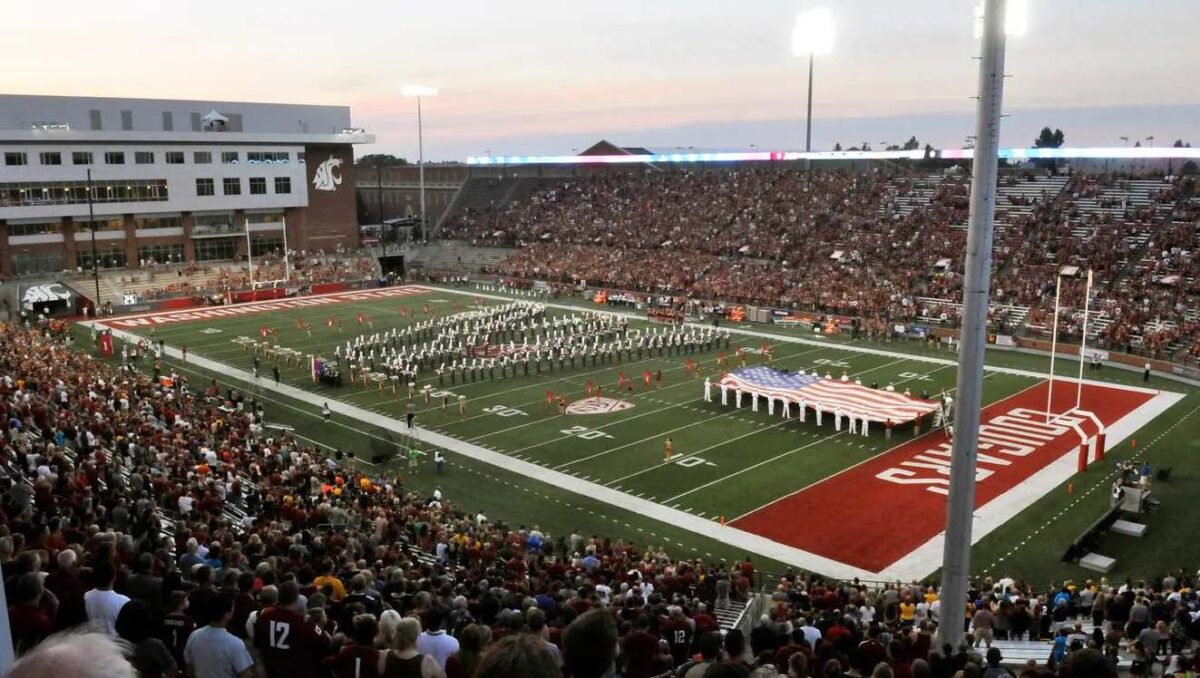
Washington State Football 2025: The Ultimate Rebuild

New Washington State Football Coach Jimmy Rogers has inherited one hell of a mess.

The new Washington State head coach took over a program that lost 46 players to the transfer portal, watched its former coach flee to Wake Forest, and now sits as one of just two teams in what used to be the mighty Pac-12. If you’re looking for a case study in how quickly college football can flip your world upside down, look no further than Pullman, Washington.

But here’s the thing about rock bottom—it’s also the perfect foundation to build something special.

The South Dakota State Invasion

Rogers didn’t just take the Washington State job.

He brought an entire army with him from South Dakota State, where he compiled a ridiculous 27-3 record over two seasons and won back-to-back FCS national championships. Of the 20 transfers joining the Cougars for 2025, 15 are following Rogers from South Dakota State (the Jackrabbits).

This isn’t your typical coaching hire where a few assistants tag along. This is a full-scale program transplantation:

  • Defensive backs: Tucker Large, Colby Humphrey, Matt Durrance, Trey Ridley, Caleb Francl, and Cale Reeder
  • Running backs: Maxwell Woods, Kirby Vorhees, and Angel Johnson
  • Tight ends: Beau Baker (plus Michigan State transfer Ademola Faleye)
  • Defensive line: Max Baloun, Buddha Peleti, Darrion Dalton, and Malaki Ta’ase
  • Linebackers: Anthony Palano and Carsten Reynolds
  • Special teams: Kicker Jack Stevens and punter Dylan Mauro

Rogers is essentially betting his entire reputation on one simple premise: that his championship-winning system and the players who executed it can translate from FCS to FBS competition.

The Portal Bloodbath

Want to understand the full extent of this dramatic rebuild?

Washington State lost their starting quarterback (John Mateer to Oklahoma), their top running back (Wayshawn Parker to Utah), their best linebacker (Buddah Al-Uqdah to rival Washington), and multiple offensive linemen who followed former coach Jake Dickert to Wake Forest.

The numbers tell the story:

  • 46 players entered the transfer portal
  • 26 scholarship players departed
  • 11 starters found new homes
  • 7 players followed Dickert to Wake Forest

This wasn’t just roster turnover—this was roster demolition.

But here’s where it gets interesting. Ten players who initially entered the portal because of coaching uncertainty withdrew their names and decided to stay. These returners include projected starting quarterback Zevi Eckhaus, receivers Josh Meredith and Tre Shackleford, and cornerback Jamorri Colson.

The Quarterback Situation

Zevi Eckhaus might be the most important player in college football you’ve never heard of.

After spending 2024 as John Mateer’s backup, Eckhaus got his moment in the Holiday Bowl and absolutely delivered. He completed 31 of 43 passes for 363 yards, three touchdowns, and two interceptions in his first FBS start. More importantly, he briefly entered the transfer portal before deciding to stay and bet on himself under the new coaching staff.

This decision could define Washington State’s 2025 season.

Eckhaus brings a different skill set than the departed Mateer—less of a dual-threat, more of a traditional pocket passer. But in Rogers’ system, which emphasizes ball control and efficient passing rather than the Air Raid’s vertical attack, Eckhaus might be a perfect fit.

The Scheme Transformation

Here’s what makes this rebuild even more fascinating.

Rogers isn’t just changing the players—he’s completely overhauling the offensive and defensive philosophies that have defined Washington State football for over a decade. The Air Raid system that made the Cougars famous is being replaced by a more balanced, physical approach that emphasizes:

  • Two tight end sets instead of four and five receiver packages
  • Power running game instead of spread concepts
  • Ball control instead of high-tempo passing
  • Defensive pressure instead of coverage-heavy schemes

The new coaching staff has brought in three tight ends through recruiting and transfers, plus converted linebacker Hudson Cederland to the position. This signals a fundamental shift toward formations and concepts that would be unrecognizable to Mike Leach or his successors.

The Recruiting Reality Check

Let’s be brutally honest about Washington State’s 2025 recruiting class.

Ranked 71st nationally by ESPN, this represents a historic low for a program that had never previously finished below 76th in recruiting rankings. The class lacks the blue-chip talent that defined previous WSU recruiting cycles, instead featuring a mixture of:

  • 18 high school prospects (many flipped from South Dakota State)
  • Multiple JUCO transfers, including top-rated receiver Devin Ellison
  • Graduate transfers filling immediate needs
  • Three-star prospects rather than four-star game-changers

But here’s the counterargument: Rogers isn’t trying to win a recruiting ranking. He’s trying to build a cohesive team that can execute his system immediately. Sometimes the best recruiting class isn’t the one with the highest ratings—it’s the one with the right players for your specific approach.

The Schedule Gauntlet

Washington State’s 2025 schedule reads like a geography lesson and a difficulty test rolled into one.

The Cougars will face six teams they’ve never played before, make three trips east of the Mississippi River before Halloween, and somehow play Oregon State twice in the same month. Here’s how the season breaks down:

Winnable home games:

  • Idaho (August 30) – FCS opponent, regional rivalry
  • San Diego State – Mountain West program in transition
  • Toledo – Solid MAC team, but beatable
  • Louisiana Tech – Conference USA opponent
  • Oregon State (November 29) – Pac-12 rematch

Challenging road tests:

  • North Texas – Improved AAC program
  • Colorado State – Mountain West contender
  • Ole Miss – SEC powerhouse (guaranteed loss)
  • Virginia – ACC program on the rise
  • James Madison – Sun Belt success story
  • Oregon State (November 1) – First of two meetings

Most analysts project a 5-7 finish, with strong home performance offsetting road struggles. But in a rebuilding year with this much roster turnover, even that might be optimistic.

The Unique Pac-12 Situation

Here’s something that makes Washington State’s rebuild completely unprecedented.

The Cougars are one of just two remaining members of the Pac-12, alongside Oregon State. This creates challenges that no other program faces:

  • Scheduling difficulties requiring creative non-conference arrangements
  • Recruiting hurdles without a stable conference identity
  • Financial constraints from reduced media rights revenue
  • National relevance questions in a two-team conference

The Oregon State double-header perfectly illustrates this bizarre reality. The schools will meet November 1 in Corvallis and November 29 in Pullman—the first time they’ve played twice in the same season since 1945. It’s a scheduling necessity born from conference chaos.

The Make-or-Break Factors

Rogers’ success in 2025 will depend on three critical variables.

First: Can the South Dakota State transfers handle the jump from FCS to FBS competition? These players dominated at the subdivision level, but facing Power 4 and Group of 5 opponents every week presents a massive step up in speed and athleticism.

Second: Will the new offensive system mesh with returning skill position players? Receivers like Meredith and Shackleford thrived in the Air Raid, but adapting to a more balanced approach with tight end-heavy formations could create growing pains.

Third: How quickly can Rogers establish his culture and leadership in a program that’s experienced massive upheaval? Championship coaches succeed because their players buy into their vision. With so many new faces and systems, building that trust becomes paramount.

The Bottom Line

Washington State’s 2025 season isn’t really about wins and losses.

It’s about Jimmy Rogers proving that his championship formula can scale from FCS to FBS competition. It’s about whether a program can completely reinvent itself in one offseason and remain competitive. It’s about survival in the weird, wild world of modern college football.

The Cougars enter this season with the lowest expectations in program history. No bowl projections. No conference championship hopes. No playoff dreams.

But sometimes that’s exactly where magic happens.

Rogers has built championship programs before. He’s developed players, installed winning systems, and created cultures that produce results. The question isn’t whether he can coach—it’s whether he can do it fast enough to keep Washington State relevant while rebuilding from scratch.

One thing is certain: college football has never seen a rebuild quite like this one.

The 2025 Washington State Cougars will either validate Rogers’ vision and provide a blueprint for program transformation, or they’ll serve as a cautionary tale about the dangers of wholesale roster replacement. Either way, they’ll be absolutely fascinating to watch.

The Next Billion Dollar Game

College football isn’t just a sport anymore—it’s a high-stakes market where information asymmetry separates winners from losers. While the average fan sees only what happens between the sidelines, real insiders trade on the hidden dynamics reshaping programs from the inside out.

Our team has embedded with the power brokers who run this game. From the coaching carousel to NIL deals to transfer portal strategies, we’ve mapped the entire ecosystem with the kind of obsessive detail that would make a hedge fund analyst blush.

Why subscribe? Because in markets this inefficient, information creates alpha. Our subscribers knew which coaches were dead men walking months before the mainstream media caught on. They understood which programs were quietly transforming their recruiting apparatuses while competitors slept.

The smart money is already positioning for 2025. Are you?

Click below—it’s free—and join the small group of people who understand the real value of college football’s new economy.
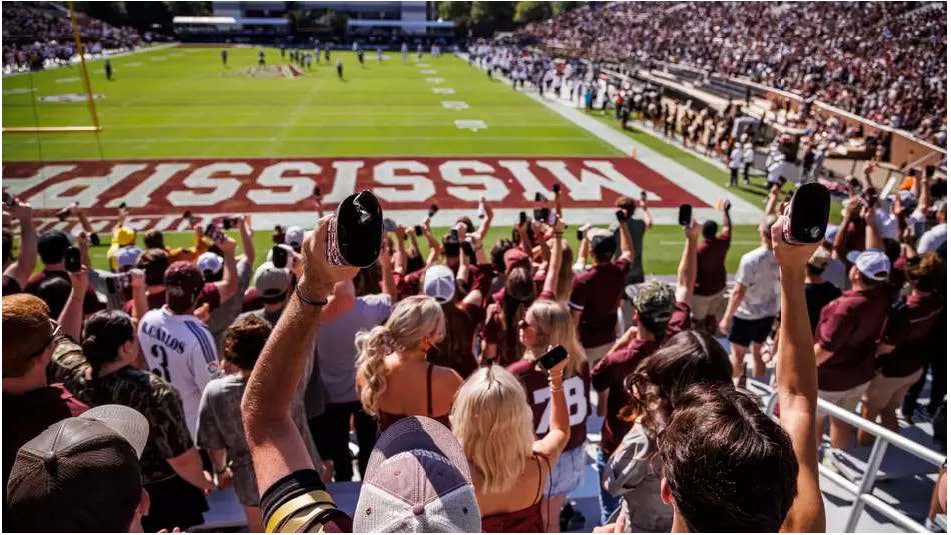
No related posts found.

LOAD MORE BLOG ARTICLES

Illinois Football 2025 Season Preview: Championship Aspirations Meet Reality

Illinois football is no longer a punchline.

The Fighting Illini enter the 2025 season with something they haven’t experienced in decades: legitimate championship expectations. Following a breakthrough 10-3 campaign that culminated in a Citrus Bowl victory over South Carolina, Bret Bielema’s program has captured national attention and positioned itself among college football’s emerging powers.

The Numbers Don’t Lie: Illinois Has Arrived

The preseason rankings tell the story of a program transformed:

  • Fox Sports’ Joel Klatt: #10
  • ESPN: #11
  • CBS Sports: #12
  • 247 Sports: #14
  • On3.com: #7 (yes, you read that correctly)

This marks Illinois’ first preseason ranking since 2008, and the highest preseason expectations in over two decades. “Everyone will tell you around Illinois they’re shooting for college football playoffs,” analyst Jeremy Werner said on the Cover 3 Podcast.

That’s not wishful thinking anymore.

Luke Altmyer: The Quarterback Who Changed Everything

The foundation of Illinois’ championship dreams rests on one decision: whether Luke Altmyer will return.

In front of a packed State Farm Center during a basketball game, the junior quarterback announced he would return for his senior season rather than entering the transfer portal. That announcement might have been the most critical moment for Illinois football in 20 years.

Altmyer’s 2024 numbers were exceptional:

  • 2,717 passing yards
  • 22 touchdowns, five interceptions
  • 61% completion percentage
  • #34 nationally in passer rating (144.9)
  • 5 career game-winning drives (most among active QBs)

But the numbers only tell part of the story. Altmyer has become the clutch performer Illinois desperately needed, throwing three game-winning touchdown passes in the final minute or overtime during 2024 alone.

Bret Bielema Gets Paid (And Illinois Gets Certainty)

Illinois wasn’t taking any chances with their coach.

The university signed Bielema to a six-year contract extension through 2030, worth $7.7 million annually. The deal signals institutional commitment and provides the stability that championship programs require.

Since arriving in 2021, Bielema has compiled a 28-22 overall record and transformed Illinois from Big Ten doormat to legitimate contender. His “tough, smart, dependable” philosophy has produced tangible results:

  • 12 NFL draft picks in four seasons
  • Two bowl appearances
  • First 10-win season since 2001
  • Largest attendance growth in the nation

The Schedule: A Championship Window Opens

Illinois caught a break with its 2025 schedule.

The Illini avoid traditional Big Ten powers Penn State, Oregon, and Michigan. Their toughest opponent? Defending national champion Ohio State, but that game comes at home in Memorial Stadium.

Early season tests will define the trajectory:

  • Duke (road): Nine-win team in 2024 with talented QB Maalik Murphy
  • Indiana (road): Big Ten opener against Curt Cignetti’s improved Hoosiers
  • USC (home): Lincoln Riley’s Trojans in a must-win spot
  • Ohio State (home): The measuring stick game

Werner emphasized the importance of those early road games: “I think that’s going to tell us a lot about this team.”

Replacing NFL Talent Through the Portal

Illinois lost significant production to the NFL:

  • Pat Bryant (WR): Drafted by Denver Broncos (3rd round)
  • Zakhari Franklin (WR): Signed with Las Vegas Raiders
  • Seth Coleman (LB): Joined Seattle Seahawks
  • JC Davis (OL): Departed for NFL opportunities

But Bielema’s staff struck back through the transfer portal.

The headliner addition is West Virginia wide receiver Hudson Clement, who posted 51 catches for 741 yards in 2024. Ball State’s Justin Bowick (6’5″, compared to the NFL’s Courtland Sutton) adds size and athleticism to the receiving corps.

Defensively, Wisconsin transfers James Thompson Jr. and Curt Neal bolster a front seven that needs to replace Coleman’s pass-rushing production. Florida State’s Tomiwa Durojaiye provides additional depth and upside.

The Foundation: 16 Returning Starters

Here’s why Illinois isn’t a one-year wonder: continuity.

The Illini return 16 starters from their 10-win squad, creating the experience and chemistry that championship teams require. Key returning players include:

  • Xavier Scott (DB): Led team with four interceptions
  • Matthew Bailey (DB): Citrus Bowl defensive MVP (93 tackles)
  • Gabe Jacas (LB): Top pass rusher, National Defensive Player of the Week
  • Josh McCray (RB): Citrus Bowl MVP (609 rushing yards)

This level of roster retention is rare in the transfer portal era, giving Illinois a significant competitive advantage.

Statistical Reality Check: What Needs Improvement

Illinois’ 2024 numbers reveal both strengths and concerns.

Offensive Strengths:

  • 364.8 total yards per game
  • 211.2 passing yards per game
  • 153.6 rushing yards per game
  • Only 40.2 penalty yards per game (excellent discipline)

Defensive Concerns:

  • 373.2 total yards allowed per game
  • 224.8 passing yards allowed
  • 148.4 rushing yards allowed

The defensive numbers suggest room for improvement, especially against high-powered offenses like Ohio State. The transfer portal additions should help, but Illinois must prove they can stop elite attacks consistently.

College Football Playoff: Dream or Destiny?

The expanded playoff format creates new opportunities for programs like Illinois.

ESPN’s Heather Dinich ranked Altmyer as the sixth-most impactful returning player nationally, noting that Illinois “can be a CFP sleeper team by competing for the Big Ten title and earning an at-large bid if it doesn’t win the league.”

The comparison being made? Indiana’s shocking 11-1 season and playoff appearance in 2024.

The comparison being made? Indiana’s shocking 11-1 season and playoff appearance in 2024.

If Illinois can navigate early road tests and avoid significant injuries, a 10-win season and playoff berth become realistic rather than fantasy.

The Bottom Line: This Is Illinois’ Moment

Vegas set the over/under for Illinois wins at 7.5, but that feels conservative.

The combination of experienced leadership, coaching stability, favorable scheduling, and strategic roster additions creates the foundation for sustained success. Illinois has moved beyond hoping for bowl eligibility to expecting championship contention.

The 2025 season represents more than an opportunity to repeat recent success—it’s a chance to establish Illinois as a permanent fixture among the college football elite.

The question isn’t whether Illinois can compete at the highest level.

The question is whether they’re ready to handle the pressure that comes with finally being taken seriously.

The Next Billion Dollar Game

College football isn’t just a sport anymore—it’s a high-stakes market where information asymmetry separates winners from losers. While the average fan sees only what happens between the sidelines, real insiders trade on the hidden dynamics reshaping programs from the inside out.

Our team has embedded with the power brokers who run this game. From the coaching carousel to NIL deals to transfer portal strategies, we’ve mapped the entire ecosystem with the kind of obsessive detail that would make a hedge fund analyst blush.

Why subscribe? Because in markets this inefficient, information creates alpha. Our subscribers knew which coaches were dead men walking months before the mainstream media caught on. They understood which programs were quietly transforming their recruiting apparatuses while competitors slept.

The smart money is already positioning for 2025. Are you?

Click below—it’s free—and join the small group of people who understand the real value of college football’s new economy.
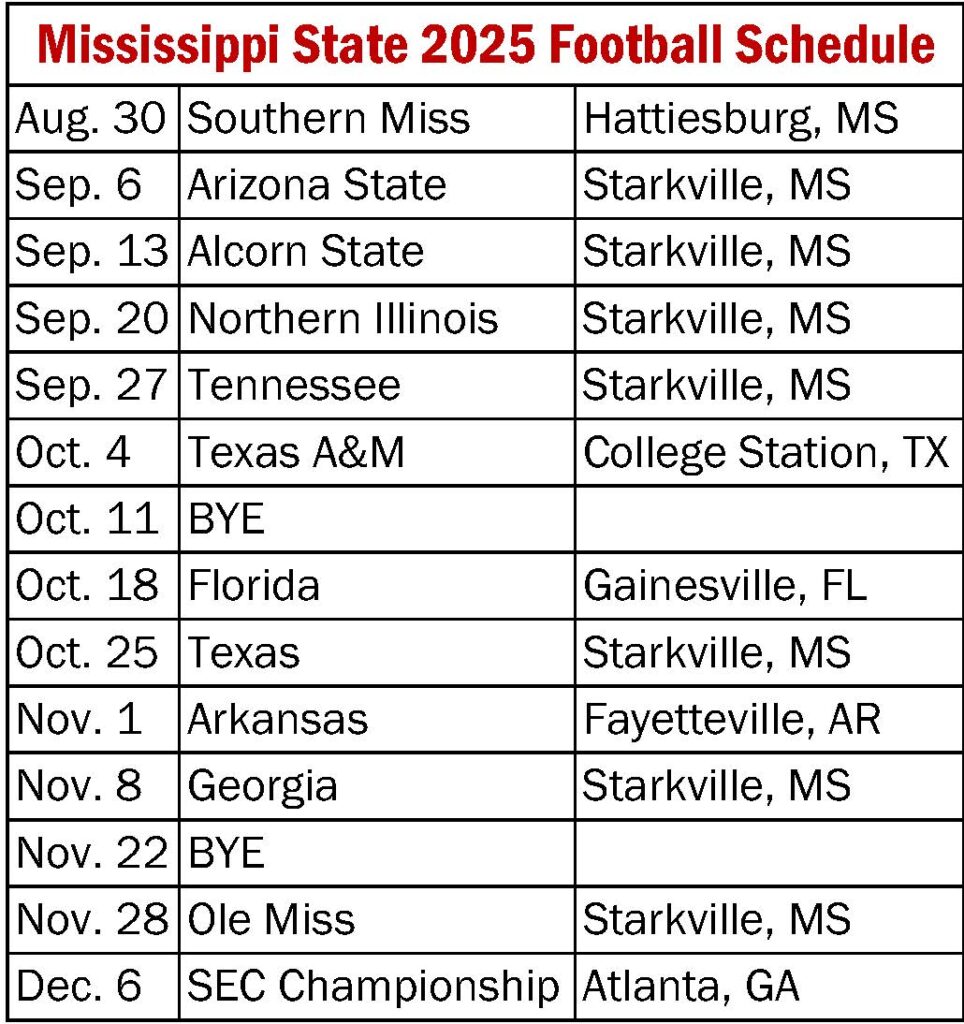
No related posts found.

LOAD MORE BLOG ARTICLES