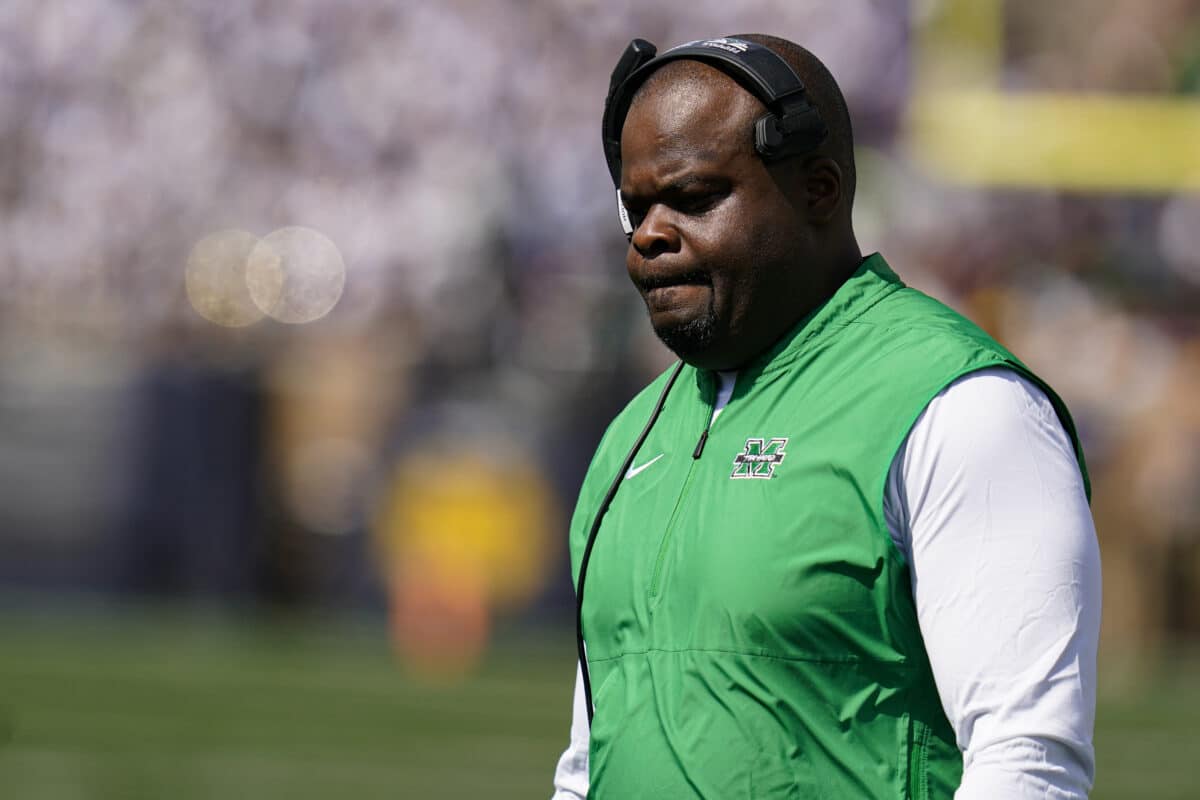
Charles Huff Took Southern Miss From 1-11 to 7-5 In One Season. Now He’s At Memphis—His Third Job In Three Years.

Charles Huff fixes broken programs.

That’s the value proposition Memphis is buying. Not a recruiter who needs five years to build his guys. Not a developmental coach who grows freshmen into seniors. Huff is a fixer — a guy who walks into a disaster, flips the portal, resets the culture, and delivers wins fast.

The pattern is clear now.

And if you’re trying to understand what Memphis is getting (and what they’re risking), you need to see how the pattern repeats.


The Southern Miss Fix: 1-11 to 7-5 In One Year

Huff inherited a catastrophe.

  • Zero Sun Belt wins in 2024.
  • Out of most games by halftime.
  • A program with no pulse.
  • One year later: 7-5, bowl eligible, in division-title contention deep into November.
  • That six-win jump was one of the largest single-season improvements in FBS.

Here’s how he did it:

Turnover Margin

Through 10 games, Southern Miss forced 25 turnovers while committing only 12. That’s a +1.30 margin per game — top three nationally. Those takeaways produced 61 points and shortened the field for an offense still finding its footing.

Portal reconstruction.

Huff didn’t try to develop the 1-11 roster. He replaced it. New faces, new expectations, new standards. The veterans who stayed had to buy in or get out.

Defensive identity.

Coordinator Jason Semore’s unit was top-tier in red-zone defense and strong against the run. The offense didn’t need to be special. It just needed to not lose games.

Close-game composure.

The 2024 team was routinely outclassed and out of games early. The 2025 team finished. Multiple tight conference wins late in the year.

  • Huff talked about confronting the “scar tissue” of the previous season.
  • His team played like they believed him.
  • But here’s the tension in the splits:
  • Late-season record at Southern Miss: 1-3 (.250).
  • The turnaround was real. The finish wasn’t. After starting 6-2, Southern Miss dropped three of their last four.

And then Huff left.


The Marshall Fix: 32-20 With A Top-10 Upset

Southern Miss wasn’t the first time.

Huff arrived at Marshall in 2021 with a Saban pedigree and a recruiting reputation. Four years later, he left with a 32-20 record, a Sun Belt title, and the signature win of his career: a road upset of #8 Notre Dame in 2022.

The splits tell the story of a coach who built something real:

  • Late-season record: 12-5 (.706)
  • Road record: 13-6 (.684)
  • Bowl record: 1-2

Marshall under Huff wasn’t elite. Advanced metrics rated them as respectable but not dominant at the G5 level. But they were consistently competitive, consistently bowling, and occasionally dangerous.

  • The late-season finishing that disappeared at Southern Miss? It was there at Marshall.
  • The difference: he had four years to build it.

Then he left for Southern Miss.


The Memphis Play: Same Playbook, Bigger Stage

This is a different setup than Marshall or Southern Miss.

Huff isn’t walking into a crater. Memphis went 8-4 in 2025, climbed as high as #22 in the polls, and returns a relatively healthy roster. Ryan Silverfield left for Arkansas. Reggie Howard handled the bowl.

The bones are there.

Huff is attacking it the same way anyway.

The portal haul is already significant:

  • Air Noland (QB, South Carolina) — former blue-chip, 3,500-yard passer, projected starter
  • Dallan Hayden (RB, Colorado) — ex-Ohio State signee with Big Ten/Big 12 experience
  • J’Mond Tapp (EDGE, Southern Miss) — All-Sun Belt, 70 tackles, 7.5 sacks
  • Michael Montgomery (LB, Southern Miss) — All-Sun Belt, knows Semore’s system
  • Ian Foster (DB, Southern Miss) — All-Sun Belt, ball production in the secondary

He’s importing proven production to raise the talent ceiling immediately.

Same playbook. Same urgency.

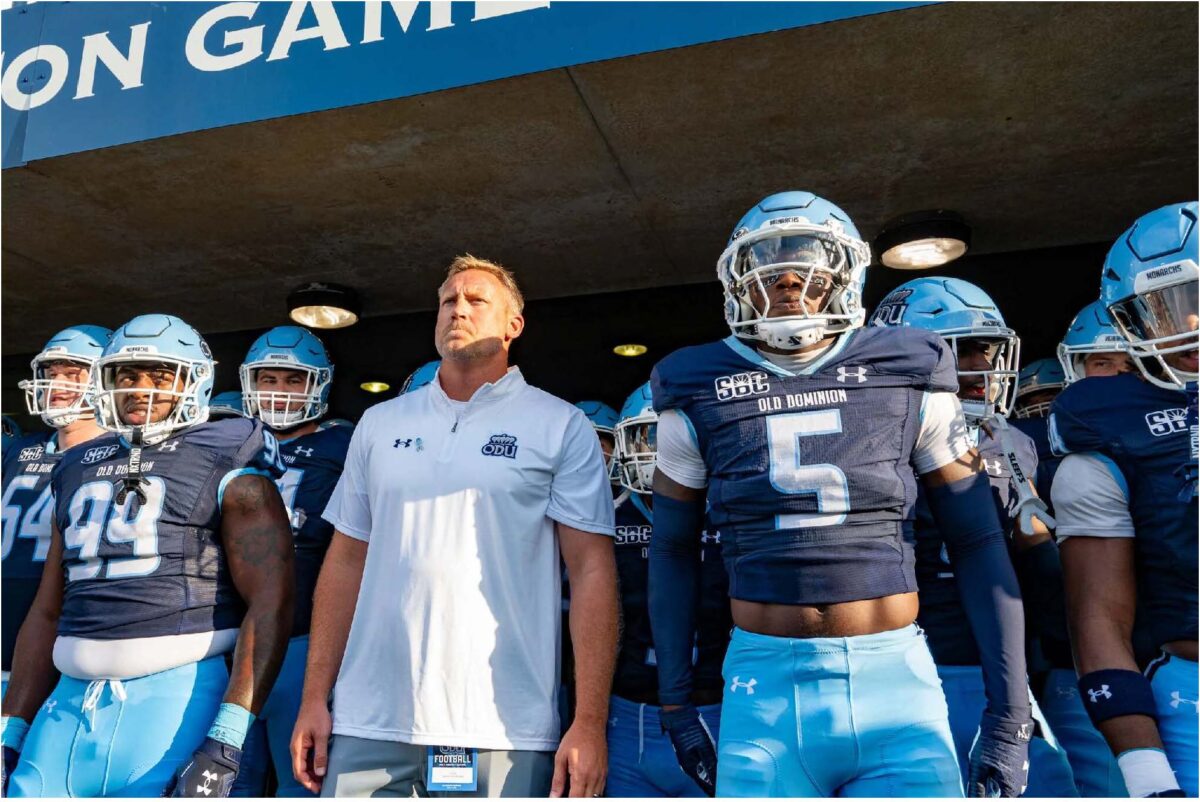
The staff reflects it too. Kevin Decker comes from Old Dominion, where his offense averaged 460+ yards per game with tempo and spread concepts. Jason Semore followed from Southern Miss to run the defense. Ben Ashford, Huff’s long-time strength coach, is the culture anchor.

Everything is built for Year 1 impact.


The Risk: Three Jobs In Three Years

Here’s what Memphis is betting against:

Charles Huff has never stayed anywhere long enough to see what happens after Year 4.

This is his third head job in three years. Marshall to Southern Miss to Memphis — each time chasing a bigger opportunity, each time leaving before the program had to answer harder questions about depth, development, and sustained excellence.

The turnaround pattern is proven.

The sustainability pattern doesn’t exist yet.

At Marshall, he built something and left before the conference-title team had to defend it. At Southern Miss, he engineered a miracle year and left before finding out if it was a mirage. Now at Memphis, he inherits an 8-4 roster and a program with CFP aspirations in a realigning AAC.

The questions he has to answer:

  • Can he win when he’s not the underdog?
  • Can he develop a roster instead of just replacing one?
  • Can he stay?

The splits say Huff is a .609 coach who wins on the road, finishes strong at his longer stops, and hasn’t proven much against ranked opponents or in bowl games.

The narrative says he’s an elevator.

But elevators go both directions.

Memphis is betting he keeps going up.

They’re also betting he doesn’t get off at the next floor.

No related posts found.

LOAD MORE BLOG ARTICLES

Billy Napier Was 40-12 At Louisiana And 22-23 At Florida. Here’s Why JMU Is Betting He’s Still The Louisiana Version.

Billy Napier just landed the best job in Group of Five football.

James Madison went 40-10 in its first three FBS seasons. The Dukes won a Sun Belt title. They made the College Football Playoff. And now Bob Chesney – the coach who built that 2025 run – is gone to UCLA.

Napier inherits a dynasty mid-flight.

This isn’t a rebuild. This isn’t a “prove yourself” job. This is a “don’t break what’s already working” job – and that’s an entirely different kind of pressure.


22-23 At Florida. 40-12 At Louisiana. Same Coach.

Napier was fired from Florida with the worst 30-game record for a Gators coach since the 1940s.

He went 5-20 against ranked opponents. He won just four road games in nearly four full seasons. His late-season record at Florida was 6-10 – the opposite of a closer.

But the same coach went 40-12 at Louisiana.

He won back-to-back Sun Belt titles. He finished ranked in the AP Top 20 twice. His late-season record with the Ragin’ Cajuns was 16-3.

Same coach. Completely different results.

The difference wasn’t scheme. It wasn’t recruiting. It wasn’t even playcalling (though that didn’t help). The difference was context.

At Louisiana, Napier had the best roster in his conference. At Florida, he was bringing a knife to a gunfight every Saturday in the SEC.


6-24 Against Ranked Teams – But Context Changes Everything.

I pulled Napier’s career splits across both stops.

The numbers reveal exactly why this JMU hire makes sense—and exactly where the risk lives.

Career Record: 64-39 (.621)

SplitRecordWin %
Home38-23.623
Away22-9.710
Neutral4-7.364
Late Season22-13.629
vs Ranked6-24.200
Bowl Games5-4.556

That 6-24 record against ranked teams looks catastrophic.

But context matters. At Louisiana, he only faced five ranked opponents in four years – and went 1-4. At Florida, he faced 25 ranked teams and went 5-20. The SEC forced him into a weight class he couldn’t compete in.

Louisiana-specific splits:

SplitRecordWin %
Overall41-12.774
Late Season16-3.842
Bowl Games4-3.571

When Napier has the roster advantage, he closes. When he doesn’t, he collapses.

JMU gives him the roster advantage.


23 Players Hit The Portal. 7 Already Followed Chesney To UCLA.

Here’s the part that should worry JMU fans.

Twenty-three players entered the transfer portal after the Dukes’ CFP run. Seven have already followed Chesney to UCLA – including star running back Wayne Knight, receiver Landon Ellis, and edge rusher Aiden Gobaira. Sun Belt Player of the Year Alonza Barnett III left for UCF.

This isn’t a one-time thing, either.

When Curt Cignetti left JMU for Indiana after 2023, he took 13 players with him – including multiple All-Group of Five performers. The Dukes have now lost two head coaches to Power Four jobs in back-to-back years, and both times the roster got raided.

Napier’s first job isn’t installing his system. It’s stopping the bleeding.

Early signs are encouraging:

  • He’s landed former LSU four-star receiver Kylan Billiot
  • He’s kept key returners like running back George Pettaway and receiver Braeden Wisloski
  • He’s pulling transfers from East Tennessee State, West Florida, and Northern Arizona to restock the depth chart

But the margin for error is thin.


He’s Giving Up Playcalling. Florida Is Paying His Salary. He Won’t Get Poached.

Three things are working in Napier’s favor that weren’t true at Florida.

First: He’s giving up playcalling.

This was the single biggest complaint during his Gainesville tenure. Slow tempo. Predictable sequences. Clock management disasters. Napier publicly committed at his JMU introduction to letting offensive coordinator Cam Aiken call plays.

If he actually follows through, that’s the biggest operational change of his career.

Second: Florida is subsidizing his salary.

Napier’s buyout from Florida was approximately $21 million – paid with no offset. That means JMU is getting a former SEC head coach at a modest base, freeing up budget for staff and NIL. Napier has also said his performance bonuses will go directly into a program discretionary fund.

Donors love this structure. It’s leverage without cost.

Third: He won’t get poached.

Cignetti left for Indiana. Chesney left for UCLA. Both coaches used JMU as a springboard to Power Four jobs within two years.

Napier’s Power Four stock is damaged. Nobody is calling him for a major job anytime soon. That’s a feature, not a bug. JMU finally has a coach who might actually stay.


Chesney’s Career Win Rate: .706. Napier Is A Stabilizer, Not An Elevator.

Bob Chesney’s career record is 120-50 (.706) across four stops.

He won conference titles at Salve Regina, Assumption, Holy Cross, and JMU. He took Holy Cross to five straight Patriot League titles and four FCS playoff berths. In two seasons at JMU, he went 21-5 with a bowl win and a CFP appearance.

Chesney is a program elevator. He takes jobs and immediately exceeds their historical baseline.

Napier is a stabilizer. He wins when the infrastructure is already in place. He struggles when he has to build from scratch or compete above his weight class.

JMU fans aren’t upgrading. They’re trading upside for security.

That’s not necessarily a bad trade. But it’s the trade they’re making.


Year 1 Is The Excuse Year. Year 2 Is The Real Test.

Here’s how this plays out.

Year 1 (2026): The excuse year. Massive roster turnover. New staff. Learning the Sun Belt landscape again. Anything above 8-4 is a win. Anything below 7-5 is a problem.

Year 2 (2027): The prove-it year. By now, the roster is his. The system is installed. JMU should be competing for a Sun Belt title. If they’re not, questions start.

Year 3 (2028): The ceiling year. This is where we find out if Napier can match what Cignetti and Chesney built – or if he’s just maintaining altitude. A CFP appearance resets the clock. A third-place Sun Belt finish starts the hot seat conversation.

Napier has a five-year deal. But the real evaluation window is 24 months.


Good Hire. Not A Home Run. JMU Is Trading Upside For Security.

Billy Napier is a good hire for JMU.

He’s not a great hire. He’s not a home-run hire. He’s a logical, defensible, high-floor hire for a program that just lost its second coach in two years to a Power Four job.

The Sun Belt is his natural habitat. The roster he’s inheriting is better than anything he had at Louisiana. The financial structure works in his favor. And for the first time in his career, he’s publicly committed to getting out of his own way on gameday.

If he can stabilize the portal losses, maintain top-three Sun Belt recruiting, and actually let Cam Aiken call plays – JMU stays in the CFP conversation.

If he reverts to Florida habits – slow tempo, conservative playcalling, late-game collapses – the 40-10 era ends fast.

The stat that got him fired is the same stat that makes him perfect for JMU.

Now he has to prove it.


Want more coaching analysis like this? Subscribe to Coaches Hot Seat for weekly rankings of all 136 FBS coaches – plus deep dives on the hires, fires, and pressure situations shaping college football.

No related posts found.

LOAD MORE BLOG ARTICLES

Is Jim Mora an Upgrade Over Jay Norvell at Colorado State?

Colorado State just made a bet.

Not a small bet. Not a ‘let’s see what happens’ bet. A real bet – the kind where you fire a coach coming off an 8-5 season because you believe something better exists. The kind where you write a check to a 64-year-old with 100+ career wins and say, ‘Finish what the last guy couldn’t.’ The kind that looks brilliant or foolish in three years, with very little in between.

Here’s what the numbers say.

The Tale of the Tape

Most fans will argue about ‘culture’ and ‘fit.’

That’s fine. But before we get into narratives, let’s look at what actually happened. Career numbers. Home and away splits. Performance against ranked teams. Late-season execution. Bowl results. The stuff that doesn’t care about press conferences.

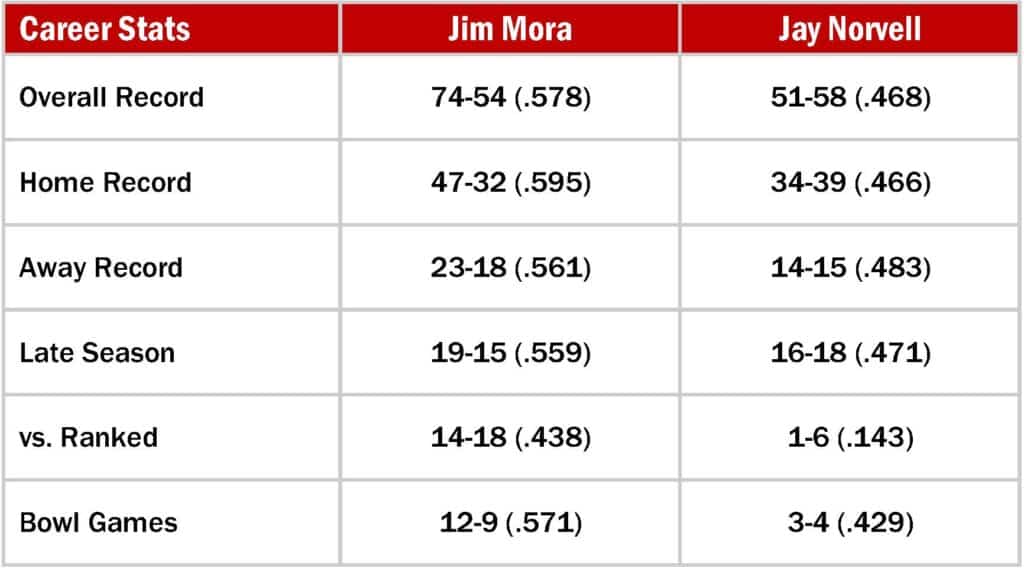
Here’s the side-by-side:

Look at the ‘vs. Ranked’ row.

Mora is 14-18. Not dominant—but competitive. He’s been in those games. He’s won some of them. Norvell is 1-6. One win in seven tries against ranked opponents. That’s not bad luck. That’s a pattern. And patterns tell you what happens when the pressure goes up.

The late-season splits tell the same story.

What Norvell Built

Let’s be fair to the guy who just got fired.

Norvell inherited the Steve Addazio disaster. He brought energy. He brought recruits. He brought an 8-5 season that made CSU fans remember what winning felt like. That’s not nothing. But here’s the problem: one season doesn’t erase four years of data. And four years of data paint a different picture.

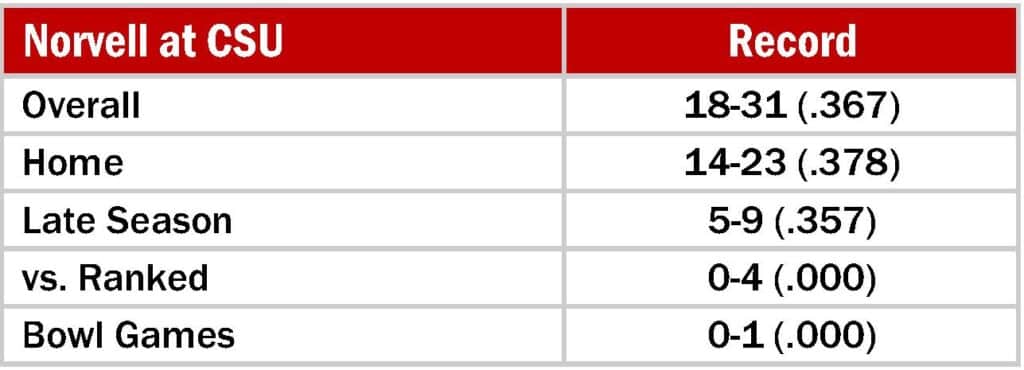
The numbers at CSU specifically:

18-31 overall.

Zero wins against ranked teams. Zero bowl wins. A .357 late-season record—meaning when November hit, the Rams folded. And here’s the detail that doesn’t show up in win-loss columns: across Norvell’s 18 victories, only two came against opponents who finished with winning records. The wins looked good on paper. They didn’t mean much in context.

Then came 2025: 2-9.

The UConn Proof of Concept

Here’s why CSU wrote the check.

Before Mora arrived, UConn was 9-50 over five seasons. Read that again. Nine wins in five years. An FBS program with no conference, no TV money, no hope. The kind of job you take to prove a point – or to disappear. Mora didn’t disappear.

In four years:

Look at that late-season number: .692.

When the games mattered, UConn won. Back-to-back nine-win seasons. Bowl eligibility in three of four years. A ranked upset. All at a program that had been left for dead. This isn’t theory. This is proof. Mora knows how to turn a broken program into a competitive one.

The question is whether he can do it one more time.

The UCLA Question

You can’t write about Mora without addressing how UCLA ended.

He started 29-11. Two 10-win seasons. A Pac-12 South title. Then: 17-19 over his final three years. Three straight losses to USC. Declining attendance. A $12 million buyout. The program had stagnated, and UCLA wanted a reset. That’s the honest version. But here’s what matters for CSU: the reasons Mora struggled at UCLA don’t necessarily apply to Fort Collins.

Different expectations. Different resources. Different definition of success.

Why This Fit Makes Sense

Three things line up here.

First: CSU is joining the rebuilt Pac-12. That means real TV money, a conference identity, and a path to the CFP. Mora has Pac-12 experience. He has West Coast recruiting ties. He knows what it takes to compete in that ecosystem. Second: CSU’s AD has promised actual investment: NIL, facilities, and staff. Mora never had those resources at UConn. If CSU delivers, his ceiling goes up significantly. Third: credibility. Norvell was a promising G5 profile. Mora is a known commodity with an NFL pedigree and 100+ wins.

CSU isn’t asking Mora to win a national title. They’re asking him to make the Rams relevant.

Where It Could Go Wrong

This isn’t a guarantee.

Mora is 64. His offensive philosophy skews conservative: ground-and-pound, control the clock. That’s not the explosive style dominating modern college football. If CSU under-invests, or if Mora whiffs on portal and staff hires, this becomes a ‘veteran stabilizer’ move instead of a transformational one. And remember: Norvell did go 8-5 with a 6-1 league record. Mora has to at least match that while navigating a tougher schedule and a transition year.

The bar isn’t zero. But the ceiling is higher.

The Bottom Line

On paper, this is a clear upgrade.

Career win rate: .578 vs .468. Bowl record: 12-9 vs 3-4. A proven rebuild at UConn. A Pac-12 South title at UCLA. Norvell raised the floor from the Addazio disaster, but he never proved he could sustain contention. He never beat a ranked team at CSU. He never won a bowl game. Mora has done all of those things—multiple times, at multiple programs.

CSU traded a promising profile for a proven builder.

The numbers say that’s the right call.

No related posts found.

LOAD MORE BLOG ARTICLES

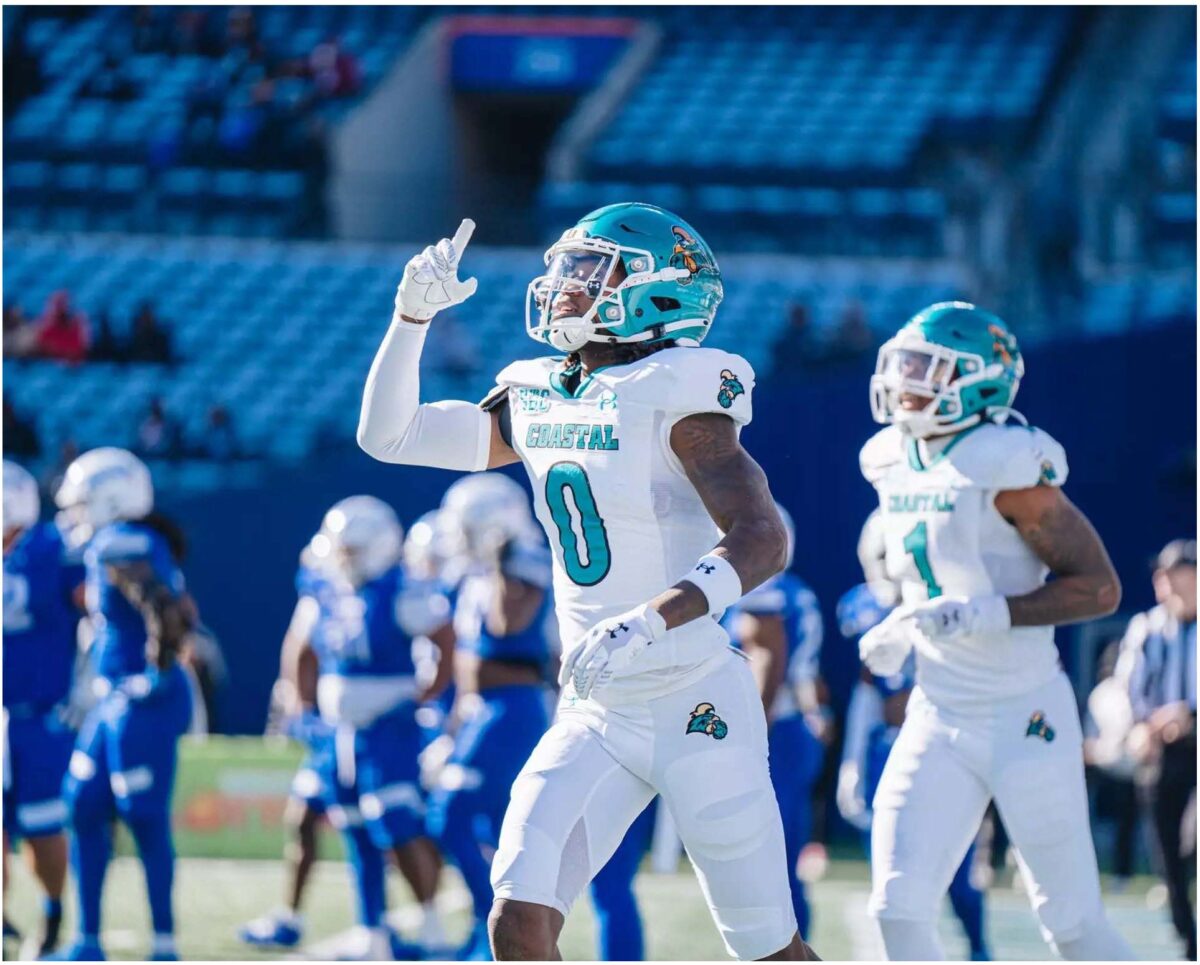
Coastal Carolina Fans Wanted Chadwell 2.0. They Got Tim Beck With A Defensive Coat Of Paint

This is not a home run. It’s a lateral move with a defensive coat of paint.

Coastal Carolina just replaced Tim Beck with Missouri State’s Ryan Beard, a 36-year-old defensive-minded coach who led his program to a 7-6 season in his second year at the FBS level. The move signals a clear philosophical shift: out with Beck’s offensive, QB-guru identity, in with a physical, havoc-creating defensive approach. Whether that recalibration leads to Sun Belt titles or just a different flavor of mediocrity remains the open question.

Here’s what we know about Beard’s résumé:

  • 14-11 overall as an FBS head coach (two seasons at Missouri State)
  • 7-5 in 2025
  • Got blown out 73-13 by his one ranked opponent (USC)
  • Lost his final three games of the season
  • Defenses at Missouri State set school records for sacks and produced back-to-back FCS playoff appearances before the FBS jump

That’s a mixed bag. Not a disaster. Not a clear upgrade either.

The Tim Beck Context

Beck wasn’t a catastrophe. He was a plateau.

Coastal went 6-6 in each of his final two seasons – bowl-eligible, but a far cry from the 31-6 run under Jamey Chadwell from 2020-22. The program didn’t collapse. It just stopped climbing. Late-season fades (.385 winning percentage down the stretch), and a 0-2 record against ranked opponents told the story of a team that couldn’t punch above its weight.

That’s why Beck is gone. Coastal’s investment level: enhanced salaries, an indoor facility, sustained bowl expectations, means 6-6 now gets you fired.

The FBS Comparison

On paper, Beard’s numbers are nearly identical to Beck’s. And the red flags are similar too.

MetricTim Beck (Coastal)Ryan Beard (Missouri State)
Overall Record20-18 (.526)14-11 (.560)
Home Record13-12 (.520)10-5 (.667)
Away Record6-6 (.500)4-5 (.444)
vs. Ranked0-20-1
Bowl Games1-10-0
Late-Season FadeYes (.385)Yes (lost final 3)

Beard is slightly better at home. Slightly worse on the road. Winless against ranked opponents. Winless in bowl games. And just like Beck, his teams collapse down the stretch.

This isn’t a clear upgrade. It’s a profile swap with the same underlying problems.

The Verdict

This hire makes sense in the process. Beard has shown he can manage roster building through structural change; FCS-to-FBS maps directly onto Sun Belt reality in the portal and NIL era. His defensive identity gives Coastal a clear schematic north star it lacked under Beck. And at 36, he’s young enough for a multi-cycle build if it works.

But the warning signs are hard to ignore.

Beard has never won double-digit games as a head coach. His one shot against a ranked opponent ended 73-13. And his teams fade late, the same problem that got Beck fired.

Coastal fans expecting Chadwell 2.0 should pump the brakes.

This is a medium-risk hire with a floor that looks a lot like what they just had. The Chanticleers are betting on defensive identity and culture over proven results. The trajectory could bend upward. But the evidence so far says this is a lateral move dressed up as a fresh start.

No related posts found.
VISIT OUR SHOP [COMING SOON]

LOAD MORE BLOG ARTICLES

Reader Sean Mullen says I Owe Ricky Rahne A Public Apology. So I Wrote One. He’s Not Going To Like How It Ends.

Reader Sean Mullen sent me this message last week:

“Congratulations Mark on being completely wrong about Ricky Rahne at Old Dominion. Are you gonna do the right thing now and follow up and state publicly you were wrong?”

Fair enough.

In August, I predicted Rahne would be fired by November. Instead, ODU went 10-3, beat Virginia Tech on the road, won the Cure Bowl, and Rahne signed a 4-year extension.

I was wrong about 2025. Completely, unambiguously wrong.

But here’s the thing.

Sean’s victory lap proves exactly why some fans misunderstand how coaching evaluation works.


The Number Everyone Wants to Ignore

Ricky Rahne’s career record at Old Dominion: 30-33.

That’s a .476 winning percentage across five seasons on the field. Still below .500. Still losing more games than he wins over the full sample.

Before 2025, he was 20-30. He was 0-2 in bowl games. Three of his first four seasons were losing seasons.

One 10-win year doesn’t erase that. It changes the trajectory. It doesn’t rewrite history.

This is the part where someone says: “But Mark, he just won 10 games! The program is clearly headed in the right direction!”

Maybe. Probably, even.

But that’s not what Sean argued.


The Argument That Defeats Itself

Sean didn’t say “Rahne has turned a corner.”

He said I was wrong to ever question Rahne in the first place. That I “slung stupid crap without doing any research.

The research was the problem.

Four years of data showed a coach who consistently lost close games, couldn’t win bowls, and failed to elevate ODU’s national profile. The 2025 prediction was based on roster losses, a brutal early schedule, and a pattern of fourth-quarter collapses.

The prediction was wrong. The pattern was real.

Virginia Tech and Indiana were supposed to expose ODU’s weaknesses. Instead, ODU beat Virginia Tech 45-26 and hung tough with the #1 team in America before losing. The roster losses that looked catastrophic on paper didn’t play out that way on the field.

That’s coaching. That’s development. That’s Rahne doing his job better than the data suggested he would.

Credit where it’s due.


But Here’s What Sean Missed

One year of evidence doesn’t invalidate four years of evidence.

It adds to it.

Rahne’s career now tells a more complete story: A coach who struggled to close games for four years, then figured something out in year five. A coach who went 0-2 in bowls, then won one. A coach who was below .500, and still is, but trending upward.

That’s a legitimate narrative. That’s a coach earning the benefit of the doubt.

What it’s not?

Proof that anyone who questioned him was “slinging stupid crap.”


The Real Problem With CFB Fandom in 2025

Here’s what drives me crazy about college football discourse:

The most recent season is the only season that matters.

Coach goes 10-3 after four losing seasons? He was always good, and anyone who questioned him was an idiot.

Coach goes 6-6 after three 10-win seasons? He’s washed, fire him immediately.

This is how you end up with coaching carousels that cost programs $50 million in buyouts. This is how you end up firing guys after one bad year and hiring guys after one good year.

One season is a data point. Five seasons is a sample.

Rahne now has a sample that says: below .500 overall, but improving. One bowl win after two bowl losses. A program trending up after years of stagnation.

That’s worth watching. That’s worth acknowledging.

It’s not worth rewriting history.


The Prediction I’ll Make Now

Ricky Rahne has earned his extension.

The 2025 season was legitimately impressive. Beating Virginia Tech. Beating a favored South Florida team in the bowl game. Winning 10 games with a backup quarterback in the biggest moments.

If he builds on this, the 20-30 start becomes a footnote in a successful tenure. He’ll have proven that the first four years were about building something that finally clicked.

But if ODU regresses in 2026? If they go 5-7 again?

The same people celebrating today will be calling for his head tomorrow.

Because that’s how this works now.

One year at a time. No memory. No sample size. Just whatever happened last Saturday.


The Bottom Line

I was wrong about Ricky Rahne in 2025.

The prediction said he’d be fired by November. Instead, he signed an extension and won a bowl game.

That’s the business. You make predictions based on available data. Sometimes the data misleads you. Sometimes coaches figure things out.

But Sean demanding I apologize for “slinging stupid crap”?

He’s doing the exact thing that makes coaching evaluation impossible: treating one season as the entire story.

Rahne is 30-33. He was 20-30 before this year. The pressure was real. The questions were legitimate .

2025 was a great answer.

It wasn’t the only answer that mattered.

What the Original Prediction Got Right (and Wrong)

Go back and read the August piece. Here’s what I said would happen:

“Indiana and Virginia Tech expose the inexperienced skill players. The secondary gives up multiple explosive plays.”

Indiana won. They’re now in the College Football Playoff. That part tracked.

Virginia Tech? ODU won 45-26. Not even close. Complete miss.

“The roster talent is evaporating. They’re replacing 2,229 yards of offense with players who produced 292 yards.”

The numbers were accurate. The conclusion was wrong. Rahne developed the replacements better than anyone expected. Devin Roche went from 274 yards to a 100-yard bowl game. Quinn Henicle went from backup to Cure Bowl MVP.

That’s coaching. That’s the part I didn’t account for.

“By Halloween, Ricky Rahne will be at the top of every coaching hot seat ranking in America.”

By Halloween, ODU was 7-3 and rolling toward a bowl bid.

Swing and a miss.

Here’s what I’ll stand by: The questions were legitimate. A 20-30 coach with an 0-2 bowl record and a pattern of close losses deserved scrutiny. The pressure was real.

Rahne answered it. That’s the story.

The prediction was wrong. The process wasn’t.

No related posts found.

LOAD MORE BLOG ARTICLES

Iowa State Hired Jimmy Rogers 72 Hours After Losing Matt Campbell. Now He Has to Replace a Legend With One Year of FBS Experience”

Iowa State moved fast.

Matt Campbell took the Penn State job, and within days, the Cyclones had their guy. Jimmy Rogers, fresh off a 6-6 debut season at Washington State, now inherits a program that made the Big 12 Championship Game and became a legitimate conference contender under Campbell. The question everyone in Ames is asking: Can a 38-year-old coach with one FBS season under his belt sustain what Campbell built?

Here’s our breakdown.

The Resume

Rogers has won everywhere he’s been.

At South Dakota State, he went 27-3 over two seasons, capturing an FCS national championship in 2023 and reaching the semifinals in 2024. His overall head-coaching record is 33-9. That’s a .786 winning percentage, the kind of number that gets attention from Power Four athletic directors scanning the FCS ranks for the next big thing.

But there’s a caveat.

His lone FBS season produced a 6-6 record at Washington State, a program navigating life as a Pac-2 orphan with legitimate roster and scheduling challenges. Rogers rebuilt that roster with Jackrabbit transfers and freshmen, secured bowl eligibility with a late-season win over Oregon State, and showed an ability to self-correct when early offensive struggles threatened to derail the season.

Not spectacular. But not a disaster either.

What He Does Well

Defense is his calling card.

Rogers built dominant defensive units at South Dakota State, and that reputation followed him to Pullman. He understands how to scheme, develop players within a system, and create an identity on that side of the ball. For a Big 12 that has become increasingly offense-heavy, a defense-first coach could provide an interesting counterbalance.

Key strengths:

  • Defensive scheme expertise and player development
  • Deep Midwest recruiting ties and familiarity with Big 12 culture
  • Youth and energy (38 years old) for a program needing momentum
  • Demonstrated ability to adjust mid-season when things aren’t working

The Concerns

One year of FBS experience is a legitimate worry.

The jump from FCS to FBS is significant. The jump from FBS to Power Four is another leap entirely. Rogers now faces higher-level competition, greater media scrutiny, bigger recruiting battles, and the weight of following a coach who transformed Iowa State from a doormat into a contender. That’s a lot of pressure for someone still learning the FBS landscape.

Risk factors:

  • Limited Power Four head coaching experience
  • Iowa State’s financial resources lag behind Big 12 peers
  • Transfer portal management becomes critical with expected roster attrition
  • Following a legend creates unrealistic short-term expectations

The Washington State Tape

His 2025 season in Pullman tells us something important.

Rogers can keep a program afloat in adverse conditions. Washington State was a mess when he arrived: roster turnover, scheduling chaos, conference uncertainty. He didn’t elevate them to contender status, but he didn’t let the program crater either. Early offensive struggles (conservative run emphasis, quarterback questions, talent mismatches) were eventually addressed through real-time adjustments.

That adaptability matters at Iowa State.

The Breakdown

Here’s how Rogers stacks up across key categories:

CATEGORYSTRENGTHSCONCERNS
Record33-9 overall, FCS national championOnly 6-6 at FBS level
DefenseHighly regarded scheme and developmentMust adapt to Big 12 offenses
ExperienceMidwest familiarity, strong recruiting networkLimited Power Four head coaching
Program FitYouthful energy, cultural alignmentSucceeding a legend, portal challenges

The Bottom Line

This hire grades out as a B-minus.

Iowa State moved quickly to secure a coach with a proven ability to win at every stop. Rogers brings defensive credibility, Midwest roots, and the energy of a young coach on the rise. But he’s stepping into one of the toughest situations in college football, replacing a beloved coach, managing portal attrition, and competing with limited resources in an increasingly arms-race conference.

What to watch:

  • Can he retain enough talent through the portal to remain competitive in Year 1?
  • Will his defensive identity translate against Big 12 offensive firepower?
  • How patient will the Iowa State administration and fanbase be?

Year 1 will likely be stabilization mode, defense-first, mid-tier results, and a lot of learning. The real test comes in Years 2 and 3, when we’ll see if Rogers can recruit at the Power Four level and build something sustainable.

The pressure is real. But so is the opportunity.

No related posts found.

LOAD MORE BLOG ARTICLES

Penn State Fired A Coach Who Won 104 Games Because He Couldn’t Beat Elite Teams. Matt Campbell’s Record Says He Might Solve That Problem.

Penn State didn’t hire Matt Campbell.

They settled for him.

After 54 days of chaos (Pat Kraft whiffing on Matt Rhule, Mike Elko, Kalen DeBoer, and watching Kalani Sitake use Happy Valley as leverage for a BYU extension), the Nittany Lions landed on a coach who was never Plan A. The search that began with dreams of “championship-level” coaching ended with a guy whose ceiling is an open question. And yet, this might be exactly what Penn State needs.

Here’s the uncomfortable truth:

Campbell is a better fit than the process suggests.


The Search Was a Disaster. The Outcome Wasn’t.

Let’s be clear about what happened.

Penn State fired James Franklin on October 12 after a 3-3 start, expecting to land a splash hire before the early signing period. Instead, Kraft conducted the longest Power 4 coaching search of the cycle. By National Signing Day, Penn State had signed exactly two recruits, ranking 134th nationally, while Franklin raided their class from Blacksburg. Former players called it “an unmitigated disaster.” Josh Pate said the search “feels lost.” Landon Tengwall called it “about as big a disaster as you could possibly imagine.”

All of that is true.

But none of it changes what Campbell actually brings.


The Franklin Comparison Everyone’s Making (And Getting Wrong)

The lazy take is that Penn State replaced Franklin with Franklin.

Both coaches hover around .600 win percentage. Both struggle against ranked opponents. Both have conference title game appearances but no championships. On paper, it looks like a lateral move. But that framing ignores context, and context is everything.

Here’s what the numbers actually say:

Campbell vs. Top 10 teams at Iowa State: 4-6 (40%)

Franklin vs. Top 10 teams at Penn State: 4-21 (16%)

Campbell won the same number of Top 10 games in 10 years at Iowa State as Franklin won in 11 years at Penn State. The difference? Campbell did it with the 68th-ranked roster in the talent composite. Franklin had top-10 recruiting classes almost every year.

That’s not the same coach.

That’s a coach who maximizes what he has, versus one who underperforms with what he’s given.


What Campbell Does Well

Campbell’s reputation isn’t built on schemes or slogans.

It’s built on development.

Before Campbell arrived in Ames, Iowa State hadn’t had a player drafted since 2014. Since then, he’s produced 15 NFL Draft picks, including Breece Hall, Brock Purdy, David Montgomery, and Will McDonald IV. He took a program that went 8-28 in the three years before he arrived and delivered eight winning seasons in ten years, two Big 12 title game appearances, and the program’s first-ever 11-win season in 2024.

His philosophy is simple: “Love, care, serve our players.”

That sounds soft until you realize his teams are consistently among the most physical in their conference. Campbell’s offensive identity is built on protecting the quarterback, running the ball downhill, and winning in the trenches. His defensive coordinator, Jon Heacock (who’s following him to Penn State), pioneered the 3-3-5 “three-high safety” scheme that’s been copied across college football. Iowa State ranked in the Big 12’s top three in scoring defense seven of the last eight years.

This isn’t a finesse operation.

It’s blue-collar football with a developmental edge.


The Staff Tells You Everything

Within days of being hired, Campbell made his philosophy clear.

He’s not here to manage someone else’s vision.

He let Jim Knowles walk to Tennessee, the highest-paid assistant in college football, fresh off a national title at Ohio State. He’s bringing his own people: Taylor Mouser as offensive coordinator, Jon Heacock on defense, Ryan Clanton on the offensive line, and Deon Broomfield in the secondary. Nine of his first ten hires came from Iowa State.

The only holdover? Terry Smith.

That’s significant. Smith was the interim coach who went 3-3 after Franklin’s firing. Players held up “HIRE TERRY SMITH” signs on the sideline. Keeping him signals continuity with the locker room while installing an entirely new system everywhere else.

Campbell isn’t blending philosophies.

He’s doing a full operating system replacement.


The Real Question: Can He Win the Games That Matter?

This is where skepticism is fair.

Campbell has never sustained a multi-year Top 10 operation. He’s 0-2 in conference championship games, losing to Oklahoma in 2020 and Arizona State in 2024. His teams have a habit of playing up to elite competition, only to fall short at the finish line. The 2020 Big 12 title game saw Iowa State fall behind 17-0 before mounting a comeback that came up short. The 2024 title game against Arizona State wasn’t close.

Sound familiar?

That’s the exact problem that got Franklin fired.

Penn State’s issue was never the floor. Franklin won 104 games in 11 seasons. The issue was the ceiling, specifically, a 4-21 record against Top 10 teams and a 2-21 record against Top 6 teams. The program that once competed for national titles under Joe Paterno has become a consistent “almost” program. Good enough to get ranked. Not good enough to break through.

Campbell’s track record doesn’t definitively answer whether he can fix that.

But the circumstances are different.


The Resource Upgrade Is Massive

Iowa State was a resource knife fight.

Campbell recruited against Oklahoma and Texas with a fraction of their budget, no blue-chip recruiting geography, and a fan base that had never seen sustained success. He turned Jack Trice Stadium into one of the toughest venues in the Big 12, but he was always swimming upstream.

Penn State is a different animal.

The Nittany Lions are committing $30 million in NIL money and $17 million in staff salary pool—among the highest commitments in the country. Campbell’s contract is $70.5 million guaranteed over eight years, with automatic extensions for playoff appearances. Beaver Stadium is undergoing a $700 million renovation. The recruiting geography includes Pennsylvania, New Jersey, Ohio, and the DMV corridor.

Campbell has never had these resources.

The bet is that a coach who went 72-55 at Iowa State, with five eight-win seasons and the program’s only 11-win campaign, can do significantly more when he’s not outgunned on every front.


What Nick Saban Got Right (And Wrong)

Saban weighed in on the hire, calling Campbell “a great coach who’s proven on a consistent basis.”

Then he issued a warning.

“These places that have, to me, a little bit of unrealistic expectations that we’re going to win the national championship… to make that sort of the goal – we gotta win the championship or we’re gonna get rid of the coach – to me is totally wrong. They’ll have a hard time doing it if that’s the approach that they take.”

Saban’s point is valid: championship-or-bust thinking creates instability. Penn State hasn’t won a national title since 1986. They’ve made one playoff appearance ever. Demanding immediate championships from Campbell is unrealistic.

But Saban’s framing also misses something.

Penn State didn’t fire Franklin because he wasn’t winning championships. They fired him because he went 4-21 against Top 10 teams with top-10 recruiting classes. The standard isn’t “win it all.” The standard is “don’t collapse against elite competition every single time.”

That’s a different bar.

And Campbell has a better track record of clearing it.


The Pressure Meter

Current Hot Seat Temperature: COLD

Campbell gets a honeymoon period. Penn State’s 2026 roster is inexperienced after the recruiting disaster, and expectations should be modest for Year 1. The $70.5 million guaranteed contract gives him runway. The administration is invested in patience after the Kraft search debacle embarrassed the university.

What Would Heat Things Up:

  • Losing to teams Penn State shouldn’t lose to (see: Franklin’s Northwestern loss)
  • Failing to establish a recruiting foothold in Pennsylvania
  • Another collapse against Ohio State/Oregon tier opponents in Years 2-3
  • Portal mismanagement or roster instability

What Keeps Him Safe:

  • 9-win floors with competitive losses to elite teams
  • Development of homegrown talent and smart portal additions
  • Playoff appearance by Year 3-4
  • Beating a Top 10 team at least once per season

Campbell isn’t on the hot seat.

But the leash is shorter than his contract suggests, because the last coach proved you can win 104 games and still get fired for not winning the right ones.


The Bottom Line

Matt Campbell is a floor hire, not a ceiling hire.

He stabilizes the program. He installs a coherent identity. He develops players. He builds culture. He doesn’t embarrass the university with off-field chaos. He gives Penn State a high floor of 8-9 wins with an occasional 10-win season.

Is that enough?

It depends on what Penn State actually wants.

If the goal is “be consistently good and occasionally great,” Campbell is an A hire. If the goal is “become Ohio State,” the jury is still out. Campbell has never built a dynasty. He’s never recruited at a top-5 national level. He’s never won a conference championship.

But he’s also never had the resources to try.

Penn State is betting that the coach who overachieved at Iowa State can break through when he’s finally playing with a full deck. It’s a reasonable bet, probably the most sensible option available after the search went sideways.

The question now is simple:

Can Matt Campbell win the games James Franklin couldn’t?

We’re about to find out.


What do you think of the Campbell hire? Send me an email and let me know. mark@coacheshotseat.com

No related posts found.

LOAD MORE BLOG ARTICLES

Auburn Hired Alex Golesh For $42 Million. Here’s Why His 23-15 Record At USF Either Makes Him A Genius Bet Or Buyout #6

Auburn just bet $42 million on an unproven offensive coordinator turned three-year Group of Five head coach.

The Tigers fired Hugh Freeze after five straight losing seasons. They handed the keys to Alex Golesh, a 39-year-old who went 23-15 at South Florida, has never coached a Power Four game as a head coach, and is now expected to compete weekly against Nick Saban disciples, Kirby Smart, and Lane Kiffin in the SEC. This is either the smartest process-driven hire Auburn has made in a decade, or another $15 million buyout waiting to happen in 2027.

Here’s what the data actually says about this hire.

The Résumé: Modest Numbers, Clear Trajectory

Golesh’s three-year record at USF tells two different stories depending on how you read it.

The raw numbers are underwhelming. His overall record sits at 23-15 with a 0.605 win percentage. His first two seasons produced identical 7-6 records that barely cleared the bowl-eligibility threshold. His home record (16-10) is solid but unspectacular; his away record (5-4) is merely competent; and his performance against ranked opponents (2-4) suggests he struggled against elite competition.

But the trajectory is what caught Auburn’s attention.

2023 SRS: -4.92 (below average)
2024 SRS: -2.55 (still below average)
2025 SRS: 12.54 (top-25 caliber)

That’s a 17.46-point improvement in the Simple Rating System over three years, one of the steepest climbs in college football during that span.

His 2025 season at USF was legitimately impressive. The Bulls went 9-3 with wins over Boise State and at Florida, climbed as high as 18th in the AP poll, and fielded an offense that ranked 2nd nationally in total offense (501.7 yards per game) and 4th in scoring (43.0 points per game). Quarterback Byrum Brown posted 3,158 passing yards and 1,008 rushing yards in the dual-threat role that has become Golesh’s offensive signature.

The problem?

That’s one season of elite performance against a schedule with a -0.88 strength of schedule rating.

What Auburn Needed vs What Auburn Got

Auburn’s offensive issues have been catastrophic for the past 6 years.

The Tigers have cycled through three different head coaches and multiple offensive coordinators without ever establishing a consistent offensive identity or developing a competent quarterback. Gus Malzahn’s final seasons became stagnant and predictable. Bryan Harsin brought complete dysfunction and zero recruiting momentum. Hugh Freeze delivered high-variance chaos, producing explosive moments but no sustainable success.

Golesh brings a clear offensive philosophy.

He helped build the tempo-based spread attacks at UCF and Tennessee that finished top-10 nationally in both scoring and total offense. At Tennessee, his offense set multiple school records. At USF, he developed Byrum Brown into one of the nation’s most dynamic dual-threat quarterbacks.

If you’re hiring for scheme and QB development, this makes perfect sense.

But if you’re hiring for proven SEC-level program management, this is a massive projection. Golesh has never recruited against Georgia and Alabama. He has never navigated the weekly defensive fronts that have defined the SEC for the last 20 years. He has never managed a roster with the depth and complexity required to survive a 12-game SEC gauntlet.

Auburn needed both offensive innovation and proven Power Four leadership.

They got the first part in spades.

The second part is purely aspirational.

The Risk: Power Four Proof Points Don’t Exist

This is where the pressure intensifies immediately.

Golesh has never been a head coach in a Power Four conference. His entire head coaching résumé consists of three years in the American Athletic Conference against schedules with an average strength of -3.09. His record against ranked opponents is 2-4, and those four losses came by an average margin of 18.5 points.

His biggest wins?

  • Home against Boise State
  • On the road at a 5-7 Florida team that fired Billy Napier mid-season

That’s not a knock on Golesh.

It’s just the reality that Auburn is asking him to make the largest jump any coach can make in college football: from three years of Group of Five success to immediately competing in the SEC where your margin for error is zero, and your schedule features six teams that could beat you by 30 if you’re not prepared.

The SEC has become a league where even veteran Power Four head coaches get fired after 18 months.

Auburn is betting that Golesh’s offensive acumen and program-building track record will translate immediately to a level he’s never experienced.

The Auburn Context: $70 Million in Buyouts Says This Better Work

Here’s what makes this hire especially high-pressure.

Auburn has spent approximately $60-70 million in head coaching buyouts since 2000, more than any program in college football.

The last three firings alone totaled roughly $52 million:

  • Gus Malzahn: $21.5 million
  • Bryan Harsin: $15.3 million
  • Hugh Freeze: $15.8 million

That’s generational wealth burned on coaches who didn’t work out, and now Auburn is paying $7+ million annually for a coach whose entire head coaching résumé would fit comfortably in the “Group of Five” section of any coaching database.

If you’re going to normalize eight-figure buyouts, the expectation is that you shop at the top shelf.

Established head coaches with multiple high-level seasons. Proven Power Four success. Résumés that justify the risk.

Instead, Auburn has now cycled through four completely different archetypes in 12 years:

  • A proven winner they fired too early (Malzahn)
  • An unproven outsider with zero recruiting ties (Harsin)
  • A baggage-laden reclamation project (Freeze)
  • A rising G5 schemer with offensive chops (Golesh)

That’s no coherent long-term hiring philosophy.

And the financial cost of that indecision is staggering.

Process Grade: Actually Better Than It Looks

Despite the risk, this hire scores well on process.

Athletic Director John Cohen made a coherent, data-driven choice instead of recycling a fired SEC name or chasing a splashy retread. He targeted a sitting head coach with proven rebuild capability (4-29 to 23-15 in three years), elite offensive credentials (top-5 nationally in 2025), modern QB development track record, and upward trajectory in his most recent season.

Cohen also retained DJ Durkin to maintain defensive continuity.

Durkin served as interim after Freeze and was in the mix for the full-time job. Keeping him on staff prevents a complete roster exodus during the transition and provides institutional knowledge that Golesh will desperately need during Year 1.

From a process standpoint, this is how you make a high-upside bet:

  1. Identify the deficiency (offense)
  2. Hire for the specific skill set needed (elite offensive coordinator turned successful G5 head coach)
  3. Structure the transition to minimize chaos (retain key staff, maintain recruiting relationships)

The problem is that “process” doesn’t guarantee results.

And Auburn’s margin for error with this hire is essentially zero.

The Verdict: High-Upside Bet With Existential Risk

If we’re grading this hire strictly on data and trajectory, here’s what the numbers say.

Process: B+ / A-

Auburn targeted a need and hired for scheme fit rather than recycling a known commodity. Cohen identified offensive dysfunction as the core problem and hired an elite offensive mind to fix it. The retention of Durkin shows strategic thinking about transition management.

Scheme Fit: A-

Golesh’s offensive identity directly addresses Auburn’s biggest weakness over the last six years. His track record of developing dual-threat quarterbacks and fielding top-10 offenses is exactly what Auburn needed after half a decade of offensive mediocrity.

Risk: High

No Power Four head coaching experience. Limited proof against elite competition. Stepping into a job where three straight coaches have been fired inside five years. The cultural and competitive jump from the American to the SEC is enormous, and Golesh has zero margin for error.

Ceiling: Top-15 program if the system scales

If Golesh’s tempo-based attack and QB development translate to the SEC, Auburn could legitimately compete for 9-10 wins annually within 2-3 years. The offensive system is proven at elite levels (UCF, Tennessee). The recruiting footprint favors Auburn. The resources are there to support sustained success.

Floor: Another expensive mistake

If the scheme doesn’t hold up against SEC defensive depth, the recruiting doesn’t scale, or the cultural pressure becomes overwhelming, this becomes buyout #6 in Auburn’s ongoing coaching experiment. The 23-15 record provides zero cushion for early struggles, and Auburn boosters have demonstrated they will not wait patiently for long-term development.

The data says this hire has real upside.

The 12.54 SRS in 2025 and the elite offensive profile suggest legitimate top-25 potential. But the question isn’t whether Golesh can succeed in theory.

The question is whether Auburn has the patience to let that upside develop.

The Pressure Timeline: Year 2 Is Make-or-Break

Auburn fans and boosters won’t wait long.

Year 1 (2025): 5-7 or 6-6 is acceptable as a “transition year”

The bar is low in Year 1 if the offense shows clear improvement and recruiting stays competitive. Auburn can sell the rebuild narrative for one season, especially if the offensive system produces explosive plays and Golesh identifies a long-term quarterback solution.

Year 2 (2026): 7-5 minimum, with at least one marquee win

This is where the expectations escalate dramatically. Auburn will need to see signs that the offensive system is scaling against SEC defenses. A marquee win over a ranked opponent becomes non-negotiable. Recruiting classes must stay in the top-20 nationally.

Anything less and the heat becomes unbearable.

Year 3 (2027): 8-4 or better, with a path to 9-3 if everything breaks right

This is the “prove it” year: either Auburn commits long-term or starts the buyout conversation. Golesh needs to show he can win consistently in the SEC, develop SEC-caliber players, and compete with the conference’s elite programs.

This is when the hire either validates the process or becomes another cautionary tale.

Golesh is walking into one of the three or four highest-pressure jobs in college football.

His margin for error is smaller than that of any first-time Power Four coach in recent memory.

Final Analysis

If you’re grading this hire for Coaches Hot Seat purposes, it’s a B/B+ on process and fit, but it carries existential risk because of Auburn’s history and the SEC’s unforgiving nature.

The upside is real.

The risk is massive.

And the pressure starts immediately.

No related posts found.

LOAD MORE BLOG ARTICLES

Bob Chesney Is a Great Coach. UCLA’s Leadership Might Destroy Him Anyway

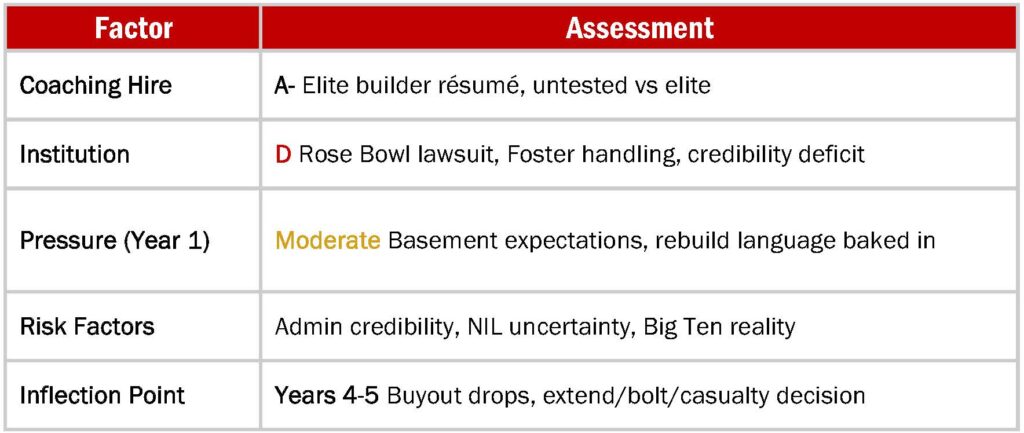
UCLA made a strong coaching hire inside a broken institutional structure.

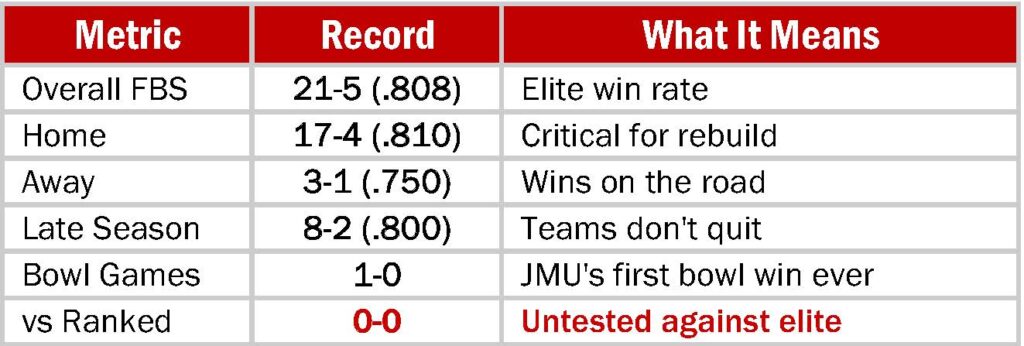
Bob Chesney brings an elite program-building résumé to Westwood. He’s 131-51 overall (.720) across four levels of college football. He rebuilt every program he touched. And at James Madison, he went 21-5 in two years, won the Sun Belt, earned the program’s first bowl victory ever, and landed a CFP berth as the #12 seed.

The question isn’t whether Chesney can coach. It’s whether UCLA’s leadership can stop sabotaging its own program long enough for him to build something.

The Numbers Don’t Lie

Here’s what Chesney accomplished at the FBS level in just two seasons:

The year-over-year progression tells the real story.

  • 2024: 9-4, SRS 2.32, Boca Raton Bowl win
  • 2025: 12-1, SRS 11.43, Sun Belt champion, CFP #12 seed

The SRS jump from 2.32 to 11.43 in one year? That’s program building, not inherited talent coasting.

Here’s The Concern

Zero games against ranked FBS opponents.

Schedule strength of -6.45 in 2024 and -4.03 in 2025. At UCLA in the Big Ten, he walks into a conference with Ohio State, Oregon, Penn State, Michigan, and USC on the schedule. That’s a different universe than the Sun Belt.

His profile is “elite builder against inferior competition, untested against elite competition.” His UCLA tenure will answer that open question.

The Institutional Reality

UCLA’s leadership has earned distrust, not the benefit of the doubt.

This isn’t speculation. It’s documented. The LA Times’ Ben Bolch (in his 10th season covering UCLA football) wrote in October 2025 that athletic director Martin Jarmond approached him mid-game during a blowout win at Michigan State to take credit for the team’s turnaround. Then Jarmond tried to retroactively claim his comments were “off the record” after making them in public, in front of other reporters.

Bolch’s assessment: “He’ll take credit for the cleanup, even if he helped create the spill.”

The evidence falls into four categories.

1. The Foster Sequence

This is textbook AD malpractice.

Jarmond failed to fire Chip Kelly when it was clear to even casual fans that the move was overdue. His stated reason? “Continuity and stability” for a program entering the Big Ten. Then Kelly left for Ohio State in February 2024, and Jarmond appeared surprised, even though Kelly’s job shopping had been widely reported.

What followed was worse.

The timeline:

  • Kelly’s departure forced a search after the coaching carousel had stopped
  • Jarmond self-imposed a needless 96-hour deadline
  • Pivoted to DeShaun Foster, a beloved RB coach who wasn’t on anyone’s list for an OC job, much less a head coaching position
  • Foster was fired after just 15 games and an 0-3 start
  • UCLA ate a $6-8M buyout

Then came the narrative shift.

On the day he dismissed Foster, Jarmond changed his story on the Kelly situation. His new line: “Many stakeholders and factors” go into a coaching change. He also acknowledged regrets about putting Foster in a situation “for which he was clearly not qualified.”

Read that again: the AD admitted he set his own head coach up to fail.

2. The Selective Appearance Pattern

Jarmond shows up for wins. He disappears for losses.

Per Bolch’s reporting, Jarmond doesn’t make a habit of attending postgame media sessions in high-profile sports unless it’s a big win or milestone victory. The pattern:

  • Nebraska win (2024): Jarmond was there, smiling as Foster proclaimed “he hired the right coach”
  • Penn State upset: Jarmond showed up in the locker room to hand Skipper the game ball
  • Michigan State blowout: Jarmond approached reporters mid-game to claim credit for the turnaround
  • UNLV loss: Nowhere to be found when Foster faced tough questions
  • New Mexico loss: Nowhere to be found
  • Athletics Hall of Fame dinner: Skipped it. Announced at the event that he had a “prior commitment.”

No leadership. Only credit-seeking.

3. The Rose Bowl Litigation

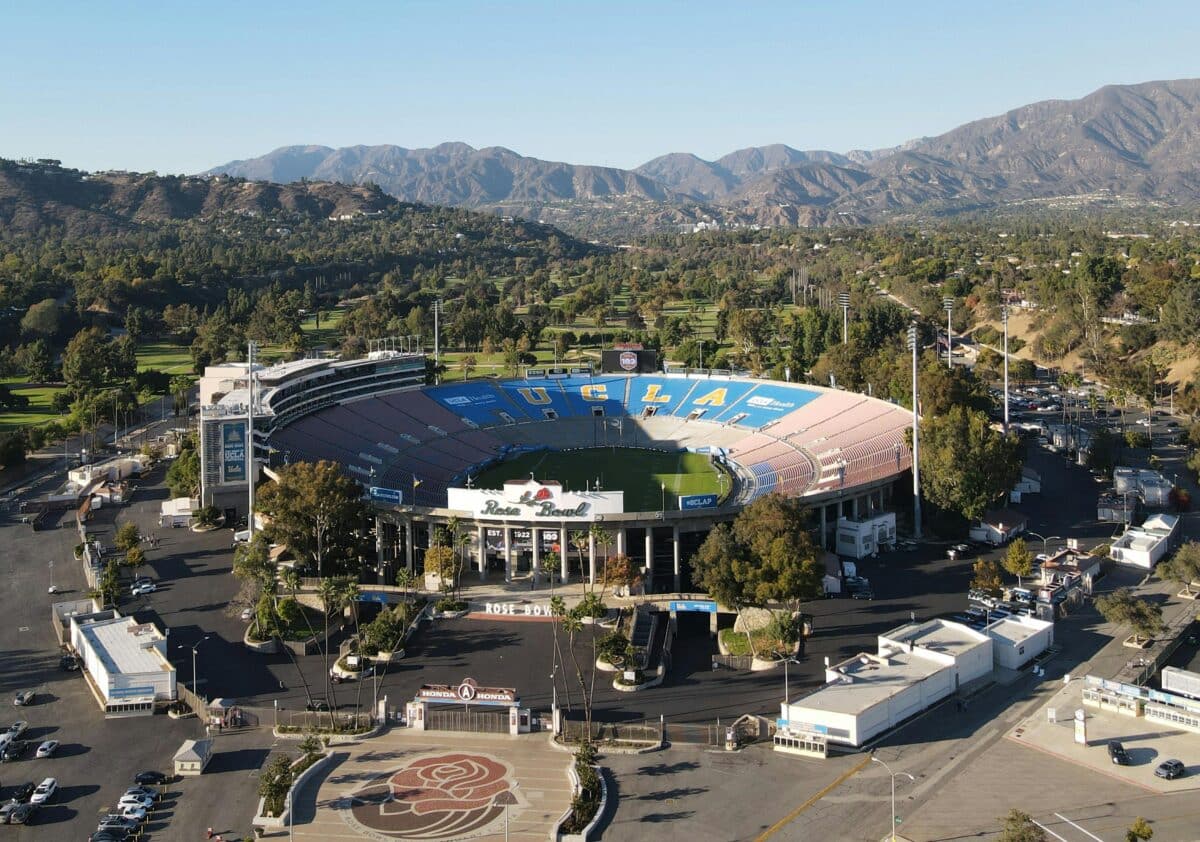
The City of Pasadena and the Rose Bowl Operating Company are taking UCLA to court for allegedly exploring a move to SoFi Stadium while under contract through 2044. The amended complaints claim UCLA “coordinated” with SoFi and Kroenke to breach lease obligations. They claim UCLA’s failure to commit to the Rose Bowl for 2026 has already caused harm.

When your own landlord and host city are suing you for breach of trust, “alignment” is just a press conference word.

4. The Departure Pattern

If a coach has leverage and alternatives, UCLA is usually what he tries to leave. Not where he’s dying to go.

  • Chip Kelly took a pay cut and a demotion to call plays for Ohio State rather than stay in Westwood.
  • DeShaun Foster was used as a cheap bridge hire and scapegoated once predictable problems materialized.
  • Jim Mora chose Colorado State over any return to UCLA, despite being the last coach to win 10 games there.

When coaches with options consistently run from your program, that’s structural. Not coincidental.

So, Why Did Chesney Take The Job?

Because the upside is enormous and the downside is manageable.

Strip away the press conference gloss and the logic looks like this: It’s his first crack at a true power-brand job in a Big Ten/SEC world where those chairs are finite. He’s 48, not 38. UCLA beat out at least one plausible Big Ten landing spot to get him, which tells you they outbid and out-promised others in ways that materially change his career arc.

The contract:

  • Five years, $33.75 million
  • $6.75M annually through 2030
  • Buyout starts around $2.5M before 2029, then drops

Here’s the real calculus:

If he wins, he’s a star who either retires at UCLA or parlays it into almost anything. If he fails, he still cashes the deal and remains hirable because people will blame UCLA’s dysfunction as much as him.

From his seat, that’s a rational gamble.

Bottom Line

Bob Chesney is a good coach in a structurally compromised place.

What he can control: Scheme. Culture. Development. Recruiting effort.

What he can’t control: Whether NIL infrastructure materializes. How the AD behaves when adversity hits. Rose Bowl lease politics. Whether the same leadership that mishandled Kelly and Foster suddenly becomes competent.

UCLA made a strong coaching hire.

But until Jarmond and Frenk demonstrate sustained follow-through rather than press conference promises, skepticism isn’t cynicism. It’s due diligence. As Ben Bolch wrote, Jarmond will take credit for the cleanup, even if he helped create the spill.

No related posts found.

LOAD MORE BLOG ARTICLES

Join Our Bowl Challenge

Our friends at the Targeting Winners podcast are in on the Capital One Bowl Mania challenge this year, and they’ve invited Coaches Hot Seat readers to join the group.

The setup: three contest modes (Standard, Spread, and Confidence). Go perfect in any of them and you could walk away with up to $1 million. Miss perfection? There’s still $20,000 grand prizes for each mode.

It’s free, it’s fun, and it gives us all something to argue about through bowl season.

No related posts found.

LOAD MORE BLOG ARTICLES