Jon Sumrall Has 3 Conference Titles And A 79.6% Win Rate. Here’s The Red Flag Buried In His Record That Could Doom Him In The SEC

The Bottom Line

Jon Sumrall is a clear upgrade in process and upside over Billy Napier.

But whether he’s a true results upgrade in the SEC will hinge almost entirely on staff hires and whether he can translate his Group of Five discipline-and-physicality pitch into a cleaner, more explosive product than Napier ever managed in Gainesville. On résumé and trajectory, you can justify calling this a good, even ambitious, hire for Florida. But it lands with risk and fan skepticism because it looks, on the surface, like “Napier 2.0” from another G5 power.

Let’s dig into the data.

Résumé vs. Résumé

The surface-level comparison writes itself: Florida just fired a coach who went 22-23 over four years after a dominant G5 run, and replaced him with a coach who went 43-11 over four years during a dominant G5 run. But dig one layer deeper and meaningful distinctions emerge.

Sumrall has already won three conference championships – two Sun Belt titles at Troy and an American Athletic Conference title at Tulane – with Tulane appearing in the AAC title game again in 2025. He’s made a conference championship game in every season as a head coach. Napier never won a conference title at Florida and finished 12-16 in SEC play, with one 8-5 season sandwiched between losing years and no serious division contention.

Head-to-Head Coaching Records
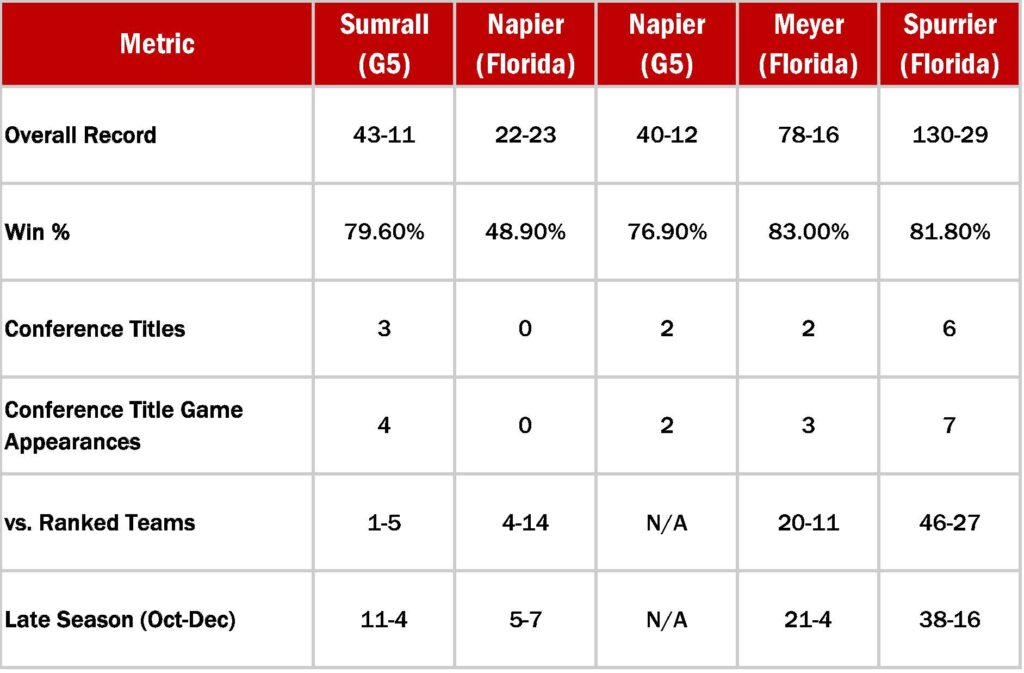
On raw head-coaching record, championship appearances, and consistency, Sumrall’s four-year run is substantially stronger than Napier’s four years in Gainesville – and matches or exceeds what Napier did at Louisiana before he jumped to the SEC.

The Efficiency Profile: SRS & SOS Analysis

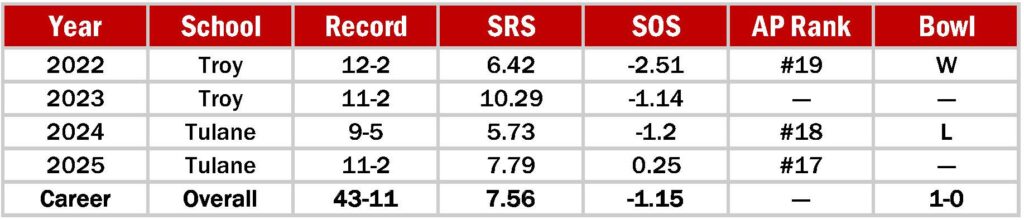
Simple Rating System (SRS) measures how many points better or worse a team is than average on a neutral field. Strength of Schedule (SOS) shows whether a team faced above-average or below-average competition. Together, they tell a clearer story than wins and losses alone.
What the Numbers Mean

Sumrall’s teams average an SRS of +7.56, while their SOS is -1.15. Translation: his programs consistently performed about a touchdown better than an average FBS team on a neutral field while playing slightly below-average schedules.

His best season by the metric was 2023 Troy at +10.29 SRS, with top-25-quality production on a clearly G5 schedule. His 2025 Tulane squad posted a +7.79 SRS against a +0.25 SOS, showing he can maintain strong efficiency even as the competition creeps toward truly average.

The Troy vs. Tulane split is telling. Troy under Sumrall averaged +8.36 SRS against a soft -1.82 SOS, the profile of a bully in a weak conference. Tulane under Sumrall averaged +6.76 SRS against a -0.48 SOS, reflecting a tougher AAC slate. Even there, 2025’s 11-2 with positive SOS suggests a team that would profile like a mid-tier SEC bowl squad.

The bottom line: Sumrall’s SRS/SOS profile says “very good G5 operator beating mostly average-or-worse schedules by real margins.” It’s a stronger and more consistent efficiency résumé than what Florida just fired. But nothing in that profile proves he can hit the +15 SRS territory you need to chase titles against an SEC-caliber schedule.

What the Film Says: A Defensive Identity with Pro-Style Offense

Film analysis by Max Browne, ESPN analyst and former USC/Pitt quarterback, who reviewed every Tulane sack, turnover, and touchdown pass from this season. [LINK]

Jon Sumrall played linebacker at Kentucky and has never held an offensive coaching position. His stops at San Diego, Tulane (as an assistant), Troy, Ole Miss, and Kentucky were all on defense. This matters because it defines his program’s DNA.

The Defensive Philosophy

Reviewing every sack and turnover from Tulane’s 2025 season reveals a consistent philosophy: trust your front four, don’t get cute.

Sumrall’s defenses aren’t exotic pressure teams. They rely on the defensive line to generate a pass rush through twist-and-stunt packages rather than bringing extra rushers from the secondary. When they do blitz, it’s typically a single linebacker from depth – rarely a safety or corner, and rarely multiple backers at once.

The results speak for themselves:

  • Both seasons at Troy: Top 10 nationally in scoring defense, allowing just 17.1 points per game
  • 2024 Tulane: 20.1 points per game allowed
  • 2025 Tulane: 22.8 points per game allowed
  • 2025 national rankings: 36th in sacks, 24th in turnovers

For Florida fans, there’s an upside and a downside to this approach. The upside: it’s not gimmicky or scheme-dependent—it’s about fundamentals and trusting your players to win their matchups. The downside: opposing quarterbacks won’t face exotic pressure packages that require extensive preparation. This is old-school, come-right-at-you defense.

The Offensive Identity

Sumrall’s offensive coordinator for the past four years has been Joe Craddock, who became the youngest OC in college football when SMU hired him in 2014 and later the youngest OC in the SEC at Arkansas. The Craddock-Sumrall partnership has produced a distinctive offensive identity.

Reviewing every touchdown pass from Darian Mensah (2024) and Jake Retzlaff (2025) reveals clear themes. This offense leans pro-style: under center, heavy play-action, attacking vertically with deep overs and posts. It’s a different family tree than Lane Kiffin’s Art Briles spread or Ben Arbuckle’s QB-run-heavy RPO system.

The signature concepts:

  • Play-action deep overs: Under center, big fake, receivers working across the field at depth
  • Vertical posts: Taking the top off the defense, especially with Retzlaff in 2025 (4-5 touchdowns on identical pistol-formation deep post concepts)
  • Tight end integration: Motions, flat routes, and seam threats creating coverage conflicts

Notably, this system shares DNA with what DJ Lagway ran at Florida last year, pro-style play-action with vertical concepts. That’s a potential recruiting pitch: “We’re not asking you to learn something completely different.”

There’s nothing in this offensive film that won’t translate to the SEC. But it requires talent, particularly speed on the perimeter and a quarterback who can make deep throws off play-action. Florida has historically recruited that speed. Whether Sumrall retains the quarterback to run it is another question.

Where the Upgrade Is Real

  • Higher ceiling and week-to-week consistency: Four straight league title game appearances, multiple championships, and a dominant late-season record (11-4 in October through December). Napier’s Florida teams faded down the stretch (5-7 late season).
  • Proven program flipper: Sumrall rapidly turned around two different programs (Troy and Tulane) rather than just sustaining one build. Napier’s Louisiana success was about maintaining what he inherited.
  • Philosophical clarity: In his introductory press conference, Sumrall explicitly said that “having an explosive offense isn’t optional, it’s mandatory” at Florida. That acknowledgment of program-specific expectations is something Napier never clearly articulated.
  • Reputation as a relationship builder: Analysts consistently describe Sumrall as someone who connects with players and gets the most out of his roster. His handling of the Tulane transition, promising not to poach players, earned praise for character and loyalty.

Where the Upgrade Is Fragile

  • No Power-2 head coaching experience: Like Napier, Sumrall has never run a Power-conference program. The question isn’t whether he can win, it’s whether his model scales to SEC resources, NIL battles, and overlapping expectations with Georgia and FSU.
  • Napier’s failure wasn’t just about his résumé: The Billy Napier experiment collapsed because of in-game management, special teams breakdowns, discipline issues, and confusion about offensive identity, not because he came from the Sun Belt. Sumrall’s margin to be an upgrade depends on avoiding those same organizational failures.
  • Soft schedule strength: Sumrall’s career SOS of -1.15 means he hasn’t lived in a top-10 schedule world where +7 or +8 SRS is table stakes just to finish 9-3. The SEC will be a different animal.
  • The optics problem: Florida ended up on Sumrall after publicly chasing Lane Kiffin. That “pivot after a miss” narrative is driving fan frustration and the “settled for another G5 guy” perception, regardless of Sumrall’s actual qualifications.
  • A persistent penalty problem: Sumrall’s 2025 Tulane squad ranks 113th nationally in penalties per game (7.2), the bottom quartile in FBS. That’s not a one-year blip; his teams have consistently ranked in the middle-to-bottom third in penalty discipline. Sloppy procedural penalties, late hits, and undisciplined play are survivable against G5 competition. Against SEC defenses and hostile road environments, those self-inflicted wounds become drive-killers and game-changers. If Sumrall can’t clean up the penalty margin, the physicality he sells will look more like undisciplined football than tough football.

The Verdict

Jon Sumrall represents a meaningful résumé upgrade over Billy Napier with a higher win percentage, more championships, better late-season performance, and demonstrated ability to flip multiple programs quickly.

But this is not a “home-run SEC proven commodity” hire. It’s a higher-upside reroll of the identical dice with a coach whose winning profile and multi-school turnarounds give Florida more justification than they had with Napier in 2021.

The defensive identity is sound and translatable. The offensive philosophy fits what Florida has run. The staff hires, particularly whether Craddock comes along or whether Florida pursues a bigger name at OC, will determine the ceiling. (Sumrall has hired Buster Faulkner, currently the offensive coordinator at Georgia Tech, as the Gators’ new offensive coordinator. This move brings an experienced play-caller to run an explosive offense for quarterback DJ Lagway. Faulkner previously coached quarterbacks at Georgia and has a strong background in offensive schemes.)

Our assessment: Good but risky hire. Sumrall is better positioned to stabilize Florida above the 6-8 win purgatory Napier lived in. Whether he can push into consistent 9-10 win territory against SEC competition remains an open question, one that won’t be answered until we see how the model translates to Power-conference resources, expectations, and schedule strength.
No related posts found.

LOAD MORE BLOG ARTICLES

Tulane Just Made The College Football Playoff. Then They Hired A Coach Who Went 14-30 And Was Fired Mid-Season.

Is This a Good Hire?

The Short Answer: No.

Tulane just went from one of the best Group of Five coaching situations in America to hiring a coach who was fired mid-season after going 14-30 at Southern Miss.

Let that sink in.


The Numbers Tell the Story

Will Hall’s FBS head coaching record is brutal:

Southern Miss (2021-2024)

  • Overall: 14-30 (.318)
  • Home: 8-19 (.296)
  • Away: 5-16 (.238)
  • vs. Ranked Opponents: 0-4 (.000)
  • Late Season: 5-9 (.357)

The only bright spot? A 7-6 season in 2022 that included a LendingTree Bowl win. Everything else was a disaster. Hall was fired seven games into 2024 after a 1-6 start.

Now compare that to Jon Sumrall’s career:

Sumrall Career Record: 32-10 (.762)

  • At Tulane: 9-5 (.643)
  • Home: 17-5 (.773)
  • Away: 14-3 (.824)
  • Late Season: 11-4 (.733)

The drop-off isn’t subtle. It’s a cliff.


The “Continuity” Argument

Here’s what Tulane is selling:

Hall knows the building. He was the offensive coordinator under Willie Fritz in 2019 when Tulane set multiple school records. He’s back on staff as pass-game coordinator. He won’t bolt after one good season. He’ll keep the system running.

There’s some logic here.

Back-to-back coaching departures (Fritz to Georgia Tech, now Sumrall to Florida) have created genuine instability. An internal hire preserves scheme, culture, and recruiting relationships during a CFP run. Hall genuinely does have Tulane ties and likely is less likely to leave than a hot external name.

But here’s the problem:

Being loyal and being good aren’t the same thing.


What the Record Shows

Hall’s 2019 Tulane offense was legitimately excellent, top-25 nationally in rushing and total offense, school records falling left and right. He can clearly call plays and develop quarterbacks at the coordinator level.

But FBS head coaching is a different job entirely.

At Southern Miss, Hall couldn’t:

  • Win on the road (5-16)
  • Compete against ranked teams (0-4)
  • Close out seasons (5-9 late)
  • Build any sustainable momentum after 2022

The one outlier season (7-6) looks more like a blip than proof of concept. The year before was 3-9. The year after was 3-9. Then 1-6 before the firing.


Fan Sentiment Is Brutal

This isn’t a case where analytics nerds are upset, but the fanbase is excited.

The Tulane fanbase is angry.

The dominant reaction across social media, message boards, and podcasts is “deflated and confused.” National observers are calling it “the worst hire of the cycle.” Fans are openly questioning whether AD David Harris made a cheap, small-time decision at the exact moment Tulane finally had leverage.

The optics are terrible:

  • AAC champions
  • First-ever CFP berth
  • Program at an all-time high
  • Hire a guy who was fired mid-season with a .318 winning percentage

That’s not how you capitalize on momentum.


The Process Grade

Here’s how this breaks down for Coaches Hot Seat purposes:

CategoryGradeExplanation
RésuméD14-30 at Southern Miss, fired mid-season. The FBS head coaching track record is disqualifying.
FitB+Knows Tulane, knows the system, knows the city. Won’t leave. The continuity case is coherent.
ProcessCInternal hire looks budget-conscious, not ambitious. Fanbase is booing on Day 1.
CeilingTBDHas never proven he can sustain success at FBS level. Coordinator success doesn’t guarantee HC success.

Overall: C-


The Bottom Line

Tulane made a continuity bet that looks dramatically misaligned with where the program actually is.

This is a school that just made the College Football Playoff. That’s a program with real leverage—the ability to attract a rising coordinator from a Power Four school, a hot Group of Five name, someone with actual FBS head coaching wins.

Instead, they promoted a coach with a .318 FBS head-coaching record who was literally unemployed two months ago after Southern Miss fired him.

The fit case is coherent. The résumé case is mind-boggling.

Tulane’s AD spent a considerable chunk of goodwill to hire a coach his own fans are booing on Day 1. That’s not how you build on historic success. That’s how you risk giving it all back.


Hall’s Pressure Status

Starting Pressure Level: HIGH

He inherits a CFP roster but enters with:

  • Zero credibility cushion from his FBS head coaching record
  • A skeptical-to-hostile fanbase
  • Immediate expectations to maintain what Sumrall built
  • Questions about whether he can close games, win on the road, or beat good teams

Year 1 needs to be 8+ wins minimum to quiet the noise. Anything less, and the “we told you so” chorus will be deafening.

The margin for error here is essentially zero.

No related posts found.

LOAD MORE BLOG ARTICLES

Ryan Silverfield Is 3-12 On The Road Against Winning Teams. Arkansas Just Asked Him To Win At Georgia, LSU, Texas, And Texas A&M.

Ryan Silverfield is a high-floor stabilizer hire for Arkansas.

He’ll almost certainly get the Razorbacks back to bowl eligibility and competent, week-in/week-out SEC football. His Memphis track record – 50-25, bowl games every year, back-to-back double-digit-win seasons – shows he knows how to build and maintain a program.

But nothing in his profile screams “SEC title contender.” And the data suggests Arkansas just hired a coach whose ceiling is 7-8 wins in a league where that gets you fired.

The Numbers

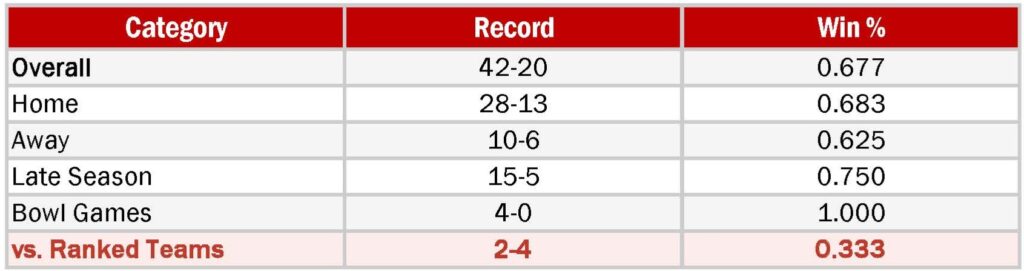
Silverfield’s career record looks solid on the surface. But the splits tell a different story.

Silverfield at Memphis (Career)

The bowl record is perfect. The late-season numbers are strong. But look at the bottom row: 2-4 against ranked teams. That’s a .333 win rate when games matter most.

The Schedule Cliff

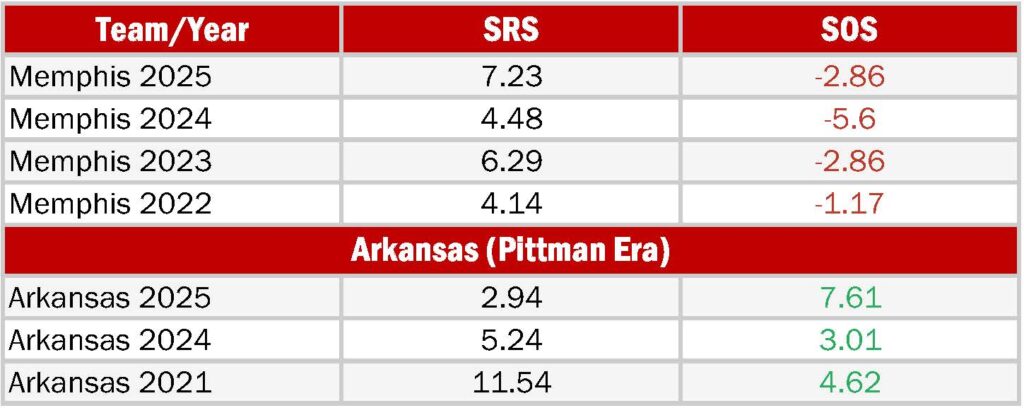
This is where the data gets uncomfortable. Every single season at Memphis, Silverfield coached against a negative strength of schedule. Every season at Arkansas – even in Pittman’s worst years – featured a positive.

Strength of Schedule Comparison

That’s an 8-10 point swing in schedule difficulty. Silverfield has never navigated a positive strength of schedule. Now he walks into the SEC West, where Georgia, LSU, Tennessee, Texas, and Texas A&M are all on the schedule.

He won .677 against weak competition. What happens when every week is a test?

The AAC Problem

Here’s the detail that haunts this hire: Silverfield never won an AAC Championship.

Mike Norvell won one before leaving for Florida State. Silverfield inherited a stable program with solid G5 resources and continuity, and never broke through. His best teams (2023, 2024) finished 6-2 in conference play both years. Good. Not great. Never the best.

That hints at a coach who reliably gets you to “good and organized” but hasn’t shown evidence of consistently punching above his resource level. In the AAC, that meant no title. In the SEC, it likely means a ceiling of 7-8 wins.

The Fan Reaction

Arkansas fans didn’t just express disappointment. They protested.

Razorback fans organized an on-campus protest at the Jones Center the day the hire became public—a rarity even by SEC drama standards. Social media reaction was brutal: “Such a 6-7 hire” became the instant meme. National observers piled on. Rival fanbases mocked the move.

The core complaints:

  • Going 8-4 in the AAC gets you an SEC job?
  • Memphis never won a conference title under Silverfield despite strong resources
  • Memphis fans openly celebrated his departure—and that’s who Arkansas hired?
  • Yurachek asked for major booster commitments, missed on bigger targets, then settled late

Compare this to James Franklin at Virginia Tech: protests = zero, fan sentiment = cautiously optimistic, narrative = “boss move.” Silverfield walks into Fayetteville with the shortest leash of any new hire in this cycle.

The Memphis Tell

Want to know what Memphis fans think? They’re celebrating.

Local Memphis media describe Tiger fans as “relieved” Silverfield left on his own rather than forcing an awkward firing decision. Message board comparisons to Josh Pastner – likable, professional, solid floor, limited ceiling – capture the mood perfectly.

The Memphis framing: “Good man, good coach, but not the guy to take us to the next level.” When your own fanbase is thanking you for leaving, that’s a data point.

The Bottom Line

Silverfield’s realistic outcome at Arkansas:

  • Years 1-2: 6-7 wins, bowl eligibility, stabilized culture
  • Years 3-4: 7-8 wins with an occasional shot at 9 if the schedule breaks right
  • Ceiling: Occasional 8-9 win seasons; unlikely to be a consistent SEC contender

That makes him a defensible hire for an AD who wanted stability and professionalism after the Pittman disaster. But it also explains why the reception has been so harsh, and why this move will be judged harshly if the on-field turnaround isn’t obvious by Year 2.

High floor. Low ceiling. Short leash.

Arkansas traded the uncertainty of another developmental hire for a known quantity. The problem is, everyone knows what that quantity is, and the SEC doesn’t grade on a curve.

No related posts found.

LOAD MORE BLOG ARTICLES

James Franklin Is 4-21 Against Top-10 Teams. Here’s Why Virginia Tech Hired Him Anyway, And Why It Might Actually Be The Right Call

Is James Franklin a Good Hire at Virginia Tech?

The Verdict

James Franklin is a high-floor, polarizingly safe hire for Virginia Tech.

He dramatically raises the talent and competency baseline in Blacksburg. His recruiting prowess will immediately transform VT’s roster trajectory. And his track record of building programs (Vanderbilt, Penn State) removes the developmental gamble that tanked the Pry era.

But his historical ceiling in big games makes it unlikely he turns VT into a true national title contender.

The Numbers Don’t Lie

Franklin’s career record speaks for itself—and it stacks up favorably against Virginia Tech’s coaching legacy.

Franklin vs Virginia Tech Coaching Legends

Franklin’s .687 career win percentage actually exceeds Frank Beamer’s legendary .667 mark at Virginia Tech. His bowl record (4-2) significantly outpaces Beamer’s 16-19 postseason ledger.

The Elephant in the Room

Franklin wins games. But can he win the right games?

At Penn State, Franklin went 4-21 against AP Top-10 opponents. That’s the number that haunted him in Happy Valley—and the number that will follow him to Blacksburg. When games mattered most, when a breakthrough win would have changed the program’s trajectory, Franklin came up short.

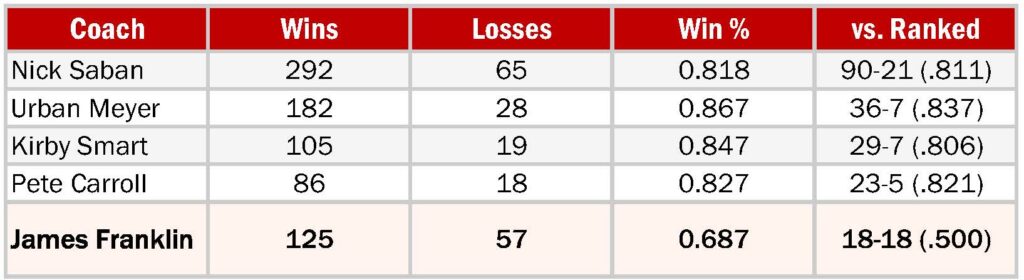
Franklin vs. Elite Coaches (Career Records)

The gap is stark. Saban won 81% of his games against ranked opponents. Meyer won 84%. Franklin? He’s .500 against ranked teams—and significantly worse against Top-10 competition specifically.

The Recruiting Rocket

This is where Franklin immediately changes everything.

In roughly two weeks on the job, Franklin dragged Virginia Tech’s 2026 class from around No. 120-125 nationally into the low-20s. He flipped 10+ former Penn State commits, pulling heavily from Pennsylvania, New Jersey, and the Mid-Atlantic. The current class includes at least six ESPN Top 300 prospects.

This isn’t incremental improvement. This is a complete geographic and talent-level reorientation.

  • Before Franklin: VT classes hovered in the 30s-50s nationally with only one top-25 finish in the last decade.
  • After Franklin: Tracking toward VT’s best class since the early 2010s—with no full staff and a three-week runway
  • Projected steady-state: Classes settling in the 15-25 range annually instead of the 30-50 band

Franklin has explicitly said VT will “always” prioritize offensive and defensive line recruiting. Given VT just produced a top-25 class with almost no runway, expect Hokies classes to feature more blue-chip linemen than they’ve signed in years.

The Virginia Tech Context

Virginia Tech made this move after an 0-3 start in 2025, including a blowout loss to Old Dominion and a defensive collapse under a defensive-minded coach.

Let’s be clear about where the Hokies have been since Beamer left:

  • Only one double-digit win season since 2011 (Fuente’s first year, 2016)
  • Brent Pry went 16-24 and never finished ranked
  • The program has drifted mainly into the ACC middle

Franklin’s win rate, ranked finishes, and recruiting baselines are all significantly above what VT has produced since 2011. The expected value jump from Pry to Franklin is massive—even if the ceiling remains debated.

The ACC Factor

Here’s the key insight that makes this hire make sense:

The ACC path is significantly easier than the Big Ten gauntlet Franklin just left.

In the Big Ten, Franklin had to navigate Ohio State, Michigan, Oregon, and Washington every year. His historical ceiling there translated to “playoff fringe but not elite.” But in the ACC? That same performance profile projects to frequent 9-10-win seasons, regular conference title contention, and occasional playoff appearances in the expanded field.

For a program that hasn’t lived in that neighborhood for a decade, that represents a clear upgrade.

The Bottom Line

Virginia Tech’s realistic near-term needs are:

  1. Consistent 8-10 win seasons
  2. Regular ACC contention and major bowl relevance
  3. A recruiting/portal footprint that looks like peak Beamer-era VT, modernized

Franklin’s history suggests he is very likely to deliver that tier and stabilize the brand—even if he falls short of making VT a playoff mainstay.

  • High probability of getting VT “back.”
  • Low probability of a true national-title breakthrough.
  • Virtually no mystery about what you’re buying.

VT is effectively trading the uncertainty (and downside) of another developmental hire for a highly predictable product: strong floor, defined ceiling, and an immediate recruiting jolt that reestablishes the Hokies as a serious operation in the region.

Is that a “good hire”?

For what Virginia Tech needs right now? Yes. Absolutely.

No related posts found.
VISIT OUR SHOP [COMING SOON]

LOAD MORE BLOG ARTICLES

Grading the Carousel: Preliminary Hire Grades for the 2024-25 Cycle

The carousel never stops spinning.

We’re tracking 21 coaching changes this cycle — 13 with new coaches already named, 8 still waiting on their guy. What follows are our preliminary grades across three categories: Hire Quality, Process, and Fan/Media Sentiment.

These aren’t final verdicts.

They’re initial reactions. First impressions. The kind of grades that will look either brilliant or idiotic in three years when we revisit them.

We’ll do deep dives on each hire individually in the coming weeks. But for now, here’s where every job stands — from the home runs to the dumpster fires.


The Home Runs

These programs swung big and connected.

Virginia Tech — James Franklin (A / A– / A)

The Hokies didn’t just make a hire. They made a statement.

Landing James Franklin from Penn State signals that Virginia Tech is done being a sleeping giant. The staff and recruiting implications will ripple through the ACC for years. The only question now is whether VT finally acts like the resource program it’s always claimed to be.

How his Penn State staff/recruits follow, what this does to the ACC power structure, and whether VT is finally acting like a “resource program” again.


Oregon State — JaMarcus Shephard (A / A– / A)

The Beavers landed their guy without a nationwide circus.

JaMarcus Shephard comes from Alabama’s staff into the most uncertain moment in Oregon State history. Post-realignment survival depends on portal management and identity preservation. A first-time head coach navigating conference limbo while maintaining Trent Bray’s defensive DNA is a tall order — but OSU handled this search like a program that knows exactly who it is.

Post-realignment survival, recruiting without a stable league home, and whether a first-time HC can maintain Bray’s defensive identity.


LSU — Lane Kiffin (A / D / A)

The hire is an A. The process was a circus.

Lane Kiffin to LSU was the worst-kept secret in college football, which made the public courtship even messier. But the end result? A program with unlimited resources landing one of the sport’s best offensive minds and most ruthless recruiters. The marriage either produces championships or a spectacular implosion. There is no middle ground in Baton Rouge.

Ole Miss fallout, staff poaching wars, and if LSU’s booster culture amplifies or burns out Kiffin’s volatility in a hurry.


Colorado State — Jim Mora Jr. (A / B / B+)

The Mountain West needed a credible name. CSU delivered.

Jim Mora brings NFL pedigree, P4 experience, and a recruiting network that Jay Norvell never fully activated. The question is whether this is a “last tour” victory lap or a legitimate rebuild. Either way, CSU positioned itself to capitalize on a weakened conference landscape.

Can Mora still grind on the trail, how CSU positions itself vs. a weakened MWC, and whether this is a “last tour” or a true rebuild.


Kentucky — Will Stein (A / B– / B)

Mark Stoops cast a long shadow. Will Stein steps into it confidently.

The offensive identity pivot is exactly what Kentucky needed after years of defensive-first football. Stein’s explosiveness ceiling could push the Wildcats from the 7-win band into genuine SEC East contention. The NIL landscape remains a challenge, but this hire signals ambition.

Stoops’ shadow, offensive identity pivot, NIL vs. league peers, and whether Stein can keep Kentucky in the 7–9 win band with a higher explosiveness ceiling.


Auburn — Alex Golesh (A– / B+ / B+)

Auburn got its tempo guy, Alex Golesh, from South Florida.

Golesh’s USF offense translated well enough to earn him a shot at the SEC’s toughest division. The patience level in Auburn is… historically nonexistent. But the process was clean, the hire was decisive, and line-of-scrimmage recruiting will determine whether this becomes a home run or a cautionary tale.

Translation of his USF tempo offense to the SEC West equivalent, patience level in Auburn, and how he recruits the lines of scrimmage.


The Solid Singles

Not flashy. Not embarrassing. Just… fine.

Stanford — Tavita Pritchard (B+ / B / B)

The Cardinal went internal and pragmatic.

Tavita Pritchard inherits Andrew Luck’s GM involvement and Stanford’s perpetual NIL/admissions constraints. The bet is that an NFL-style QB room can overcome portal friction in an ACC that doesn’t care about your academic reputation. It’s a reasonable swing given the circumstances.

Andrew Luck’s GM role, Stanford’s NIL constraints, and whether an NFL-style QB room can overcome admissions/portal friction in the ACC.


UCLA — Bob Chesney (B+ / C / C+)

This is either the next Kalen DeBoer or bargain shopping.

Bob Chesney’s jump from FCS to the Big Ten grind is significant. Here’s the strange part: the process was actually solid — because Martin Jarmond wasn’t running it. And that tells you everything about the real red flags at this job. An ineffective, egomaniacal athletic director. A disconnected, tone-deaf chancellor. A bean counter who only understands counting beans. Chesney’s system might translate just fine. Whether anyone can succeed under this administration is the bigger question.

The massive jump from FCS to the Big Ten grind, and whether anyone can succeed under an ineffective AD, a tone-deaf chancellor, and an administration that only understands counting beans.


Oklahoma State — Eric Morris (B– / B– / B–)

Life after Gundy is officially here.

Eric Morris keeps the Air Raid DNA without the 20-year cultural infrastructure. The question is whether Oklahoma State wants to chase Big 12 titles or just stability. This hire suggests stability. That’s not necessarily wrong — but it’s not inspiring either.

Life after Gundy’s long tenure, keeping the Air Raid DNA without the old culture, and whether OSU wants to chase Big 12 titles or just stability.


Ole Miss — Pete Golding (B / C+ / B)

Continuity hire. Full stop.

Pete Golding’s job is to keep the portal from hemorrhaging and maintain defensive credibility while the offense finds a new identity post-Kiffin. Whether he can be more than a recruiter/DC remains the central question. The Rebels are betting on stability over splash.

Defensive continuity vs. offensive identity change, portal retention after Kiffin, and whether Golding can be more than a recruiter/DC.


Michigan State — Pat Fitzgerald (C / B / B)

The Spartans hired a culture reset.

After back-to-back scandals, Pat Fitzgerald’s “Northwestern-style overachiever” ceiling might be exactly what East Lansing needs. The long-term recruiting upside against Ohio State and Michigan is… limited. But the hire makes sense for a program that desperately needed adults in the room.

Cultural cleanup after back-to-back scandals, ceiling of “Northwestern-style overachiever” in the new Big Ten, and long-term recruiting upside vs. Ohio State/Michigan.


The Fan Base Meltdowns

These aren’t going well.

Florida — Jon Sumrall (C / B+ / D)

The process was fine. The reaction was not.

Sumrall arrives with Steve Spurrier’s public blessing and a mandate to fix Billy Napier’s in-game disasters. But there’s a red flag worth noting: Sumrall’s Tulane teams were consistently among the most penalized in the country — the kind of undisciplined football that suggests coaching issues, not just player mistakes. Florida fans already wanted a bigger name. The D in sentiment reflects a fan base that feels the program settled.

Spurrier publicly blessing the hire, fixing Napier’s in-game messes, and whether Sumrall can weaponize UF’s NIL/portal machine fast enough in the SEC arms race.


Arkansas — Ryan Silverfield (D+ / D / D)

This is a disaster.

The fan backlash isn’t simmering — it’s boiling over into organized protests. Ryan Silverfield’s task is nearly impossible: win quickly in a 16-team SEC with a hostile home base from Day 1. The AD’s survival odds are now directly tied to Silverfield’s record. D across the board, and that might be generous.

Fan backlash/protests, AD survival odds, and if Silverfield can win quickly enough in the new 16-team SEC to quiet a hostile base.


The Clown Shows

No other way to describe these.

Penn State — TBD (INC / F / F)

James Franklin is gone. The portal is circling. And Penn State is playing leverage games with agents while their roster evaporates in real time. At some point, “waiting for the right guy” becomes “watching your program collapse.” That point may have already passed.

Whether PSU finally swings for a top-5 coach, how Sexton’s leverage games play out, and how long they can sit in limbo without bleeding portal talent.


UAB — TBD (INC / F / F)

The Bill Clark era feels like ancient history now.

Former coach Trent Dilfer gets plenty of blame, but AD Mark Ingram deserves more. Together they torched everything Clark built — the goodwill, the culture, the upward trajectory. All of it gone. Now the job sits open and nobody wants it. This isn’t a “hidden gem” search. It’s a punchline. Stadium and resources exist on paper, but the dysfunction has made this one of the least attractive openings in the country.

How attractive the job really is post-Dilfer, stadium/resources vs. recent chaos, and whether UAB leans into offense again or buys a culture guy.


Still on the Board

These jobs remain open. Grades pending.

California (INC / B / B) — Cal’s identity crisis continues. Do they want academics or football? The ACC move demands an answer.

UConn (INC / C+ / C) — Independence is lonely. The next hire determines whether UConn commits to regional recruiting or another failed “national” vision.

North Texas (INC / C / C) — Serial resets in Denton. UNT needs to pick an offensive identity and stick with it.

Coastal Carolina (INC / B– / B–) — The post-Chadwell slump continues. Another spread-option innovator, or something different?

South Florida (INC / B / B) — Golesh left equity in the roster. USF has a window before FSU/UF/Miami clean up their messes.

Memphis (INC / B / B) — The Tigers launch coaches. The question is whether they want another launchpad guy or someone who stays.


The Bottom Line

Thirteen hires graded. Eight more coming.

The best hire so far? Virginia Tech landing James Franklin changes the ACC. The worst situation? Arkansas — and it’s not close.

We’ll revisit these grades in-season. Some will age like wine. Others will age like milk.

The carousel keeps spinning.

No related posts found.

LOAD MORE BLOG ARTICLES

Martin Jarmond Set DeShaun Foster Up To Fail. Now UCLA’s Athletic Director Should Be The One Looking For A New Job.

Martin Jarmond fired DeShaun Foster after 15 games, but the real problem sits one floor above the football offices.

UCLA’s athletic director created the perfect storm that destroyed Foster’s tenure before it began. The hasty hiring process, inadequate resources, and administrative dysfunction all trace back to one person: the man who pulled the trigger on Foster’s dismissal.

Here’s why Jarmond should be updating his resume.

The Timeline Tells The Real Story

Foster never had a fair chance at UCLA because Jarmond bungled the coaching transition from the very beginning.

In November 2023, Chip Kelly was openly shopping for coordinator jobs elsewhere. Instead of making a clean break, Jarmond let the situation drag on for nearly six weeks. Kelly finally left on February 2, 2024, just weeks before spring camp.

The damage was already done:

  • Recruiting class decimated
  • Transfer portal window missed
  • Staff continuity destroyed
  • Spring preparation compromised

Foster was told he wouldn’t be considered for the head coaching job if Kelly left. He took the running backs job with the Las Vegas Raiders. When Kelly bolted two weeks later, UCLA had no viable candidates willing to leave their current positions so close to spring practice.

Jarmond made calls to other coaches, but no one was going to abandon their team weeks before training camp.

The UCLA players rallied around Foster, and Jarmond gave him the job with little time to prepare. It was a desperation move masquerading as a feel-good story.

Foster Inherited An Impossible Situation

The numbers don’t lie about what Foster walked into at UCLA.

Financial constraints:

  • Reduced Big Ten revenue sharing
  • Limited NIL resources compared to Big Ten peers
  • Budget restrictions on staff expansion
  • Facility upgrades delayed or cancelled

Roster challenges:

  • Late start on transfer portal acquisitions
  • Minimal time to evaluate existing players
  • Spring practice shortened by hiring timeline
  • No established recruiting relationships

Administrative support:

  • No clear vision for Big Ten transition
  • Conflicting directives from university leadership
  • Unclear reporting structure with new chancellor

Foster went 5-10 in 15 games, but considering the circumstances, the surprise is that UCLA won five games at all.

The Zoom Call Revealed Everything

More than 100 former UCLA players held a Zoom call with Jarmond after Foster’s firing, and the conversation exposed the real problems in Westwood.

Former players told Jarmond directly:

  • He needs to listen more than he talks
  • There’s a disconnect between athletics and program traditions
  • Foster was active in recruiting local high schools
  • Previous coaches ignored alumni outreach entirely
  • The athletic department lacks a central point of contact for former players

“Martin was told he needs to listen more than he does,” one participant revealed.

The Zoom call wasn’t about defending Foster.

It was about confronting Jarmond’s broader failures as an athletic director. Former players demanded accountability from the person directly responsible for UCLA’s decline.

Chancellor Frenk Sees The Problem

The power struggle between Jarmond and Chancellor Julio Frenk reveals who really understands UCLA’s situation.

Frenk told the LA Times he intends to be “very involved in the athletic department and the football program, recognizing that success in a marquee sport like football can be financially advantageous for the school as a whole.”

This contrasts sharply with former Chancellor Gene Block, who was “notoriously removed from athletics.”

Frenk’s involvement signals recognition that Block’s hands-off approach failed. The new chancellor understands what Block and Jarmond missed: football success drives university-wide benefits.

Multiple sources confirm the coaching search committee will report directly to Frenk, not Jarmond.

When your boss creates a workaround to bypass your authority, it’s usually a sign your days are numbered.

Bill Plaschke Said The Quiet Part Out Loud

LA Times columnist Bill Plaschke published a scathing column arguing Jarmond should not be allowed to hire the next coach.

Plaschke blamed Jarmond for the “wreckage” of UCLA football, specifically calling out:

  • Mishandling Chip Kelly’s departure
  • The rushed Foster hiring process
  • Lack of adequate support for Foster
  • Creating systemic problems beyond coaching

When the city’s paper of record publishes a column calling for an athletic director’s removal from a coaching search, it reflects widespread institutional failure.

Plaschke captured what many UCLA stakeholders believe: the problem isn’t coaching, it’s leadership.

The Kelly Contract Extension Debacle

Jarmond’s pattern of poor decision-making extends beyond the Foster situation.

In December 2021, Kelly’s contract was subject to renewal clauses. His tenure had been unsuccessful, but Jarmond offered him a contract extension without a definitive decision deadline.

Kelly dragged out the process for months:

  • His representatives floated Oregon Ducks interest
  • Several qualified potential coaches took jobs elsewhere
  • UCLA missed multiple hiring cycles
  • Uncertainty damaged recruiting and staff retention

Good athletic directors create timelines and stick to them.

Jarmond allowed coaches to control processes that should have clear administrative deadlines. The Kelly extension saga revealed an athletic director unwilling or unable to make difficult decisions when necessary.

The Attendance Scandal

The LA Times recently reported that UCLA has been “blatantly and artificially boosting attendance numbers at games at the Rose Bowl.”

Reporter Ben Bolch obtained data from actual ticket scan machines and compared them to UCLA’s attendance announcements. The difference was usually several thousand, consistently inflated by the university.

This isn’t just bad optics.

It’s institutional dishonesty that reflects broader problems with Jarmond’s leadership. When athletic departments resort to fabricating attendance figures, it signals deeper issues with accountability and transparency.

UCLA Needs New Leadership

Foster’s firing was the inevitable result of Jarmond’s administrative failures, not coaching incompetence.

The evidence is overwhelming:

  • Poor timing on coaching transitions
  • Inadequate resource allocation
  • Disconnect from alumni and program traditions
  • Inflated attendance reporting
  • Loss of confidence from university leadership

Foster deserved better support. UCLA deserved better planning.

Both paid the price for organizational dysfunction that starts at the top of the athletic department.

The next coaching search faces identical systemic problems that doomed Foster unless UCLA addresses the real issue: the continued employment of Martin Jarmond as athletic director.

UCLA can fire coaches every 15 games, or they can fire the person who hires the wrong coaches for the wrong reasons at the wrong time.

The choice seems obvious to everyone except the person making the decisions.

No related posts found.

LOAD MORE BLOG ARTICLES

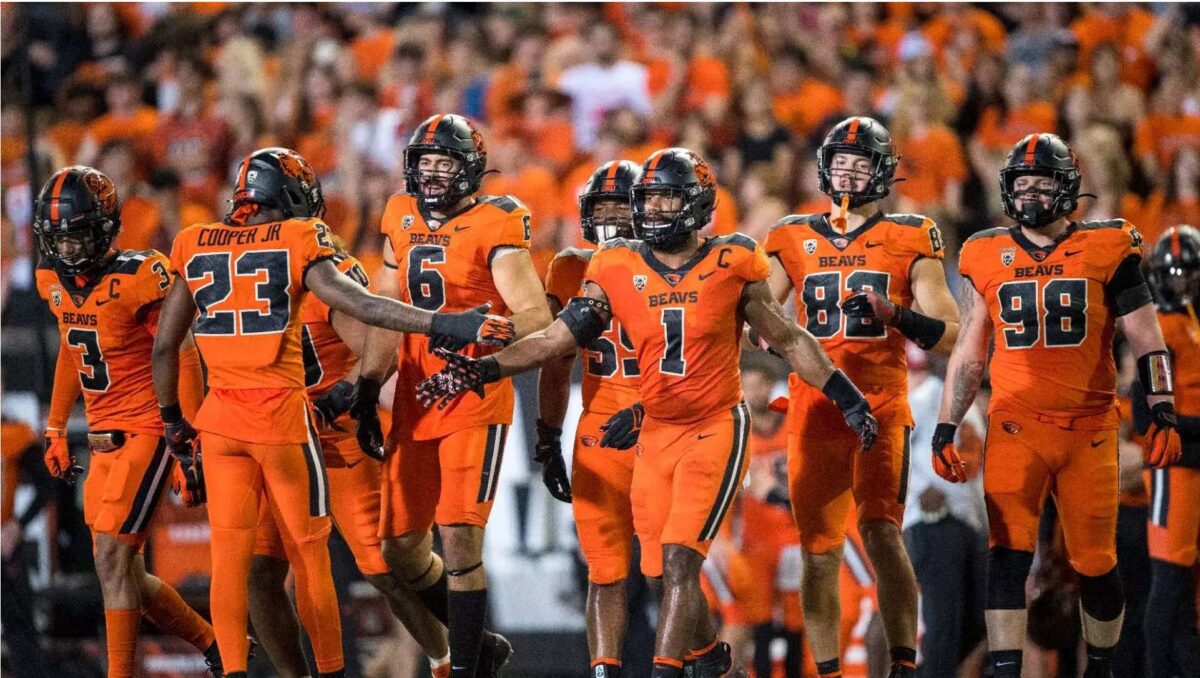
Oregon State Football 2025 Season Preview: From Chaos to Contention

The 2024 season was a nightmare for the Oregon State football team.

After enduring conference realignment chaos, coaching departures, and quarterback carousel disasters that led to a disappointing 5-7 record, the Beavers enter 2025 with something they haven’t had in years: hope. The program has made aggressive moves during the offseason to address its most glaring weaknesses while building around a foundation of returning talent that finally has a chance to shine.

The Quarterback Solution That Changes Everything

Oregon State found its answer at the most important position on the field.

Former Duke quarterback Maalik Murphy committed to the Beavers in December, bringing proven production and leadership to a position that was an absolute disaster in 2024. The numbers tell the story of just how desperate Oregon State was for help at quarterback:

  • The Beavers’ quarterbacks collectively completed just 216 of 360 passes for 2,417 yards
  • They threw seven touchdowns against 11 interceptions
  • They averaged a pathetic 201.4 passing yards per game
  • Three different quarterbacks started games, with zero providing consistent results

Murphy’s 2024 season at Duke represents everything Oregon State was missing. He led the Blue Devils to a 9-3 season and threw a school-record 26 touchdown passes, completing 254 of 421 passes for 2,933 yards with 12 interceptions. The 6-foot-5, 230-pound redshirt sophomore has two years of eligibility remaining.

“Felt like a great opportunity, and I really felt welcomed and wanted there. I was made a priority, and that’s all I could ask for. I’m excited to be a Beaver and get out there with the guys!” Murphy told ESPN about his decision to transfer to Oregon State.

Murphy alone threw nearly four times as many touchdown passes as Oregon State’s entire quarterback room combined last season.

The Supporting Cast Is Already In Place

Murphy won’t be throwing to scrubs.

Senior Trent Walker led all Oregon State receivers with 901 yards. He scored two touchdowns in 2024, providing Murphy with a proven target who served as a reliable safety valve during the quarterback chaos. Darrius Clemons, a Michigan transfer who battled through injuries, returns healthy after catching 29 passes for 292 yards and 2 touchdowns.

The depth at receiver has improved significantly:

  • Redshirt sophomore Taz Reddicks is expected to play a larger role after recording 17 catches in 11 games
  • Zachary Card played in all 12 games and can return kicks
  • David Wells Jr. provides additional depth as a redshirt sophomore

The tight end position received a massive boost with Riley Williams, a transfer from Miami who returns home to Oregon (Central Catholic HS in Portland). Williams brings experience from a high-level program and gives Murphy another reliable target.

But the real game-changer might be what’s already proven in the backfield.

Anthony Hankerson: The Foundation Everything Builds Upon

The ground game isn’t a question mark for Oregon State.

Anthony Hankerson returns after a breakout 2024 season, during which he nearly reached 1,000 rushing yards and scored 15 touchdowns. The senior running back provides the Beavers with a proven ground threat that should help balance the offense and take pressure off Murphy as he adjusts to his new system.

Oregon State averaged 189.2 rushing yards per game in 2024, actually outpacing their opponents’ 185.8 yards per game. This wasn’t the problem—it was everything else that fell apart around the running game.

Defense Gets a Complete Makeover

Last season’s defensive performance was embarrassing.

The Beavers managed just seven sacks all season, ranking dead last in FBS, while allowing nearly 30 points per game. The pass rush was so bad it became a national punchline. But the coaching staff has made substantial changes to address these glaring issues.

The defensive line transformation through the transfer portal includes:

  • Walker Harris from Southern Utah (expected starter at defensive end)
  • Kai Wallin from Nebraska (expected starter at defensive end)
  • Tevita Pome’e from Oregon (interior line anchor)
  • Tahjae Mullix from Western Carolina (additional depth)

The secondary returns some stability with sophomore Exodus Ayers, who was thrust into action as a freshman, and Kobe Singleton is expected to start if healthy. Captain Skylar Thomas anchors the safety position after leading the team with 81 tackles in 2024.

This defense has nowhere to go but up.

Schedule Reality Check

The 2025 schedule will test every improvement Oregon State has made.

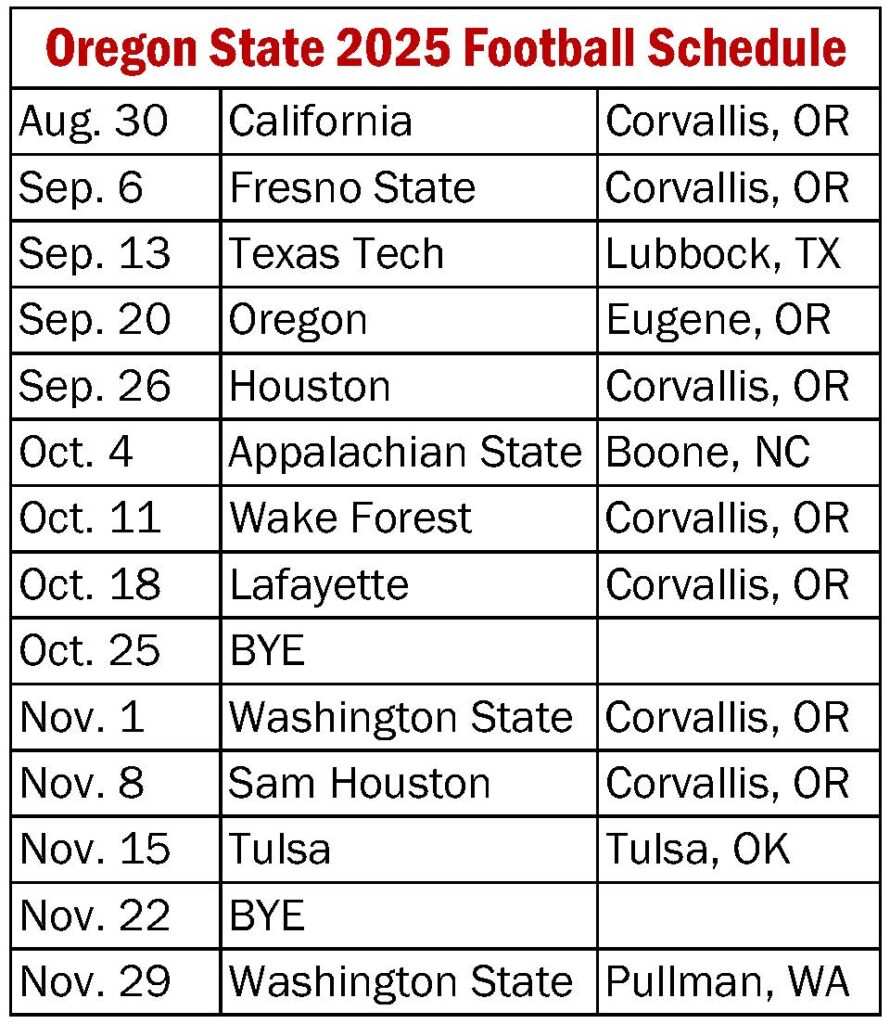
Seven home games provide some comfort, but six autonomy, five opponents create serious challenges. The slate includes demanding matchups against California, Houston, and Wake Forest at home, while road trips to Texas Tech and Oregon will provide early tests of the team’s progress.

The November dynamics are particularly interesting:

  • November 1: First meeting with Washington State (the only other Pac-12 survivor)
  • November 29: Season finale at Washington State in Pullman

These two games essentially represent the entire Pac-12 Conference, as both programs function as quasi-independent entities while maintaining their conference affiliation.

Coaching Stability Finally Arrives

Head coach Trent Bray enters his second season providing much-needed continuity.

Offensive coordinator Ryan Gunderson also returns for his second year, which should help the offense develop more consistency and familiarity with the system as Murphy settles into his role at quarterback. The coaching staff has been strengthened with five new additions, including Mark Criner as defensive quality control and Mikey Jacobsen as offensive quality control.

After years of upheaval, Oregon State finally has the coaching stability necessary to implement sustainable systems.

Transfer Portal Reinforcements Address Every Weakness

Beyond Murphy, Oregon State made strategic moves to fix its most obvious problems.

The offensive line, which struggled with protection and consistency in 2024, received reinforcements:

  • Keyon Cox from UCF
  • JT Hand from Arizona
  • Josiah Timoteo from Nevada

Defensively, the Beavers added multiple front-seven players, including linebacker Raesjon Davis from USC, in addition to the defensive line transfers. These additions offer both immediate impact potential and crucial depth for a program that has experienced significant roster turnover.

Every major weakness from 2024 has been addressed through the transfer portal.

Bowl Eligibility: The Realistic Goal That Matters

Six wins from a challenging 12-game schedule represent success for this program.

Oregon State’s ability to reach bowl eligibility will depend on three critical factors:

  • How quickly Murphy adapts to the offensive system
  • Whether the retooled defensive line can generate consistent pressure
  • How well the team navigates the demanding travel schedule that comes with their quasi-independent status

The schedule structure creates both opportunities and obstacles. Early-season games against California and Fresno State provide opportunities to build momentum, but the October stretch, featuring Appalachian State, Wake Forest, and Washington State, will likely determine bowl prospects.

A strong start could position the Beavers for their first bowl appearance since 2022.

The Bigger Picture: Program Survival and Growth

This season represents more than wins and losses for Oregon State.

After weathering conference realignment chaos, coaching changes, and massive roster turnover, the Beavers have assembled a team capable of taking meaningful steps forward. The success of 2025 will be measured in the development of sustainable systems and culture under Bray’s leadership.

Murphy’s presence at quarterback provides immediate upgrade potential, while the combination of returning players and strategic transfer additions offers hope for both short-term improvement and long-term stability.

For a program that has faced unprecedented challenges, 2025 offers an opportunity to demonstrate resilience and chart a path toward relevance in the rapidly changing landscape of college football.

The foundation has been laid, the pieces are in place, and the expectations are realistic but meaningful.

Now comes the execution that will determine whether Oregon State can transform from a program in survival mode into one capable of competing for bowl games and respect in the new era of college football.

The Next Billion Dollar Game

College football isn’t just a sport anymore—it’s a high-stakes market where information asymmetry separates winners from losers. While the average fan sees only what happens between the sidelines, real insiders trade on the hidden dynamics reshaping programs from the inside out.

Our team has embedded with the power brokers who run this game. From the coaching carousel to NIL deals to transfer portal strategies, we’ve mapped the entire ecosystem with the kind of obsessive detail that would make a hedge fund analyst blush.

Why subscribe? Because in markets this inefficient, information creates alpha. Our subscribers knew which coaches were dead men walking months before the mainstream media caught on. They understood which programs were quietly transforming their recruiting apparatuses while competitors slept.

The smart money is already positioning for 2025. Are you?

Click below—it’s free—and join the small group of people who understand the real value of college football’s new economy.

No related posts found.

LOAD MORE BLOG ARTICLES

Washington State Football 2025: The Ultimate Rebuild

New Washington State Football Coach Jimmy Rogers has inherited one hell of a mess.

The new Washington State head coach took over a program that lost 46 players to the transfer portal, watched its former coach flee to Wake Forest, and now sits as one of just two teams in what used to be the mighty Pac-12. If you’re looking for a case study in how quickly college football can flip your world upside down, look no further than Pullman, Washington.

But here’s the thing about rock bottom—it’s also the perfect foundation to build something special.

The South Dakota State Invasion

Rogers didn’t just take the Washington State job.

He brought an entire army with him from South Dakota State, where he compiled a ridiculous 27-3 record over two seasons and won back-to-back FCS national championships. Of the 20 transfers joining the Cougars for 2025, 15 are following Rogers from South Dakota State (the Jackrabbits).

This isn’t your typical coaching hire where a few assistants tag along. This is a full-scale program transplantation:

  • Defensive backs: Tucker Large, Colby Humphrey, Matt Durrance, Trey Ridley, Caleb Francl, and Cale Reeder
  • Running backs: Maxwell Woods, Kirby Vorhees, and Angel Johnson
  • Tight ends: Beau Baker (plus Michigan State transfer Ademola Faleye)
  • Defensive line: Max Baloun, Buddha Peleti, Darrion Dalton, and Malaki Ta’ase
  • Linebackers: Anthony Palano and Carsten Reynolds
  • Special teams: Kicker Jack Stevens and punter Dylan Mauro

Rogers is essentially betting his entire reputation on one simple premise: that his championship-winning system and the players who executed it can translate from FCS to FBS competition.

The Portal Bloodbath

Want to understand the full extent of this dramatic rebuild?

Washington State lost their starting quarterback (John Mateer to Oklahoma), their top running back (Wayshawn Parker to Utah), their best linebacker (Buddah Al-Uqdah to rival Washington), and multiple offensive linemen who followed former coach Jake Dickert to Wake Forest.

The numbers tell the story:

  • 46 players entered the transfer portal
  • 26 scholarship players departed
  • 11 starters found new homes
  • 7 players followed Dickert to Wake Forest

This wasn’t just roster turnover—this was roster demolition.

But here’s where it gets interesting. Ten players who initially entered the portal because of coaching uncertainty withdrew their names and decided to stay. These returners include projected starting quarterback Zevi Eckhaus, receivers Josh Meredith and Tre Shackleford, and cornerback Jamorri Colson.

The Quarterback Situation

Zevi Eckhaus might be the most important player in college football you’ve never heard of.

After spending 2024 as John Mateer’s backup, Eckhaus got his moment in the Holiday Bowl and absolutely delivered. He completed 31 of 43 passes for 363 yards, three touchdowns, and two interceptions in his first FBS start. More importantly, he briefly entered the transfer portal before deciding to stay and bet on himself under the new coaching staff.

This decision could define Washington State’s 2025 season.

Eckhaus brings a different skill set than the departed Mateer—less of a dual-threat, more of a traditional pocket passer. But in Rogers’ system, which emphasizes ball control and efficient passing rather than the Air Raid’s vertical attack, Eckhaus might be a perfect fit.

The Scheme Transformation

Here’s what makes this rebuild even more fascinating.

Rogers isn’t just changing the players—he’s completely overhauling the offensive and defensive philosophies that have defined Washington State football for over a decade. The Air Raid system that made the Cougars famous is being replaced by a more balanced, physical approach that emphasizes:

  • Two tight end sets instead of four and five receiver packages
  • Power running game instead of spread concepts
  • Ball control instead of high-tempo passing
  • Defensive pressure instead of coverage-heavy schemes

The new coaching staff has brought in three tight ends through recruiting and transfers, plus converted linebacker Hudson Cederland to the position. This signals a fundamental shift toward formations and concepts that would be unrecognizable to Mike Leach or his successors.

The Recruiting Reality Check

Let’s be brutally honest about Washington State’s 2025 recruiting class.

Ranked 71st nationally by ESPN, this represents a historic low for a program that had never previously finished below 76th in recruiting rankings. The class lacks the blue-chip talent that defined previous WSU recruiting cycles, instead featuring a mixture of:

  • 18 high school prospects (many flipped from South Dakota State)
  • Multiple JUCO transfers, including top-rated receiver Devin Ellison
  • Graduate transfers filling immediate needs
  • Three-star prospects rather than four-star game-changers

But here’s the counterargument: Rogers isn’t trying to win a recruiting ranking. He’s trying to build a cohesive team that can execute his system immediately. Sometimes the best recruiting class isn’t the one with the highest ratings—it’s the one with the right players for your specific approach.

The Schedule Gauntlet

Washington State’s 2025 schedule reads like a geography lesson and a difficulty test rolled into one.

The Cougars will face six teams they’ve never played before, make three trips east of the Mississippi River before Halloween, and somehow play Oregon State twice in the same month. Here’s how the season breaks down:

Winnable home games:

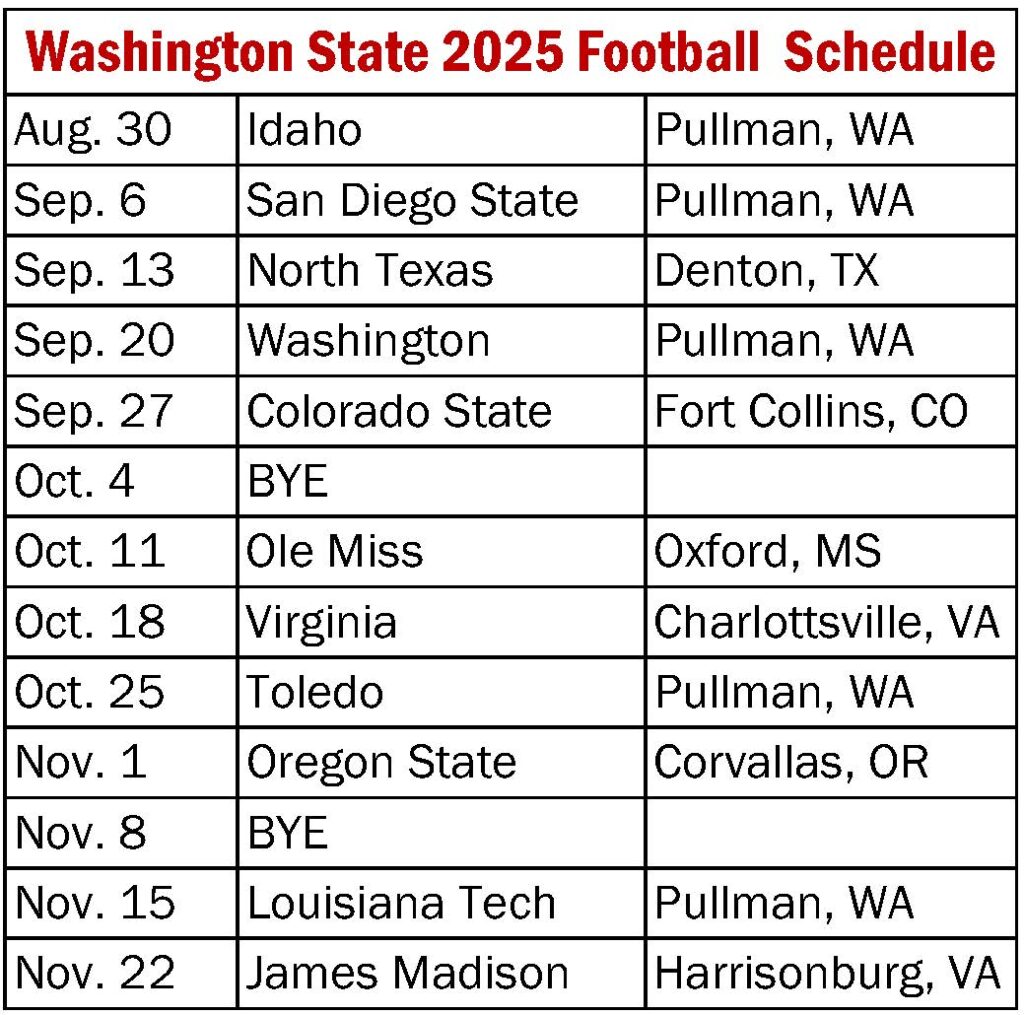
  • Idaho (August 30) – FCS opponent, regional rivalry
  • San Diego State – Mountain West program in transition
  • Toledo – Solid MAC team, but beatable
  • Louisiana Tech – Conference USA opponent
  • Oregon State (November 29) – Pac-12 rematch

Challenging road tests:

  • North Texas – Improved AAC program
  • Colorado State – Mountain West contender
  • Ole Miss – SEC powerhouse (guaranteed loss)
  • Virginia – ACC program on the rise
  • James Madison – Sun Belt success story
  • Oregon State (November 1) – First of two meetings

Most analysts project a 5-7 finish, with strong home performance offsetting road struggles. But in a rebuilding year with this much roster turnover, even that might be optimistic.

The Unique Pac-12 Situation

Here’s something that makes Washington State’s rebuild completely unprecedented.

The Cougars are one of just two remaining members of the Pac-12, alongside Oregon State. This creates challenges that no other program faces:

  • Scheduling difficulties requiring creative non-conference arrangements
  • Recruiting hurdles without a stable conference identity
  • Financial constraints from reduced media rights revenue
  • National relevance questions in a two-team conference

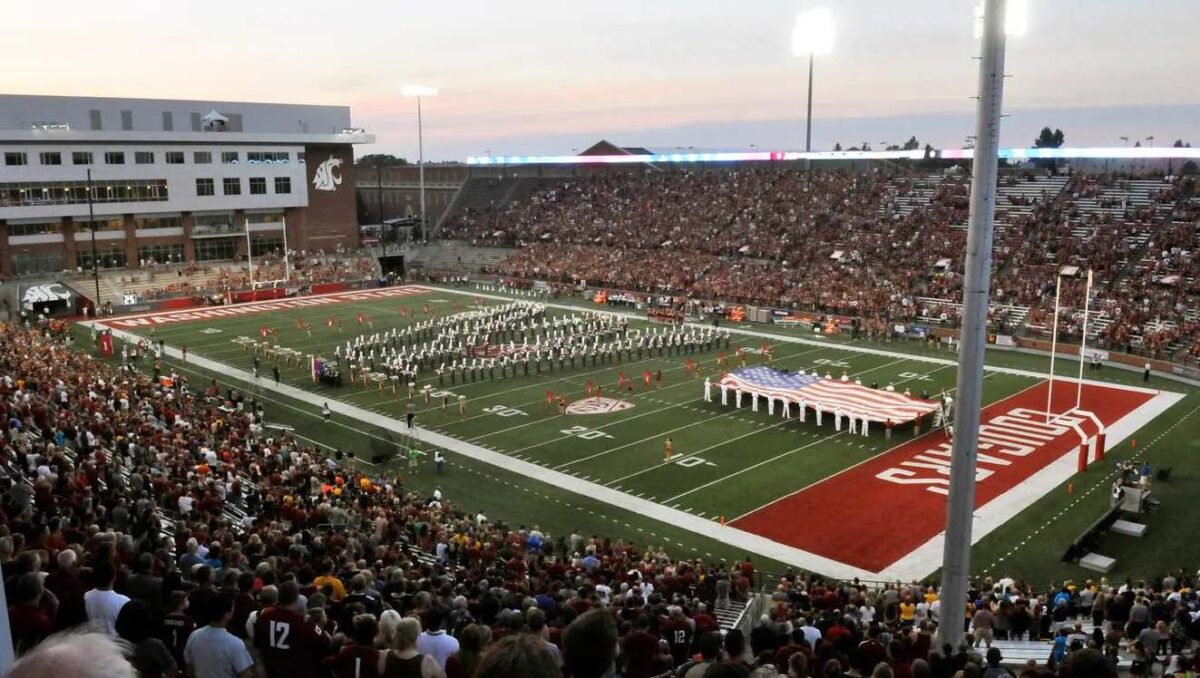
The Oregon State double-header perfectly illustrates this bizarre reality. The schools will meet November 1 in Corvallis and November 29 in Pullman—the first time they’ve played twice in the same season since 1945. It’s a scheduling necessity born from conference chaos.

The Make-or-Break Factors

Rogers’ success in 2025 will depend on three critical variables.

First: Can the South Dakota State transfers handle the jump from FCS to FBS competition? These players dominated at the subdivision level, but facing Power 4 and Group of 5 opponents every week presents a massive step up in speed and athleticism.

Second: Will the new offensive system mesh with returning skill position players? Receivers like Meredith and Shackleford thrived in the Air Raid, but adapting to a more balanced approach with tight end-heavy formations could create growing pains.

Third: How quickly can Rogers establish his culture and leadership in a program that’s experienced massive upheaval? Championship coaches succeed because their players buy into their vision. With so many new faces and systems, building that trust becomes paramount.

The Bottom Line

Washington State’s 2025 season isn’t really about wins and losses.

It’s about Jimmy Rogers proving that his championship formula can scale from FCS to FBS competition. It’s about whether a program can completely reinvent itself in one offseason and remain competitive. It’s about survival in the weird, wild world of modern college football.

The Cougars enter this season with the lowest expectations in program history. No bowl projections. No conference championship hopes. No playoff dreams.

But sometimes that’s exactly where magic happens.

Rogers has built championship programs before. He’s developed players, installed winning systems, and created cultures that produce results. The question isn’t whether he can coach—it’s whether he can do it fast enough to keep Washington State relevant while rebuilding from scratch.

One thing is certain: college football has never seen a rebuild quite like this one.

The 2025 Washington State Cougars will either validate Rogers’ vision and provide a blueprint for program transformation, or they’ll serve as a cautionary tale about the dangers of wholesale roster replacement. Either way, they’ll be absolutely fascinating to watch.

The Next Billion Dollar Game

College football isn’t just a sport anymore—it’s a high-stakes market where information asymmetry separates winners from losers. While the average fan sees only what happens between the sidelines, real insiders trade on the hidden dynamics reshaping programs from the inside out.

Our team has embedded with the power brokers who run this game. From the coaching carousel to NIL deals to transfer portal strategies, we’ve mapped the entire ecosystem with the kind of obsessive detail that would make a hedge fund analyst blush.

Why subscribe? Because in markets this inefficient, information creates alpha. Our subscribers knew which coaches were dead men walking months before the mainstream media caught on. They understood which programs were quietly transforming their recruiting apparatuses while competitors slept.

The smart money is already positioning for 2025. Are you?

Click below—it’s free—and join the small group of people who understand the real value of college football’s new economy.

No related posts found.

LOAD MORE BLOG ARTICLES

Coaches on Fire? Readers Respond to the Hot Seat Rankings

Welcome back to the Coaches Hot Seat, where we dissect the volatile world of college football coaching and track those whose seats are getting too toasty for comfort. Today, we’re tackling our readers’ fiery feedback and passionate perspectives. Because let’s face it, college football fandom is a crucible of emotions, and sometimes those emotions boil over. So hang on – we’re about to explore the highs and lows, the agreements and disagreements, and the raw, unfiltered takes from the passionate community that makes college football what it is.

A Fan’s Take: Will Hall’s Legacy and the Future of Southern Miss Football

Will Hall is a good man who did many great off the field teams for the program. But, on the field, it just didn’t work out. His “last season” (2023) was 3-9, replicating his first season, and now this 1-6 start that finally led to the plug being pulled. Southern Miss not many years ago under Jeff Bower and Larry Fedora, consistently had winning records and made bowl games. Jay Hopson had winning teams every year, until resigning after the first game of 2021 after losing to South Alabama.

In the landscape of NIL and up and rising programs like South Alabama that have cut into their recruiting pool, it is going to take a home run hire to bring USM back to relevance in my opinion.”

You bring up some great points about the challenges facing Southern Miss football. It’s a brutal landscape, with the rise of NIL and programs like South Alabama making it harder to recruit top talent.

Will Hall indeed had some success off the field, and we wish him all the best in his future endeavors. Ultimately, wins and losses matter most in college football, and unfortunately, those weren’t consistently enough during his tenure.

As you mentioned, Southern Miss has a proud football tradition with a history of success under coaches like Jeff Bower and Larry Fedora. The fans in Hattiesburg are hungry to get back to that level, and it will take a dynamic leader and a strong recruiting effort to make that happen.

We’re excited to see who Southern Miss hires as its next head coach. It’ll be interesting to follow their search and see what direction they decide to take. Hopefully, they can find someone to bring the Golden Eagles back to prominence in the Sun Belt!

“Do Some Research!”: Fans Demand Huff’s Hot Seat Status

How do you not list Charles Huff in your Coaches Hot Seat Rankings? 20 coaches with a hotter seat is complete BS!! He almost got fired last year and still sucks!!! He blew a 23-3 in the 4th quarter and almost blew another lead against Georgia State. We know you don’t care about the smaller schools. The fact that nobody has Huff on the hot seat at this point in the season is ridiculous!! Do some research, probably don’t even know the Sun Belt exists. At least pretend to care about smaller schools like Marshall.

Look, I get it. It’s infuriating. You’ve got a coach who, in your eyes, just isn’t cutting it. The team’s underperforming, and to add insult to injury, nobody seems to notice or care. It’s like Marshall football exists in its own little bubble, right?

Believe me, I understand that frustration.

But here’s the thing: you’re not alone. We see those smaller schools grinding it out, battling every week. Look at our Hot Seat rankings – we’ve got coaches from smaller programs all over the list. Did we miss Marshall this time? Absolutely. And that’s on us. We’re not perfect.

But here’s where you come in. This isn’t just my list. It’s a conversation. Our community, our members – you guys – you have a voice. You provide the insights and the on-the-ground perspective that we need. And guess what? Starting next week, you’re going to have even more say. We’re putting the power in your hands with community voting.

So speak up. Let your voice be heard. This is how we build a truly comprehensive and insightful Hot Seat ranking – together.

Fan Reaction to Riley’s Reign

This is year 3, and “coach” Lincoln Riley can collect $12,000,000 per year for the rest of the decade.

The stadium was 1/3 full on Saturday. Will Jennifer Cohen be handing tickets out at the border before the ND game to fill seats? Lincoln better be #1 on the hot seat list. He was there last year.

“Better be?” “1/3 full?” Okay, let’s dive into this.

First, let’s acknowledge the elephant in the room: Lincoln Riley is making money. A reported $10 million a year (not 12) is a lot of cheddar, and with that comes a certain expectation. USC expects to win, and they expect to win big.

He’s also got a reported $87 million buyout. Do you want to know why he’s not #1? There are 87 million reasons why.

Wisconsin and Penn State were sellouts. So are Nebraska and Notre Dame.

I’ve been critical of certain aspects of Riley’s program at USC, but let’s not get ahead of ourselves.

So, let’s hold off on the “better be’s” and the panic buttons. It’s more likely that he decides to leave on his own rather than USC buying him out.

No related posts found.

LOAD MORE BLOG ARTICLES

Coaches Hot Seat is Targeting Winners for Week 9

Think you know college football? Think again. Coaches Hot Seat spends a little time listening to the Targeting Winners Podcast every Friday afternoon during the season. We take our picks and look for the storylines, the upsets, the wins, and the losses to bring you the inside scoop on where the seats are getting hot. We’re not just talking about picking winners but about understanding the why behind the wins. The hidden narratives, the coaching mismatches, the moments that define a season.

The CFB Dudes at Targeting Winners live and breathe this stuff. They break down film, analyze matchups, and find the edges that the casual fan misses. We compare our picks with the Targeting Winner’s intel, and boom!

So buckle up, because we’re about to take you on a wild ride through three games we’ve got our eye on this week. Fans looking for an edge? You’ve come to the right place.

Notre Dame vs. Navy: The Midshipmen’s Mutiny

Notre Dame limps in, battered and bruised. Five starters down, maybe more. They’re like a prizefighter with a glass jaw, and Navy, they come in with a battering ram. 6-0, averaging 45 points a game. Blake Horvath, their quarterback? He’s not just running the triple option, he’s weaponizing it. Think Barry Sanders with a playbook designed to make defensive coordinators cry.

The line moved? Of course, it did. Smart money knows: Notre Dame’s defense hasn’t seen this kind of chaos. They’re trained for chess matches, not bar fights.

The Play: Navy +12.5. Take it, and don’t look back. This isn’t about talent; it’s about heart. Navy’s got it in spades.

Penn State vs. Wisconsin: The Calm Before the Storm

Penn State is undefeated, but they just survived a brawl with USC. Now they’re staring down Ohio State, the biggest game of their season. It’s a classic trap game. Wisconsin smells blood.

But here’s the thing: Penn State’s defense is a force. Drew Allar, their quarterback? He’s growing up fast. Wisconsin’s offense? Let’s say they haven’t exactly been lighting up the scoreboard.

Camp Randall’s a tough place to play, sure. But Penn State’s been there, done that. They’ve got the experience, the defense, and the quarterback play to weather the storm.

The Play: Penn State -6.5. They’ll win this one ugly, but a win’s a win. And take the Under 47.5. This game’s going to be a slugfest.

Boise State vs. UNLV: The Rebels’ Redemption

Boise State has Ashton Jeanty, a one-man wrecking crew. But here’s their problem: their quarterback, Maddux Madsen, is like a Ferrari with a lawnmower engine. He has lots of flash but not enough horsepower.

UNLV? They’ve got a secret weapon: the “Go-Go Offense.” Hajj-Malik Williams, their quarterback, is slinging the ball like he’s got something to prove. And their offensive line? They’re opening holes you could drive a truck through.

Boise’s defense? They lead the nation in sacks but can’t stop a nosebleed on third-and-short. UNLV’s going to exploit that weakness.

The Play: UNLV +140 on the moneyline. They’re at home, they’re playing with confidence, and they’re about to pull off the upset. Boise State? They’re about to learn a hard lesson: talent only gets you so far.


There you have it. Three games, three takes. This is all about the story. And these stories, they’re just getting started. Post your comments here.

No related posts found.

LOAD MORE BLOG ARTICLES