
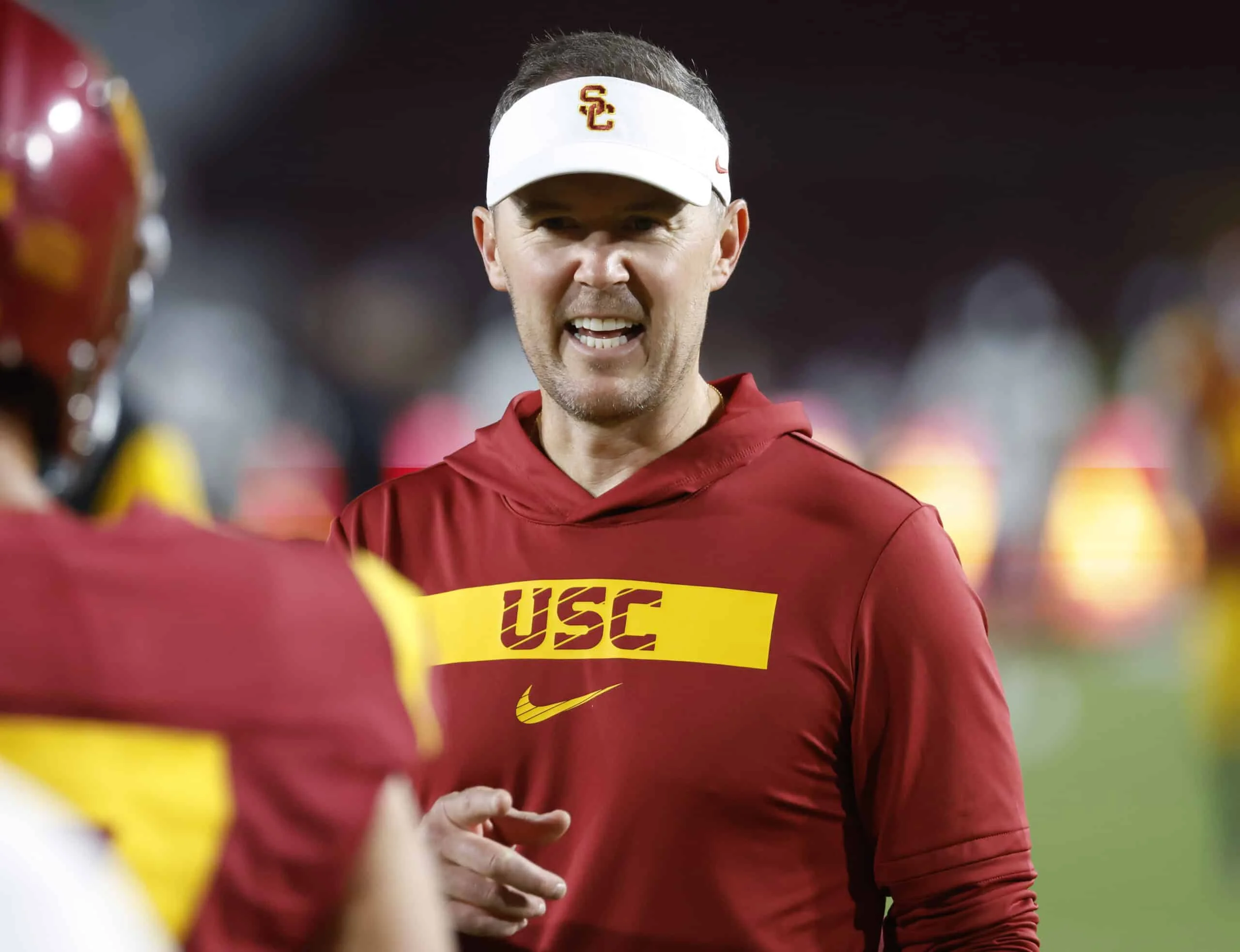
Week 2 Coaches Hot Seat Rankings

Luke Fickell takes over at 1 after Wisconsin was outscored 28‑3 in the second half at Lambeau Field, and Dabo Swinney climbed 44 spots after losing by 41.

Luke Fickell had Notre Dame beaten at halftime, and 86 seconds later he was the hottest seat in America.

He had company. Every other man on this board who played a football game lost too, with 1 exception, and the exception got punished for it. Mike Locksley beat somebody 62‑0 on Saturday, and this board dropped him 3 spots. Dave Doeren never left the house and climbed 5.

Anybody who finds that backward can take it up with the scoreboard. It lied twice on Saturday and again on Monday night.

Dabo Swinney moved 44 spots.

The season is 5 days old.

Get these rankings sent directly to your inbox weekly – subscribe to the Coaches Hot Seat Newsletter:

The Week 2 board

Figure 1. The Week 2 Coaches Hot Seat top 10, with each coach’s position on the Week 1 board published August 31.

1.    Luke Fickell and the 86 seconds

Give the man his 30 minutes.

Wisconsin led 13‑10 at the break at Lambeau Field, with 75,939 people in the seats, against a Notre Dame team that would be ranked 3rd in the country by Tuesday afternoon. Then the Irish scored 14 points in 86 seconds of the third quarter. DJ McKinney took a Colton Joseph pass 55 yards the other way, and nobody laid a hand on him. The Badgers managed 3 points the rest of the night.

Final score: Notre Dame 41, Wisconsin 13.

“I don’t have a great explanation for the second half,” Fickell said.

Nobody in Madison has asked him for one in 4 years.

Wisconsin has this instead:

  • 7,193 people quit buying tickets. A 13.1% drop, and an athletic department that believed them enough to write ticket revenue down 11.6% in its own budget. Chanting is free. Nobody cancels 7,193 season tickets by accident.
  • The record is 16‑22. 3 full seasons and 1 game in Madison, all of it pointing the same direction.
  • The schedule was supposed to be the gift. No Ohio State. No Oregon. No Michigan. No Indiana. Wisconsin cleared his calendar of every excuse it could find, and he opened against the 1 non-conference opponent left on it capable of embarrassing him.

They hired Luke Fickell to put a ceiling on a program that used to win 9 games a year in its sleep. 3 years later, the Badgers cannot locate the floor with a flashlight.

He takes the top spot from a man who lost by less.

2.    Greg Schiano and the 8 possessions

Greg Schiano scored a touchdown on his opening drive Thursday night and then took the rest of the evening off.

8 straight possessions, no points. UMass 37, Rutgers 21, in Piscataway, where Rutgers had the post-game fireworks show lined up in advance, seemingly expecting a win.

The winner deserves a good look. UMass went 0‑12 last season and came in on a 16-game losing streak. UMass had not beaten an FBS opponent since a win over Army in 2023. Rutgers was favored by roughly 28, and the Minutemen answered that opening touchdown with 30 unanswered points while Dylan Lonergan, imported from Boston College to solve the quarterback position, threw 3 interceptions and lost a fumble.

Now somebody in New Jersey must live with it.

The UMass head coach is Joe Harasymiak. From 2022 to 2024, he ran Greg Schiano’s defense and was twice nominated for the prestigious Broyles Award after building a top-20 national defense.

Schiano’s 2025 defense finished last in the FBS, all 136 of them, at 7.6 yards allowed per play. His old coordinator brought a winless roster into that stadium, and his team moved the ball whenever the mood struck. A bad Thursday looks nothing like that. Schiano watched his own methods work beautifully from the wrong sideline.

Schiano has coached 208 games at Rutgers across 2 tenures and won 99.

People in New Brunswick have been saying for years that Greg Schiano is the only man alive who can win in Piscataway. Thursday night was the first time that stopped sounding like a compliment.

3.    Mike Norvell and the 585 yards

The genius got outgained by 261 yards, won the turnover battle by 3, and lost anyway.

SMU beat Florida State 27‑24 on Monday night in a stadium that lost power and pushed kickoff back nearly 2 hours, and the lights were not the only thing in Tallahassee that went out early. The Mustangs put up 585 yards. Florida State managed 324, took the ball away 4 times, and converted all of that into 7 points. Bill Connelly’s postgame model gave the Seminoles a 1.4% chance of winning a game they lost by 3.

Doak Campbell booed him when the video board found him.

Norvell went 0‑4 in one-score games last season. He is 0‑5 now.

That number is the entire case against him, and it fits on a napkin. Hand this man 4 extra possessions, a home crowd and a 3-point deficit in the fourth quarter, and he will find a way to give it back. He has done it 5 times in a row.

Florida State still has not won a road game since November of 2023. Monday was at home, so the streak got the night off, along with everybody in garnet who was supposed to tackle Kevin Jennings.

He drops to 3 because 2 other men had worse weekends. Nothing in Tallahassee got better.

4.    Mike Locksley and the 62 points that cost him 3 spots

Mike Locksley beat somebody 62‑0, and this board moved him down, and the only thing he can blame is his own schedule.

Maryland gained 646 yards. Maryland ran for 365 on 40 carries. Maryland scored 6 rushing touchdowns. Maryland held Hampton to 85 total yards, and 10 of them on the ground. Hampton plays in the FCS and had never once in its history lined up across from a big-time program.

“Excited again that we were able to get a win for the first time in a long time,” Locksley said.

That is the head coach of a Big Ten football program describing a shutout of Hampton as a special occasion.

The awful part is that he is right. Maryland had not won a football game in almost 11 months. The Terrapins dropped the final 8 games of 2025 and then waited out the summer for Hampton to arrive and break the drought. The non-conference winning streak now stands at 19, the longest active run in the FBS. Nobody in this country beats the teams that agreed in advance to lose quite like Mike Locksley.

The seat cools 3 spots. It cools the way a stove cools when somebody opens a window.

Every game that made it hot is still on the schedule.

5.    Dave Doeren and the 0 snaps

Dave Doeren climbed 5 spots without leaving the house.

NC State did not play. The only football Raleigh has seen in 2026 is a 34‑8 loss at Virginia, 168 total yards, 3.3 per play, and a fan base that started the argument before this newsletter printed a number. He moved up 5 anyway, because 3 men above him fell off the board.

Richmond comes to Carter-Finley on Friday.

Fourteenth season, FCS opponent, 4 days after an idle Saturday, his own supporters spent relitigating him. Somebody in Raleigh should check on the man.

6.    Dave Aranda and the 1-point

Dave Aranda intercepted the other quarterback 3 times and lost by 1.

Auburn 17, Baylor 16, in Atlanta. Byrum Brown made his first start for the Tigers, threw 3 picks, and won. DJ Lagway went 27-of-54 for 333 yards and got Baylor into the end zone on 4th-and-goal with 9 seconds to play, and Aranda sent the offense back out for 2 points rather than take the tie. It died a yard short of the line.

Nobody in Waco is arguing with that call, and neither am I. The call was never the problem.

Aranda is 36‑38 at Baylor with 1 winning season since the 2021 conference title. A team that takes the football away from a first-time starter 3 times and still loses by a point had already told on itself long before anybody lined up for a conversion.

7.    Butch Jones and the 4 interceptions

Butch Jones led 3 separate times before halftime and handed Memphis the football 4 times, and only 1 of those facts made it into the final.

Memphis 42, Arkansas State 24. Trey Owens, the Texas transfer, threw for 325 yards in his first career start, and Jones announced afterward that Owens keeps the starting job. Memphis ran for 335 on its way to 523 total yards while Jaylin Carter scored 4 touchdowns, 3 of them after the break.

Jones is 26‑38 in Jonesboro across 6 seasons, and his point differential has finished negative in every one of them, including the 8‑5 that Arkansas keeps holding up as evidence.

6 years is long enough to stop calling it a rebuild.

Eight, Nine and Ten: The 44 spots and the 30 spots

2 men climbed into this top 10 from the middle of the board, and 1 of them covered 44 spots to get here.

Dabo Swinney, Clemson, 50 to 6. LSU won 51‑10 with better than 600 yards of offense, the worst beating of Swinney’s Clemson career. He spent the summer calling his own roster a bunch of nobodies. Lane Kiffin agreed with him in Baton Rouge, in public, by 41. The loss has fans and experts questioning if his older methods still work in modern college football. Candidly, I don’t think Clemson will fire him – his buyout is too high – but a negotiated exit or Swinney stepping down at the end of the season are both realistic options.

Bill O’Brien, Boston College, 40 to 10. Cincinnati won 34‑15 while JC French ran for 3 touchdowns and threw for a 4th. Boston College went 2‑10 a year ago and opened the sequel getting outscored by 19.

Joe Moorhead, Akron, 12 to 9. Wake Forest 38, Akron 16, with the Zips opening as a 24.5-point underdog. Moorhead is 13‑36 at Akron and has never finished a season above .500 there. This is his 5th.

The 3 who came off

Lance Leipold, Matt Rhule, and Chris Creighton are gone from this board, and none of them did anything to earn the favor.

Leipold sat at 5 a week ago. Creighton sat at 9. Their seats did not cool by a degree. 5 other men simply had a worse 5 days, and that is how a top 10 behaves in September. A coach doesn’t get relief around here. Somebody else just steps in front of him.

What Friday night settles

Greg Schiano goes to Chestnut Hill on Friday to play Bill O’Brien.

Number 2 on this board against number 10, 4 days after both lost to opponents they had no business losing to. Whoever loses spends next week explaining it to the other, and both know precisely how it will read in this space.

Somebody will be number 1 on this board next Tuesday, and it may well be whichever of them loses.

The rule for this week

Check who a man beat before checking whether he won.

Mike Locksley won by 62 and fell 3 spots because Hampton is an FCS program that had never played a big-time opponent in its life. Greg Schiano lost by 16 and climbed 6, because UMass went 0‑12 last year and the man holding the clipboard on the other side of the stadium used to work for him. The scoreboard reported both games accurately and got both wrong.

The only 2 men on this board who did not lose a football game over the weekend are ranked 5th and 7th on it.

Nobody made a mistake.

Get these rankings sent directly to your inbox weekly – subscribe to the Coaches Hot Seat Newsletter:

No related posts found.

LOAD MORE BLOG ARTICLES

The Clock In The Stadium Said Michigan Lost. The Big Ten Has A Different Clock, And You Are Not Allowed To See It

The clock you watched isn’t the real clock

Everybody in that stadium looked at the same number: zero.

Bryce Underwood threw a Hail Mary out the back of the end zone. The scoreboard hit triple zeros. Western Michigan’s sideline emptied onto the field, because that’s what teams do when the clock says the game is over and they are ahead. Lance Taylor said he looked up and it was past zeros before anybody touched the ball. Then a replay official reached into a drawer somewhere and produced one more second; Underwood hit JJ Buchanan for 47 yards, and Michigan won 13-12.

So which clock was right, and why does the answer require a press release?

The Big Ten’s explanation eats itself

Read the conference statement slowly, because it argues against the conference.

The Big Ten says it used a direct shot of the game clock in the stadium, side by side with the play, to rule that Broncos safety Micah Davis touched the ball with one second left. Fine. Except NBC’s rules analyst, Terry McAulay, a man who refereed three Super Bowls, went on the air and said his producer had confirmed the network’s inset clock was the stadium clock. That is the clock you saw. That clock read zero with the ball still hanging in the air, and McAulay said flatly that it wasn’t close.

Both of those things can’t be true, and the conference is the one asking you to believe both.

Introducing the clock nobody knew existed

The fallback explanation is worse than no explanation.

The story now is that the Hawk-Eye replay system had a different sync, which means there is a version of Saturday night’s clock that lives in a replay center and disagrees with the version bolted to the stadium. The conference notes that 85 minutes before kickoff, every broadcast camera in the replay system, including the one pointed at the game clock, gets synced with a strobe. Wonderful. Nobody asked how it gets synced. They asked why the one clock that the players, the coaches, the officials on the field, the 110,000 in the seats, and the audience at home all use is the backup copy. McAulay, live on the air, said the Big Ten was going to have to explain how anyone got to one second on that play.

Twenty-four hours later, the Big Ten still hasn’t.

Now go check the rest of college football

If the visible clock is advisory, the problem doesn’t stop in Ann Arbor.

  • Every game that has ever ended with zeros on the board and a ball in the air is now a second short
  • Every coach who has ever managed the last 10 seconds of a half did it off a display the conference now treats as approximate
  • Every quarterback who has spiked the ball with one tick showing was working from a number that might have been someone else’s number
  • Every fan who has watched a clock run out and assumed the game was over was, it turns out, guessing

Basketball figured this out with a red light around the backboard, and college football has decided the light is a suggestion.

Then Michigan stormed its own field

And here is where a bad night became embarrassing.

Michigan is ranked. Michigan was favored by four touchdowns. Michigan is the flagship of the state, and Western Michigan is a directional school 130 miles up the road with a $1.5 million payday and nothing to lose. During the celebration, you could hear chants of “fire Kyle” in the background, which is a hell of a soundtrack for a win. Then the students came over the wall to celebrate surviving a MAC team by one point on a second that the visible clock says never existed.

A ranked blue blood rushing the field after that is the single most humiliating image of Week 1.

What this does to the seat

Nobody gets fired for winning, and nobody gets a pass on how.

Kyle Whittingham called it one for the history books, which is true in a way he didn’t intend, and then he did the honest thing at the podium and listed what his team failed to do:

  • Stop the run
  • Run the ball
  • Win the turnover margin
  • Get enough first downs

Western Michigan kicked four field goals, took the ball away three times, and ran a 20-play drive that ate 13 minutes and 40 seconds off a clock that belongs to somebody else. Michigan trailed for 60 minutes. Whittingham has a long enough record that Saturday counts, and what it says is that his run defense couldn’t get a MAC offense off the grass, and his quarterback put the ball on the ground at his own 31 with 1:50 to go. If that is still true in October, nobody will remember the Hail Mary.

Michigan is 1-0, and the only clock anyone in that stadium could see says otherwise.

Weekly Coaches Hot Seat rankings will be available Wednesday.

They’re still playing. SMU at Florida State closes Week 1 tonight, with SMU a slight favorite by win probability and a huge favorite in the eyes of most who follow college football. Look for Norvel to keep that hot seat hot. Subscribe to have the rankings delivered straight to your inbox each week.

No related posts found.

LOAD MORE BLOG ARTICLES

Mike Norvell Won by 17 and Got Hotter. Dave Doeren Lost by 26 and Jumped to 10 on Our Board. Week 0 Wasn’t About Wins.

Week 1 Coaches Hot Seat Rankings

Florida State wrote New Mexico State a $1.4 million check and got booed 20 minutes into the game it bought.

The money amounts to roughly $82,000 per point of the final margin, and the margin was 17. Mike Norvell, in his seventh season as Florida State’s head coach, was favored by 31.5 and led by 7 in the third quarter. His own building turned on him in the second quarter, after a touchdown drive by the visitors and a three-and-out by the hosts, and the invoice sat there the rest of the night.

That is the whole weekend in a single transaction. Across 8 games, 4 coaches walked out of Saturday hotter than they walked in, and only 2 of them lost. It reads backward only if you believe this board only measures wins. It never has. It measures whether a program looked like the thing it’s paying to be, and on Saturday a lot of them didn’t.

Something stated up front, because the window matters more than the label. Only 3 of the 10 coaches on our board played, so the weekend produced exactly 1 move. Dave Doeren enters the top 10 at 10, and Barry Odom comes off it. Doeren spent most of last season bubbling under, parked in the teens while the pressure built, and Saturday finished a climb that’s been 3 years in the making. Mike Locksley, Lance Leipold, Luke Fickell, Butch Jones, Dave Aranda, Matt Rhule, and Greg Schiano all open next weekend, and the rest of the board holds until they do.

Figure 1. Every Week 0 favorite measured against its closing spread. Orange marks the 4 favorites that failed to cover, including a Florida State team that laid 31.5 and won by 17. Source: closing consensus lines via BetMGM, Caesars, DraftKings and FanDuel, compiled by College Football News. Final scores via the CHS 2026 season workbook.

Mike Norvell and the 1,008 days

The number that walked into Doak Campbell Stadium with Norvell on Saturday was 1,008.

That is how many days had passed since Florida State last won a football game outside Tallahassee, a 24-15 win at Florida on November 25, 2023. The streak stands at 11 straight road losses. Week 0 couldn’t touch it because the game was at home, and neither of the 2 tells this newsletter named in the spring was on the schedule. No bus ride, no close fourth quarter.

That left a single question: Does this look like a program that has fixed something?

Florida State put up 419 yards at 6.3 a play and went 6-for-6 in the red zone against a team picked near the bottom of the FBS. Then the other column. New Mexico State converted 10 of its 17 third downs. Trey Hedden, the Aggies quarterback, went 10-of-13 for 158 yards on third down alone, including throws of 33 and 34 yards for scores. Ashton Daniels, the Auburn transfer running Norvell’s offense, finished 17-of-27 for 202 yards with a touchdown and an interception, and spent the night getting hit in a pocket that wouldn’t hold.

Norvell said during the offseason that he expected 2026 to be the best year of his life.

The season is 1 game old.

I am still waiting for the part where somebody at Florida State explains what’s different. Different quarterback, yes. Different play-caller, technically, since Norvell took the sheet back himself. Different result? New Mexico State cut the lead to 10 midway through the fourth quarter, and New Mexico State has gone 7-17 across the previous 2 seasons.

Here is the sentence that should follow him into September. Norvell has 4 losing seasons at Florida State. The 3 men who held the job before him produced 4 between them across the previous 44 years.

He won the game and got the worse half of it.

Dave Doeren and the 168 yards

Dave Doeren has coached NC State for 14 seasons, and Saturday spent about 30 minutes relitigating all of them.

Virginia beat the Wolfpack 34-8 and had it finished by halftime. NC State gained 168 total yards on 3.3 yards per play with 10 first downs, punted 5 times before the break, and turned it over twice. CJ Bailey went 12-of-23 for 84 yards with an interception and a lost fumble in the red zone. Beau Pribula, the Missouri and Penn State transfer now playing for Tony Elliott, went 9-of-11 for 155 yards with 2 touchdowns and led everybody on the field in rushing with 110 yards on 15 carries.

Doeren had won 8 consecutive season openers. He was 4-0 against Virginia. Both of those died on the same afternoon.

Now the structural number, the one that has always defined him. Doeren has 8 seasons of 8 wins or more at NC State. He has zero seasons of 10.

“It was disappointing as hell, to say the least,” he said afterward. “I own that. That’s on me. Everybody can blame the head coach. That’s great.”

Everybody did.

Doeren went into Saturday at 14 on our board and came out at 10. His fan base didn’t make that call; we did. But what a fan base does on the night of a 34-8 loss is one of the things this board reads, and NC State’s was loud enough to hear from here.

Figure 2. Offensive yards per play for all 16 teams that played in Week 0. NC State and TCU finished 15th and 14th of 16 in the weekend both coaches needed to go differently, and Florida State posted 6.3 against a team picked near the bottom of the FBS. Source: CHS 2026 team stats workbook, Week 0.

Sonny Dykes and the fewest points in 31 games

Sonny Dykes flew a brand-new offense to Dublin and came home with the fewest points TCU has scored since 2023.

The Horned Frogs lost 15-10 to a North Carolina team that went 4-8 last season. Jaden Craig, the Harvard transfer installed to replace Josh Hoover under new coordinator Gordon Sammis, threw for 175 yards. That is TCU’s lowest passing total since the January 2023 championship game against Georgia. The offense posted a 27% success rate, the worst mark of a Dykes tenure that started in 2022. The Frogs also took 11 penalties for 90 yards and jumped offside on fourth-and-1 to end it.

The Aer Lingus Classic has developed a habit worth knowing about:

  • 2022. Nebraska lost it to Northwestern and fired Scott Frost 12 days later.
  • 2023. Navy lost it and finished 5-7.
  • 2024. Florida State lost it and collapsed to 2-10.
  • 2025. Kansas State lost it, started 1-3, and Chris Klieman retired before the bowl.

That is 4 straight losers and 4 bad autumns. Dykes gets to find out whether that’s a pattern or a coincidence, and he gets to find out in public.

Chris Creighton and the 69 rushing yards

Chris Creighton got Eastern Michigan the 500th win in program history and couldn’t run the ball 3 yards at a time to do it.

The Eagles beat Sacramento State 28-17 and carried 30 times for 69 yards, an average of 2.3. Dontae McMillan ran for 1,014 yards last season at 5.7 yards per carry. Noah Kim carried the whole night instead, 27-of-38 for 279 yards with 2 touchdowns and a third on the ground.

The defense looks like it surrendered 17 points. It surrendered 11. Sacramento State blocked a punt and scored 6 on a defensive return, so the honest number for Creighton’s defense is better than the box score reads.

That’s the good news, and it’s thinner than it sounds. A 4-8 team that fixed nothing about how it moves the ball on the ground beat a program playing the first FBS game in its history, and needed a late interception to do it.

The 3 winners and what their wins were worth

Saturday produced 3 wins that will read differently in November.

  • Bill Belichick, North Carolina. In year 2, he got the first halftime lead over a major-conference opponent of his college tenure, and his offense had almost nothing to do with it. The Tar Heels scored 15 points with 0 passing touchdowns and 90 rushing yards on 29 carries while losing 2 fumbles, and the defense held TCU to 281 yards. He won a game his defense won for him, and after 4-8 he’ll take it.
  • Tavita Pritchard, Stanford. In his first game as a head coach, he watched a 23-7 lead turn into a tie, then scored with 1:41 left and added a scoop-and-score 29 seconds after that to beat Hawaii 37-27. By CBS Sports’ count, Stanford had been the worst closer in the sport over 5 years, so the debut counts as an exorcism.
  • Tony Elliott, Virginia. He replaced an 11-win quarterback and upgraded. Pribula’s 110 rushing yards were the most by a Virginia quarterback since 2020, and Elliott, sitting on a seat that was warm 2 seasons ago and an extension that runs through 2030, had the cleanest Saturday of anybody in week 0.

The 2 debuts and the 7.0 yards per play

Saturday added 2 programs to the FBS and gave Memphis the loudest argument of the weekend.

North Dakota State opened its FBS life by beating Jacksonville State 33-7 in the Fargodome, and the Bison are 10-5 against FBS opponents since moving to Division I in 2004. Sacramento State lost by 11 in its first game at this level under first-year head coach Alonzo Carter, and blocked a punt and scored on defense. Memphis went to Las Vegas and beat Dan Mullen’s UNLV 27-21, averaging 7.0 yards per play, the best figure anybody posted all weekend, and sacked Jackson Arnold 6 times after halftime.

Mullen won 10 games in his first season in Las Vegas and was voted the national first-year coach of the year for it. He opened his second by losing at home. Nobody is putting him on a hot seat over a single Saturday, and everybody in that building noticed.

The rule for the next 3 months

Watch the crowd before checking the score.

Florida State won by 17, and its own crowd booed in the second quarter of a $1.4 million tune-up. NC State lost by 26, and its own coach volunteered the blame before a reporter could ask him for it. Norvell has a fan base that has quit on the games. Doeren has a fan base that hasn’t quit on him yet. The distance between those 2 conditions is the entire difference between a bad Saturday and a hot seat, and a win-loss column will never show it to you.

The other 7 coaches on our top 10 Coaches Hot Seat Rankings board play their first game next weekend.

Stay tuned.

That’s a Wrap

Eight games, and neither coach who needed a clean Saturday got one.

  • Mike Norvell won by 17 and got hotter. Florida State paid New Mexico State $1.4 million to come to Doak Campbell, laid 31.5, won by 17, and heard boos in the second quarter. The road losing streak is untouched at 11 games and 1,008 days, because this one was at home.
  • Dave Doeren went from 14 to 10 on the Coaches Hot Seat board. NC State managed 168 total yards on 3.3 a play in a 34-8 loss; Barry Odom came off the top 10 to make room, and the fan base started the argument before we published a number.

The suits had a better week than the coaches

The SEC’s other 15 schools called a meeting, made sure LSU wasn’t invited, and spent it hunting through 48 pages of bylaws for a lawful way to throw a member out of the conference.

They haven’t found one. They’re still reading.

In another room, a committee voted to erase Week 0 and take 5 days off the January portal window, then stood up and called the whole thing clarity.

And the federal rulebook this sport has chased for 7 years slipped again, for a reason that has nothing to do with football and everything to do with men who’d rather be home campaigning.

Not one of those 3 stories has a coach in it. Not one of them has anybody who ever threw a block.

They’re all in the newsletter.

On the Radar is exclusively available to newsletter subscribers. Join us here [LINK]

Next week: The Diagnosis, Dave Doeren

Doeren is the winningest coach in NC State history and the second-longest-tenured coach in the ACC behind Dabo Swinney, yet in 13 seasons he has never won 10 games. That isn’t a slump, and it isn’t bad luck. It’s the product. NC State built a program that can’t fall far enough to fire him and can’t climb high enough to matter, and it pays him almost $6 million a year to hold it right there.

The number to carry in is 0. Across 13 seasons: 95 wins, more than any coach the school has ever had, 4 nine-win years, and 0 seasons of 10.

No related posts found.

LOAD MORE BLOG ARTICLES

Week 0 – 2026 Coaches Hot Seat Rankings

Wisconsin Fans Stopped Chanting and Canceled 7,193 Season Tickets. That Is How You Measure a Hot Seat in 2026

Here is who has the least room to fail in 2026, and why it is not the order our own numbers produce.

Every coach in the top 4 was publicly saved by his own school last fall. A president or an athletic director issued a written statement explaining why the man was staying at Florida State, Wisconsin, Baylor, and Maryland. That detail matters to you for one reason: it means the school already ran the buyout, already weighed the alternative, and already told you in public which way it leans.

Nobody publishes that statement about a winning coach.

A vote of confidence is a receipt with a date. The top 10 sits below, with the number that puts each man there.

Lance Leipold at 5 is the exception nobody had to defend, which is exactly why he ranks behind 4 men who did.

The Board

1. Mike Norvell, Florida State: 7 wins in 2 seasons and 53 million reasons he is still employed

Florida State did something almost no athletic department has the nerve to do.

It publicly graded its own football program in writing and gave it an F. The president, the athletic director, and the board chair put out a statement agreeing the operation needed structural changes. Then they kept the man operating it. A school announced the building was on fire, named no firefighters, and renewed the lease.

Here is what the fire looks like in numbers. 7 wins across 2 seasons, which arrived directly after a 13-1 year, and 38-34 for the whole tenure. No road win since November of 2023. In 2025, the Seminoles outscored their schedule by 11 points a game and finished 5-7, and if that sounds impossible, it is because the entire margin came from beating an FCS team 77-3 and a MAC team 66-10.

Remove those 2 games and the 11 points become two-tenths of a point. Remove the tune-ups from anybody’s season, and you get the truth about them.

The buyout is the reason he is still employed and the reason this seat is the hottest in America. Walking away after 2025 will cost about $53 million. After this season, it drops to roughly 46. The price of the decision falls at the exact moment the evidence for making it arrives, and Florida State has already told you in writing which way it grades him.

He opens Saturday against New Mexico State. The hottest seat in the country gets a bye week disguised as a game.

2. Luke Fickell, Wisconsin: 7,193 fans quit buying tickets

In September, with Camp Randall chanting for his firing during the fourth quarter, Luke Fickell was asked what he wanted to say to the people paying to watch this.

He said they had to be just like the team.

The fans took him up on it.

Wisconsin sold 47,587 season tickets for 2026, down from 54,780. That is 7,193 people who decided their best effort was staying home, a 13.1 percent drop, and the athletic department believed it enough to write ticket revenue down 11.6 percent in the budget. A chant is free. A season ticket is not. When a fan base stops yelling and starts subtracting, the message has been upgraded.

Then the man holding the umbrella left. Chris McIntosh hired Fickell, defended him through 2 losing seasons, published the letter, and took a job at the Big Ten office. Shawn Eichorst walked into a building holding a coach he did not hire and a reputation that survives either outcome.

At media days in July, Fickell said the last 2 years had not been up to the standard and that he was not shying away from it. Nobody asked him to shy away from it. 12.8 points a game, 135th out of 136 teams, is not the kind of thing that hides.

This year the schedule finally cooperates. No Ohio State. No Oregon. No Michigan. No Indiana. The easiest Big Ten draw of his tenure arrives in the same season as a $21.3 million buyout and a new boss, and the sport rarely removes every excuse at once like that.

3. Dave Aranda, Baylor: 59 players left in one offseason

Dave Aranda spent his July at Big 12 media days explaining the concept of finishing.

There is a start, he said, and a middle, and a finish, and Baylor had been working on the finish all offseason. He said the Bears had to close the deal. It is a fine coaching thought, and it lands strangely when you check what happened the last time this program reached December.

59 players closed a deal. All of them with other schools.

That’s not a roster refresh, and this is where the numbers everybody else uses fall apart. Message-board sentiment reads Baylor as the calmest fan base in this group, well behind the noise at Wisconsin and Maryland. Quiet is not the same as content. Look at what left the building rather than what got posted.

  • The class they saved him for left too. 4-star defensive lineman Jamarion Carlton went to Texas, and 4-star cornerback Jamarion Vincent went to Michigan. The recruiting haul Baylor cited as its reason to keep Aranda is suiting up elsewhere this fall.
  • The man who would have made the call was already gone. Athletic director Mack Rhoades resigned in November, and university president Linda Livingstone announced that Aranda was returning, with the team sitting at 5-5.
  • The record has not moved in 4 years. Aranda is 36-37 at Baylor and 22-28 since the 2021 conference title, with 1 winning season in that stretch and a 1-5 mark against TCU.
  • He handed off the defense. Aranda gave the unit to Joe Klanderman and moved into a front-office role. A defensive coordinator answered the hot seat by doing less defensive coordinating.

An anonymous Big 12 coach told Athlon this summer that Aranda knows football and is a little weird. Peers don’t say that about coaches who won 10 games. New athletic director Doug McNamee now runs a program he didn’t build for a coach he didn’t pick, and there is no more precarious arrangement in the sport.

4. Michael Locksley, Maryland: 71 percent of the roster back and 8 straight losses to explain

Michael Locksley has the angriest fan base on this board, and only the fourth spot, and the reason is that Maryland just handed him everything he has been asking for.

71 percent of production returns, second most in the country behind Notre Dame. 14 projected starters are back. Malik Washington returns at quarterback after throwing for 2,963 yards as a true freshman. Every alibi from last season, the youth and the churn and the roster that had never played a down together, reported to camp this month with a year of experience and nowhere left to point.

The 2025 season is a strange document. Maryland led in 11 of its 12 games. Maryland then lost the last 8 in a row. A team that cannot hold a lead 8 consecutive times has stopped being unlucky and started being coached that way.

Athletic director Jim Smith wrote his letter, backed an eighth season, and promised more money for the roster. The buyout is 13 million dollars, which in this crowd is a rounding error. Public support plus a cheap exit is the definition of a short rope, and 37-49 with no winning conference record in 8 attempts is how the rope got short.

5. Lance Leipold, Kansas: back-to-back 5-7 seasons after the rebuild that made him

Nothing happened at Kansas last fall, which is precisely why Lance Leipold is on this list.

No statement. No letter. No president stepping to a microphone to explain the football coach. Sentiment in Lawrence still runs positive, the only place in this group where that is true, because Leipold took a program that won 21 games in 11 years and got it to 9 wins and consecutive bowls without padding the schedule to do it. That buys a man something, and it does not buy him forever.

Then 5-7. Then 5-7 again. He is 27-35 at Kansas, and the arrow has pointed the same direction for 2 straight seasons.

Back-to-back losing years after the rebuild that made your name is where pressure begins. Fifth on this board is the polite way of saying that the grace period now has an expiration date.

Where our numbers and our judgment disagree

The workbook that runs this board would order the top 5 differently, and hiding that would make the entire exercise a fraud.

On the numbers alone, it reads Locksley first at 93.2, Norvell second at 84.5, Leipold third at 84.2, Fickell fourth at 77.9, Aranda sixth at 76.1. The published board moves Norvell up 1, Fickell up 2, Aranda up 3, Locksley down 3, Leipold down 2.

Every one of those moves comes from the same blind spot. The model counts what a fan base says and cannot count what an institution does, and institutions are the better tell. Maryland is loud, cheap to unwind, and just committed more money to the coach. Baylor is silent and just watched 59 players walk. Loud and cheap wins a column in sentiment and loses a season.

Check the call in November. That is what the Prior column is for.

What to watch Saturday

Week Zero is 1 game, and anybody selling it as a referendum is selling something.

It does hand you one thing. Norvell hosts a New Mexico State program with 7 wins in 2 seasons, and there is no version of a competitive fourth quarter in Tallahassee that reads as progress. Everybody else waits. The board barely moves next week and then moves hard in October, when the window feeding these rankings finally fills with 2026 football.

Until then, this is the baseline, and baselines are only useful if someone writes them down before the season rather than after.

The bottom line

None of these 5 men is finished, and this has never been a list of who loses a job.

It is a list of who has the least room left. Four of them work for schools that already priced the alternative, chose the cheaper year, and then dressed the arithmetic up as faith. Faith had nothing to do with it. Receipts are reconciled, and December is when the accounting is done. When a university publishes a letter about its football coach, save it. Check the date in December.

No related posts found.
VISIT OUR SHOP [COMING SOON]

LOAD MORE BLOG ARTICLES

North Carolina Needs $29 Million To Fire Bill Belichick. He Needs $1 Million To Walk Away From Them.

John Preyer, you sent the offer sheet.

You were running the North Carolina Board of Trustees in December 2024 when ESPN says you put a contract in front of Bill Belichick’s agent without bothering to ask Bubba Cunningham, the athletic director whose entire job that was. Then you called an emergency meeting, closed the doors, and handed a 72-year-old man 5 years and $50 million. The first 3 guaranteed.

You did remember to run the cost analysis, though. On the professors.

A lawsuit says your board studied the 30-year cost of granting a faculty member tenure and never ran a single number on the football contract. You wanted to know what a tenured chemist would run you in 2054. You did not want to know what Bill Belichick would run you in 2027.

It runs $29 million. You found out in 11 months.

He can leave for $1 million

Here is the door you built for him, and it does not lock.

Belichick can end this himself for $1 million, payable within 180 days. That number dropped from $10 million in June of 2025, before he had coached one college snap. You owe him $29 million to make him go. He owes you a rounding error to walk. Thirty to one, and the cheap door is his.

A guarantee protects a coach from losing football games. Nobody in Chapel Hill is losing football games anymore. They are answering questions from lawyers.

31 NFL teams read the same file you did

Eight head coaching jobs came open in the NFL in 2024, and he got 1 serious interview.

Atlanta talked to him twice and hired Raheem Morris. Everybody else passed without picking up the phone. They were not confused about whether he could coach. They said out loud, on the record, that he would rebuild the command structure around himself, and The Athletic reported that clubs which had just hired somebody else felt relief about it.

You gave him personnel authority in writing anyway, and let him hire his own general manager.

He hired Michael Lombardi, who had not worked in college football since 1984, when he was recruiting coordinator at UNLV. Lombardi announced that North Carolina was the NFL’s 33rd team. The 33rd team went 4-8, beat nobody with a winning record, lost to all 3 in-state rivals and sent 0 players to the draft off a 41-man roster overhaul.

The season, with the padding removed

They beat Charlotte, an FCS team from Richmond, a 3-9 Syracuse, and a 4-8 Stanford.

Take Charlotte and Richmond out, and what is left is 2-8 against Power 4 opposition at minus 11.5 points a game. Adjust for schedule strength, and the year grades 100th of 136 nationally, the second-worst Carolina season since 2000, and 10.53 points below the 6-year average of the coach he replaced. Two computer systems looked at the schedule and called it easier than average.

Mack Brown got let go for going 6-7. This was worse by every measure anyone keeps.

Then the 33rd team called HR

Lombardi went on paid administrative leave on July 27, 3 days before the first practice.

The university says its Office of University Counsel is investigating. The Athletic says the leave came out of a human resources complaint and that the College Sports Commission has come around asking about the program. Somebody asked Belichick about that Thursday morning and got this: “Yeah, next question. We can’t talk about it.”

The greatest defensive mind in football history just called a coverage on his own general manager.

The handbook caps this kind of leave at 30 days, which means the whole thing resolves before the opener against TCU in Dublin on August 29. Twenty-one days before that game, Belichick goes into the Pro Football Hall of Fame in Canton.

Enjoy Ohio, coach. The lawyers will still be here when you get back.

Read the full story

The newsletter version has the coronation, the girlfriend, the donor letter, what Bobby Petrino’s last 2 stops did to the head coaches who hired him, and The Market Read on the win total.

No related posts found.

LOAD MORE BLOG ARTICLES

Dabo Swinney Is the Safest 7-6 Coach in America

Dabo Swinney is not getting fired, and that is the whole problem. In 2025, he coached the most talented roster of his eighteen years at Clemson to a 7-6 record and the lowest team rating of his tenure. A buyout of over fifty million dollars means nothing on the field can force him to change. This is what a hot seat looks like when the pressure is real and the consequences are missing.

Key takeaways

  • Clemson sent nine players to the 2026 NFL Draft and still finished 7-6, its worst full season under Swinney since 2010.
  • The 2025 team graded out at a 6.42 SRS, the lowest opponent-adjusted rating of Swinney’s eighteen years.
  • Over the last five years, against Kirby Smart and Ryan Day, Clemson trails on 20 of 22 measured stats, and does it on a softer schedule.
  • Swinney’s buyout sits near fifty-seven million dollars in 2026, which leaves real pressure without real risk.
  • The CHS read is a structural decline, not a one-season blip.

Nine draft picks, seven wins

The 2025 Tigers were the most talented team Swinney has ever failed with. Clemson put nine players into the 2026 NFL Draft, tying the most of his career, with five gone in the first three rounds. The only other Swinney team to hit nine picks played for the national title. This one watched the Playoff from home for the fourth time in five years.

Now put the talent next to the rating. By SRS, the opponent-adjusted number that separates beating Georgia from beating Furman, Clemson graded out at 6.42 in 2025. That is the lowest mark of his eighteen years, under the 6-7 team from 2010 and under the group he inherited in 2008. The most NFL talent of his career produced the worst football of his career, and only one of those facts is about the players.

Clemson’s opponent-adjusted rating by season under Dabo Swinney, 2008 to 2025, fell to a tenure low of 6.42.

The chart is the tell. The peak was the 15-0 team in 2018, and every season since has stepped downhill into the 2025 floor.

The peer test that Clemson keeps losing

Swinney likes to talk about money and how the bluebloods print theirs. Kirby Smart and Ryan Day took the same brand and the same five-star pipeline and answered differently, winning national titles while Clemson slid.

Over the last five years, 2021 through 2025, Clemson has trailed the Smart and Day average in 20 of 22 measured stats. It loses in winning percentage, SRS, scoring, and points allowed. It owns zero final top-ten finishes in that window, while each of the other two has five. The two rows it wins are takeaways and turnover margin, the numbers that look nice and keep nobody employed.

Peer matrix: Swinney’s Clemson versus Smart’s Georgia and Day’s Ohio State, 2021 to 2025, shaded on Clemson’s column.

Read the strength-of-schedule row, because it turns a gap into an indictment. Clemson played the softest schedule of the three yet still scored fewer points and allowed more points. An easy slate is supposed to flatter your numbers, and Clemson’s came out worse anyway.

Death Valley stopped being a fortress

The strangest part of the 7-6 is where the losses happened. Clemson went 4-1 on the road in 2025 and 3-4 at home, losing every game but the bowl inside a stadium where it had gone 73-9 in the Playoff era. LSU, Syracuse, SMU, and Duke all walked into Death Valley and walked out with a win.

Clemson’s 2025 results by final margin, showing every loss came at home or on neutral turf.

The close games got away, too. Clemson went 1-3 in one-score games, losing three of them by a combined eleven points. Good teams win the games this team lost, and that is a coaching grade, not a talent one.

The cure Clemson bought is a memory

Swinney saw the offense break and reached backward for the fix. He fired offensive coordinator Garrett Riley, the air-raid hire he brought from TCU, after a 2025 unit that finished 116th on third down and 109th in rushing. His replacement is Chad Morris, who ran the Clemson offense from 2011 to 2014 and has not called plays for a good one in nearly a decade.

The roster underneath is thin where it matters. Cade Klubnik is gone to the NFL, and the job goes to redshirt junior Christopher Vizzina or a freshman. Swinney broke his own rule by signing a program-record 10 transfers this cycle and still refused to spend one on a quarterback. Nine draft picks left the building, and Clemson enters 2026 in the bottom third of the country in returning offensive production.

The Market Read

The number that frames the season is 7.5, the win total the books hung on Clemson, with the over juiced to -135. That is the schedule talking. The market can see the soft home dates and is pricing a team that clears the tune-ups and stalls against the top of the league. Clemson sits around +8000 to win the national title and is nowhere near the ACC conversation that now belongs to Miami.

The edge is the live-dog window in the games that matter, at LSU and home against Miami, where the public still hears the word Clemson and pays for the logo. Fade the brand until a Swinney offense wins a game it is supposed to lose. Re-verify these numbers before acting on them, since win totals and futures move.

The verdict

This is a Structural Trend, not a blip. Five straight declining years by the opponent-adjusted number, on a softer schedule, against two peers who took the same materials and lapped him. The fair counter is that the one-score luck regresses and the roster is loaded, and both can be true while the verdict holds, because every flattering number describes something that happened to Swinney rather than something he did.

On the CHS thermometer, which measures pressure to win now and never predicts a firing, the reading is up and climbing. The buyout guarantees Swinney time, and time has never once forced a comfortable man to change.

Dabo Swinney hot seat FAQ

Is Dabo Swinney on the hot seat?

Yes, in the way that matters to Clemson. The 2025 team posted the worst rating of his tenure, extending a five-year slide. The CHS thermometer measures pressure to win now, and that pressure is rising, even while his job stays safe.

Is Dabo Swinney getting fired?

There is no sign of it, and the math rules it out. Swinney is signed through 2031, and his buyout is near $57 million in 2026. CHS does not predict firings. We measure pressure, and the point of this profile is that the pressure and the consequence have come apart.

What is Dabo Swinney’s buyout?

Roughly $57 million in 2026, down from about $60 million a year earlier, with a clause that rises by half again if he leaves for his alma mater, Alabama. Verify the current figure before publishing, since buyouts decline over time.

Who is Clemson’s offensive coordinator in 2026?

Chad Morris, in his second stint. He ran the Clemson offense from 2011 to 2014 and returns to replace Garrett Riley, who was fired after three seasons.

Want the full breakdown, with the complete peer matrix and every number behind the verdict? Read the full Diagnosis and subscribe to Coaches Hot Seat for the weekly Hot Seat Index.

No related posts found.

LOAD MORE BLOG ARTICLES

The Real Reason Luke Fickell Is on the Hot Seat at Wisconsin (It’s Not the Air Raid)

Yes, Luke Fickell is on the hot seat, and it is one of the hottest in college football.

The reason is not the one most fans reach for. Wisconsin spent two years blaming the Air Raid, then fired the coordinator who ran it and watched the offense get worse, scoring 12.8 points a game in 2025. The pressure is real, and the story underneath it is more interesting than the boos suggest.

This is a pressure read, not a firing prediction. Below are the five questions that decide whether Fickell’s 2026 cools the seat or lights it, with the tell to watch for each one so you can judge the season as it happens.

Question 1: Can the offense clear the mid-20s, or is 12.8 the real Wisconsin?

Start with the number that ended the scheme debate.

In 2025, the reborn run-first offense scored 12.8 points a game, 135th out of 136 teams in the country and dead last in the Power Four. That happened after Wisconsin buried the Air Raid, which means the scheme was never the whole problem. The old system, which averaged in the low 20s, had more life in it than the throwback version brought in to save the day.

The tell to watch: look for the offense to camp in the mid-20s a game. Anything near 12 means the disease is still active, and a unit score of 24 or more is the first honest sign that the patient is up and walking.

Question 2: Does Colton Joseph survive to November?

The single biggest variable is not the scheme or the schedule; it is health.

Fickell has brought in a veteran transfer quarterback every year, and three straight have lost their seasons to injury: Tanner Mordecai’s hand in 2023, Tyler Van Dyke’s ACL in 2024, and Billy Edwards Jr.’s knee in 2025. New starter Colton Joseph is a dynamic dual-threat from Old Dominion, which is exciting and also the catch, because a runner behind a rebuilt line is an injury risk. The last three Wisconsin starters went down the same way.

The tell to watch: count how many games the Week 1 quarterback finishes. Joseph, standing on the field for the Minnesota finale, would break the pattern that has defined the entire tenure, and it matters more than any single stat line.

Question 3: Can Wisconsin make a bowl on the easiest schedule in the Big Ten?

The 2026 schedule takes away every excuse.

CBS Sports rated Wisconsin’s slate the easiest in the Big Ten, with no Ohio State, Oregon, Michigan, or Indiana. Last year’s opponents went a combined 110-53, with the eventual national champion among them. This year’s group went 69-79. With a draw this soft, six wins is the floor of competence rather than an achievement.

The tell to watch: treat bowl eligibility as the baseline, not the prize. A third straight bowl miss on a schedule this forgiving would be the loudest result of the season and a sign the problem runs deeper than luck.

Question 4: Is it bad luck or bad coaching?

This is the fairest question in the whole debate, and it deserves a real answer.

The quarterback injuries are a genuine misfortune, and no coach draws up a torn ACL. But building every season on a one-year rental with no functional backup is a roster decision, and Fickell made that call three straight times. When the school kept him, athletic director Chris McIntosh pointed at money, and there is a sliver of truth there, since Wisconsin has lagged in NIL. Paul Chryst won 67 games on less, though, and Fickell reached a College Football Playoff at Cincinnati on a fraction of a Big Ten budget.

The tell to watch: separate the wound from the plan. Injuries are luck, but depth behind the starter and finishing close games are coaching, so watch whether Wisconsin has a real answer the first time something goes wrong.

Question 5: What cools the seat, and what only looks like progress?

Not every win means the same thing this fall.

A nine-win season built on a soft schedule can still hide the same flaw, just as two non-conference blowouts can flatter a point differential. The results that move the needle are the ones that test the real problem. Wisconsin closed 2025 by upsetting ranked Washington and ranked Illinois, proof that the pulse is there when the quarterback is upright.

The results that change the read:

  • A healthy quarterback in December. If Joseph finishes the year, the biggest variable will finally break Wisconsin’s way.
  • An offense in the mid-20s. Scoring, not scheme talk, is the proof the fix took.
  • A road win over a team with a pulse. Padding the record at home proves nothing the schedule did not already promise.

The bottom line on Luke Fickell’s hot seat

This is a Structural Trend, and it is the hottest honest seat on the board.

The scheme war is over, and the offense lost anyway, which points the finger at the quarterback room rather than the playbook. The best-case scenario is real because the injuries were rotten luck, and a healthy Joseph on the softest schedule in the league could spark a genuine bounce. The buyout of about 25 million dollars buys Fickell the patience his record could not earn, so 2026 is the year the excuses finally run out.

Ask these five questions as the season unfolds, and you will know whether Wisconsin is climbing or just enjoying a soft landing.

Score it yourself

Want to run this same diagnosis on your team’s coach?

The Coach Evaluation Scorecard is our free, seven-category tool for scoring any coaching situation out of 35, so you can tell a hot seat from a cold take before the season starts. Grab it here.

Our complete Diagnosis: Fickle breakdown is available to subscribers. Click the button below to subscribe.

No related posts found.

LOAD MORE BLOG ARTICLES

Is Lance Leipold on the Hot Seat? 5 Tells That Separate a Blip From a Slide at Kansas

Is Lance Leipold really on the hot seat at Kansas? Five ways to tell if a coach bounces back or keeps sliding, run start to finish on the Jayhawks.

Every offseason, the preseason magazines sort last year’s 5-7 teams into “bounce-back” and “rebuild” based on almost nothing, and every fall, half of those calls fall apart. There is a better way to read it, and it is the method we use here at Coaches Hot Seat to rank coaching pressure.

One note, if you are new. Our ranking is a thermometer, not a firing prediction. It measures how much heat the job is putting on a coach right now, and none of what follows is a forecast that anyone gets fired. It is a way to read the seat honestly.

We will run all five tells on the same case: Lance Leipold at Kansas, who sits at No. 3 on our 2026 board. Here is how to do it yourself.

Tell 1: Throw out the record and read the point differential

The win-loss line is the least useful number on the page.

A coin-flip team can finish 5-7 with average underlying numbers, and a lucky team can finish 8-4 while getting outplayed. The two numbers that actually predict next year are point differential and SRS, an opponent-adjusted rating you can find on any team’s Sports Reference page. If the margin sits near zero and the SRS is low single digits, there is no contender hiding under the record and no collapse waiting either.

Kansas was plus 1.3 points a game with a 2.88 SRS in 2025. Those are the vitals of a thoroughly average team, which means the record is roughly honest and no kind bounce is buried in it.

Tell 2: Count the one-score games

This is the number that decides most bounce-back bets.

Games settled by eight points or fewer are close to coin flips, and they regress hard from one year to the next. A team that lost a pile of them is a decent bet to win a few next season without changing a thing, and a team that won a pile is due to give some back. Walk the schedule and tally the one-score finishes and who came out on top.

Kansas went 1-4 in winnable Power Four games and led in the fourth quarter of four of its seven losses. That is a finishing problem, and finishing problems in close games are the most likely thing on this list to correct on their own, which is the single strongest reason for Kansas optimism.

Tell 3: Find the side of the ball nobody fixed

Most struggling teams are lopsided, and the trick is naming the unit that is actually sinking them.

Compare scoring offense to scoring defense, then dig one layer down to yards per play on each side. Points allowed tends to be the more stable and more telling number, so when a team keeps blowing late leads, look at the defense before you blame the offense.

Kansas has the opposite of Florida State’s problem. The offense is real and efficient, better than its historical Kansas comps in yards per play and yards per carry. The defense gives up 189 rushing yards per game at 4.9 per carry. You do not surrender fourth-quarter leads because the offense turned shy. You surrender them because you cannot get off the field.

Tell 4: Strip the cupcakes out of the schedule

A shiny record or scoring margin is often two blowouts against overmatched teams in costume.

Pull the game log, remove the FCS opponent and any clear buy game, and recompute the record and the margin against everyone with a pulse. If the team padded its résumé on tune-ups, this is where it shows. If it did not, the record is telling you the truth.

Kansas bought an FCS guarantee game every fall and beat Wagner 46-7 right on schedule, and still missed a bowl. When the cupcakes cannot buy you a sixth win, the record is honest, not inflated.

Tell 5: Watch what the staff repaired in the offseason

The offseason tells you the coach’s own diagnosis, and whether he agrees with yours.

Look at the coordinator hires and the transfer portal class, and ask one question: which unit got the resources? If a staff spent the winter upgrading the thing that already worked and left the real problem alone, next season tends to rhyme with the last one.

Kansas brought coordinator Andy Kotelnicki back to sharpen an offense that was never the problem, while the defense that surrenders 31 points a game got no equivalent rescue. Fixing the symptom and leaving the disease is a tell, and it is the one that keeps Leipold at No. 3.

Run the five on Kansas, and here is the verdict

Add them up, and the seat reads clearly.

The underlying numbers say average, the close-game math says a rebound is possible, the defense says the problem is real and unaddressed, the schedule says the record is honest, and the offseason says the staff fixed the wrong side. That is a Trend, and it is hardening. It is not structural yet, because the offense is real and coin flips regress toward even, and it is not a firing call, because this is a pressure reading. Win a handful of tight ones in 2026, and it will be a blip that fixes itself. Lose them again, and the slide becomes the address.

That is the whole method, run start to finish on one coach.

Want to run it on your own team? Our free Coach Evaluation Scorecard walks you through seven categories on a 1-to-5 scale, 35 points in all, so you can score any coach’s seat the way we do. [LINK]

Want the complete case on Leipold? The full Diagnosis, with the workbook comparison matrix against Mark Mangino and Matt Campbell, and The Market Read on where the betting line disagrees with the hype, is here. [LINK]

No related posts found.

LOAD MORE BLOG ARTICLES

Florida State Graded Its Own Coach as Failing, in Writing, and Kept Him

Mike Norvell would like to apologize again, and he has had the practice.

After Florida ran through his team 40-21 in November, the fourth losing season in his six years, he stepped to the podium and said he had not coached well enough and his team had not played well enough. He called it infuriating. A year earlier, off a 2-10 season, he promised an immediate, fast fix and took full responsibility.

The fix showed up at 5-7.

Florida State hired a genius and got half of one

Norvell arrived with the reputation he built piling up points at Memphis, and it was half right.

He can draw up a Saturday. It is the other six days, the leading and the steadying of a team when the building shakes, that he cannot do. That is how a man who knows the X’s and O’s cold has not won a road game since November of 2023.

The reputation got him the job, and the other six days are the job he skips.

The plus-eleven is a magic trick

Here is the number his defenders want you to hold: plus eleven.

Florida State outscored its 2025 schedule by eleven points a game and finished 5-7, and one of those numbers is lying to you. Watch where the eleven goes:

  • The whole margin is two games. Strip a 77-3 win over an FCS team and a 66-10 win over a MAC team, and plus-eleven falls to plus-0.2 against everyone else.
  • Every close game was a loss. Florida State went 0-4 in one-score games.
  • The road stayed winless. Zero for five away from home, a skid that now runs to ten straight games away from Doak.

Beat the helpless, lose every coin flip, and the spreadsheet stops being a defense and turns into the indictment.

The roster was not the problem

The 2025 team did not quit, which is the whole case against its coach.

A Gus Malzahn offense led the ACC in total and rushing yards and hung 30-plus on four league teams. The talent came back and the scheme worked, and the team still could not win a game in doubt in the fourth quarter or anywhere outside its own zip code. When a roster has the talent and the scheme and still folds the moment a game tightens or the bus crosses a state line, the missing piece was never the talent.

It is the part of the job a coordinator never had to do.

So Norvell fixed the wrong thing

He took back the play-calling, the one job that was working.

“I’ve been really good at calling plays throughout my coaching career,” he said, and you can wait a long time for the part about the fourth quarter or the road. It never comes. The team’s flaw was finishing, and his answer was to hand himself the one task the season never flagged.

That is a coordinator treating the head-coach job like a position he can coach his way out of.

Why the checkbook keeps him

None of this got him fired, and the reason has eight figures and a comma.

Firing Norvell after 2025 cost about 53 million, the bill from the extension Florida State handed him in 2024 when Alabama came calling for a Saban replacement. So President Richard McCullough, athletic director Michael Alford, and board chair Peter Collins kept him and put it in writing that the three of them agreed “changes are needed for our program to improve.” Read that for what it is: a school grading its own coach as failing, in a press release, and admitting in the same breath that it cannot afford to act on the grade.

The seat never cooled, because the buyout runs hotter than it does.

The verdict

The fair counter is real, and it still loses.

The offense travels, and one-score records are close to a coin flip, so the record could climb back without Norvell coaching a down better. Both can be true, and the call holds. On the thermometer, this is Structural, not a blip, because until Florida State wins a game it is supposed to lose, the flattering numbers stay hollow, and the genius label is marketing for a man doing half the job. The buyout even falls from about 53 million to roughly 46 million after this season, which drops the price of moving on at the exact moment the verdict comes due.

No seat in the country runs hotter than the one a program has already graded and chosen, for now, to keep.

The full Diagnosis is for subscribers

You are reading the abbreviated version of our Diagnosis: Norvell breakdown.

The complete breakdown puts Norvell, row by row, against Jimbo Fisher and Mario Cristobal in the comparison matrix, then runs the 2026 schedule through the stress test designed to expose the road and close games. It also carries The Market Read on where the win total and the futures still misprice a team that cannot finish.

Subscribe and read the whole thing:

The Coach Evaluation Scorecard is yours, too

Subscribers also get the tool we use to grade.

The Coach Evaluation Scorecard walks you through seven categories, each scored from 1 to 5 and totaling 35, so you can take any coach’s temperature yourself. You do the scoring, so it is a tool that makes you the analyst rather than a grader who hands you the answer.

It is free – just click the button below:

No related posts found.

LOAD MORE BLOG ARTICLES

Mike Locksley’s Hot Seat in 2026: Maryland’s 18-0 and 0-19 Problem

Mike Locksley is 18-0. He is also 0-19.

Locksley is the head coach at Maryland, the program he grew up rooting for, and those two numbers are why he enters 2026 coaching for his job. The 18-0 is his record in nonconference games, the bodies nobody schedules to test you. The 0-19 is his mark against ranked Big Ten teams, the only games that decide a season. He beats the filler and loses to everyone who matters, and Maryland keeps meeting that ceiling on national television.

A coach can survive a lot. He cannot survive a number that specific.

Our model grades Locksley a Trend, not a Blip, and 2026 is the cleanest test he will ever get. Maryland brought back nearly everyone that matters, from the freshman quarterback who reset its passing records to a defense that returns almost intact. If a roster this experienced still cannot beat a ranked team, the ceiling was never the talent.

Why the seat is hot

On a Sunday in November, Maryland fired Mike Locksley, and none of it was true.

A fake report tore across social media, blamed a 55-10 homecoming wipeout by Indiana, and pulled past two million views before anyone debunked it. The lie outran the truth for one reason, the same reason the seat is hot: it felt true. This is Locksley’s hometown, the program he grew up rooting for, and for the first time his own stadium chanted for the firing out loud.

Athletic director Jim Smith, in his first year, could have made the move and chose not to. Instead, he retained Locksley for 2026 and published an open letter promising more resources, conceding that competing requires a level commitment. That is not a clean endorsement. It is a new AD betting on continuity while admitting the program has been under-supported, and it leaves Locksley coaching for his job with the safety net half-removed.

Here is the standard. Ralph Friedgen won 60 percent of his games at Maryland and kept the Terps ranked across 36 separate weeks. Locksley has won 45 percent and reached the rankings in exactly one week of his entire tenure.

The comparison that fuels the heat:

  • Win rate: .453 to Friedgen’s .600. Greg Schiano at Rutgers, the peer comp, sits at .444.
  • Quality: an average SRS of 2.5 to Friedgen’s 5.5.
  • Relevance: one ranked week, against Friedgen’s 36.

The national lists agree with the fans. Sports Illustrated slots his seat among the hottest in the Big Ten, CBS Sports files him under start-improving-now, and 247Sports calls 2026 a referendum.

The rebuild that makes this hurt

To understand the fall, you have to understand what Locksley walked into.

He took the job in December 2018 as a man who already knew the worst thing. Fifteen months earlier, his son Meiko had been shot and killed in Columbia at 25, a case still unsolved, and nine months after that, a Maryland player named Jordan McNair died of heatstroke after a team workout, in the same Shock Trauma center where Meiko died. Locksley had helped recruit McNair. He did not inherit a football program so much as grief, and he came home anyway, telling recruits’ families he would treat their sons as his own.

The program was rubble. DJ Durkin had been fired after McNair’s death exposed a toxic culture, and Locksley’s first team went 3-9 with an SRS of minus 3.18, the signature of a dead program. Then he built. The SRS climbed season by season: -3.18, 0.49, 3.44, 6.68, 9.74. By 2022 and 2023, Maryland was 8-5 and 8-5 with three straight bowl wins, the longest such streak the program had ever produced, powered by quarterback Taulia Tagovailoa.

[Figure 1: SRS climb-and-fall chart, insert from the Diagnosis]

Figure 1. The climb out of a dead program to a 9.74 SRS peak, and the two-year fall that gave it all back. 2020 is omitted from trend scoring.

That 9.74 peak is what convicts him, because the program gave it all back in twenty-four months. Tagovailoa left, and Maryland has not replaced him. This is the cruelty the standings hide: Locksley already proved he could win here, which is exactly why losing it back has felt like a death in the family.

What the data says

Start with the number that ends the cookout argument: Mike Locksley is 0-19 against ranked Big Ten opponents.

In the same years, he has won 18 straight nonconference games. He beats the bodies nobody schedules to test you and loses to everybody who decides a season. Luck does not lose you the same game nineteen times. That is a ceiling, and Maryland keeps meeting it on national television.

Figure 2. The defining split of the Locksley era: unbeaten against the schedule’s filler, winless against everyone ranked.

One honest caveat, because it raises the credibility of everything else.

Friedgen coached entirely in the ACC; Locksley coaches entirely in the Big Ten, and the workbook’s strength-of-schedule numbers confirm his slate is meaningfully tougher. Part of the .600-versus-.453 gap is two leagues, not two coaches. But the harder league explains the floor, not the collapse. He hit 9.74 in this same Big Ten in 2023, then fell to minus 0.74 and minus 0.91. The conference did not change in twenty-four months. The roster did.

The full comparison: Locksley against the Maryland standard

Here is the entire profile in one place, the same way we grade every coach: Locksley measured against the school-success comp, Ralph Friedgen, and the peer comp, Greg Schiano at Rutgers.

The shading is Locksley’s only, and it is read across the three coaches. Green means he is the best of the three on that metric, red means the worst, and the rest is a wash. One glance tells the story: he wins the passing-game rows and loses almost everything that decides games.

Table 1. Career per-game and rate averages, eligible seasons only, 2020 excluded. Shading marks where Locksley ranks best (green) or worst (red) among the three coaches; defensive and giveaway metrics are scored so that lower is better. Source: CHS Hot Seat Diagnosis workbook v3.

Read the green and the red as two sentences.

The green is the passing game: completion percentage, passing yards, passing touchdowns, total yards, and total touchdowns per game, each a Locksley advantage over both comps. The red is everything that turns yards into wins: win percentage, ranked weeks, point differential, turnover margin, points allowed, and passing touchdowns allowed. A coach can lead this table in passing production and still trail it in the only column that matters, which is the win percentage row at the very top.

The defense is the reason, and the names tell the story

If you watched Maryland in November, you watched a secondary get cooked in real time.

The Terps lost their final eight games of 2025, and the defense did the losing. The unit finished fifth-worst in the Big Ten at 26.5 points allowed per game, and it got worse as the year wore on, surrendering a staggering 39.4 points per game across five November contests. They did not hold a single opponent under 20 points down the stretch. The matrix shows why: 28.0 points allowed per game to a comp average of 24.3, 236.8 passing yards allowed to 211.5, and 1.68 passing touchdowns allowed per game to a comp average of 1.32. The run game stagnated too, 128.5 rushing yards a game against a comp average of 151.2 and falling, so an offense that could throw could not run, and a defense that could not stop anyone turned every shootout into a loss.

Here is the twist, and it is the heart of the 2026 case.

Defensive coordinator Ted Monachino keeps his job and enters year two, with co-coordinator Aazaar Abdul-Rahim alongside him, so this is a continuity bet: the same coordinators, kept on to fix what they just broke. The argument for patience is that the bleed was youth, not talent. Monachino has said the young players made young-player mistakes, and Locksley points out the unit still led the Big Ten with 19 regular-season interceptions and four defensive touchdowns, the playmaking of a good defense trapped inside a unit that could not close. The bet is that experience fixes the rest.

And the experience is real, which is what makes 2026 the verdict. Maryland returns 74 percent of its defensive production, fourth nationally behind Florida, Notre Dame, and Air Force, anchored by senior linebacker Daniel Wingate, who turned down outside interest to come back and is arguably the Terps’ best 2027 draft prospect. The edge rotation of Zahir Mathis and Sidney Stewart returns, with five-star recruit Zion Elee added to it. Cornerbacks Dontay Joyner and Jamare Glasker are back, joined by Boston College transfer Amari Jackson. This is a maximally experienced defense by design.

Blip or trend

Most hot-seat lists hand you a label without telling you the window that produced it, which is selling an opinion in a lab coat.

Start the clock in 2023, Locksley’s best year, and the model says a possible blip. Start it in 2024, and the same model says a clear decline. The honest read is the shape itself: this is two straight 4-8 seasons stacked directly on the best two-year run in twenty years. That is not a dip, it is a cliff with a peak right behind it, which is the worst kind, because the talent to be good is recent enough to remember and already gone.

The label is Trend. We make the call in the open instead of hiding the window behind it.

What still works

The case for patience starts at quarterback, and his name is Malik Washington.

The in-state four-star from Archbishop Spalding started as a true freshman in 2025, set Maryland freshman passing records, and agreed to return for 2026 instead of testing the portal, the kind of continuity almost nobody at a 4-8 program keeps. He inherits a new offensive coordinator in Clint Trickett, who ran Conference USA’s top-scoring and rushing offense at Jacksonville State last year, powered by national rushing leader Cam Cook, a deliberate hire to fix the exact run-game problem the matrix flags in red. Washington has a veteran portal room behind him, Cardell Williams from Sacramento State and Devin Kargman from Kent State, so a Washington injury no longer ends the season the way it would have in 2024.

The rest of the case for waiting:

  • Continuity: Maryland returns 14 starters, tied for the second-most in the country. Locksley is betting the whole season on the idea that experience converts close losses into wins.
  • Resources: the AD’s public pledge of more NIL support, per Bleacher Report, signals the administration thinks it underbuilt the roster it is now judging.
  • Local recruiting: five-star edge Zion Elee headlines a build-from-within approach that is keeping DMV talent home, the foundation Locksley’s peak was built on.

None of this erases the cliff. It explains why a move is not automatic. But it also removes the alibis, because a roster this experienced does not get to blame youth in 2026.

The 2026 outlook: the 4-0 start is the trap

The single most dangerous thing that can happen to Maryland in 2026 is a 4-0 start, because it would prove nothing and feel like everything.

The first two openers are the kind of games the 18-game nonconference streak was built on, and Maryland should win them. The next two have teeth: a Virginia Tech rebuild under James Franklin, and a UCLA team the Terps are favored against for one reason only, home field. So even a 4-0 start would rest on two routine wins, one coin flip, and a game decided by a plane ticket. Then the season tells the truth, and the ceiling the standings hide comes due in October.

The runway, all winnable:

  • Sept 5: Hampton: an FCS opener, a scheduled win.
  • Sept 12: at UConn: a road trip but a manageable one, against a team Maryland routed 50-7 in 2024.
  • Sept 19: Virginia Tech: the toughest of the four, at home. Note the wrinkle: this is the first Maryland meeting with a Virginia Tech now coached by James Franklin, who took over in Blacksburg after his Penn State exit, so the rebuilt Hokies are a genuine unknown.
  • Sept 26: UCLA: the Big Ten home opener, and the biggest test of the opening month. This is not the 3-9 UCLA that still beat Maryland in 2025. The Bruins hired Bob Chesney off a James Madison run to the playoffs, reloaded with a top-25 transfer class, and returned Nico Iamaleava with weapons at last. Maryland’s edge is the zip code, not the roster: UCLA crosses three time zones for a road kickoff. Lean on that, but lightly, because if a plane ride is the difference, a win here proves Maryland holds home field, not that it closes the gap that decides seasons.

Then the measuring sticks, where the 0-19 gets its 2026 stress test. Back-to-back road trips to Nebraska on Oct 3 and to Ohio State on Oct 10 are the ceiling for the schedule. The October 31 home game against Illinois and the November 7 trip to Purdue are the swing games that decide bowl math, since Purdue was among the league’s weakest last year, and Locksley has owned Rutgers, his Oct 17 home opponent. The November back half hardens: Wisconsin at home Nov 14, a cross-country trip to USC Nov 21, and the home finale Nov 28 against a Penn State program that has beaten Maryland four straight and owns the all-time series 44-3-1. A scalp there would rewrite the season.

The Market Read

The books have already told you what the model did, if you know how to listen.

Sportsbooks price Maryland around a six-and-a-half win total and a 500-to-1 shot to win the Big Ten, which is the market’s polite way of saying bowl-eligible and irrelevant. The trap is the front end of the schedule. Maryland should walk into October at or near 4-0, and a clean September will tempt the market to price an improvement over the 0-19 mark against ranked teams says is not real. The value, if it exists, lives in the gap between a record propped up by the 18-game cupcake streak and a back half that hardens through Nebraska, Ohio State, Wisconsin, USC, and Penn State.

Watch the tells, not the win column.

  • The numbers to trust are SRS and point differential, because both turn before the record does, and a September that looks clean but flat in the predictive metrics is a mirage with a price tag.
  • The fade window is October, when the filler runs out and the ceiling the standings hide finally comes due.

We do not hand out picks. We hand you the read and the line where it breaks.

What changes the story next

Forget the win total. The signal that matters is whether Maryland finally beats a ranked opponent.

2026 is year eight, and the continuity bet means the excuses are spent. Watch three things, none of them the record against the filler.

  • The defense: with 74 percent of production back and Monachino in year two, the unit that gave up 39.4 a game in November has to actually close games, or the youth excuse dies, and the Trend hardens to Structural.
  • The run game: Trickett was hired to build one. If Washington still has to throw it every down, the offense stays easy to defend when the lights come up.
  • The predictive metrics: watch SRS and point differential early, because they flash a real turnaround before the win column does.

If those hold where they have sat for two years, the next label is Structural Trend, and the conversation stops being about whether to wait.

Bottom line

This is a Trend, and 2026 is the cleanest test Locksley will ever get.

He has his quarterback in Malik Washington, a run-game fixer in Clint Trickett, 14 returning starters, a defense that gets almost everyone back, and an AD who chose him and promised the money. The alibis are gone. Strip them away, and you are left with his own number, 9.74, reached and surrendered in twenty-four months, and an 0-19 mark against which everyone Maryland measures itself. He proved he could build it once. If this roster, this experienced, still cannot beat a ranked team, then Maryland will have its answer: the ceiling was never the talent.

Three things would change my mind, and none of them is another blowout of an overmatched opponent.

  • A one-score win. They went 0-4 in them. One close victory is worth more than every cupcake blowout combined.
  • A road win. The first since November 2023 would be the cleanest evidence that the finishing problem is coaching progress, not noise.
  • The anchors converting. SRS and point differential mean nothing until they start showing up in the fourth quarter of a tight one.

Grade your own coach

You just watched us put Locksley’s seat under the thermometer. You can run the same read on your team.

Our free Coach Evaluation Scorecard breaks a coaching tenure into seven categories, each scored from 1 to 5 based on the evidence in a Diagnosis. Add them up for a number out of 35 that says whether your coach is building the program or losing it. It is how an analyst evaluates a coach, not how a message board does.

Click the button below. Enter your email and hit Grade My Coach. The Scorecard is yours in about two minutes.

No related posts found.

LOAD MORE BLOG ARTICLES