
WEEK 3 – 2026 COACHES HOT SEAT RANKINGS

Ryan Day led by 20 points in the fourth quarter Saturday night and moved 56 spots up the Coaches Hot Seat Rankings by Sunday morning.

That’s the biggest one-week jump anybody has made this season, and it happened to a man who went into the weekend sitting 115th with a playoff bracket on his mind. Texas took the last 21 points in Austin and won 24-23. Day didn’t coach any worse in the fourth quarter than he had in the first 3. He lost, and this board only speaks one language.

Here’s the read on Week 3.

Of the 86 games played, the ones that moved this board were the ones against opponents capable of winning them. Nearly every coach who cooled off did it by beating somebody with no business on a big-time schedule, and nearly every coach who heated up did it by losing to somebody real. The week graded the calendar more than it graded the coaching.

What moved and why

  • Ryan Day went from 115th to 59th, and it cost him 1 quarter. Ohio State led 23-3 entering the fourth at Texas and lost 24-23, which knocks down the 2-year win column and the record-against-ranked-teams column inside the same 15 minutes. He’s still 59th, so nobody should confuse this with a hot seat. The point is that 56 spots were sitting there the whole time, waiting on 1 bad quarter.
  • Brent Venables climbed 18 spots to 17th on a 17-10 loss at Michigan. Oklahoma walked in ranked 11th and walked out ranked 24th, and the column that punished him is the one counting games against the AP Top 25. He wins 73 percent of his games in the 2-year window and 38 percent against ranked teams. That second number is the entire profile, and it didn’t get better in Ann Arbor.
  • P.J. Fleck moved 11 spots into the top 10 after Mississippi State came to Minneapolis and won 38-13. It’s year 10, the Gophers were outrushed 252 to 13, and Fleck’s Monday answer was penalties and communication. “The penalties absolutely killed us,” he said, and he added that what he loves about this team is their fight. Fight is what you discuss when the rushing number is 13.
  • Jeff Choate rose 41 spots to 68th because Nevada lost 20-7 at Montana State. Losing to an FCS opponent in September is the cleanest way to heat a seat in this system, and Choate found it on the road in Bozeman.
  • Joe Moorhead cooled 10 spots, from 9th to 19th, for beating Robert Morris 45-10. Akron hung 45 on a team that has no reason to be on the schedule and it counted as a win, because it was. That’s 10 spots of relief bought at wholesale.
  • Dabo Swinney fell 7 spots to 13th on a 22-7 win over Georgia Southern. Clemson scored 22 points at home a week after LSU beat them 51-10, and a September date against a Sun Belt team cooled him anyway.

The top of the board

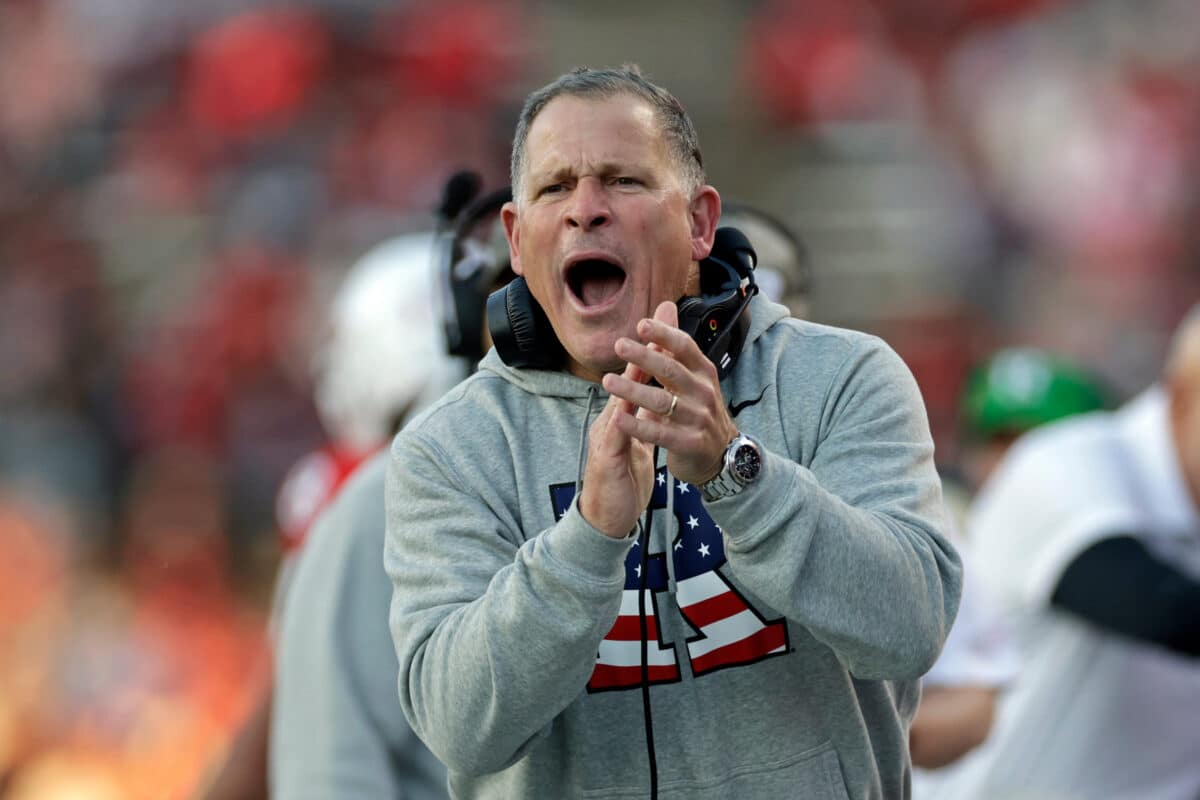
Greg Schiano is the No. 1 hot seat in college football at 0-2, and he earned it the hard way.

Rutgers lost 37-21 at home to a UMass team that hadn’t won a game since October of 2024, as a favorite of nearly 30 points, and Schiano called the performance embarrassing. 8 days later, the Scarlet Knights went to Chestnut Hill and lost 28-21 to a Boston College team that had already been beaten by 19 at Cincinnati. That leaves him with 5 wins in his last 14 games and none in the 2 most winnable dates on his schedule. His composite sits at 96.4.

Mike Norvell is 2nd at 92.4, a gap of 4 points, and the way he got there tells you what kind of week this was.

Norvell didn’t play. Florida State was on a bye, and he still earned a spot because everyone near him got worse. Luke Fickell dropped from 1st to 3rd for beating Western Illinois 36-9. The top of this board rearranged itself over games the top of this board largely sat out.

Schiano has been in it; he’d like everyone to know. Asked about the UMass loss, he reached for Teddy Roosevelt and told the room, “I’ve been in it for 39 years.”

39 years, and 5 wins in the last 14.

Top 25 on the board

Click the button below to see the full ranking of all 138 FBS coaches.

The seat nobody is watching

Tim Albin sits 12th on this board, and I haven’t found his name on a national list all month.

Charlotte opened as a favorite by more than 20 points against The Citadel, an FCS program, and lost 43-41 in triple overtime at home. The 49ers gave up 268 rushing yards and 6 rushing touchdowns to a team that runs the option without apology. A week later, Ole Miss beat them 41-9 in Oxford. Albin’s record at Charlotte is 1-13.

That’s the number, and it’s the reason the board has him ahead of Swinney, ahead of Beamer, ahead of Venables. The only win came against Monmouth last September.

“My heart hurts for the staff and the fan base,” Albin said after The Citadel.

He won a conference championship at Ohio in 2024. He has won 1 game since he left Athens.

Looking ahead to next week

Saturday hands this board 2 games with a hot seat on both sidelines.

  • Akron at Minnesota, noon. Moorhead is 19th, and Fleck is 6th, and 1 of them leaves Minneapolis with a September win over an FBS opponent. If it’s Moorhead, the top 5 gets a new resident.
  • Eastern Michigan at Wisconsin, 12:30. Creighton is 18th, and Fickell is 3rd, and Camp Randall is supposed to make this one boring. A close fourth quarter here lands on the 3rd seat, not the 18th.
  • USC at Rutgers, 3:30 on CBS. Schiano gets the 12th-ranked Trojans at home with AJ Surace at quarterback, the same Surace who threw 3 touchdowns and 4 interceptions at Boston College. Nothing on this date is built to cool the No. 1 seat.
  • Florida State at Alabama, 3:30 on ABC. Norvell hasn’t won a road game since November of 2023, a streak that now runs 1,024 days, and the bye did nothing to shorten it. Tuscaloosa either ends that number or makes it the story of his season.
  • NC State at Vanderbilt, 12:45. Doeren is 5th, Vanderbilt won 10 games last year, and this is the first result of his season that carries real information.
  • Charlotte at App State, 6:00. Albin needs a win badly enough that a respectable loss won’t buy him anything.

Bottom line

A September win over a team with a losing record is worth exactly what you paid for it.

Want to win the debate every single time?

Get our free Coaches Evaluation Scorecard + our 5-day mini-course on how to use it like a pro. Plus, get our weekly coach rankings delivered straight to your inbox. Sign up below.

No related posts found.

LOAD MORE BLOG ARTICLES

Week 15 Coaches Hot Seat Rankings – Breaking Down the Top 5

Welcome to our breakdown of the Top 5 ranked coaches on the Week 15 Coaches Hot Seat Rankings.

In the era of social media and team message boards, College football communities typically fall into three categories:

Picture the modern college football landscape as a digital Roman Colosseum, where three distinct tribes gather daily to pass judgment on their gladiators. I’ve spent months studying these tribes, fascinated by how their collective voice can determine the fate of multimillion-dollar coaching careers with the force of an emperor’s thumb.

First, you have the Sunshine Pumpers – college football’s eternal optimists, whose rose-tinted view of their program would make Pollyanna seem cynical. They’re the ones who’d watch their team’s practice facility burn to the ground and declare it a strategic move to improve ventilation. Their unwavering positivity isn’t just amusing; it’s a psychological defense mechanism worth millions to beleaguered athletic directors who need someone, anyone, to keep buying season tickets.

Then there are the Negative Nellies, the digital descendants of Ancient Greek tragedy choruses. These people have turned catastrophizing into an art form and see an upset loss to a rival as evidence of civilization’s collapse. They don’t just want their coach fired; they want him launched into the sun, preferably before halftime.

But the real power brokers? They’re the Middle Majority – college football’s silent jury. These are the clear-eyed realists who still remember that this is, ultimately, a game played by 20-year-olds. Lose their support, and a coach’s career expectancy drops faster than a team’s ranking after a loss to an FCS opponent.

As we examine this week’s coaching hot seat rankings, remember: these three tribes aren’t just posting on message boards – they’re reshaping the power dynamics of a $8 billion industry, one complaint thread at a time.

Ryan Day, Head Coach at Ohio State University - Coaches Hot Seat

The Ryan Day situation at Ohio State exemplifies how these three tribes can reshape a program’s trajectory. With a staggering 86.8% winning percentage and a 64-3 record outside of Michigan games and playoff appearances, Day should be untouchable in the eyes of any rational observer. But that’s not how college football works in 2024, especially not in Columbus.

The Sunshine Pumpers point to the program’s continued playoff contention and recruiting dominance, including a roster powered by $20 million in NIL money. They’ll tell you that Day’s overall record (.868 winning percentage) would be celebrated at 95% of programs nationwide. And they’re not wrong.

The Negative Nellies, however, have found their ammunition: a 2-7 record in career-defining moments and four straight losses to Michigan, including an unthinkable defeat to an unranked Wolverines squad that had just lost their head coach to the NFL. The “Big Game Day” epithet has stuck, and the critics are getting louder.

But it’s the Middle Majority that makes this situation genuinely fascinating. They’re running the numbers: a $35 million buyout, a coach who consistently wins everything except the games that matter most and a recruiting machine that just watched Michigan flip five-star quarterback Bryce Underwood with a reported $10 million NIL deal. The silent jury is still deliberating, but their patience is wearing thin.

Athletic Director Ross Bjork’s carefully worded support – “Coach Day does a great job leading our program. He’s our coach” – reads less like a vote of confidence and more like a holding pattern until the playoff scenario plays out. The real question might not be whether Ohio State wants to keep Day but whether Day wants to stay in a pressure cooker where even a 66-10 record can’t guarantee job security.

Kenni Burns - Kent State Head Coach - Coaches Hot Seat

Unlike the Ohio State scenario, Kent State’s situation with Kenni Burns has achieved something remarkable: it’s united all three tribes in bewilderment. When you’ve lost 21 straight games and your head coach is being sued for defaulting on a $24,000 credit card debt despite making nearly half a million dollars annually, even the Sunshine Pumpers run out of silver linings to grasp.

The raw numbers read like a satire of college football excess: a 1-33 overall record, a $1.51 million buyout, and a contract extension through 2028 that was inexplicably granted in February 2024 – the same period during which Burns was reportedly falling behind on his credit card payments. The Golden Flashes haven’t just lost games; they’ve been dismantled with surgical precision, outscored 486-160 overall and 282-99 in MAC play. The season’s nadir came early with a loss to St. Francis (PA), though the subsequent 71-0 demolition by Tennessee and 56-0 erasure by Penn State suggest “nadir” might be a moving target.

In any rational football universe, this would be where our three tribes engage in their usual warfare of interpretation. The Negative Nellies would demand immediate change, the Sunshine Pumpers would preach patience, and the Middle Majority would weigh the practical constraints against the competitive collapse. But when your head coach can’t manage his personal finances – defaulting on debt to a local bank that once sponsored the athletic program, no less – while earning $475,000 a year, it raises uncomfortable questions about institutional judgment.

Kent State has transcended such traditional dynamics. When your season ends with a 43-7 loss to Buffalo, extending the nation’s longest active losing streak to 21 games, while your head coach dodges court summons over unpaid credit card bills, you’ve achieved something rare in modern college football: unanimous consensus. The same industry that might force out Ryan Day and his 87% winning percentage at Ohio State has somehow found infinite patience for a program redefining competitive futility both on and off the field.

Perhaps that’s the most fascinating part of this story – how Kent State has inadvertently experimented with just how far institutional inertia can stretch. The answer is at least 21 games, one credit card default, and counting.

Trent Dilfer head coach of UAB - Coaches Hot Seat

The UAB situation under Trent Dilfer exemplifies what happens when all three fan tribes suddenly realize they’ve been watching the same horror movie. Four seasons ago, UAB dominated Tulane with a bruising defense that held the Green Wave to 21 points. This year? Tulane hung 71 points on the Blazers in their stadium.

As Joseph Goodman of the Alabama Media Group devastatingly points out, UAB has completed a stunning transformation “from being a symbol of pride for the city of Birmingham to the worst team in college football.” Not the bottom 10. Not second-to-last. The worst. This is a program that, under Bill Clark, made five consecutive bowl games and engineered a move to the American Athletic Conference. Under Dilfer, they’re losing 32-6 to Louisiana-Monroe, a program he describes as “historically tragic.”

The Sunshine Pumpers, usually reliable defenders of any coach with an NFL pedigree, have gone quiet. The Negative Nellies are pointing to a season-ending loss to Charlotte where the Blazers missed not one but two chip-shot field goals. And the Middle Majority? They’re doing the math on how a program goes from nine wins and a bowl victory over BYU in 2021 to this level of competitive collapse.

Yet in a twist that would bewilder even the most optimistic fans, UAB appears ready to run it back with Dilfer in 2024. The sacrifice of assistant coaches is enough to appease the football gods, even as the program that Bill Clark rebuilt piece by piece crumbles into competitive irrelevance.

The most telling sign of the program’s descent is when a senior quarterback abandons the team mid-season to preserve his eligibility. This suggests that the quarterback whisperer might have lost his voice.

Luke Fickell, Head Coach at University of Wisconsin

You know something has gone wrong when your fanbase goes from celebrating a splash hire to demanding his head in just two years. Luke Fickell’s descent at Wisconsin is a cautionary tale about the dangers of heightened expectations, with his .760 winning percentage at Cincinnati deteriorating to .500 in Madison.

The Sunshine Pumpers still point to his overall .667 career winning percentage and Cincinnati success, including that magical College Football Playoff run. They’ll tell you that losing starting quarterback Tyler Van Dyke to a torn ACL derailed what could have been a breakthrough season. And didn’t Fickell already show accountability by firing offensive coordinator Phil Longo?

However, the Negative Nellies have the receipts: five consecutive losses to the end of 2024, the first such streak since 1991. It was a humiliating 24-7 home loss to Minnesota that snapped a 22-year bowl streak and an offense that managed just 44 total yards in the first half of their season finale, with bowl eligibility on the line. The boos raining down at Camp Randall tell their own story.

The Middle Majority finds itself in an uncomfortable position. This is the same Luke Fickell who Ohio State passed over for Ryan Day – and now both men find themselves scrutinized for failing to meet their program’s standards, albeit at very different levels. The irony isn’t lost on anyone that while Ohio State contemplates moving on from Day’s 87% win rate, Wisconsin seems prepared to give Fickell another chance to prove he hasn’t lost his Cincinnati magic.

The most damning indictment? When athletic director Chris McIntosh’s recent raise and extension become part of the conversation about your job security, you know the pressure is mounting.

Hugh Freeze, Head Football Coach at Auburn University - Coaches Hot Seat

At Auburn, the three tribes of college football fandom find themselves engaged in a uniquely expensive form of warfare. Since 2000, the program has spent $68 million not on building success but on buying out failure – a figure transforming Auburn football from a sports program into a case study of institutional self-sabotage.

The Sunshine Pumpers are clinging to Auburn’s 2025 recruiting class, currently ranked fifth nationally, like a life raft in a storm of mediocrity. They’ll tell you that Freeze needs time, that his 444.5 yards per game show the offense is close to clicking, and that better days are just around the corner. Remember that Texas A&M signed a top-20 class a month after firing their coach last year.

The Negative Nellies point to numbers that are harder to spin: 11-14 overall, 5-11 in the SEC, and now 0-2 in the Iron Bowl. As Paul Finebaum put it, after the latest loss to Alabama, people “really have to wonder about this program’s future.” When you’re generating 444.5 yards per game but still can’t score, you’re not just failing – you’re finding innovative new ways to disappoint.

But it’s the Middle Majority that genuinely appreciates the dark comedy here. Auburn has fired a coach two years after winning a national title (Gene Chizik), dismissed another despite his mystifying ability to beat Alabama in odd-numbered years (Gus Malzahn), and scrapped Bryan Harsin for the crime of not being from around here. Now they’ve got Freeze, whose $20.3 million buyout can be paid monthly through 2028 – less like a coaching contract and more like a mortgage on mediocrity.

The most revealing detail is that Auburn structured Freeze’s buyout not as a deterrent to firing him but as a more convenient payment plan. This behavior reflects an institution that knows itself too well—like someone who builds the divorce settlement into their wedding vows.

Thoughts? We’re ready to hear from you. Click right here

No related posts found.

LOAD MORE BLOG ARTICLES