These rankings reflect pressure, not predictions. We don’t forecast firings. We track the gap between expectations and results – the weight of buyouts, the patience of administrators, the brutal math of wins and losses in a sport that changes by the hour.
This list is a work in progress.
Openings remain unfilled. Coordinators are fielding calls. NFL franchises are circling college sidelines. By the time you read this, names may have moved to new programs, new positions, or out of the profession entirely.
What won’t change:
The decisions these coaches made in 2025. The results those decisions produced. And the pressure that follows them into the off-season.
Ten coaches.
Ten programs, stuck between the cost of change and the cost of staying the same.
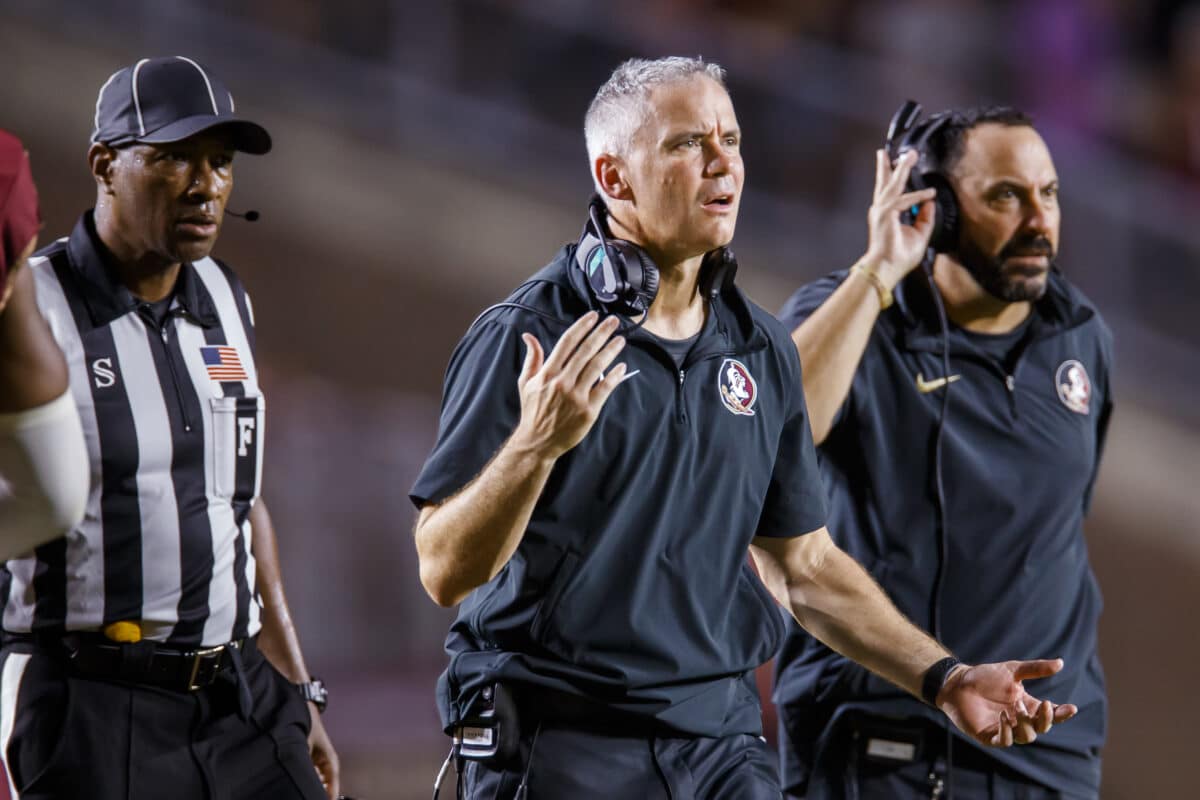
#1. Mike Norvell – Florida State (5-7, 2-6 ACC)
Started 3-0 with win over #8 Alabama, collapsed to 7 losses in final 9 games.
Outgained opponents in 10 of 11 games but kept losing.
Lost to Stanford (no head coach), NC State, Florida.
Norvell publicly admitted he doesn’t have answers after losses.
Administration retained him with vague “fundamental changes” statement despite $60M+ buyout.
Zero road wins.
Fan base exhausted.
#2. Mike Locksley – Maryland (4-8, 1-8 Big Ten)
Started 4-0, finished 0-8.
Pattern repeated: 21-5 in Aug/Sept under Locksley, 15-39 after that.
Eight-game losing streak included a loss to Michigan State (winless in conference entering the game).
Now 16-43 in Big Ten play, 0-18 vs ranked Big Ten opponents.
Worst winning percentage of any Power Four coach with tenure as long as his (after Cal fired Wilcox).
“Fire Locksley” chants at Indiana game.
AD Jim Smith retained him citing $13M buyout, lack of booster money, desire to build around freshman QB Malik Washington.
Locksley: “winning has a cost.”
#3. Shane Beamer – South Carolina (4-8, 1-7 SEC)
SEC Coach of Year 2024 to hot seat in 11 months.
Entered 2025 ranked #13 after 6-game win streak, finished 4-8.
Only Power Four team never to hit 350 yards in single game all season.
Fired OC Mike Shula (after 9 games), OL coach Lonnie Teasley, RB coach Marquel Blackwell.
Fourth OC in five years incoming.
Clemson beat them 28-14 at home (6th straight loss in Columbia).
Beamer gave “one billion percent” guarantee 2026 will be different.
2026 schedule brutal: at Alabama, Florida, Oklahoma; home vs Georgia, Tennessee, Texas A&M.
#4. Dave Aranda – Baylor (5-7, 3-6 Big 12)
The 2021 Big 12 championship now feels like a different lifetime.
22-26 since that trophy.
Defense (Aranda’s specialty) ranked 112th in rushing defense, 106th in total defense, and 123rd in sacks.
Sawyer Robertson led the nation in passing yards; it didn’t matter.
Went 1-5 down stretch.
Only retained due to AD Mack Rhoades’ resignation amid investigation (alleged sideline altercation with TE Michael Trigg).
President Linda Livingstone’s retention letter read like a hostage statement: “We are not settling for mediocrity,” while keeping the coach who delivered exactly that.
37-35 at Baylor with one elite season, five years of drift.
#5. Luke Fickell – Wisconsin (4-8, 1-7 Big Ten)
Took Cincinnati to CFP.
Now 17-21 at Wisconsin with back-to-back losing seasons (first since 1991-92).
Worst record since 1-10 in 1990.
Offense historically bad: 135th of 136 FBS teams in yards (261.6), 134th scoring (12.5 PPG).
Shut out in consecutive games (Ohio State, Iowa) for the first time since 1977.
Lost to Minnesota 17-7 in the finale.
QB situation disaster—hand-picked transfers available for full season in just 11 of 33 games due to injuries.
Fired OC Phil Longo after 10 games in 2024, answered “Why does it matter?” when asked who’d call plays.
Four-star RB Amari Latimer flipped to West Virginia on signing day.
AD Chris McIntosh issued a vote of confidence and promised more resources.
6-18 since taking over program that played in 11 bowls under Rick Stockstill’s 18-year tenure.
Lost season opener to FCS Austin Peay.
Seven-game losing streak included losses to Delaware, Missouri State, Kennesaw State (all in first/second year as FBS, all bowl eligible or close).
Defense allowed 31.5 PPG. Lost four consecutive conference games by touchdown or less.
Closed with wins over 2-10 Sam Houston, 4-8 New Mexico State.
Mason is calling that “momentum.”
Retained reportedly because AD Chris Massaro may retire in 2026.
Now 33-67 as head coach.
Stanford coordinator “shine” wore off at Vanderbilt, and it wore off in Murfreesboro.
#7. Bill Belichick – North Carolina (4-8, 2-6 ACC)
The six-time Super Bowl champion went 4-8 in his first college season.
Debut: College GameDay for 48-14 loss to TCU.
Midseason WRAL report: program “unstructured mess,” “complete disaster.”
Lost five games by 16+ points.
Three FBS wins vs teams with a combined 8-28 record.
Offense last in ACC: 264.8 yards, 19.3 PPG.
GM Mike Lombardi called UNC the “33rd NFL team” at the presser.
Off-field chaos: banned Patriots scouts, assistant suspended for NCAA violations, players cited for reckless driving, 24-year-old girlfriend tabloid fixture.
Four-minute postgame presser after NC State blowout, no season recap: “I don’t have one. We haven’t done it.”
Guaranteed $10M/year through 2027.
Losing players to the portal while fielding NFL inquiries.
Three straight losing seasons (two New England, one Chapel Hill).
“Patriot Way” hasn’t translated.
#8. Scotty Walden – UTEP (2-10, 1-7 CUSA)
Turned Austin Peay into an FCS power.
5-19 in two years at UTEP.
Finished 2-10 in 2025 (one fewer win than Year 1).
Finale: 61-31 humiliation at Delaware (first FBS season, still blew out UTEP by 30).
Walden confronted Delaware coach Ryan Carty over a late field goal, calling it “classless.”
UTEP threw five interceptions that game.
Lost to Kennesaw State, Missouri State, and Jacksonville State (all FCS) a year ago.
UTEP hasn’t won a bowl game since 1967 (the longest FBS bowl drought).
Moves to Mountain West in 2026: tougher opponents, longer travel.
Age 35 with time to figure it out, but rebuild producing no results.
#9. Jay Sawvel – Wyoming (4-8, 3-5 Mountain West)
Craig Bohl built seven straight winning seasons.
Sawvel: 7-17 in two years, 4-11 conference, zero bowls.
Finished 4-8 in 2025, four-game losing streak to end season (24 combined points).
Defense solid (19.9 PPG, 23rd nationally).
Offense averaged 16 PPG (inflated by two defensive TDs).
Demoted OC Jay Johnson midseason, promoted WR coach Jovon Bouknight – didn’t help.
Beat Colorado State 28-0, then scored 17 total over the final three games.
AD Tom Burman confirmed return for Year 3, citing $2.88M buyout: “4-8 doesn’t work” but Sawvel “gives us the best chance to get it fixed.”
Mountain West losing Boise State, CSU, Fresno State, SDSU, Utah State to Pac-12.
Only 20 players remain from Bohl era, none earned all-conference honors.
Rebuild stalling.
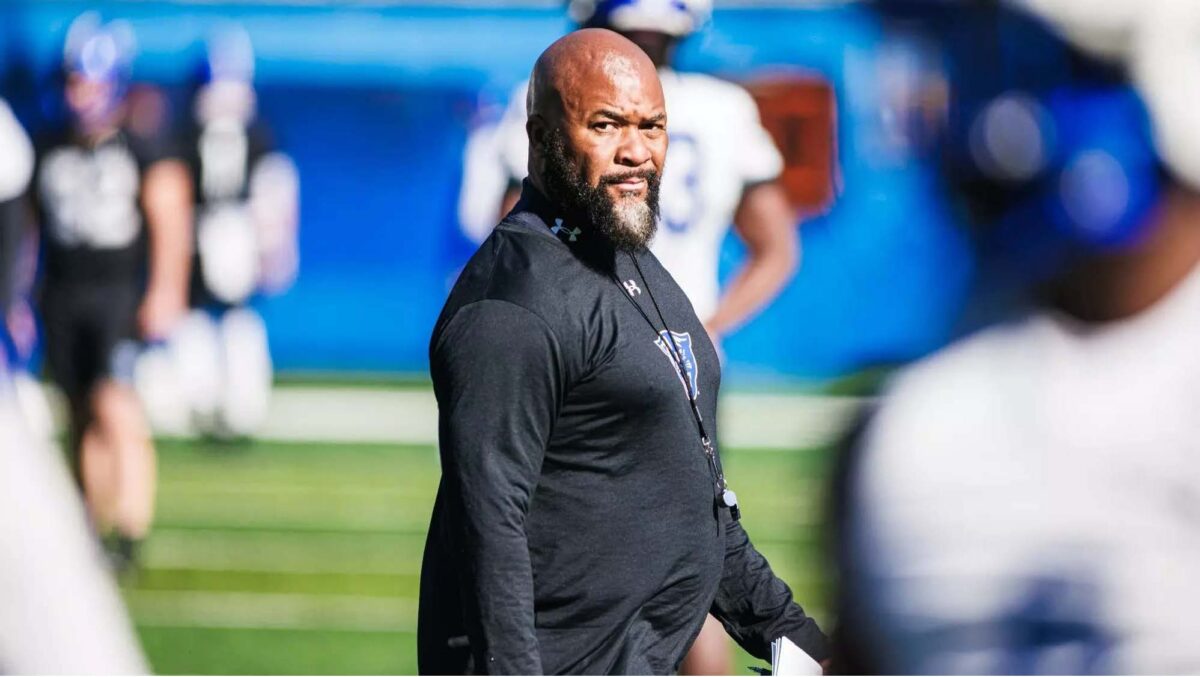
#10. Dell McGee – Georgia State (1-11, 0-8 Sun Belt)
Two national championship rings at Georgia. 4-20 at Georgia State.
Dell McGee helped develop Nick Chubb, Sony Michel, and D’Andre Swift into NFL first-rounders.
He can’t develop a competitive Sun Belt roster.
Inherited a program that went 7-6 with a bowl win in 2023 under Shawn Elliott.
Two years later: back-to-back double-digit loss seasons.
The 2025 campaign delivered historic futility.
Lost opener at Ole Miss 63-14 (gave up nearly 700 yards).
Lost to Vanderbilt 70-28—first time allowing 70 points in program history.
Defense surrendered 40.7 PPG (135th of 136 FBS teams).
Nine-game losing streak to finish.
Only win: FCS Murray State.
The Hue Jackson hire told the story.
McGee promoted the 0-16 Browns architect (3-36-1 NFL record) to offensive coordinator after Grambling State fired him for “lack of transparency, coordination, and collaboration.”
The results: 21.1 PPG, 114th nationally.
Lost finale 10-27 at Old Dominion.
McGee’s Georgia State tenure has never held an opponent under 21 points.
Not once in 24 games.
He’s now 4-20 as a head coach at a program that made four bowls in five years before he arrived.
The “four Cs”, connected, competitive, committed, and composure, remain talking points.
Results remain absent.
AD Charlie Cobb hasn’t addressed McGee’s future publicly.
The program averaged 11,000 fans at Center Parc Stadium – when they showed up.
Year 3 brings no relief: at Georgia Tech, at LSU, at Miami on the non-conference slate.
Position coaching excellence doesn’t automatically translate to program building.
Georgia State is learning that lesson at considerable cost.
Dell McGee’s first season at Georgia State ended exactly how everyone feared it would.
The former Georgia running backs coach—who helped develop Nick Chubb, Sony Michel, and D’Andre Swift into NFL stars—managed just 3 wins in 12 games. His hot seat rating of .702 against weak competition tells the brutal truth: even lowered expectations proved too high.
But the real nightmare isn’t what happened in 2024.
It’s what’s coming in 2025.
The 3-9 Disaster That Nobody Saw Coming (Except Everyone Did)
McGee inherited a Georgia State program that won 7 games and a bowl in 2023 under Shawn Elliott.
Twelve months later, the Panthers managed wins against:
Chattanooga (24-21)
Vanderbilt (36-32)
Texas State (52-44)
That’s it.
The offensive numbers expose the systematic failure. Georgia State averaged 23.7 points per game—exactly matching the 23.7 points they surrendered on defense. This wasn’t a team learning a new system. This was a program drowning in mediocrity.
The tale of two seasons lived within individual games.
In victories, McGee’s offense exploded for 440.3 yards per game with 176.3 rushing yards. In losses, those numbers collapsed to 371.9 total yards and a pathetic 118.9 rushing yards per game.
For a coach whose specialty was developing elite ground games, watching his rushing attack average 4.4 yards per carry had to be torture.
The Position Coach Paradox That’s Destroying Everything
Here’s the uncomfortable truth about Dell McGee: his resume creates impossible expectations.
Eight seasons at Georgia. Back-to-back national championships. 56 NFL draft picks developed, including 15 first-rounders. National Recruiter of the Year in 2018.
Yet his Georgia State debut featured:
A quarterback (Christian Veilleux) with 11 interceptions against 13 touchdowns
A defense surrendering 6.2 yards per play
A rushing offense that managed just 133.3 yards per game
The cruelest reality in college football is that excellence doesn’t transfer between roles.
The disconnect shows up everywhere. McGee’s Georgia offenses operated with surgical precision. His Georgia State offense completed 60.4% of passes while turning the ball over 1.6 times per game.
The 68-Player Roster Explosion That Could Backfire Spectacularly
McGee’s response to 2024’s failure? Blow up the entire roster.
Georgia State brought in 68 new players for 2025:
33 true freshmen
Multiple FBS transfers
Power Five running backs Rashod Amos (Ole Miss), Djay Braswell (South Carolina), Branson Robinson (Georgia)
Wide receiver Leo Blackburn from Georgia Tech
Four-star defensive tackle Jartavius Flounoy
This represents more than 60% roster turnover—the college football equivalent of burning down the house to kill a spider.
The recruiting class ranks as Georgia State’s best in program history and tops in the Sun Belt according to 247Sports. On paper, it solves every problem that plagued 2024.
But here’s what nobody wants to admit: chemistry matters more than talent.
Team cohesion doesn’t develop overnight. When three-quarters of your roster is new, you’re essentially coaching a completely different team. New problems emerge even as old ones theoretically get solved.
McGee is gambling his career on unproven players developing instant chemistry while learning his system.
The odds are not in his favor.
The Hue Jackson Hire That Should Terrify Georgia State Fans
McGee replaced offensive coordinator Jim Chaney with former NFL head coach Hue Jackson.
On the surface, this looks smart. Jackson brings play-calling experience from both college and professional levels. He should address the offensive inconsistencies that plagued 2024.
But Hue Jackson’s history reveals a pattern of organizational destruction that should keep Georgia State administrators awake at night.
Jackson’s NFL tenure ended with a historically bad 3-36-1 record with Cleveland. Former quarterback Baker Mayfield called Jackson “fake” after he immediately joined division rival Cincinnati following his firing.
The pattern repeats everywhere Jackson coaches:
NFLs Oakland Raiders fired him in 2011 after he publicly criticized his team and defensive coordinator following a season-ending loss
The Cleveland Browns fired him after 2.5 seasons of historic futility
Grambling State fired him after just two seasons amid complaints about “lack of transparency, coordination, and collaboration.”
Jackson’s documented tendency toward organizational undermining creates a ticking time bomb within McGee’s staff.
His X’s and O’s knowledge is legitimate. His ability to function within organizational structures remains questionable.
For a first-time head coach already fighting for credibility, bringing in a coordinator with Jackson’s baggage represents either desperation or poor judgment.
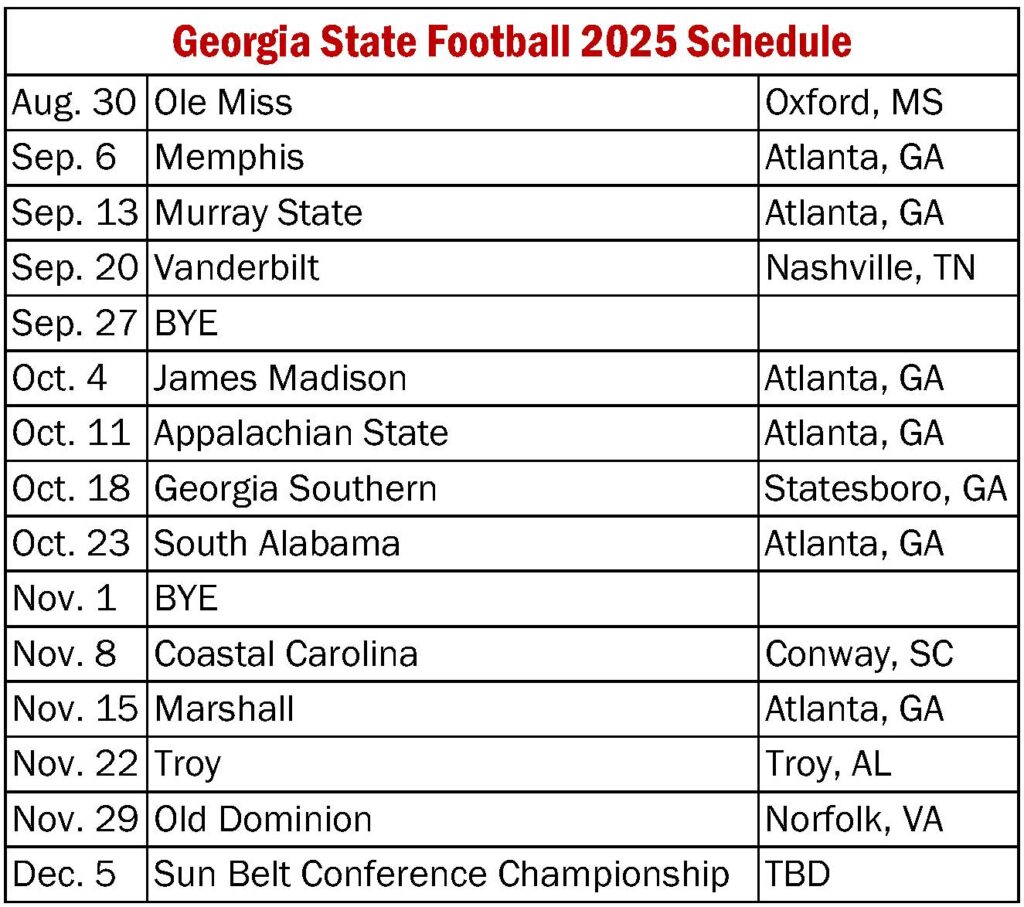
The Schedule From Hell That Will Expose Every Weakness
The 2025 schedule offers zero mercy for a program attempting massive reconstruction.
Non-conference games include:
At Ole Miss (August 30)
Memphis (September 6)
At Vanderbilt (September 20)
These aren’t tune-up games—they’re potential blowouts that could destroy confidence before Sun Belt play begins.
The conference schedule presents additional nightmares. James Madison, Appalachian State, and Georgia Southern all possess the talent to embarrass Georgia State if the roster overhaul fails to gel quickly.
McGee’s 1-7 Sun Belt record in 2024 demands immediate improvement. The roster upheaval creates uncertainty about whether improvement is even possible.
Bowl eligibility requires six wins. Based on the current trajectory, that target appears optimistic rather than achievable.
The Hot Seat Mathematics That Don’t Add Up
Dell McGee’s .702 Hot Seat Rating reflects a harsh reality: even modest expectations exceeded actual performance.
The “weak competition” qualifier stings because it suggests Georgia State couldn’t meet diminished standards. When your floor becomes your ceiling, the trajectory points in only one direction.
The financial commitment suggests institutional patience, but college football rarely affords extended timelines.
McGee signed a five-year deal worth approximately $850,000 annually. That investment should provide job security.
But Georgia State’s overall program record of 54-92 across 12 seasons creates fan apathy that demands a dramatic reversal rather than gradual improvement.
Year two becomes crucial for demonstrating that 2024’s struggles represented growing pains rather than fundamental limitations.
The Uncomfortable Truth Nobody Wants to Acknowledge
McGee’s situation exposes college football’s cruelest contradiction.
Fans and administrators expect immediate improvement while simultaneously understanding that roster reconstruction takes time. This creates impossible expectations that doom coaches before systems fully develop.
The hot seat rating reflects broader impatience with Georgia State football’s entire existence.
The program has never achieved sustained success. Four different head coaches. Multiple conference changes. A fanbase that’s watched 12 years of mostly mediocre football.
McGee inherited not just personnel problems but cultural ones. He needs to simultaneously rebuild the roster and manage expectations in a market that’s already given up on the program.
Success in 2025 depends less on McGee’s coaching ability than on his capacity to manage a program undergoing complete identity transformation.
The massive roster turnover represents both opportunity and vulnerability. Potential solutions that could easily become new problems if chemistry and execution falter.
Dell McGee’s future hinges on proving that elite position coaching translates to program leadership.
The early evidence remains incomplete, but the hot seat temperature continues rising with each passing month.
Year two will determine whether Dell McGee represents Georgia State’s future or merely another transition point in the program’s ongoing search for something it has never actually achieved: sustained success.
Get insider college football intel delivered to your inbox
Want insider analysis on college football program moves before they happen? Get hard-hitting insights, no fluff – straight to your inbox. Subscribe to the Coaches Hot Seat newsletter and be on the cutting edge of what’s happening in the world of college football.