
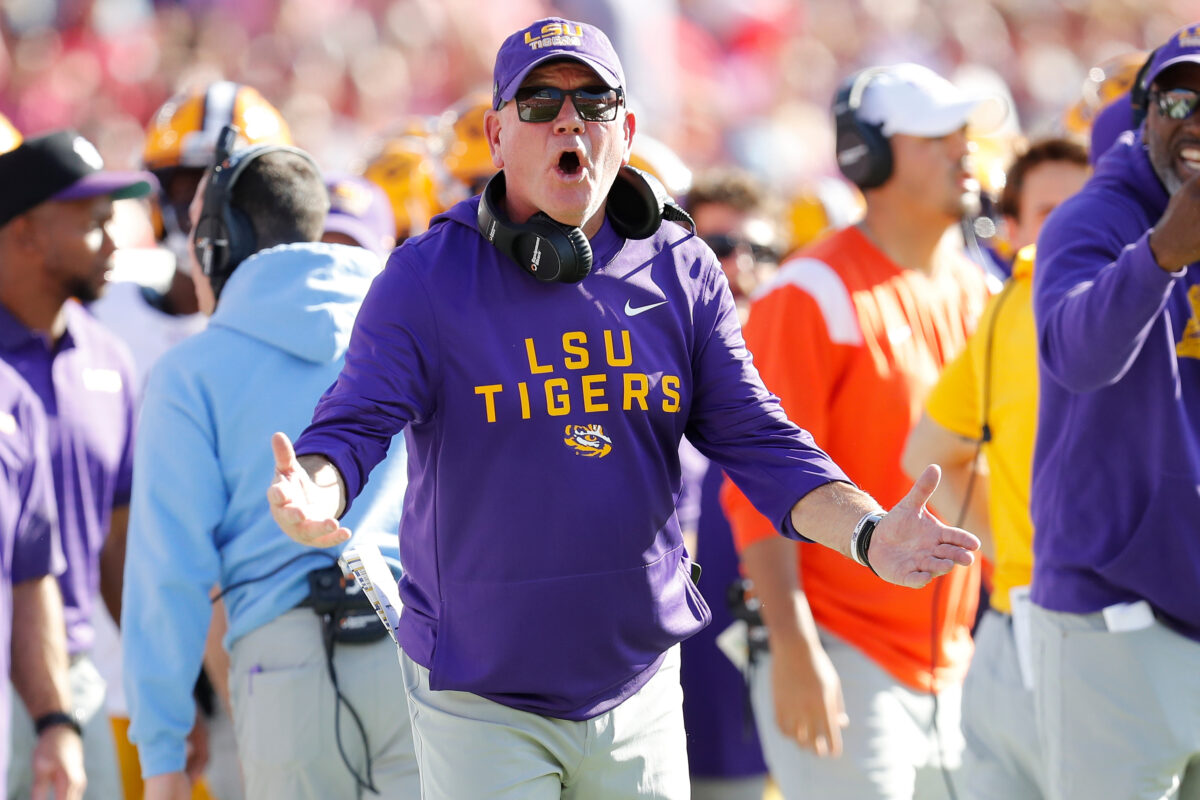
Brian Kelly Is Out at LSU—And the Coaching Carousel Just Got Absolutely Insane

The coaching carousel just claimed its biggest name yet.

Brian Kelly is out at LSU. Fired. Done. Less than 24 hours after a humiliating 49-25 home loss to Texas A&M—after running into the locker room while students chanted “Fire Kelly,” after being forced to come back out and sing the alma mater with his players—LSU finally pulled the trigger. But this wasn’t a simple firing. This was a full-blown confrontation that spiraled out of control.

Here’s what happened.

The Dramatic Showdown That Ended It All

Sunday afternoon, according to The Athletic’s Bruce Feldman and Ralph D. Russo.

Brian Kelly and athletic director Scott Woodward meet. Woodward wants staff changes. Specifically, he wants Kelly to fire offensive coordinator Joe Sloan. LSU’s offense ranks dead last in the SEC in rushing. Something has to give. Kelly fires back. If we’re making staff changes, he says, I want to make different changes. Ones Woodward isn’t comfortable with.

Things get tense.

The conversation escalates. Kelly pushes back hard against his boss. Threats about negotiating Kelly’s $53 million buyout come up. But there’s a question: will the LSU Board of Supervisors even give Woodward the authority to do that?

By Sunday night, it’s over.

Kelly is out. A team meeting is called for 8 p.m. Associate head coach Frank Wilson is named interim head coach. Tight ends coach Alex Atkins will take over play-calling duties. And on Monday morning, LSU announces they’ve fired Sloan anyway. “When Coach Kelly arrived at LSU four years ago, we had high hopes that he would lead us to multiple SEC and national championships during his time in Baton Rouge,” Woodward said in the release. “Ultimately, the success at the level that LSU demands simply did not materialize.”

Translation: You didn’t win enough.

But here’s the thing: Kelly isn’t the only one.

This has been one of the most chaotic coaching carousel seasons in years. Jobs are opening everywhere:

  • Penn State
  • LSU
  • Florida
  • Oklahoma State
  • Arkansas
  • Virginia Tech
  • UCLA
  • Stanford

And that’s just so far.

Florida State and Oklahoma could be next. Maybe others. The competition for top candidates is going to be insane. Top-tier schools like Florida, LSU, and Penn State are in their own tier—massive resources, elite NIL, phenomenal facilities. But even they’re going to have to pay up. Big time.

Agents are salivating.

Salaries are about to get wildly inflated. And how many of these coaches will actually complete their contracts without needing to be bought out? History says not many. But here’s the question nobody wants to ask: Who are these schools actually going to hire?

And that leads to an even more uncomfortable question for programs down the ladder.

If You’re Cal (Or Nevada, Or Louisiana Tech), What Do You Do?

Let’s talk about the schools further down the food chain for a second.

If you’re Cal, what do you do? Justin Wilcox has been there for nine years. No winning seasons since 2019. The program is stuck in mediocrity. Do you fire him and jump into this insane market where every coach’s price just tripled? Do you keep investing in a guy who hasn’t delivered? If you’re Nevada, do you pay the $2.7 million buyout for Jeff Choate and try to compete with Penn State and LSU for the same candidate pool? If you’re Louisiana Tech, do you cut ties with Sonny Cumbie and hope you can find someone better in a market that’s about to be picked clean?

The reality is brutal.

The top jobs are going to snap up the top candidates. Everyone else will be fighting over the scraps. Or they’re going to have to roll the dice on assistant coaches and hope they hit on the next Cignetti. Schools like Vanderbilt, Missouri, Tulane, North Texas, Memphis, Wake Forest, and Boise State have coaches who are prime poaching targets. And they won’t have the money to keep them if the big boys come calling.

It’s a bad year to be a mid-tier program with an up-and-coming coach.

So, Who Is LSU Going to Get That’s Better Than Brian Kelly?

Which brings us back to the biggest question of all.

Think about Kelly’s résumé for a second:

  • Two Division II national championships
  • Took Cincinnati to 11-1 and a top-4 finish
  • Took Notre Dame to two national championship games
  • Ten top-25 finishes at Notre Dame, half of them in the top 10
  • Won 10 games in each of his first two seasons at LSU with top-15 finishes
  • Won 9 games last year
  • On pace for 8 wins this year

That’s not a bad coach.

That’s an excellent coach who didn’t meet LSU’s sky-high expectations. So who’s the upgrade? The names being thrown around: Lane Kiffin, Marcus Freeman, Brent Key, Eli Drinkwitz, Jon Sumrall. Are those guys sure things? Are they going to be infinitely better than Kelly?

Nobody knows.

LSU is about to spend $100 million (or more) buying out Kelly and his staff, then funding a new coaching staff, to get someone who might be better. It’s a massive gamble. Here’s the reality: You’re going to spend probably $100M buying out your previous coaching staff and funding your new one to get someone that isn’t necessarily a sure thing. It’s not like Brian Kelly was going 4-8.

And here’s the kicker.

Unless LSU is bringing back Nick Saban, Chris Petersen, or Urban Meyer from retirement, there isn’t a candidate out there who’s a sure thing. Lane Kiffin is going to make a fortune – either from Ole Miss giving him a massive raise to stay, or from one of these desperate schools throwing ridiculous money at him. Brian Kelly won’t be out of work long. Neither will James Franklin, who Penn State moved on from. They’re outstanding coaches. The problem is they weren’t great enough for programs with championship-or-bust expectations.

And that’s the new reality of college football.

What’s Next?

The carousel is spinning.

Fast. More jobs will open. More coaches will get massive paydays. More schools will regret the contracts they’re about to hand out. In about four years, a lot of these fan bases are going to be asking: “Why did we give him that contract?!”

But right now?

It’s chaos. And LSU is right in the middle of it.

Stay tuned.

No related posts found.

LOAD MORE BLOG ARTICLES

LSU Football 2025: Brian Kelly’s Championship Window Is Closing Fast

LSU Football Coach Brian Kelly is coaching for his legacy.

After three seasons in Baton Rouge that have produced solid records but no championship hardware, the LSU head coach enters 2025 with the best roster he has ever assembled and absolutely no margin for error.

The Tigers finished 9-4 in 2024, including a Texas Bowl victory over Baylor (44-31), but that’s not why Kelly was hired. He came to LSU with one mission: to deliver a national championship. ESPN listed Kelly among the 10 “coaches to watch” in 2025, joining Colorado’s Deion Sanders and Alabama’s Kalen DeBoer as coaches facing make-or-break seasons.

The message from college football analysts couldn’t be clearer: “With [quarterback] Garrett Nussmeier, a guy I think will be the No. 1 pick in next year’s draft, (Kelly has) got to get it done this time around or Brian Kelly is going to be on the hot seat by November.”

This is “championship or bust” for LSU in 2025.

The Quarterback Question Is Finally Answered

Garrett Nussmeier isn’t just returning—he’s arriving as a legitimate Heisman candidate.

The redshirt senior threw for 3,738 yards and 26 touchdowns in his first year as the starter, completing 315.2 passing yards per game with a 64.4% completion rate. Those numbers powered LSU’s offense to 431.5 total yards per game, making them one of the SEC’s most explosive units.

But here’s what makes Nussmeier’s return even more valuable: he finished the 2024 season as LSU’s undisputed leader. The Tigers won their final three games, including victories over Vanderbilt, Oklahoma (37-17), and the Texas Bowl triumph over Baylor.

“He and I have talked about this, but he was as prepared as he could be and developed as much as he could have developed to play, but then there’s experience you have to get from playing,” offensive coordinator Joe Sloan said. “There were things that happened during the season that he’s now aware of how they transpired.”

The experience factor cannot be overstated. Nussmeier now understands SEC defenses, pressure situations, and what it takes to win championship-level games.

“You know, that’s not really my focus,” Nussmeier said about Heisman talk. “I think that I’m worried about doing the best I can to help LSU win a national championship. That’s the mindset; that’s the energy and intensity that I bring every single day.”

Portal Perfection: LSU Built A Championship Roster

Brian Kelly made the most crucial decision of his LSU tenure after the 2024 season.

He went all-in on the transfer portal, landing the nation’s No. 1 transfer class with 18 elite additions. This wasn’t just roster management—this was championship construction.

“We have a strong young nucleus in our program, but now it’s time to add to that,” Kelly said in December. “Those that have moved on, we wish them the best, and now we feel like we’ve put ourselves in a position where we can put together an SEC Championship roster.”

The results speak for themselves:

  • LSU landed 8 of the Top-100 transfer portal players
  • Every major weakness from 2024 was addressed
  • Immediate starters were added at critical positions
  • Depth was created across the entire roster

“It has put us in a position where we can be aggressive on anybody that comes into the portal. And that simply wasn’t the case before,” Kelly said of the new NIL approach.

The Offensive Additions That Change Everything

Wide Receivers: Barion Brown from Kentucky and Nic Anderson from Oklahoma join a receiving corps that already features Aaron Anderson (884 yards in 2024), Kyren Lacy (866 yards), and Mason Taylor (546 yards). This creates the deepest, most talented receiver room in the SEC.

Offensive Line: LSU’s biggest weakness in 2024 was their rushing attack, which averaged just 116.4 yards per game. The Tigers brought in Braelin Moore and Josh Thompson, two of the portal’s top interior linemen, to completely transform their ground game.

Tight Ends: After losing Mason Taylor, LSU added Bauer Sharp, Donovan Green, and JD LaFleur to create what many consider one of the nation’s best tight end rooms.

Running Backs: Five-star freshman Harlem Berry joins returning rusher Caden Durham (753 yards in 2024) to form a dynamic backfield capable of explosive plays.

Defense Gets A Complete Makeover

Blake Baker returns for his second season as defensive coordinator with a mission: fix everything that went wrong in 2024.

Last season’s defense allowed 364.4 yards per game and 24.3 points per game, struggling particularly against elite competition. The Tigers surrendered 140.1 rushing yards per game and couldn’t generate consistent pressure.

Baker’s solution? Reload through the portal with proven performers.

The Defensive Additions That Will Matter

Patrick Payton (Florida State): The crown jewel of LSU’s defensive haul. The 6-foot-5, 250-pounder logged 109 tackles, 32 tackles for loss, 16 sacks, 12 pass breakups, and three forced fumbles in three seasons. He was rated as the No. 2 overall transfer and the No. 1 edge rusher in the market.

Jack Pyburn (Florida State): Adds proven pass rush ability alongside Payton.

Jimari Butler (Nebraska): Brings 16 tackles for loss over his last two seasons.

Mansour Delane (Virginia Tech): Elite cornerback who tallied 146 tackles, 16 pass breakups, six interceptions, and four forced fumbles in his ACC career.

A.J. Haulcy (Houston): First Team All-Big 12 safety who provides leadership and playmaking ability.

Bernard Gooden (South Florida): All-AAC defensive tackle who addresses interior line depth alongside returning starter Jacobian Guillory.

This isn’t hope-based roster building. This is a surgical improvement of specific weaknesses.

The Schedule That Will Define Kelly’s Future

LSU opens the 2025 season at Clemson on August 30.

This isn’t just a season opener—it’s a statement game that will set the tone for Kelly’s entire campaign. The Tigers face a Clemson team with championship aspirations and a hostile environment that will test everything LSU has built.

But that’s just the beginning. LSU’s schedule includes:

  • Road games at South Carolina, Alabama, and Texas A&M
  • Home contests against Florida, Ole Miss, and Oklahoma
  • Multiple opponents are likely to be ranked throughout the season

The schedule provides opportunities for statement victories but offers zero margin for error. Every game becomes a measuring stick for Kelly’s championship vision.

The Hot Seat Reality Nobody Wants to Discuss

Brian Kelly is widely considered to be on the hot seat entering 2025, and for good reason.

Every LSU head coach this century has won a national championship. That’s the standard. That’s the expectation. That’s what Kelly was hired to deliver.

After three seasons, Kelly has produced:

  • Two 10-win seasons
  • One 9-4 campaign in 2024
  • Zero SEC titles
  • Zero College Football Playoff appearances

At LSU, that’s unacceptable in the long term.

However, Kelly’s massive buyout of over $50 million provides some protection. An immediate firing after early losses is considered unlikely due to the financial implications, but that doesn’t mean he’s safe.

“They have playoff expectations here, and it’s a better depth chart than he’s had in Baton Rouge. If they aren’t in the CFP, I think there’s some serious pressure here,” an anonymous SEC coach noted.

The pressure is real, but Kelly has the tools to succeed.

The Psychological Hurdle That Could Derail Everything

LSU has lost five straight season openers dating back to 2020.

This isn’t just a statistical oddity—it’s a psychological burden that could impact everything Kelly is trying to build. The opener against Clemson represents more than just a game; it’s an opportunity to break a troubling pattern and establish early momentum.

In an expanded playoff format where early losses aren’t necessarily fatal, starting strong becomes even more critical for confidence and team chemistry.

The Moves Nobody Is Talking About

Several under-the-radar developments could prove crucial to LSU’s championship hopes:

Special Teams Transformation: After ranking last in the SEC in special teams efficiency, LSU hired Aman Anand as coordinator and dramatically increased practice emphasis. With proven returners like Barion Brown and Aaron Anderson, this unit could become a difference-maker.

Harold Perkins’ Evolution: The standout linebacker returns from injury to play a hybrid “STAR” role, maximizing his athleticism and creating matchup problems for opponents.

Coaching Staff Additions: Alex Atkins joins as tight ends coach and run game specialist, designed to transform LSU’s ground attack that averaged just 4.1 yards per carry in 2024.

Leadership Integration: With nearly 40 new players joining the roster, veteran leadership from Nussmeier and linebacker Whit Weeks becomes crucial for maintaining chemistry.

These aren’t glamorous storylines, but they’re the details that separate good teams from championship teams.

What Championship Success Looks Like

LSU enters 2025 with legitimate College Football Playoff aspirations.

“This is the best roster that we’ve put together,” Kelly acknowledged during a recent SEC Network appearance. The combination of elite quarterback play, strategic portal additions, and recruiting momentum has created championship-level expectations.

“It’s the closest team I’ve been a part of at LSU from top to the bottom of the roster and so that’s very exciting,” Nussmeier said. “There’s a lot of expectations for us, and we accept those expectations.”

The statistical foundation supports championship aspirations:

  • 2024 offense averaged 431.5 total yards per game
  • 30.3 points per game scoring average
  • Proven quarterback with 3,738 yards passing
  • Elite defensive additions addressing every weakness

Success in 2025 will be measured by playoff qualification and championship competitiveness.

Anything less represents failure.

The Bottom Line: Championship Window Is Now

Brian Kelly’s LSU tenure reaches its defining moment in 2025.

ESPN’s assessment captures the reality: “Kelly came to the Bayou with the expressed purpose of winning a national title, just like the three Tigers coaches before him. Instead, he watched his former team, Notre Dame, make a CFP run while he sat home again.”

Kelly has eliminated every excuse:

  • The quarterback situation is solved
  • The transfer portal class ranked No. 1 nationally
  • The recruiting momentum continues with elite classes
  • The coaching staff provides continuity and expertise

The resources are available. The talent is elite. The expectations are championship-level.

For LSU football in 2025, it’s a championship or consequences.

Kelly’s future in Baton Rouge depends on delivering the breakthrough season that has eluded him since leaving Notre Dame. The pieces are in place for historic success. Still, execution under pressure will determine whether Kelly joins the pantheon of LSU championship coaches or becomes another coach who fails to meet the program’s unattainable standards.

The window is open. The question is whether Kelly can walk through it.

The Next Billion Dollar Game

College football isn’t just a sport anymore—it’s a high-stakes market where information asymmetry separates winners from losers. While the average fan sees only what happens between the sidelines, real insiders trade on the hidden dynamics reshaping programs from the inside out.

Our team has embedded with the power brokers who run this game. From the coaching carousel to NIL deals to transfer portal strategies, we’ve mapped the entire ecosystem with the kind of obsessive detail that would make a hedge fund analyst blush.

Why subscribe? Because in markets this inefficient, information creates alpha. Our subscribers knew which coaches were dead men walking months before the mainstream media caught on. They understood which programs were quietly transforming their recruiting apparatuses while competitors slept.

The smart money is already positioning for 2025. Are you?

Click below—it’s free—and join the small group of people who understand the real value of college football’s new economy.

No related posts found.

LOAD MORE BLOG ARTICLES

LSU’s Tiger Stadium: A Century of Gridiron Glory

Few venues can match the storied legacy of Louisiana State University’s Tiger Stadium in the annals of college football history. For nearly a century, this hallowed ground has been the stage for some of the sport’s most electrifying moments, a colosseum of the South that has witnessed the rise and fall of football dynasties.

A Monument to American Ingenuity

The year was 1924. Calvin Coolidge was president, George Gershwin’s “Rhapsody in Blue” premiered, and in Baton Rouge, a modest 12,000-seat stadium known as “State Field” rose from the earth. Little did anyone know that this humble beginning would evolve into one of college football’s most iconic landmarks.

But the true stroke of genius came during the Great Depression, a time when American resourcefulness was put to the test. In the 1930s, as the nation grappled with economic turmoil, Louisiana’s larger-than-life Governor Huey P. Long and LSU’s crafty athletics manager Thomas “Skipper” Heard concocted a plan that epitomized the era’s “make do and mend” spirit.

The Dormitory Stadium: A Depression-Era Masterstroke

Their audacious idea? Transform the stadium into a dual-purpose structure by building dormitories underneath the seats. This brilliant (or mad, depending on your perspective) scheme solved two pressing issues: the need for expanded student housing and the desire for a larger football venue. It was a uniquely American solution, born from necessity and fueled by ambition.

This wasn’t just a minor addition. At its peak, these dorms could house up to 1,500 students. Imagine the scene: young scholars poring over their textbooks, their desks vibrating with the thunderous cheers from the game above. These students had the ultimate front-row seat on Saturdays in college football history.

The dorms remained in use until the 1960s and even saw a brief revival in the 1980s. Today, while no longer housing students, this unique feature of Tiger Stadium’s architecture lives on. The 528 windows that once looked into student rooms are part of the stadium’s distinctive external appearance, a visual reminder of its dual purpose in LSU’s history.

This innovative design served multiple purposes. First and foremost, it addressed a pressing need for student housing during economically challenging times. Beyond that, it created an unprecedented symbiosis between the academic and athletic aspects of university life.

The dormitory stadium wasn’t just a clever use of space but a statement. It declared that athletics and academics weren’t separate entities but intertwined facets of the college experience at LSU. Students didn’t just attend games; they lived and breathed football.

This unique feature of Tiger Stadium also contributed to its intimidating atmosphere. The dorms added height and mass to the stadium’s structure, making it loom even larger over visiting teams. On game days, with students pouring out of their rooms and into the stands, it ensured a home-field advantage like no other.

From Depression-Era Innovation to Modern-Day Colossus

As the decades passed, Tiger Stadium grew with LSU’s football aspirations and the sport’s burgeoning popularity. Each expansion was a chapter in the stadium’s evolving story:

  • 1931: The first night game set the stage for LSU’s fearsome nocturnal reputation.
  • 1936: The north end zone addition created the iconic horseshoe shape, boosting capacity to 46,000.
  • 1953: The bowl was completed with the south end zone, pushing attendance to 67,720.
  • 1978: The west upper deck rose, accommodating 78,000 passionate fans.
  • 2000: The east upper deck brought capacity to a staggering 91,600.

Today, standing at 102,321 seats, Tiger Stadium is a testament to the enduring appeal of college football and the unwavering support of the LSU faithful. It’s more than just a sports venue; it’s a living, breathing monument to over 95 years of athletic tradition.

Where Time-Honored Traditions Meet Modern Glory

What sets Tiger Stadium apart isn’t just its imposing structure or massive capacity. It’s the rich tapestry of traditions woven into its very fabric over the decades.

Take, for instance, the “H” style goalposts – a rarity in modern stadiums. These aren’t just functional equipment; they’re a portal to the past, allowing the team to continue the time-honored tradition of running through the goalposts as they enter the field.

Or consider the crossbar mounted above the locker room door, a relic from the goalposts that stood sentinel in the north end zone from 1955 to 1984. Painted with the simple yet powerful exhortation “WIN!”, players touch it as they head onto the field – a tactile connection to generations of Tigers who came before.

Even the field itself tells a story. Unlike most gridirons, Tiger Stadium marks the “5” yard lines, a subtle nod to its unique history and an extra guide for players who’ve called this field home for nearly a century.

Night Falls, Legends Rise

But perhaps no tradition looms larger in Tiger Stadium lore than the night game. Since that first evening contest in 1931, LSU has turned playing under the lights into an art form. The statistics tell the tale: since 1960, LSU’s winning percentage has skyrocketed from a respectable .419 during day games to an eye-popping .745 at night.

This isn’t just home-field advantage; it’s practically football alchemy. As twilight descends on Baton Rouge, Tiger Stadium transforms. The already daunting structure seems to grow, casting long shadows across the field. The crowd, marinated in hours of tailgating and anticipation, reaches a fever pitch. In these twilight hours, Tiger Stadium truly becomes “Death Valley” – a place where opponents’ hopes go to die.

Echoes of Greatness

Every historic stadium has its legendary moments, but Tiger Stadium’s have shaken the earth. On October 8, 1988, the “Earthquake Game” against Auburn saw the crowd’s reaction to a game-winning touchdown register on a campus seismograph. It’s not every day that a football game is measured on the Richter scale.

But perhaps the most iconic moment came on Halloween night in 1959. Billy Cannon’s 89-yard punt return against Ole Miss didn’t just win a game; it became the stuff of Louisiana legend. The crowd’s roar was so intense that local residents feared some calamity had befallen the city. In reality, it was just another Saturday night in Death Valley.

These moments, and countless others like them, have turned Tiger Stadium into more than just a venue. It’s a cathedral of college football, where the ghosts of gridiron past mingle with the stars of today and tomorrow.

The Ultimate Test for Any Coach

For visiting coaches, Tiger Stadium represents the Everest of college football challenges. It’s a crucible that has broken many and forged the legends of a select few. The late great Paul “Bear” Bryant, a man who knew something about hostile environments, once declared, “Baton Rouge happens to be the worst place in the world to be a visiting team.”

As modern amenities like luxury skyboxes are carefully integrated into its historic confines, Tiger Stadium continues to evolve. But at its core, it remains what it has always been: a monument to the passion, tradition, and sheer spectacle of college football.

Tiger Stadium has been a colossus of the college football world for nearly a century. It’s more than just concrete and steel; it’s a living, breathing testament to the enduring power of sport to unite, inspire, and create moments of pure, unadulterated magic. In an era of cookie-cutter stadiums and corporate naming rights, Death Valley stands apart—a place where history is not just remembered but continually made.

The dormitory stadium’s legacy lives on in LSU lore. It’s a testament to the resourcefulness of Depression-era planners, the passion of LSU football fans, and the deep connections between all aspects of college life. While modern students may not be able to claim that they sleep under the stands, they’re still part of a tradition that once saw Tiger Stadium serve as both a colosseum of sport and a home away from home for thousands of Tigers.

Welcome to Tiger Stadium, where football dreams and nightmares have collided spectacularly for almost 100 years. May the next century be just as glorious.

No related posts found.

LOAD MORE BLOG ARTICLES

What We’re Watching Saturday

Pre Game / Kickoff Shows

ESPN College Football Gameday from Columbia, South Carolina (LSU at South Carolina)

Fox Big Noon Kickoff from Madison Wisconsin (Alabama at Wisconsin

Early Games

LSU at South Carolina

Time: Noon Eastern, 9:00 am Pacific

Network – ABC

Announcers: Chris Fowler, Kirk Herbstreit, Holly Rowe

Our Pick: South Carolina

Boston College at Missouri

Time: 12:45 pm Eastern, 9:45 am Pacific

Network: SEC Network

Announcers: Taylor Zarzour, Matt Stinchcomb and Alyssa Lang

Our Pick: BC

Afternoon Games

Texas A&M at Florida

Time: 12:30 pm

Network: ABC

Announcers: Joe Tessitore, Jesse Palmer, and Katie George

Our Pick: Florida

Late Games

Colorado at Colorado State

Time: 4:30 pm

Network: CBS

Announcers: Ross Tucker, Rich Waltz, and Tiffany Blackmon

Our Pick: Colorado State

Indiana at UCLA

Time: 4:30 pm

Network: NBC

Announcers: Noah Eagle, Todd Blackledge, Tappen 

Our Pick: Indiana

Full Schedule

All Times Shown are Pacific

No related posts found.
VISIT OUR SHOP [COMING SOON]

LOAD MORE BLOG ARTICLES

Hot Seat Inferno: The Miami-Florida Showdown is a Must-Win for Both Coaches

Miami vs. Florida: The Hot Seat Bowl

Week 1 of college football is already shaping up to be a scorcher, and nowhere is the heat more intense than in the Sunshine State. The Miami Hurricanes and Florida Gators are set to collide in what can only be described as the “Hot Seat Bowl.”

Both Mario Cristobal and Billy Napier are feeling the pressure. Cristobal’s homecoming to Miami has been anything but triumphant, while Napier’s Gators are underperforming despite high expectations. A quick glance at their nearly identical records in key metrics paints a grim picture:

  • 0% winning vs rivals: Neither coach has secured a win against their biggest foes.
  • 22% late season wins: Both teams have struggled to finish strong, a sign of potential coaching issues.
  • Home field advantage?: While Florida boasts a 69.2% winning record at home, Miami’s is a paltry 50%.
  • Overall winning percentage: Cristobal’s 48% at Miami is slightly better than Napier’s 44% at Florida.

These numbers tell the story of two programs needing a turnaround. For both coaches, this Week 1 matchup is a must-win.

The stakes couldn’t be higher. A loss could accelerate calls for change, while a win might buy precious time and support. Every decision, every play call, will be scrutinized under the intense Florida sun.

Key Matchup: Miami’s RB Henry Parrish Jr. vs. Florida’s QB Graham Mertz. Parrish must carry the load for the Canes, while Mertz must prove he’s the answer for the Gators.

The Burning Question: In this high-stakes game of coaching survival, who will emerge victorious and cool their seat, if only for a week?

The Hot Seat Bowl is about more than just football; it’s about two coaches fighting for their jobs. The pressure is on, the heat is turned up, and the entire college football world will watch.

Georgia vs. Clemson: Reloading vs. Rebounding

Georgia, the defending champs, is looking to keep the dynasty rolling. On the other hand, Clemson is looking to remind everyone they’re still a force to be reckoned with.

Key Matchup: Georgia’s revamped defense vs. Clemson’s offense under coordinator Garrett Riley.

The Burning Question: Can Clemson’s offense keep pace with Georgia’s relentless defense?

LSU vs. USC: A Playoff Preview?

Brian Kelly’s LSU Tigers are rising, and Lincoln Riley’s USC Trojans are always in the spotlight. This clash of powerhouse programs could be a glimpse into the College Football Playoff picture.

Key Matchup: LSU’s QB Garrett Nussmeier vs. USC’s QB Miller Moss. Both quarterbacks are stepping into big shoes, and this game will be their first chance to shine.

The Burning Question: Can USC’s defense, which has been a major focus of offseason improvement, hold up against LSU’s explosive offense?

Notre Dame vs. Texas A&M: Tradition Meets High Expectations

Two storied programs collide in a game that could have profound playoff implications. Notre Dame seeks to build on recent success, while Texas A&M aims for a breakout season under Jimbo Fisher.

Key Matchup: Notre Dame’s new offensive coordinator Mike Denbrock vs. Texas A&M’s talented defense.

The Burning Question: Can Notre Dame’s offense find its rhythm against a tough Aggie defense?

Penn State vs. West Virginia: Upset Alert?

Penn State is a trendy pick to make the playoffs, but West Virginia hopes to crash the party.

Key Matchup: Penn State’s QB Drew Allar vs. West Virginia’s RB CJ Donaldson. Allar needs to lead the Nittany Lions to victory, while Donaldson has to carry the Mountaineers’ offense.

Key Matchup: Penn State’s QB Drew Allar vs. West Virginia’s RB CJ Donaldson. Allar needs to lead the Nittany Lions to victory, while Donaldson has to carry the Mountaineers’ offense.

Week 1 is just the beginning, but it could be the end for some coaches. Buckle up; it’s going to be a wild ride!


No related posts found.

LOAD MORE BLOG ARTICLES