
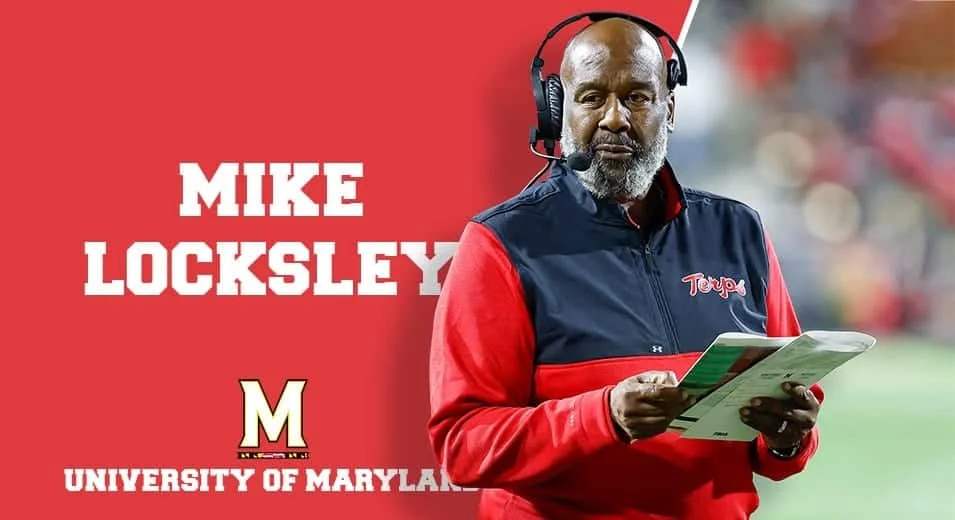
Mike Locksley’s Hot Seat in 2026: Maryland’s 18-0 and 0-19 Problem

Mike Locksley is 18-0. He is also 0-19.

Locksley is the head coach at Maryland, the program he grew up rooting for, and those two numbers are why he enters 2026 coaching for his job. The 18-0 is his record in nonconference games, the bodies nobody schedules to test you. The 0-19 is his mark against ranked Big Ten teams, the only games that decide a season. He beats the filler and loses to everyone who matters, and Maryland keeps meeting that ceiling on national television.

A coach can survive a lot. He cannot survive a number that specific.

Our model grades Locksley a Trend, not a Blip, and 2026 is the cleanest test he will ever get. Maryland brought back nearly everyone that matters, from the freshman quarterback who reset its passing records to a defense that returns almost intact. If a roster this experienced still cannot beat a ranked team, the ceiling was never the talent.

Why the seat is hot

On a Sunday in November, Maryland fired Mike Locksley, and none of it was true.

A fake report tore across social media, blamed a 55-10 homecoming wipeout by Indiana, and pulled past two million views before anyone debunked it. The lie outran the truth for one reason, the same reason the seat is hot: it felt true. This is Locksley’s hometown, the program he grew up rooting for, and for the first time his own stadium chanted for the firing out loud.

Athletic director Jim Smith, in his first year, could have made the move and chose not to. Instead, he retained Locksley for 2026 and published an open letter promising more resources, conceding that competing requires a level commitment. That is not a clean endorsement. It is a new AD betting on continuity while admitting the program has been under-supported, and it leaves Locksley coaching for his job with the safety net half-removed.

Here is the standard. Ralph Friedgen won 60 percent of his games at Maryland and kept the Terps ranked across 36 separate weeks. Locksley has won 45 percent and reached the rankings in exactly one week of his entire tenure.

The comparison that fuels the heat:

  • Win rate: .453 to Friedgen’s .600. Greg Schiano at Rutgers, the peer comp, sits at .444.
  • Quality: an average SRS of 2.5 to Friedgen’s 5.5.
  • Relevance: one ranked week, against Friedgen’s 36.

The national lists agree with the fans. Sports Illustrated slots his seat among the hottest in the Big Ten, CBS Sports files him under start-improving-now, and 247Sports calls 2026 a referendum.

The rebuild that makes this hurt

To understand the fall, you have to understand what Locksley walked into.

He took the job in December 2018 as a man who already knew the worst thing. Fifteen months earlier, his son Meiko had been shot and killed in Columbia at 25, a case still unsolved, and nine months after that, a Maryland player named Jordan McNair died of heatstroke after a team workout, in the same Shock Trauma center where Meiko died. Locksley had helped recruit McNair. He did not inherit a football program so much as grief, and he came home anyway, telling recruits’ families he would treat their sons as his own.

The program was rubble. DJ Durkin had been fired after McNair’s death exposed a toxic culture, and Locksley’s first team went 3-9 with an SRS of minus 3.18, the signature of a dead program. Then he built. The SRS climbed season by season: -3.18, 0.49, 3.44, 6.68, 9.74. By 2022 and 2023, Maryland was 8-5 and 8-5 with three straight bowl wins, the longest such streak the program had ever produced, powered by quarterback Taulia Tagovailoa.

[Figure 1: SRS climb-and-fall chart, insert from the Diagnosis]

Figure 1. The climb out of a dead program to a 9.74 SRS peak, and the two-year fall that gave it all back. 2020 is omitted from trend scoring.

That 9.74 peak is what convicts him, because the program gave it all back in twenty-four months. Tagovailoa left, and Maryland has not replaced him. This is the cruelty the standings hide: Locksley already proved he could win here, which is exactly why losing it back has felt like a death in the family.

What the data says

Start with the number that ends the cookout argument: Mike Locksley is 0-19 against ranked Big Ten opponents.

In the same years, he has won 18 straight nonconference games. He beats the bodies nobody schedules to test you and loses to everybody who decides a season. Luck does not lose you the same game nineteen times. That is a ceiling, and Maryland keeps meeting it on national television.

Figure 2. The defining split of the Locksley era: unbeaten against the schedule’s filler, winless against everyone ranked.

One honest caveat, because it raises the credibility of everything else.

Friedgen coached entirely in the ACC; Locksley coaches entirely in the Big Ten, and the workbook’s strength-of-schedule numbers confirm his slate is meaningfully tougher. Part of the .600-versus-.453 gap is two leagues, not two coaches. But the harder league explains the floor, not the collapse. He hit 9.74 in this same Big Ten in 2023, then fell to minus 0.74 and minus 0.91. The conference did not change in twenty-four months. The roster did.

The full comparison: Locksley against the Maryland standard

Here is the entire profile in one place, the same way we grade every coach: Locksley measured against the school-success comp, Ralph Friedgen, and the peer comp, Greg Schiano at Rutgers.

The shading is Locksley’s only, and it is read across the three coaches. Green means he is the best of the three on that metric, red means the worst, and the rest is a wash. One glance tells the story: he wins the passing-game rows and loses almost everything that decides games.

Table 1. Career per-game and rate averages, eligible seasons only, 2020 excluded. Shading marks where Locksley ranks best (green) or worst (red) among the three coaches; defensive and giveaway metrics are scored so that lower is better. Source: CHS Hot Seat Diagnosis workbook v3.

Read the green and the red as two sentences.

The green is the passing game: completion percentage, passing yards, passing touchdowns, total yards, and total touchdowns per game, each a Locksley advantage over both comps. The red is everything that turns yards into wins: win percentage, ranked weeks, point differential, turnover margin, points allowed, and passing touchdowns allowed. A coach can lead this table in passing production and still trail it in the only column that matters, which is the win percentage row at the very top.

The defense is the reason, and the names tell the story

If you watched Maryland in November, you watched a secondary get cooked in real time.

The Terps lost their final eight games of 2025, and the defense did the losing. The unit finished fifth-worst in the Big Ten at 26.5 points allowed per game, and it got worse as the year wore on, surrendering a staggering 39.4 points per game across five November contests. They did not hold a single opponent under 20 points down the stretch. The matrix shows why: 28.0 points allowed per game to a comp average of 24.3, 236.8 passing yards allowed to 211.5, and 1.68 passing touchdowns allowed per game to a comp average of 1.32. The run game stagnated too, 128.5 rushing yards a game against a comp average of 151.2 and falling, so an offense that could throw could not run, and a defense that could not stop anyone turned every shootout into a loss.

Here is the twist, and it is the heart of the 2026 case.

Defensive coordinator Ted Monachino keeps his job and enters year two, with co-coordinator Aazaar Abdul-Rahim alongside him, so this is a continuity bet: the same coordinators, kept on to fix what they just broke. The argument for patience is that the bleed was youth, not talent. Monachino has said the young players made young-player mistakes, and Locksley points out the unit still led the Big Ten with 19 regular-season interceptions and four defensive touchdowns, the playmaking of a good defense trapped inside a unit that could not close. The bet is that experience fixes the rest.

And the experience is real, which is what makes 2026 the verdict. Maryland returns 74 percent of its defensive production, fourth nationally behind Florida, Notre Dame, and Air Force, anchored by senior linebacker Daniel Wingate, who turned down outside interest to come back and is arguably the Terps’ best 2027 draft prospect. The edge rotation of Zahir Mathis and Sidney Stewart returns, with five-star recruit Zion Elee added to it. Cornerbacks Dontay Joyner and Jamare Glasker are back, joined by Boston College transfer Amari Jackson. This is a maximally experienced defense by design.

Blip or trend

Most hot-seat lists hand you a label without telling you the window that produced it, which is selling an opinion in a lab coat.

Start the clock in 2023, Locksley’s best year, and the model says a possible blip. Start it in 2024, and the same model says a clear decline. The honest read is the shape itself: this is two straight 4-8 seasons stacked directly on the best two-year run in twenty years. That is not a dip, it is a cliff with a peak right behind it, which is the worst kind, because the talent to be good is recent enough to remember and already gone.

The label is Trend. We make the call in the open instead of hiding the window behind it.

What still works

The case for patience starts at quarterback, and his name is Malik Washington.

The in-state four-star from Archbishop Spalding started as a true freshman in 2025, set Maryland freshman passing records, and agreed to return for 2026 instead of testing the portal, the kind of continuity almost nobody at a 4-8 program keeps. He inherits a new offensive coordinator in Clint Trickett, who ran Conference USA’s top-scoring and rushing offense at Jacksonville State last year, powered by national rushing leader Cam Cook, a deliberate hire to fix the exact run-game problem the matrix flags in red. Washington has a veteran portal room behind him, Cardell Williams from Sacramento State and Devin Kargman from Kent State, so a Washington injury no longer ends the season the way it would have in 2024.

The rest of the case for waiting:

  • Continuity: Maryland returns 14 starters, tied for the second-most in the country. Locksley is betting the whole season on the idea that experience converts close losses into wins.
  • Resources: the AD’s public pledge of more NIL support, per Bleacher Report, signals the administration thinks it underbuilt the roster it is now judging.
  • Local recruiting: five-star edge Zion Elee headlines a build-from-within approach that is keeping DMV talent home, the foundation Locksley’s peak was built on.

None of this erases the cliff. It explains why a move is not automatic. But it also removes the alibis, because a roster this experienced does not get to blame youth in 2026.

The 2026 outlook: the 4-0 start is the trap

The single most dangerous thing that can happen to Maryland in 2026 is a 4-0 start, because it would prove nothing and feel like everything.

The first two openers are the kind of games the 18-game nonconference streak was built on, and Maryland should win them. The next two have teeth: a Virginia Tech rebuild under James Franklin, and a UCLA team the Terps are favored against for one reason only, home field. So even a 4-0 start would rest on two routine wins, one coin flip, and a game decided by a plane ticket. Then the season tells the truth, and the ceiling the standings hide comes due in October.

The runway, all winnable:

  • Sept 5: Hampton: an FCS opener, a scheduled win.
  • Sept 12: at UConn: a road trip but a manageable one, against a team Maryland routed 50-7 in 2024.
  • Sept 19: Virginia Tech: the toughest of the four, at home. Note the wrinkle: this is the first Maryland meeting with a Virginia Tech now coached by James Franklin, who took over in Blacksburg after his Penn State exit, so the rebuilt Hokies are a genuine unknown.
  • Sept 26: UCLA: the Big Ten home opener, and the biggest test of the opening month. This is not the 3-9 UCLA that still beat Maryland in 2025. The Bruins hired Bob Chesney off a James Madison run to the playoffs, reloaded with a top-25 transfer class, and returned Nico Iamaleava with weapons at last. Maryland’s edge is the zip code, not the roster: UCLA crosses three time zones for a road kickoff. Lean on that, but lightly, because if a plane ride is the difference, a win here proves Maryland holds home field, not that it closes the gap that decides seasons.

Then the measuring sticks, where the 0-19 gets its 2026 stress test. Back-to-back road trips to Nebraska on Oct 3 and to Ohio State on Oct 10 are the ceiling for the schedule. The October 31 home game against Illinois and the November 7 trip to Purdue are the swing games that decide bowl math, since Purdue was among the league’s weakest last year, and Locksley has owned Rutgers, his Oct 17 home opponent. The November back half hardens: Wisconsin at home Nov 14, a cross-country trip to USC Nov 21, and the home finale Nov 28 against a Penn State program that has beaten Maryland four straight and owns the all-time series 44-3-1. A scalp there would rewrite the season.

The Market Read

The books have already told you what the model did, if you know how to listen.

Sportsbooks price Maryland around a six-and-a-half win total and a 500-to-1 shot to win the Big Ten, which is the market’s polite way of saying bowl-eligible and irrelevant. The trap is the front end of the schedule. Maryland should walk into October at or near 4-0, and a clean September will tempt the market to price an improvement over the 0-19 mark against ranked teams says is not real. The value, if it exists, lives in the gap between a record propped up by the 18-game cupcake streak and a back half that hardens through Nebraska, Ohio State, Wisconsin, USC, and Penn State.

Watch the tells, not the win column.

  • The numbers to trust are SRS and point differential, because both turn before the record does, and a September that looks clean but flat in the predictive metrics is a mirage with a price tag.
  • The fade window is October, when the filler runs out and the ceiling the standings hide finally comes due.

We do not hand out picks. We hand you the read and the line where it breaks.

What changes the story next

Forget the win total. The signal that matters is whether Maryland finally beats a ranked opponent.

2026 is year eight, and the continuity bet means the excuses are spent. Watch three things, none of them the record against the filler.

  • The defense: with 74 percent of production back and Monachino in year two, the unit that gave up 39.4 a game in November has to actually close games, or the youth excuse dies, and the Trend hardens to Structural.
  • The run game: Trickett was hired to build one. If Washington still has to throw it every down, the offense stays easy to defend when the lights come up.
  • The predictive metrics: watch SRS and point differential early, because they flash a real turnaround before the win column does.

If those hold where they have sat for two years, the next label is Structural Trend, and the conversation stops being about whether to wait.

Bottom line

This is a Trend, and 2026 is the cleanest test Locksley will ever get.

He has his quarterback in Malik Washington, a run-game fixer in Clint Trickett, 14 returning starters, a defense that gets almost everyone back, and an AD who chose him and promised the money. The alibis are gone. Strip them away, and you are left with his own number, 9.74, reached and surrendered in twenty-four months, and an 0-19 mark against which everyone Maryland measures itself. He proved he could build it once. If this roster, this experienced, still cannot beat a ranked team, then Maryland will have its answer: the ceiling was never the talent.

Three things would change my mind, and none of them is another blowout of an overmatched opponent.

  • A one-score win. They went 0-4 in them. One close victory is worth more than every cupcake blowout combined.
  • A road win. The first since November 2023 would be the cleanest evidence that the finishing problem is coaching progress, not noise.
  • The anchors converting. SRS and point differential mean nothing until they start showing up in the fourth quarter of a tight one.

Grade your own coach

You just watched us put Locksley’s seat under the thermometer. You can run the same read on your team.

Our free Coach Evaluation Scorecard breaks a coaching tenure into seven categories, each scored from 1 to 5 based on the evidence in a Diagnosis. Add them up for a number out of 35 that says whether your coach is building the program or losing it. It is how an analyst evaluates a coach, not how a message board does.

Click the button below. Enter your email and hit Grade My Coach. The Scorecard is yours in about two minutes.

No related posts found.

LOAD MORE BLOG ARTICLES

Coaches Hot Seat Rankings – End of Season 2025

The 2025 regular season is complete.

The coaching carousel is not.

These rankings reflect pressure, not predictions. We don’t forecast firings. We track the gap between expectations and results – the weight of buyouts, the patience of administrators, the brutal math of wins and losses in a sport that changes by the hour.

This list is a work in progress.

Openings remain unfilled. Coordinators are fielding calls. NFL franchises are circling college sidelines. By the time you read this, names may have moved to new programs, new positions, or out of the profession entirely.

What won’t change:

The decisions these coaches made in 2025. The results those decisions produced. And the pressure that follows them into the off-season.

Ten coaches.

Ten programs, stuck between the cost of change and the cost of staying the same.

#1. Mike Norvell – Florida State (5-7, 2-6 ACC)

  • Started 3-0 with win over #8 Alabama, collapsed to 7 losses in final 9 games.
  • Outgained opponents in 10 of 11 games but kept losing.
  • Lost to Stanford (no head coach), NC State, Florida.
  • Norvell publicly admitted he doesn’t have answers after losses.
  • Administration retained him with vague “fundamental changes” statement despite $60M+ buyout.
  • Zero road wins.
  • Fan base exhausted.

#2. Mike Locksley – Maryland (4-8, 1-8 Big Ten)

  • Started 4-0, finished 0-8.
  • Pattern repeated: 21-5 in Aug/Sept under Locksley, 15-39 after that.
  • Eight-game losing streak included a loss to Michigan State (winless in conference entering the game).
  • Now 16-43 in Big Ten play, 0-18 vs ranked Big Ten opponents.
  • Worst winning percentage of any Power Four coach with tenure as long as his (after Cal fired Wilcox).
  • “Fire Locksley” chants at Indiana game.
  • AD Jim Smith retained him citing $13M buyout, lack of booster money, desire to build around freshman QB Malik Washington.
  • Locksley: “winning has a cost.”

#3. Shane Beamer – South Carolina (4-8, 1-7 SEC)

  • SEC Coach of Year 2024 to hot seat in 11 months.
  • Entered 2025 ranked #13 after 6-game win streak, finished 4-8.
  • LaNorris Sellers (preseason Heisman candidate) regressed badly.
  • Offense dead last in SEC: 19.7 PPG, 294.1 YPG.
  • Only Power Four team never to hit 350 yards in single game all season.
  • Fired OC Mike Shula (after 9 games), OL coach Lonnie Teasley, RB coach Marquel Blackwell.
  • Fourth OC in five years incoming.
  • Clemson beat them 28-14 at home (6th straight loss in Columbia).
  • Beamer gave “one billion percent” guarantee 2026 will be different.
  • 2026 schedule brutal: at Alabama, Florida, Oklahoma; home vs Georgia, Tennessee, Texas A&M.

#4. Dave Aranda – Baylor (5-7, 3-6 Big 12)

  • The 2021 Big 12 championship now feels like a different lifetime.
  • 22-26 since that trophy.
  • Defense (Aranda’s specialty) ranked 112th in rushing defense, 106th in total defense, and 123rd in sacks.
  • Sawyer Robertson led the nation in passing yards; it didn’t matter.
  • Went 1-5 down stretch.
  • Only retained due to AD Mack Rhoades’ resignation amid investigation (alleged sideline altercation with TE Michael Trigg).
  • President Linda Livingstone’s retention letter read like a hostage statement: “We are not settling for mediocrity,” while keeping the coach who delivered exactly that.
  • 37-35 at Baylor with one elite season, five years of drift.

#5. Luke Fickell – Wisconsin (4-8, 1-7 Big Ten)

  • Took Cincinnati to CFP.
  • Now 17-21 at Wisconsin with back-to-back losing seasons (first since 1991-92).
  • Worst record since 1-10 in 1990.
  • Offense historically bad: 135th of 136 FBS teams in yards (261.6), 134th scoring (12.5 PPG).
  • Shut out in consecutive games (Ohio State, Iowa) for the first time since 1977.
  • Lost to Minnesota 17-7 in the finale.
  • QB situation disaster—hand-picked transfers available for full season in just 11 of 33 games due to injuries.
  • Fired OC Phil Longo after 10 games in 2024, answered “Why does it matter?” when asked who’d call plays.
  • Four-star RB Amari Latimer flipped to West Virginia on signing day.
  • AD Chris McIntosh issued a vote of confidence and promised more resources.
  • Went 53-10 in the final five years at Cincinnati.
  • 17-21 in three years at Wisconsin.

#6. Derek Mason – Middle Tennessee (3-9, 2-6 CUSA)

  • Two years, six wins, zero bowls.
  • 6-18 since taking over program that played in 11 bowls under Rick Stockstill’s 18-year tenure.
  • Lost season opener to FCS Austin Peay.
  • Seven-game losing streak included losses to Delaware, Missouri State, Kennesaw State (all in first/second year as FBS, all bowl eligible or close).
  • Defense allowed 31.5 PPG. Lost four consecutive conference games by touchdown or less.
  • Closed with wins over 2-10 Sam Houston, 4-8 New Mexico State.
  • Mason is calling that “momentum.”
  • Retained reportedly because AD Chris Massaro may retire in 2026.
  • Now 33-67 as head coach.
  • Stanford coordinator “shine” wore off at Vanderbilt, and it wore off in Murfreesboro.

#7. Bill Belichick – North Carolina (4-8, 2-6 ACC)

  • The six-time Super Bowl champion went 4-8 in his first college season.
  • Debut: College GameDay for 48-14 loss to TCU.
  • Midseason WRAL report: program “unstructured mess,” “complete disaster.”
  • Lost five games by 16+ points.
  • Three FBS wins vs teams with a combined 8-28 record.
  • Offense last in ACC: 264.8 yards, 19.3 PPG.
  • GM Mike Lombardi called UNC the “33rd NFL team” at the presser.
  • Off-field chaos: banned Patriots scouts, assistant suspended for NCAA violations, players cited for reckless driving, 24-year-old girlfriend tabloid fixture.
  • Four-minute postgame presser after NC State blowout, no season recap: “I don’t have one. We haven’t done it.”
  • Guaranteed $10M/year through 2027.
  • Losing players to the portal while fielding NFL inquiries.
  • Three straight losing seasons (two New England, one Chapel Hill).
  • “Patriot Way” hasn’t translated.

#8. Scotty Walden – UTEP (2-10, 1-7 CUSA)

  • Turned Austin Peay into an FCS power.
  • 5-19 in two years at UTEP.
  • Finished 2-10 in 2025 (one fewer win than Year 1).
  • Finale: 61-31 humiliation at Delaware (first FBS season, still blew out UTEP by 30).
  • Walden confronted Delaware coach Ryan Carty over a late field goal, calling it “classless.”
  • UTEP threw five interceptions that game.
  • Lost to Kennesaw State, Missouri State, and Jacksonville State (all FCS) a year ago.
  • UTEP hasn’t won a bowl game since 1967 (the longest FBS bowl drought).
  • Moves to Mountain West in 2026: tougher opponents, longer travel.
  • Age 35 with time to figure it out, but rebuild producing no results.

#9. Jay Sawvel – Wyoming (4-8, 3-5 Mountain West)

  • Craig Bohl built seven straight winning seasons.
  • Sawvel: 7-17 in two years, 4-11 conference, zero bowls.
  • Finished 4-8 in 2025, four-game losing streak to end season (24 combined points).
  • Defense solid (19.9 PPG, 23rd nationally).
  • Offense averaged 16 PPG (inflated by two defensive TDs).
  • Demoted OC Jay Johnson midseason, promoted WR coach Jovon Bouknight – didn’t help.
  • Beat Colorado State 28-0, then scored 17 total over the final three games.
  • AD Tom Burman confirmed return for Year 3, citing $2.88M buyout: “4-8 doesn’t work” but Sawvel “gives us the best chance to get it fixed.”
  • Mountain West losing Boise State, CSU, Fresno State, SDSU, Utah State to Pac-12.
  • Only 20 players remain from Bohl era, none earned all-conference honors.
  • Rebuild stalling.

#10. Dell McGee – Georgia State (1-11, 0-8 Sun Belt)

Two national championship rings at Georgia. 4-20 at Georgia State.

  • Dell McGee helped develop Nick Chubb, Sony Michel, and D’Andre Swift into NFL first-rounders.
  • He can’t develop a competitive Sun Belt roster.

Inherited a program that went 7-6 with a bowl win in 2023 under Shawn Elliott.

  • Two years later: back-to-back double-digit loss seasons.
  • The 2025 campaign delivered historic futility.
  • Lost opener at Ole Miss 63-14 (gave up nearly 700 yards).
  • Lost to Vanderbilt 70-28—first time allowing 70 points in program history.
  • Defense surrendered 40.7 PPG (135th of 136 FBS teams).
  • Nine-game losing streak to finish.
  • Only win: FCS Murray State.

The Hue Jackson hire told the story.

  • McGee promoted the 0-16 Browns architect (3-36-1 NFL record) to offensive coordinator after Grambling State fired him for “lack of transparency, coordination, and collaboration.”
  • The results: 21.1 PPG, 114th nationally.
  • Lost finale 10-27 at Old Dominion.

McGee’s Georgia State tenure has never held an opponent under 21 points.

  • Not once in 24 games.
  • He’s now 4-20 as a head coach at a program that made four bowls in five years before he arrived.
  • The “four Cs”, connected, competitive, committed, and composure, remain talking points.
  • Results remain absent.

AD Charlie Cobb hasn’t addressed McGee’s future publicly.

  • The program averaged 11,000 fans at Center Parc Stadium – when they showed up.
  • Year 3 brings no relief: at Georgia Tech, at LSU, at Miami on the non-conference slate.
  • Position coaching excellence doesn’t automatically translate to program building.
  • Georgia State is learning that lesson at considerable cost.

No related posts found.

LOAD MORE BLOG ARTICLES

MARYLAND FOOTBALL 2025 PREVIEW: LOCKSLEY’S PIVOTAL SEASON

Mike Locksley is officially on the hot seat.

After a disastrous 4-8 season in 2024, Maryland’s head coach enters the most pivotal year of his career with everything on the line. The program stands at a crossroads that could determine the next half-decade of Terps football.

But here’s the crazy part: despite last year’s collapse, all the ingredients for a dramatic turnaround are sitting right there on the table:

  • A shockingly favorable 2025 schedule (no Ohio State, Penn State, or Oregon)
  • An aggressive transfer portal haul addresses immediate needs
  • One of the program’s strongest recruiting classes in recent memory
  • New coordinator hires bringing legitimate NFL coaching pedigree

The question isn’t whether Maryland has the pieces to turn things around. The question is whether they can execute when it matters most.

Let’s Talk About What Went Horribly Wrong in 2024

Maryland’s 2024 season was Dr. Jekyll and Mr. Hyde.

The Terps kicked things off looking like legitimate Big Ten contenders, rattling off three non-conference victories against UConn, Virginia, and Villanova.

Then came conference play, and the implosion was breathtaking:

  • A single Big Ten win (a narrow USC upset) against seven losses
  • Most conference defeats coming by double-digit margins
  • A humiliating 44-7 season-ending beatdown at Penn State

What made 2024 so frustrating was that Maryland actually excelled in one crucial area: the passing game. The Terps’ aerial attack ranked 13th nationally (275.7 yards per game), with Tai Felton emerging as a legitimate #1 receiver (1,124 yards, 9 TDs).

But this success masked fatal flaws that doomed the season:

  • A non-existent rushing attack (110.6 yards per game, 112th nationally)
  • A defense that leaked points (30.4 per game)
  • An inability to pressure opposing QBs (131st of 134 FBS teams in sack rate)
  • Turnover issues (-3 margin, 102nd nationally)

The result? Maryland’s worst record since 2019, and Locksley’s seat is heating to near-combustible levels.

The Great Roster Reset Is Unprecedented

The aftermath of 2024 triggered a mass exodus unlike anything we’ve seen in College Park.

Twenty-one players fled to the transfer portal—one of the highest totals in the country. Think about that. Nearly two dozen scholarship athletes decided they’d rather play football anywhere else than return to Maryland.

Key departures included:

  • Starting QB Billy Edwards Jr.
  • RB Roman Hemby
  • WRs Kaden Prather and Tai Felton
  • LB Kellan Wyatt

But instead of wallowing, Locksley made his career’s most aggressive portal moves. He brought in 16+ transfers targeting immediate needs:

  • QB Room Reconstruction: Justyn Martin (UCLA) and MJ Morris (Coastal Carolina)
  • New Receiving Corps: Jalil Farooq (Oklahoma), Kaleb Webb (Tennessee), Jordan Scott (Florida State)
  • O-Line Reinforcements: Multiple additions including Carlos Moore Jr. (Elon), Marcus Dumervil (Arkansas)
  • Defensive Upgrades: Joel Starlings (North Carolina), Sedrick Smith (Alabama A&M)

This isn’t just tweaking the roster. This is a complete teardown and rebuild in a single offseason.

“As I’ve learned with the new landscape we’re in, you don’t have time to develop,” Locksley admitted at spring media day, officially abandoning his previous “developmental program” philosophy.

Translation: Win now or clean out your office.

Recruiting Is Somehow Red-Hot Despite the On-Field Disaster

Here’s the weirdest part of the Maryland football story.

Despite the program seemingly crumbling on the field, Locksley still wins major recruiting battles. The 2025 class ranks 25th nationally—incredibly impressive for a team that just went 4-8.

Two blue-chip recruits stand out as potential immediate difference-makers:

  1. Malik Washington (QB): The 6’4″, 215-pound Archbishop Spalding product is the 54th-ranked recruit nationally. With a cannon arm and dual-threat capabilities, it wouldn’t be shocking to see him under center in Week 1.
  2. Zahir Mathis (EDGE): The biggest recruiting win of Locksley’s career. The former Ohio State commit chose Maryland on National Signing Day, giving the Terps a 6’6″ edge rusher with a wingspan approaching 6’10”.

The 2025 class includes seven ESPN 300 players—the most in program history—and Maryland locked down 14 in-state prospects.

The talent pipeline hasn’t dried up. If anything, it’s flowing stronger than ever, creating a bizarre disconnect between recruiting rankings and on-field results.

This recruiting momentum offers Locksley a compelling argument for keeping his job: “I’m still bringing in the talent to turn this around.”

The 2025 Schedule Is a Gift from the Football Gods

If you were designing a bounce-back schedule for a coach on the hot seat, it would look exactly like Maryland’s 2025 slate.

Non-Conference (3 games):

  • Aug. 30: vs. Florida Atlantic
  • Sept. 6: vs. Northern Illinois
  • Sept. 13: vs. Towson

Big Ten (9 games):

  • Sept. 20: at Wisconsin
  • Oct. 4: vs. Washington
  • Oct. 11: vs. Nebraska
  • Oct. 18: at UCLA
  • Nov. 1: vs. Indiana
  • Nov. 8: at Rutgers
  • Nov. 15: at Illinois
  • Nov. 22: vs. Michigan
  • Nov. 29: at Michigan State

The schedule gods blessed Maryland with:

  • No Ohio State
  • No Penn State
  • No Oregon
  • No USC
  • Three extremely winnable non-conference home games
  • Multiple winnable Big Ten matchups (Rutgers, Illinois, Indiana)

Let’s be clear: if Maryland doesn’t reach bowl eligibility with this schedule, Locksley will update his resume on December 1st.

The path to six wins is right there. The opening non-conference stretch should yield three victories. After that, the Terps need three conference wins from games against Indiana, Rutgers, Illinois, and Michigan State.

This isn’t just a favorable schedule. It’s a lifeline thrown to a drowning program.

The QB Battle Will Define Everything

The most fascinating storyline of Maryland’s 2025 season is unfolding right now.

After losing their top three quarterbacks to the transfer portal, the Terps will feature a QB competition between two players who’ve barely seen collegiate action:

  1. Justyn Martin – The UCLA transfer brings the pedigree of a Power 5 program but has just one career start.
  2. Malik Washington – The true freshman phenom arrives with sky-high expectations as the 54th-ranked recruit nationally.

New offensive coordinator Pep Hamilton (who has coached Justin Herbert, C.J. Stroud, and Andrew Luck in the NFL) will make the final call. He’s already raving about Washington’s “elite traits” and “photographic memory,” which suggests the freshman has a legitimate shot at starting from Day 1.

Don’t underestimate what getting the quarterback position right would mean for this program. Maryland’s passing game was already among the top-15 nationally last year, but its quarterback play was inconsistent. With the right signal-caller, this offense could explode.

Whether it’s Martin’s experience or Washington’s raw talent, the winner of this competition inherits an offense that can move the ball effectively with competent leadership.

The NFL-ification of Maryland’s Coaching Staff

Locksley is making one final, bold bet: bringing NFL coaching expertise to College Park.

He’s completely revamped his staff with a focus on professional pedigree, particularly with his two new coordinators, who bring a combined 31 years of NFL coaching experience:

  • Offensive Coordinator Pep Hamilton: Developed NFL QBs Justin Herbert, C.J. Stroud, and Andrew Luck
  • Defensive Coordinator Ted Monachino: Extensive pro coaching background, including with the Baltimore Ravens

This pivot toward an NFL coaching model makes perfect sense for two reasons:

  1. It’s a direct response to the transfer portal era—players want coaches who can prepare them for the pros
  2. It signals to recruits that Maryland is committed to development at the highest level

It’s also a calculated gamble that more experienced, professionally-oriented coaches can accelerate player development fast enough to save Locksley’s job.

“The whining and complaining [about the new era of college sports], those are excuses,” inside linebackers coach Zac Spavital said this spring, summarizing the staff’s no-nonsense approach.

Let’s Talk About That Flaming Hot Seat

There’s no way to sugarcoat this.

Mike Locksley enters 2025 with his coaching future hanging by a thread. After posting a 4-8 record in 2024, multiple national outlets have identified him as one of the coaches most likely to get fired if results don’t improve dramatically.

The stats tell a damning story:

  • 33-41 overall record at Maryland
  • Zero finishes in the Big Ten top half
  • A disastrous regression after back-to-back bowl seasons

USA Today recently ranked Locksley 16th among Big Ten coaches, noting that last season’s “4-8 finish was a major step back after Maryland had made three bowl games in a row.”

The prevailing consensus among college football insiders? Maryland needs at least 7-8 wins in 2025 for Locksley to keep his job.

Currently in the seventh year of his contract (which runs through 2026), Locksley’s recruiting prowess has bought him time. But at some point, recruiting rankings need to translate to wins, and that point is now.

So What Actually Happens in 2025?

Projections for Maryland’s season break down into three distinct camps:

The Optimists: Some believe an eight-win season is genuinely attainable given:

  • The favorable schedule
  • The talent influx through recruiting
  • The transfer portal reinforcements
  • The upgraded coaching staff

The Pessimists: Others warn that even with the softer schedule, another sub-.500 season remains possible if:

  • The quarterback situation doesn’t stabilize
  • The defense continues its struggles
  • The roster overhaul creates chemistry issues
  • The coaching changes don’t translate to immediate improvement

The Realists: Most early previews peg Maryland for a 6-6 season with the potential to reach 7-5 if they win their toss-up games.

For the Terps to exceed these modest expectations, four things must happen:

  1. The transfer haul must make an immediate impact
  2. Either Martin or Washington must provide stability at quarterback
  3. The defense (particularly the pass rush) must show dramatic improvement
  4. Maryland must capitalize on its favorable non-conference slate

The 2025 season is Locksley’s last stand.

He’s abandoned his “The Best is Ahead” slogan in favor of a “win now” approach that acknowledges the moment’s urgency. With a favorable schedule, improved talent, and a coaching staff built for immediate results, the opportunity for a breakthrough exists.

The only question is whether Maryland can finally deliver when it matters most.

The Next Billion Dollar Game

College football isn’t just a sport anymore—it’s a high-stakes market where information asymmetry separates winners from losers. While the average fan sees only what happens between the sidelines, real insiders trade on the hidden dynamics reshaping programs from the inside out.

Our team has embedded with the power brokers who run this game. From the coaching carousel to NIL deals to transfer portal strategies, we’ve mapped the entire ecosystem with the kind of obsessive detail that would make a hedge fund analyst blush.

Why subscribe? Because in markets this inefficient, information creates alpha. Our subscribers knew which coaches were dead men walking months before the mainstream media caught on. They understood which programs were quietly transforming their recruiting apparatuses while competitors slept.

The smart money is already positioning for 2025. Are you?

Click below—it’s free—and join the small group of people who understand the real value of college football’s new economy.

No related posts found.

LOAD MORE BLOG ARTICLES