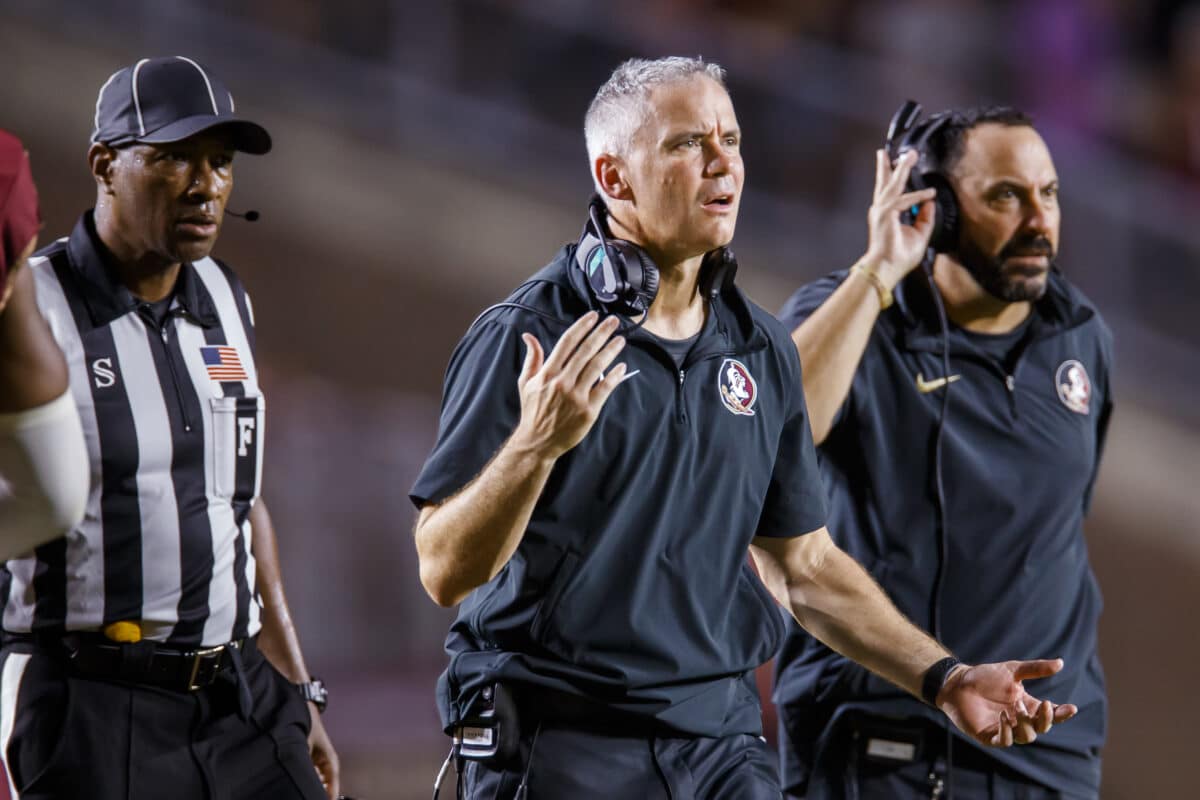
These rankings reflect pressure, not predictions. We don’t forecast firings. We track the gap between expectations and results – the weight of buyouts, the patience of administrators, the brutal math of wins and losses in a sport that changes by the hour.
This list is a work in progress.
Openings remain unfilled. Coordinators are fielding calls. NFL franchises are circling college sidelines. By the time you read this, names may have moved to new programs, new positions, or out of the profession entirely.
What won’t change:
The decisions these coaches made in 2025. The results those decisions produced. And the pressure that follows them into the off-season.
Ten coaches.
Ten programs, stuck between the cost of change and the cost of staying the same.
#1. Mike Norvell – Florida State (5-7, 2-6 ACC)
Started 3-0 with win over #8 Alabama, collapsed to 7 losses in final 9 games.
Outgained opponents in 10 of 11 games but kept losing.
Lost to Stanford (no head coach), NC State, Florida.
Norvell publicly admitted he doesn’t have answers after losses.
Administration retained him with vague “fundamental changes” statement despite $60M+ buyout.
Zero road wins.
Fan base exhausted.
#2. Mike Locksley – Maryland (4-8, 1-8 Big Ten)
Started 4-0, finished 0-8.
Pattern repeated: 21-5 in Aug/Sept under Locksley, 15-39 after that.
Eight-game losing streak included a loss to Michigan State (winless in conference entering the game).
Now 16-43 in Big Ten play, 0-18 vs ranked Big Ten opponents.
Worst winning percentage of any Power Four coach with tenure as long as his (after Cal fired Wilcox).
“Fire Locksley” chants at Indiana game.
AD Jim Smith retained him citing $13M buyout, lack of booster money, desire to build around freshman QB Malik Washington.
Locksley: “winning has a cost.”
#3. Shane Beamer – South Carolina (4-8, 1-7 SEC)
SEC Coach of Year 2024 to hot seat in 11 months.
Entered 2025 ranked #13 after 6-game win streak, finished 4-8.
Only Power Four team never to hit 350 yards in single game all season.
Fired OC Mike Shula (after 9 games), OL coach Lonnie Teasley, RB coach Marquel Blackwell.
Fourth OC in five years incoming.
Clemson beat them 28-14 at home (6th straight loss in Columbia).
Beamer gave “one billion percent” guarantee 2026 will be different.
2026 schedule brutal: at Alabama, Florida, Oklahoma; home vs Georgia, Tennessee, Texas A&M.
#4. Dave Aranda – Baylor (5-7, 3-6 Big 12)
The 2021 Big 12 championship now feels like a different lifetime.
22-26 since that trophy.
Defense (Aranda’s specialty) ranked 112th in rushing defense, 106th in total defense, and 123rd in sacks.
Sawyer Robertson led the nation in passing yards; it didn’t matter.
Went 1-5 down stretch.
Only retained due to AD Mack Rhoades’ resignation amid investigation (alleged sideline altercation with TE Michael Trigg).
President Linda Livingstone’s retention letter read like a hostage statement: “We are not settling for mediocrity,” while keeping the coach who delivered exactly that.
37-35 at Baylor with one elite season, five years of drift.
#5. Luke Fickell – Wisconsin (4-8, 1-7 Big Ten)
Took Cincinnati to CFP.
Now 17-21 at Wisconsin with back-to-back losing seasons (first since 1991-92).
Worst record since 1-10 in 1990.
Offense historically bad: 135th of 136 FBS teams in yards (261.6), 134th scoring (12.5 PPG).
Shut out in consecutive games (Ohio State, Iowa) for the first time since 1977.
Lost to Minnesota 17-7 in the finale.
QB situation disaster—hand-picked transfers available for full season in just 11 of 33 games due to injuries.
Fired OC Phil Longo after 10 games in 2024, answered “Why does it matter?” when asked who’d call plays.
Four-star RB Amari Latimer flipped to West Virginia on signing day.
AD Chris McIntosh issued a vote of confidence and promised more resources.
6-18 since taking over program that played in 11 bowls under Rick Stockstill’s 18-year tenure.
Lost season opener to FCS Austin Peay.
Seven-game losing streak included losses to Delaware, Missouri State, Kennesaw State (all in first/second year as FBS, all bowl eligible or close).
Defense allowed 31.5 PPG. Lost four consecutive conference games by touchdown or less.
Closed with wins over 2-10 Sam Houston, 4-8 New Mexico State.
Mason is calling that “momentum.”
Retained reportedly because AD Chris Massaro may retire in 2026.
Now 33-67 as head coach.
Stanford coordinator “shine” wore off at Vanderbilt, and it wore off in Murfreesboro.
#7. Bill Belichick – North Carolina (4-8, 2-6 ACC)
The six-time Super Bowl champion went 4-8 in his first college season.
Debut: College GameDay for 48-14 loss to TCU.
Midseason WRAL report: program “unstructured mess,” “complete disaster.”
Lost five games by 16+ points.
Three FBS wins vs teams with a combined 8-28 record.
Offense last in ACC: 264.8 yards, 19.3 PPG.
GM Mike Lombardi called UNC the “33rd NFL team” at the presser.
Off-field chaos: banned Patriots scouts, assistant suspended for NCAA violations, players cited for reckless driving, 24-year-old girlfriend tabloid fixture.
Four-minute postgame presser after NC State blowout, no season recap: “I don’t have one. We haven’t done it.”
Guaranteed $10M/year through 2027.
Losing players to the portal while fielding NFL inquiries.
Three straight losing seasons (two New England, one Chapel Hill).
“Patriot Way” hasn’t translated.
#8. Scotty Walden – UTEP (2-10, 1-7 CUSA)
Turned Austin Peay into an FCS power.
5-19 in two years at UTEP.
Finished 2-10 in 2025 (one fewer win than Year 1).
Finale: 61-31 humiliation at Delaware (first FBS season, still blew out UTEP by 30).
Walden confronted Delaware coach Ryan Carty over a late field goal, calling it “classless.”
UTEP threw five interceptions that game.
Lost to Kennesaw State, Missouri State, and Jacksonville State (all FCS) a year ago.
UTEP hasn’t won a bowl game since 1967 (the longest FBS bowl drought).
Moves to Mountain West in 2026: tougher opponents, longer travel.
Age 35 with time to figure it out, but rebuild producing no results.
#9. Jay Sawvel – Wyoming (4-8, 3-5 Mountain West)
Craig Bohl built seven straight winning seasons.
Sawvel: 7-17 in two years, 4-11 conference, zero bowls.
Finished 4-8 in 2025, four-game losing streak to end season (24 combined points).
Defense solid (19.9 PPG, 23rd nationally).
Offense averaged 16 PPG (inflated by two defensive TDs).
Demoted OC Jay Johnson midseason, promoted WR coach Jovon Bouknight – didn’t help.
Beat Colorado State 28-0, then scored 17 total over the final three games.
AD Tom Burman confirmed return for Year 3, citing $2.88M buyout: “4-8 doesn’t work” but Sawvel “gives us the best chance to get it fixed.”
Mountain West losing Boise State, CSU, Fresno State, SDSU, Utah State to Pac-12.
Only 20 players remain from Bohl era, none earned all-conference honors.
Rebuild stalling.
#10. Dell McGee – Georgia State (1-11, 0-8 Sun Belt)
Two national championship rings at Georgia. 4-20 at Georgia State.
Dell McGee helped develop Nick Chubb, Sony Michel, and D’Andre Swift into NFL first-rounders.
He can’t develop a competitive Sun Belt roster.
Inherited a program that went 7-6 with a bowl win in 2023 under Shawn Elliott.
Two years later: back-to-back double-digit loss seasons.
The 2025 campaign delivered historic futility.
Lost opener at Ole Miss 63-14 (gave up nearly 700 yards).
Lost to Vanderbilt 70-28—first time allowing 70 points in program history.
Defense surrendered 40.7 PPG (135th of 136 FBS teams).
Nine-game losing streak to finish.
Only win: FCS Murray State.
The Hue Jackson hire told the story.
McGee promoted the 0-16 Browns architect (3-36-1 NFL record) to offensive coordinator after Grambling State fired him for “lack of transparency, coordination, and collaboration.”
The results: 21.1 PPG, 114th nationally.
Lost finale 10-27 at Old Dominion.
McGee’s Georgia State tenure has never held an opponent under 21 points.
Not once in 24 games.
He’s now 4-20 as a head coach at a program that made four bowls in five years before he arrived.
The “four Cs”, connected, competitive, committed, and composure, remain talking points.
Results remain absent.
AD Charlie Cobb hasn’t addressed McGee’s future publicly.
The program averaged 11,000 fans at Center Parc Stadium – when they showed up.
Year 3 brings no relief: at Georgia Tech, at LSU, at Miami on the non-conference slate.
Position coaching excellence doesn’t automatically translate to program building.
Georgia State is learning that lesson at considerable cost.
Jay Sawvel inherited something both precious and dangerous when he took over Wyoming football.
The 33rd head coach in program history faces a paradox that would terrify most coaches: he must honor a decade of unprecedented stability while proving he can exceed the modest ceiling that same stability created. His hot seat rating of 0.531 after just one season reveals an uncomfortable truth about coaching transitions at programs caught between respectability and relevance.
The fear isn’t just about wins and losses. It’s about determining whether Wyoming’s defensive identity under Sawvel, as coordinator, was the foundation of success or merely a byproduct of Craig Bohl’s comprehensive system. Now, with a 3-9 inaugural season behind him and mounting pressure to validate Athletic Director Tom Burman’s internal promotion, Sawvel faces the existential coaching question: was he promoted because he was the best candidate, or because he was the safest one?
When Defense Couldn’t Save the Day
Sawvel’s first season exposed the fragility of Wyoming’s recent success.
The Cowboys’ 3-9 record (2-5 Mountain West) represented their worst performance since the pre-Bohl era. The numbers tell a story of systematic offensive failure that undermined four years of defensive development:
Offensive output: Just 19.3 points and 327.3 yards per game
Passing attack: 52.2% completion rate, 189.4 yards per game, 0.9 passing touchdowns per contest
Quarterback instability: Evan Svoboda managed 5 touchdowns against 8 interceptions before giving way to Kaden Anderson
Close game struggles: 2-7 record in contests decided by eight points or fewer
The defensive side, Sawvel’s supposed area of expertise, allowed 410.6 yards per game. While not catastrophic, it represented significant regression from the units that helped define Wyoming football under Bohl. The Cowboys surrendered 218.9 passing yards and 191.7 rushing yards per game, failing to force the game-changing turnovers that had become their trademark.
Seven of their nine losses came by margins that indicated competitive capability undermined by crucial mistakes.
The Statistical Split That Reveals Everything
Here’s what makes Wyoming’s 2024 season so maddening: when they were good, they were really good.
In victories, the Cowboys averaged 39.7 points and 435 total yards per game. This 20-point differential between wins and losses exposed the binary nature of Sawvel’s first season. When things worked, they worked spectacularly. Consistency remained elusive.
The three wins showcased different versions of competitive football:
Air Force (31-19): Defensive dominance
New Mexico (49-45): Offensive explosiveness
Washington State (15-14): Clutch execution
Yet the Cowboys couldn’t string together this level of performance across twelve games.
Special teams provided unexpected stability amid the chaos. Kicker John Hoyland converted all 25 extra points and 15 of 19 field goals, while punter Jack Culbreath averaged 40.4 yards per punt. However, all three specialists graduated, creating another area of uncertainty for 2025.
Addition Through Subtraction: The 2025 Roster Mathematics
Wyoming’s outlook hinges on whether losing its defensive leaders can somehow improve the team.
The graduation of linebacker Shae Suiaunoa (88 tackles, 10 TFL), safety Connor Shay (76 tackles), and defensive back Wrook Brown (48 tackles, 3 interceptions) removes the defensive spine that helped define recent Wyoming teams. This isn’t just about losing tackles. It’s about losing the voices that made defensive adjustments and kept younger players focused.
Yet the offensive foundation offers genuine optimism:
Quarterback Kaden Anderson: Returns as a sophomore after a 58.3% completion rate, 955 yards, 6:3 TD: INT ratio in nine games
Running back Sam Scott: Led team with 435 yards (4.7 average) in 10 games, returns for senior season
Receiver Jaylen Sargent: Team leader with 480 yards and 2 TDs, brings senior experience
Tight end John Michael Gyllenborg: 425 yards and 3 TDs, provides reliable target
The 2025 roster reveals strategic depth additions, particularly at positions that struggled in 2024. Multiple underclassmen at quarterback, running back, and wide receiver suggest increased competition and developmental potential.
The question remains whether this depth translates to on-field improvement or merely organizational depth.
The Schedule Gauntlet: Where Championships Are Won or Lost
Wyoming’s 2025 schedule will define Sawvel’s coaching identity in the first month.
The non-conference slate begins with road trips to Akron and Colorado, sandwiched around home games against Northern Iowa and Utah. This early-season stretch will likely determine whether Sawvel gets a third year or finds himself updating his resume.
The Utah Test
The Utah home game on September 13 represents everything. The Utes’ recent success makes this a measuring-stick game that could provide early validation or expose continued deficiencies. A competitive showing against Utah suggests Sawvel’s system is taking hold. A blowout loss raises questions about year-two development that won’t go away.
Conference play offers more realistic win opportunities:
Home games: UNLV, San Jose State, Colorado State, Nevada
Challenging road trips: San Diego State, Fresno State, Hawaii
The travel demands have historically tested Wyoming’s depth and conditioning, making every road game a potential trap.
The Philosophy Under Fire
Sawvel’s coaching philosophy centers on playing “harder, faster, smarter, and longer than our opponent.”
This approach worked when applied specifically to defense. Translating it to comprehensive program leadership represents his greatest challenge. The 0.531 hot seat rating suggests external observers remain skeptical about his ability to implement system-wide change.
The promotion of Aaron Bohl to defensive coordinator represents both continuity and risk. While Bohl’s four-year tenure as linebackers coach provides institutional knowledge, his lack of coordinator experience creates another variable in an already uncertain equation.
Sawvel’s ability to delegate defensive responsibilities while focusing on offensive development will determine whether Wyoming can effectively balance both phases.
The Defensive Coordinator Syndrome
Here’s the deeper concern surrounding Sawvel’s tenure: successful coordinators often struggle with the comprehensive demands of head coaching.
The Cowboys’ offensive struggles suggest Sawvel may have over-compensated in trying to maintain defensive standards while developing offensive competence. This split focus often leads to mediocrity in both phases, exactly what Wyoming cannot afford, given its resource limitations and competitive disadvantages.
Wyoming fans have been conditioned to expect defensive competence as a baseline. The fear is that Sawvel’s attempts to modernize the offense could undermine the defensive foundation that made Wyoming competitive during the Bohl era.
This balancing act becomes even more challenging when facing the immediate pressure of hot-seat speculation after just one season.
Hot Seat Mathematics: The Year Two Reality
A 0.531 hot seat rating after one season places Sawvel in precarious territory.
While Athletic Director Tom Burman typically doesn’t place first-year coaches on hot seat status, Sawvel’s rating suggests performance expectations that transcend normal grace periods. The mathematical reality is stark: significant improvement in year two isn’t just preferred, it’s essential.
Wyoming’s recent history suggests 6-7 wins represent the minimum threshold for continued confidence. Anything less than bowl eligibility would likely push Sawvel’s rating into genuinely dangerous territory, particularly if offensive struggles persist.
However, the counter-argument remains compelling:
Sawvel inherited a program transitioning from a beloved, long-tenured coach
The 2024 season could represent growing pains rather than fundamental incompetence
His defensive pedigree and institutional knowledge provide advantages external hires often lack
The 2025 Projection: Breakthrough or Breakdown?
Wyoming’s season will hinge on three critical factors.
Quarterback development: Anderson’s continued growth could unlock the offensive potential glimpsed in 2024’s victories. If he stagnates or regresses, the season could unravel quickly.
Defensive leadership emergence: Young defensive players must replace graduated leadership without sacrificing competitive intensity. This transition often takes a full season to solidify.
Special teams competence: New specialists must maintain the field position advantages that kept Wyoming competitive in close games. Poor special-teams play could turn close losses into blowouts.
The schedule provides realistic opportunities for 5-7 wins, which would represent meaningful progress while potentially falling short of bowl eligibility. However, this marginal improvement might not satisfy hot-seat concerns, particularly if losses continue to come in winnable games.
Sawvel’s coaching future depends on proving that Wyoming’s defensive identity can coexist with offensive competence.
The 2024 season showed flashes of this potential, but consistency remains the ultimate challenge. Whether he can synthesize these elements into sustained success will determine not only his job security but also Wyoming’s competitive trajectory in an increasingly challenging Mountain West landscape.
For a program caught between past success and future aspirations, the stakes couldn’t be higher.
Get insider college football intel delivered to your inbox
Want insider analysis on college football program moves before they happen? Get hard-hitting insights, no fluff – straight to your inbox. Subscribe to the Coaches Hot Seat newsletter and be on the cutting edge of what’s happening in the world of college football.