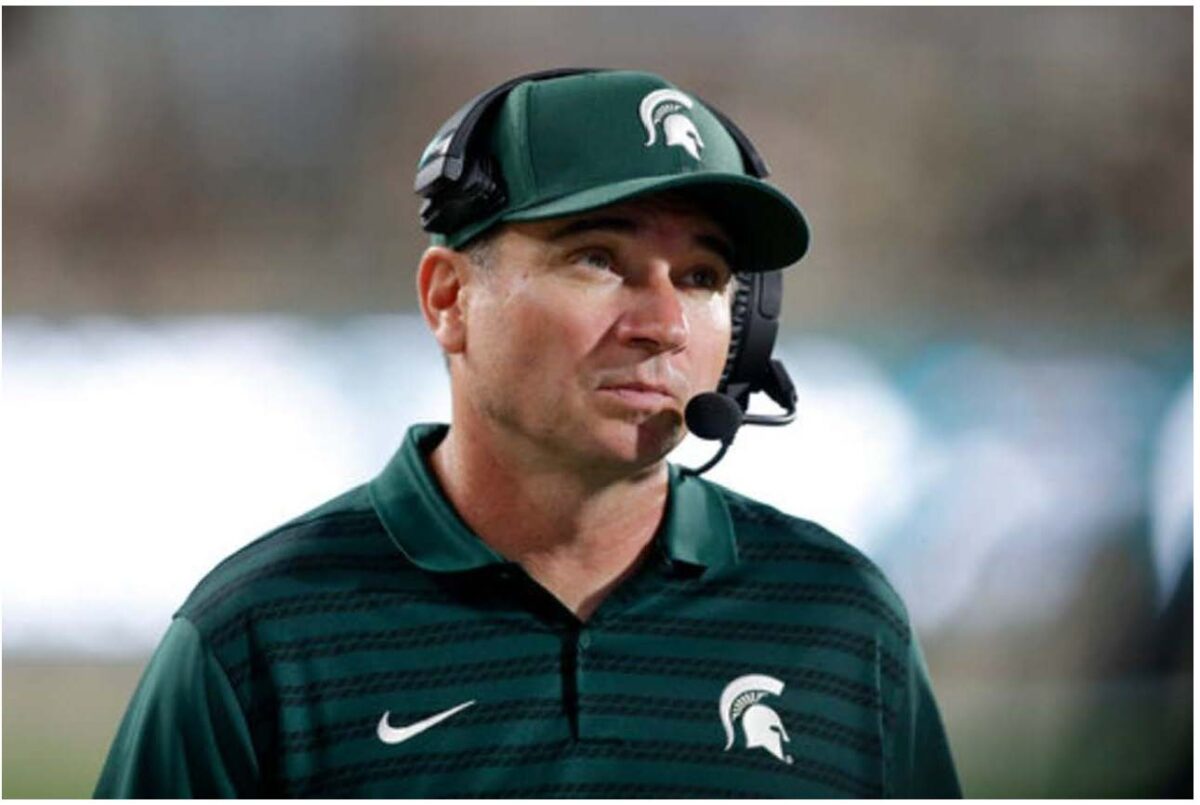
Michigan Is 6-4 And Barely Functional. Michigan State Scores 13 Points Per Game And Can’t Stop Anyone. Here’s Why Saturday’s Rivalry Game Will Be A Clinical 30-13 Win For The Wolverines (And Why Neither Fanbase Should Celebrate)

There’s a moment in every rivalry when one team stops playing to win—and starts playing not to lose.

This is not a game between two good teams. This is a game between a disappointing Michigan squad that’s learned to stop embarrassing itself, and a Michigan State program that can’t stop the bleeding. The Wolverines aren’t elite. They’re just competent enough to handle a disaster.

Michigan Isn’t Good—They’re Just Less Bad Than Before

Control is not aggression.

For Michigan, it’s survival. After Oklahoma exposed them and USC humiliated them, Sherrone Moore’s program didn’t transform into something great. They transformed into something functional. They stopped trying to be what they’re not and started grinding out wins against inferior competition.

Justice Haynes runs hard because that’s all this offense can do.

7.4 yards per carry sounds impressive until you realize Michigan hasn’t played a defense worth a damn since Week 4. They’re averaging 188 rushing yards per game because they’ve played Maryland, Washington, and Illinois—not exactly murderers’ row. This isn’t a dominant rushing attack. It’s a mediocre offense that figured out how to pick on bad defenses.

Michigan fans aren’t celebrating this version of the team—they’re tolerating it.

Moore inherited a national championship roster and turned it into a 6-4 team that wins ugly. The offensive line is solid. The running back is good. Everything else? Pedestrian at best. This isn’t the program that won it all last year. This is the program desperately trying not to become irrelevant.

Michigan State Is a Complete Disaster

When you press for meaning, you lose it.

Michigan State isn’t just bad—they’re historically terrible. Four straight losses. 13 points per game in their last four conference games. 39.8 points allowed on average. Three straight second halves where they looked like they forgot football was a real sport.

Jonathan Smith’s second season in East Lansing has been a step backward.

The offense can’t score. The defense can’t stop anyone. The special teams are a liability. Smith’s rebuilds take time—his track record at Oregon State proves that—but right now, the Mel Tucker mess he inherited looks worse, not better.

Look at their play-calling. They abandon what works because nothing works. They force throws because they’re desperate. They substitute constantly because no combination of players makes a difference.

This is a program in free fall with no parachute.

The Actual Matchup: Mediocre vs Terrible

Football isn’t about momentum.

It’s about who can execute basic tasks without falling apart. Michigan can run the ball against bad defenses. Michigan State can’t stop anyone from running the ball. This isn’t strategy—it’s arithmetic.

Haynes will get his yards because Michigan State’s front seven is Swiss cheese. Michigan’s defense will suffocate an offense that couldn’t score on a JV squad. The Wolverines will win this game doing exactly what they’ve done for six weeks: run the ball, kill the clock, and wait for the other team to collapse.

That’s not dominance—that’s taking advantage of incompetence.

The third quarter will tell the story, like it always does. Michigan will come out running the same plays they’ve run all game. Michigan State’s defense will be tired, frustrated, and making mistakes. Haynes will break a couple of runs, Michigan will extend the lead, and the Spartans will quit.

Not because Michigan is great—because Michigan State is that bad.

This Rivalry Has Become One-Sided

Most people think rivalries equalize teams.

That’s a myth. Rivalries amplify the gap between programs going in opposite directions. Michigan is trending toward mediocrity. Michigan State is trending toward irrelevance.

When Haynes rips off his third big run, watch the Spartan sideline. Players will stop fighting. Coaches will stop believing. That’s when you know a program has lost its soul—when even rivalry week can’t manufacture a fight.

Michigan State came into this season hoping Jonathan Smith’s rebuild would show signs of life in year two. Instead, they’ve regressed. Smith’s track record suggests he can fix this—he turned Oregon State from laughingstock to contender—but rebuilding the Mel Tucker disaster takes time. Meanwhile, Michigan fans are wondering if Sherrone Moore is the guy to lead them back to relevance—or just another mediocre coach riding the fumes of Jim Harbaugh’s success.

The Real Story

It’s about two programs trying to figure out who they are.

Michigan isn’t elite anymore. They’re not even good. They’re just functional enough to beat bad teams and avoid total embarrassment. Moore has stabilized the program after a rough start, but stabilization isn’t excellence.

Michigan State, meanwhile, has no idea what they are—except terrible.

One team figured out how to stop the bleeding. The other can’t find the tourniquet. That’s not a rivalry game—that’s a mercy killing.

The Takeaway

Saturday won’t be close—it will be clinical.

Michigan 30, Michigan State 13. But don’t mistake clinical for impressive. Michigan will win because they’re playing a team that can’t score, can’t stop the run, and can’t manufacture any reason to believe things will get better.

This isn’t a statement win for Michigan—it’s a layup.

For Michigan State, it’s another reminder that this season can’t end fast enough. For Michigan fans, it’s another reminder that competent isn’t the same as contending.

And for the rest of college football? It’s a reminder that rivalry games only matter when both teams show up.

Saturday, only one team will bother.
No related posts found.

LOAD MORE BLOG ARTICLES

USC’s Starting Center Kilian O’Connor Is Out vs Michigan’s Elite Defense. Here’s Why The Trojans’ 338 Passing Yards Per Game Still Wins Them The Game 28-21 (And Why The Injury Will Be The Go-To Excuse If They Lose)

Lincoln Riley needs to win this game.

Not because USC’s season depends on it—though a loss would hurt their playoff chances. Riley needs to win because he’s in the middle of a three-game stretch that will define whether he’s a program-builder or just another coach who couldn’t handle the jump to a major conference. No. 15 Michigan at home, then at No. 16 Notre Dame, then at Nebraska. Three brutal tests in three weeks. The Cornhuskers aren’t ranked in the AP Poll, but they’re ranked 22nd by The New York Times and are receiving votes in multiple polls. Three chances to prove USC belongs in the Big Ten elite.

Win two of three, and the critical mass of Trojan supporters stays on board. Go 1-2 or worse, and the questions get louder.

So naturally, USC’s starting center Kilian O’Connor is out with a leg injury.

The Injury Factor: USC’s Built-In Excuse

O’Connor went down against Illinois and will miss multiple weeks, including this game. Losing your starting center, a team leader, and a critical piece of the offensive line against Michigan’s dominant defensive front isn’t ideal. Without O’Connor, pass protection timing gets disrupted. Run blocking schemes lose continuity. Michigan’s defensive front will relentlessly attack backup center J’Onre Reed.

If Riley loses, this injury becomes the convenient narrative. Not his fault. Not a coaching problem. Just bad injury luck at the worst possible time.

But here’s the problem: USC should still win this game.

Why USC Wins (Even Without O’Connor)

USC does what Michigan can’t; they hurt you through the air. 338 passing yards per game. 72.1% completion rate. 2.4 passing touchdowns per game. They’re efficient, explosive, and capable of scoring in bunches. Michigan’s secondary is vulnerable, allowing 206.4 passing yards per game at a 65.1% completion rate.

Even with a backup center, USC’s passing attack should be able to exploit Michigan’s weakness. Quick passes, screens, play-action to neutralize pressure—the scheme adapts. Expect 280-320 passing yards from USC.

Michigan’s run defense is elite, allowing just 77 yards per game at 2.4 yards per carry. USC will struggle on the ground. Expect 80-110 rushing yards. But USC doesn’t need to dominate the run game. They need their quarterback to pick apart Michigan’s secondary.

USC generates 370-430 total yards and scores 24-28 points.

Why Michigan Can’t Keep Pace

Michigan’s offense runs through one dimension: the ground game. 237.8 rushing yards per game at 6.4 yards per carry. It’s physical, effective Big Ten football. They’re getting healthier, too. Starting left guard Giovanni El-Hadi and tight end Hogan Hansen are both probable to return.

But their passing game is borderline nonexistent. Just 200.6 passing yards per game with a 58.8% completion rate and 0.6 passing touchdowns per game. That’s not a typo—they throw a touchdown pass roughly every other game.

USC knows this. They’ll stack the box, dare Michigan to throw, and force them into predictable situations. Michigan will grind out 190-220 rushing yards and score 20-24 points. They’ll control the time of possession and keep it competitive.

But when Michigan falls behind and needs to throw? They can’t keep pace.

The Verdict: Riley Survives Game One

USC wins, 28-21.

Michigan’s healthier offensive line helps them sustain drives and score consistently through the ground game. USC’s backup center struggles at times, limiting explosive plays. The game stays tight throughout four quarters.

But USC’s passing game talent—even compromised without O’Connor—proves too much for a Michigan team that can’t match their scoring through the air.

The wildcard: If Michigan’s defensive line overwhelms the backup center early and forces turnovers, their ball-control offense could grind out a stunning upset. But that’s unlikely.

More likely? Riley wins Game One of his three-game gauntlet, the stats hold up, and USC moves to 5-1. Then it’s on to the next test.

And if Riley loses? Don’t worry—the O’Connor injury will be the headline, not the performance. The excuse is pre-packaged. The narrative writes itself.

But Riley can’t afford to use it twice more in this stretch.

Three games. Three chances. One has to go right for the injury excuse to work. If USC goes 0-3 or 1-2 in this stretch, no amount of injury talk will save Riley from the questions about whether he can win the games that matter in the Big Ten.

Saturday is Game One. The clock is ticking.

No related posts found.

LOAD MORE BLOG ARTICLES

Michigan football stands at a critical turning point that will define the program’s trajectory for years.

As spring practice concludes in Ann Arbor, the Michigan Wolverines find themselves at a fascinating crossroads.

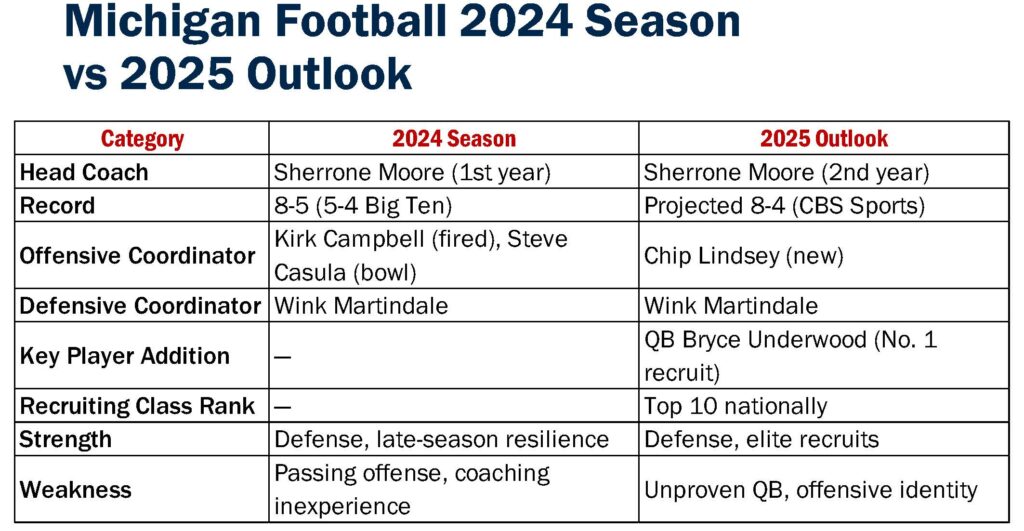
Following a rollercoaster 2024 campaign that ended with an 8-5 record, second-year head coach Sherrone Moore faces the challenge of recapturing the program’s championship form while integrating a wealth of new talent and implementing significant schematic changes.

The 2024 season will be remembered as a tale of two halves:

  • A disappointing 5-5 start that had fans questioning the program’s direction
  • Stunning upsets over No. 2 Ohio State (13-10) and No. 11 Alabama (19-13) to close the year
  • Michigan is the only program to defeat Alabama twice in one calendar year
  • A late-season surge that injected renewed optimism into a program that had struggled with consistency

These dramatic season-ending victories completely transformed the narrative around Michigan football heading into 2025.

Michigan’s 2025 campaign will hinge on how quickly the offense can develop around its new quarterback and whether the defense can maintain its late-2024 form. The program’s trajectory remains positive, but the margin for error in a tougher Big Ten is slim.

Have you ever seen a program pin its entire hopes on the shoulders of an 18-year-old quarterback?

All eyes in Ann Arbor are fixed on five-star freshman quarterback Bryce Underwood, the No. 1 overall recruit in the 2025 class and the highest-rated signee in Michigan history.

Underwood’s arrival represents both immense opportunity and significant pressure. The dual-threat signal-caller is widely expected to start immediately despite his youth. His elite talent brings an electricity to Michigan that the program desperately needs after a disappointing offensive showing in 2024.

What makes Underwood’s situation different from other freshman quarterbacks?

  • He joins a program just one year removed from a national championship
  • Michigan’s passing attack ranked a dismal 131st nationally in 2024 (129.1 yards per game)
  • Experienced transfer Mikey Keene (Fresno State/UCF) provides insurance and mentorship
  • Most analysts expect Underwood to win the starting job immediately

“The quarterback situation is widely viewed as the key to Michigan’s 2025 ceiling,” according to the program’s internal analysis. “If Underwood adapts quickly and the offense improves, Michigan could contend for a Big Ten title and a playoff spot.”

Rarely has a true freshman quarterback shouldered such immediate expectations at a blue-blood program.

Michigan’s offense underwent a complete metamorphosis following one of the worst passing attacks in program history.

The offensive struggles that plagued Michigan in 2024 (113th nationally in scoring at 22.0 points per game) prompted significant changes, beginning with the arrival of new offensive coordinator Chip Lindsey from North Carolina.

Lindsey’s arrival marks a philosophical shift in Ann Arbor. His track record shows a commitment to balanced, explosive attacks. His 2023 UNC offense was one of only two nationally to average at least 290 passing yards and 190 rushing yards per game, showcasing his ability to create dynamic, unpredictable offensive systems.

The early returns from spring practice are promising:

  • Sophomore receiver Semaj Morgan called the new system “night and day” compared to last year’s approach
  • The new scheme emphasizes more wide receiver sets instead of heavy, predictable formations
  • Greater route diversity and vertical passing concepts create more explosive play opportunities
  • Running backs will be more involved in the passing game, creating mismatches

Supporting the passing game renaissance are new weapons with size and athleticism:

  • 6-5 freshman Jamar Browder brings contested-catch ability
  • Indiana transfer Donovan McCulley (also 6-5) adds experienced size
  • Jordan Marshall (who starred in the Alabama bowl victory) returns in the backfield
  • Alabama transfer Justice Haynes joins to form a powerful one-two punch at running back

While returning experienced pieces like Giovanni El-Hadi, the offensive line must improve its consistency to protect Underwood and establish the physical run game that remains central to Michigan’s identity.

Five-star freshman Andrew Babalola and borderline five-star Ty Haywood could push for early playing time and inject immediate talent into this critical unit.

While the offense rebuilds, Michigan’s defense remains the program’s unshakeable foundation.

While the offense undergoes reconstruction, Michigan’s defense is poised to remain among the nation’s elite.

The 2024 unit allowed just 19.9 points per game (4th nationally) and held opponents to 3.1 yards per rush, showcasing the physical, suffocating style that has become the program’s calling card. Wink Martindale returns for his second season as defensive coordinator after engineering late-season masterpieces against Ohio State and Alabama that saved Michigan’s season.

What makes this defense special despite losing key pieces to the NFL?

  • The front seven projects to be especially formidable with returning stalwarts Rayshaun Benny, Derrick Moore, Jaishawn Barham, and Ernest Hausmann
  • Despite losing unanimous All-American Mason Graham, the defensive line boasts significant depth and talent.
  • While younger and less experienced, the secondary will rely on developing stars and incoming freshmen like four-star signees Shamari Earls, Elijah Dotson, and Kainoa Winston.
  • Coaching continuity in Martindale’s NFL-derived scheme provides a critical foundation.

Michigan’s defensive identity perfectly complements the program’s physical ethos and should keep the Wolverines competitive even through potential offensive growing pains early in the season.

The defense isn’t just good—it’s championship caliber.

Never underestimate the impact of elite special teams in a season defined by tight margins.

Michigan’s special teams unit, anchored by returning All-American kicker Dominic Zvada, is often overlooked but is critically important to its success.

In 2024, Zvada converted an exceptional 21 of 22 field goals (95.5%) and 26 of 27 extra points (96.3%), providing reliability in close games and a consistent weapon when the offense stalled in the red zone. His clutch performances in the Ohio State and Alabama victories underscored his value to the program.

Beyond the kicking game, Michigan’s special teams provide additional advantages:

  • The return game features explosive options in sophomores Semaj Morgan and Jordan Marshall
  • These playmakers add another dimension to Michigan’s ability to flip field position
  • Strong special teams can create scoring opportunities when the offense struggles
  • In a conference with narrow margins, special teams excellence can be the difference between victory and defeat

Michigan’s emphasis on special teams excellence reflects the program’s attention to detail and commitment to winning in all three game phases.

The 2025 schedule presents a gauntlet that would challenge even the most experienced teams.

Any assessment of Michigan’s 2025 outlook must account for a challenging schedule that offers few reprieves.

Early road tests at Oklahoma (September 6) and Nebraska (September 20) will immediately test Underwood’s development and the team’s ability to execute in hostile environments. The conference slate includes road games at USC and Michigan State, home contests against Washington and a season finale with archrival Ohio State.

What makes this schedule particularly daunting:

  • No consecutive home games appear anywhere on the schedule
  • The constant home/away alternation complicates recovery and momentum
  • Early road tests come before the team has fully established its identity
  • Four of Michigan’s opponents are projected preseason top 25 teams
  • The Ohio State finale comes after a long, grueling season

CBS Sports projects an 8-4 record for the Wolverines, citing roster turnover and the difficult schedule as primary factors. This conservative projection reflects the reality that even talented teams often struggle with consistency when facing elite competition week after week.

Navigating this schedule successfully would validate Michigan’s talent and coaching in a way that would resonate nationally.

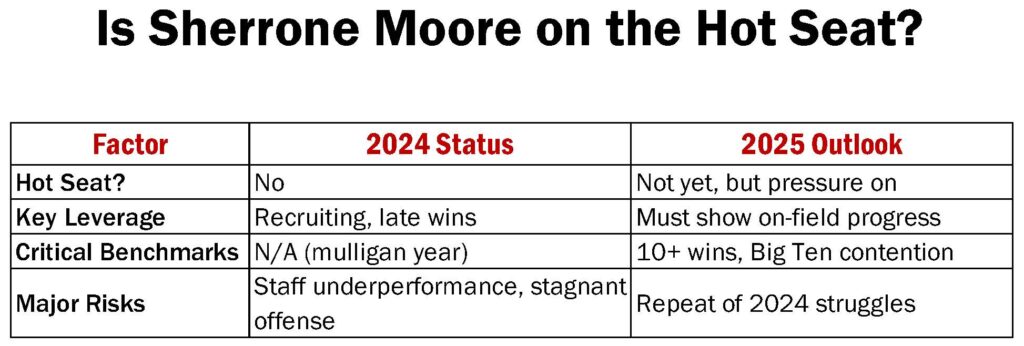
For Coach Sherrone Moore, 2025 isn’t just another season—it’s the ultimate referendum on his leadership.

For Coach Sherrone Moore, 2025 represents a critical proving ground defining his tenure at Michigan.

While his job is secure following the program’s strong finish to 2024 and recruiting success (the 2025 class ranked No. 6 nationally), expectations have risen significantly. Moore ranks 14th out of 18 Big Ten coaches in USA Today’s 2025 rankings, reflecting skepticism about his inexperience despite his impressive recruiting wins.

The challenge is multifaceted:

  • Moore must establish his own identity separate from Jim Harbaugh’s legacy
  • His offensive coordinator hire (Chip Lindsey) represents a significant philosophical shift
  • Managing a five-star quarterback’s development requires delicate handling
  • The expanded Big Ten presents new challenges and unfamiliar opponents
  • He must navigate a two-game self-imposed suspension due to fallout from the 2023 sign-stealing scandal

This early-season absence could impact the team’s development, particularly with a young quarterback. How Moore handles these challenges will reveal whether he’s merely a caretaker of Harbaugh’s program or a championship-caliber head coach in his own right.

The verdict on Moore’s leadership will emerge through how Michigan responds to adversity in 2025.

The answers to these five questions will determine whether Michigan contends for championships or faces another rebuilding year.

Several critical questions will shape Michigan’s 2025 campaign:

  1. How quickly can Bryce Underwood develop? The ceiling for this team largely depends on whether the freshman phenom can translate his immense talent to college production immediately. The history of true freshman quarterbacks suggests caution, but Underwood’s talent is undeniable.
  2. Will Chip Lindsey’s offensive overhaul yield immediate results? After ranking 131st in passing, Michigan needs dramatic improvement to compete with Big Ten powers. Schematic changes take time, but the talent influx could accelerate the transition.
  3. Can the defense maintain elite production despite key departures? The front seven appears loaded, but secondary depth and consistency remain concerns. Martindale’s second year should bring greater comfort in his system.
  4. Will the offensive line provide adequate protection for a freshman quarterback? This unit’s performance directly impacts Underwood’s development and the effectiveness of the rushing attack. The line must improve from its inconsistent 2024 performance.
  5. Can Michigan navigate the brutal road schedule? Games at Oklahoma, Nebraska, and USC represent significant challenges, particularly for a team breaking in new offensive systems. Road performance often separates good teams from great ones.

The answers to these questions will emerge gradually, but early-season performances will provide critical clues about Michigan’s trajectory.

Michigan stands poised between immediate resurgence and patient program building.

The contrast between optimism and caution defines Michigan’s 2025 outlook.

The influx of elite talent, particularly at quarterback, and the late-season momentum from 2024 suggest Michigan could quickly return to championship contention. Conversely, combining youth at key positions, a new offensive system, and a challenging schedule indicates potential growing pains.

What makes Michigan’s situation so compelling?

  • They’re just one year removed from a national championship
  • They possess championship-caliber defensive talent
  • They landed the nation’s No. 1 recruit at the sport’s most important position
  • They improved significantly at offensive coordinator
  • They face one of the nation’s most challenging schedules
  • They’re led by a head coach still establishing his identity

The talent level in Ann Arbor remains championship-caliber, the defensive identity remains strong, and the offensive ceiling is substantially higher than in 2024.

Whether Michigan can meet those expectations in 2025 or whether fans must practice patience for another season represents the defining storyline as the Wolverines embark on a new era under Sherrone Moore’s leadership, powered by a generational talent in Bryce Underwood.

Michigan’s 2025 season could ultimately be remembered as the beginning of a new dynasty or the necessary growing pains before one.

The Next Billion Dollar Game

College football isn’t just a sport anymore—it’s a high-stakes market where information asymmetry separates winners from losers. While the average fan sees only what happens between the sidelines, real insiders trade on the hidden dynamics reshaping programs from the inside out.

Our team has embedded with the power brokers who run this game. From the coaching carousel to NIL deals to transfer portal strategies, we’ve mapped the entire ecosystem with the kind of obsessive detail that would make a hedge fund analyst blush.

Why subscribe? Because in markets this inefficient, information creates alpha. Our subscribers knew which coaches were dead men walking months before the mainstream media caught on. They understood which programs were quietly transforming their recruiting apparatuses while competitors slept.

The smart money is already positioning for 2025. Are you?

Click below—it’s free—and join the small group of people who understand the real value of college football’s new economy.

No related posts found.

LOAD MORE BLOG ARTICLES

What We’re Watching On Saturday

Featured Game: Texas at Michigan

Location: Ann Arbor, Michigan

Game Time: Noon Eastern; 9:00 a.m. Pacific

Television: Fox

Game Preview

In a highly anticipated early-season matchup, the No. 10 Michigan Wolverines (1-0) host the No. 3 Texas Longhorns (1-0) at Michigan Stadium on Saturday. This clash between two of college football’s winningest programs marks only the second-ever meeting between these storied teams.

Key Storylines

Michigan’s First Real Test: After facing weak non-conference schedules in recent years, Michigan faces its first ranked non-conference opponent since 2019. The Wolverines are underdogs at home for the first time since 2021.

Texas Riding High: The Longhorns are coming off an impressive 52-0 shutout win over Colorado State and look to build on last year’s College Football Playoff appearance.

Quarterback Contrast: Texas has the edge with experienced QB Quinn Ewers, while Michigan turns to former walk-on Davis Warren in just his second start.

Strength vs. Strength: Michigan’s run-heavy offense will try to establish dominance against Texas’ stout defensive front.

Big Play Potential: Texas’ explosive offense, led by coach Steve Sarkisian, will test Michigan’s aggressive defense under new coordinator Wink Martindale.

Players To Watch

Michigan

QB Davis Warren

RB Donovan Edwards

TE Colston Loveland

LB Jaishawn Barham

CB Will Johnson

Texas

QB Quinn Ewers

WR Isaiah Bond

RB Jaydon Blue

LB Anthony Hill Jr.

Edge Trey Moore

Keys to the Game

Michigan’s Ground Game: The Wolverines must establish their running attack early to control the clock and keep Texas’ offense off the field.

Quarterback Play: Can Davis Warren keep pace with Quinn Ewers and make enough plays to keep Michigan competitive?

Limiting Big Plays: Michigan’s defense needs to contain Texas’ explosive receivers and prevent chunk plays.

Trenches Battle: The matchup between Michigan’s offensive line and Texas’ defensive front could decide the game.

Special Teams: In a potentially close game, kickers Dominic Zvada (Michigan) and Bert Auburn (Texas) could play crucial roles.

Prediction

While Michigan has a home-field advantage and a solid recent track record, Texas has the edge in talent and quarterback play. The Longhorns’ experience in big games, including last year’s win at Alabama, gives them a slight advantage.

Texas 27, Michigan 24

This game has the potential to be an instant classic and could significantly impact both teams’ College Football Playoff aspirations.

Other early games we’re watching:

Arkansas at Oklahoma State

Location: Stillwater, Oklahoma

Time: Noon Eastern; 9:00 am Pacific

Television: ABC

Kansas State at Tulane

Location: New Orleans, Louisiana

Time: Noon Eastern; 9:00 am Pacific

Television: ESPN

Afternoon Featured Game: Baylor at Utah

Location: Salt Lake City, Utah

Game Time: 3:30 p.m. Eastern; 12:30 p.m. Pacific

Television: Fox

In a unique non-conference matchup between two Big 12 teams, the Baylor Bears (1-0) travel to Salt Lake City to face the No. 11 Utah Utes (1-0) at Rice-Eccles Stadium on Saturday, September 7, 2024. Kickoff is set for 2:30 p.m. MT on FOX.

Key Storylines

Big 12 Homecoming: Although both teams are now in the Big 12, this game counts as non-conference because it was scheduled years ago when Utah was still in the Pac-12.

Return of the Stars: Utah’s quarterback Cam Rising and tight end Brant Kuithe made impressive returns from injury in week one, connecting for three touchdowns.

Baylor’s Revenge: The Bears look to avenge last year’s close 20-13 loss to Utah in Waco.

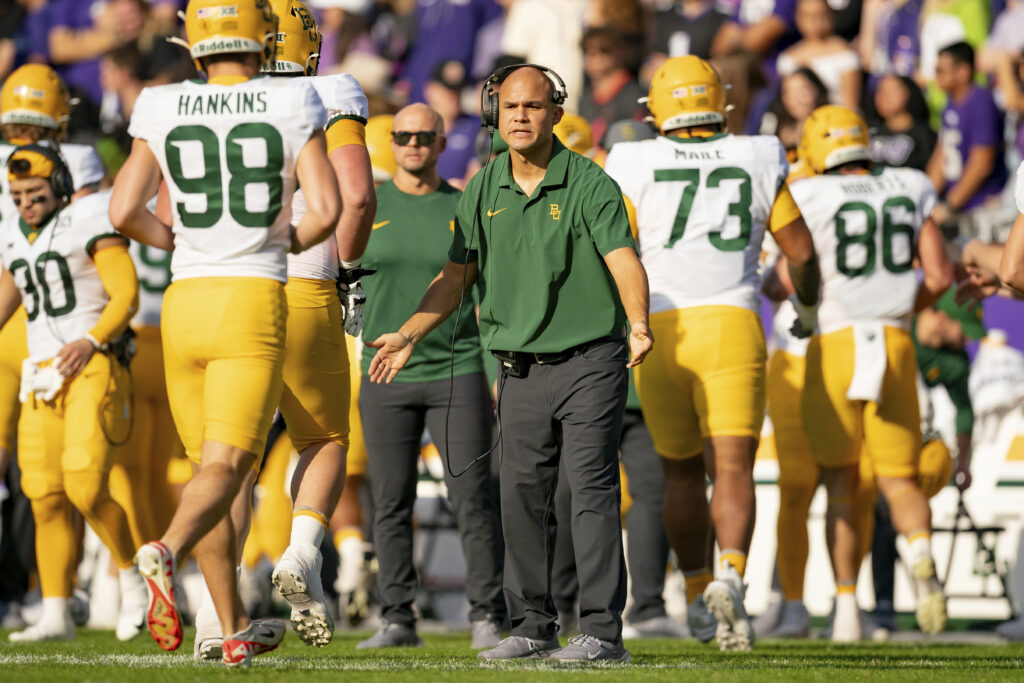
Defensive Shift: Baylor head coach Dave Aranda has taken over defensive coordinator duties, which could lead to schematic changes.

Home Field Advantage: Utah has won 32 of their last 34 home games and boasts an 84-game sellout streak at Rice-Eccles Stadium.

Players to Watch

Baylor

QB Dequan Finn

WR Ketron Jackson Jr.

RB Richard Reese

LB Matt Jones

DL Garmon Randolph

Utah

QB Cameron Rising

TE Brant Kuithe

RB Dijon Stanley

DT Junior Tafuna

CB Smith Snowden

Keys to the Game

Quarterback Play: Can Baylor’s Dequan Finn match the efficiency and production of Utah’s Cam Rising?

Establishing the Run: Both teams will look to improve their ground games after somewhat lackluster performances in week one.

Defensive Adjustments: How will Baylor’s defense, now led by Dave Aranda, contain Utah’s potent offense?

Special Teams Impact: Kickers Bert Auburn (Baylor) and Dominic Zvada (Utah) could play crucial roles in a potentially close game.

Limiting Turnovers: Both teams had turnover issues in their openers and will need to protect the ball better in this matchup.

Coaches’ Perspectives

Baylor’s Dave Aranda: “We’ve got something to prove. I think that we got a bunch of guys that want to win and want to achieve and want to be that team, and we know that the team we’re playing is kind of that team. And so we have to be able to show up with our best.”

Utah’s Kyle Whittingham: “We were fortunate to get out of there with a win last year. We haven’t forgotten that. It was a right down to the wire game. We have to prepare the right way all week long, just like we do every single week and be ready for a fight because that’s what it’s going to be.”

Prediction

While Baylor showed promise in their opener, Utah’s experience, home-field advantage, and the return of key players give them the edge. Expect a closer game than the odds suggest, but Utah should come out on top.

Utah 31, Baylor 24

This game will be a critical early-season test for both teams and could have significant implications for their respective Big 12 and national title aspirations.

Other Mid-Day Games We’re Watching

Iowa State at Iowa

Location: Iowa City, Iowa

Game Time: 3:30 Eastern; 12:30 Pacific

Television: CBS

Michigan State at Maryland

Location: College Park, Maryland

Game Time: 3:30 Eastern; 12:30 Pacific

Television: BTN – Big Ten Network

Night Game: Boise State at Oregon

Location: Eugene, Oregon

Time: 10:00 PM Eastern; 7:00 pm Pacific

Television: Peacock

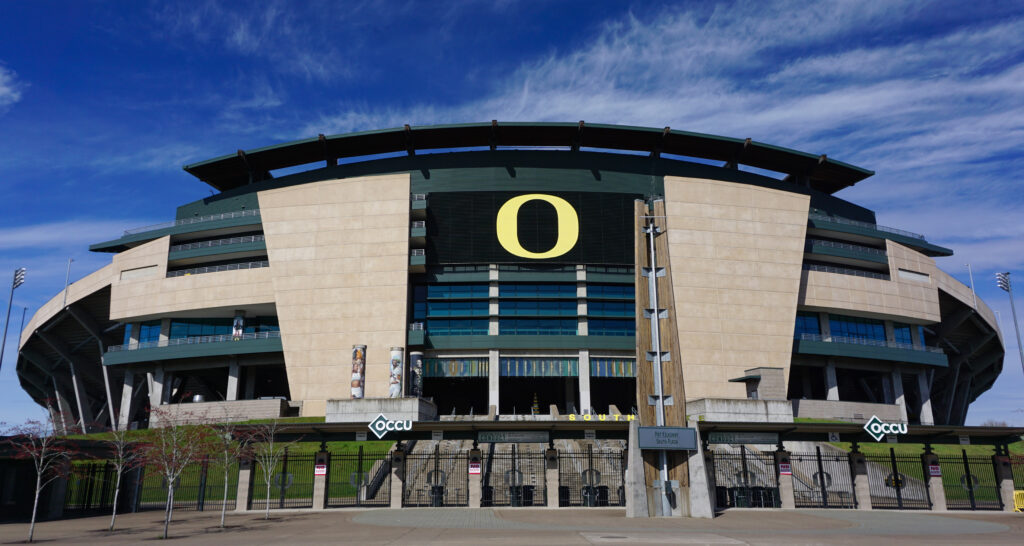
In a compelling non-conference matchup, the Boise State Broncos (1-0) travel to Eugene to face the No. 7 Oregon Ducks (1-0) at Autzen Stadium on Saturday, September 7, 2024. Kickoff is set for 7 PM PT and will be broadcast on Peacock.

Key Storylines

Oregon’s Offensive Struggles: The Ducks look to bounce back from a lackluster offensive performance in their 24-14 win over Idaho.

Boise State’s Upset Bid: The Broncos aim to continue their historical success against Oregon, having won all three previous meetings.

Ashton Jeanty’s Momentum: Boise State’s running back comes off a record-breaking 267-yard, six-touchdown performance against Georgia Southern.

Ducks’ National Championship Aspirations: Oregon enters the season with high expectations as it prepares for its inaugural Big Ten season.

Coaching Chess Match: Dan Lanning’s defense vs. Dirk Koetter’s offense could be the key tactical battle of the game.

Players to Watch

Boise State

RB Ashton Jeanty

QB Maddux Madsen

WR Prince Strachan

DT Braxton Fely

Oregon

QB Dillon Gabriel

RB Jordan James

WRs Tez Johnson and Evan Stewart

CB Jabbar Muhammad

Keys to the Game

Oregon’s Offensive Line Performance: The Ducks’ O-line struggled against Idaho and faces a tough test against Boise State’s front seven.

Explosive Plays: Oregon’s offense lacked big plays in week one, and limiting explosive plays will be crucial for Boise State’s defense.

Boise State’s Passing Game: The Broncos need to use their size advantage at receiver against Oregon’s smaller secondary.

Containing Ashton Jeanty: Oregon’s front seven will be tested by Boise State’s star running back.

Special Teams and Trick Plays: Boise State may need to steal points through special teams or trick plays in a potential upset bid.

Coaches’ Perspectives

Oregon’s Dan Lanning on fixing offensive issues: “Don’t get off schedule. Don’t end up with third and longs. Don’t shoot ourselves in the foot with penalties. If we do that, we can move the ball.”

Boise State: The Broncos will likely aim to create chaos on defense and find ways to unlock an Oregon defense that looked formidable in week one.

Injury Report

Boise State:

HB Jambres Dubar – Dealing with a nagging injury from fall camp

C Mason Randolph – Left last game with a potential arm injury. Status uncertain

Oregon:

OL Matthew Bedford – May make his Duck debut after missing the opener.

Prediction

While Boise State has the potential to keep this game competitive, especially with Ashton Jeanty’s running ability, Oregon’s talent advantage and motivation to improve from last week’s performance should prove too much for the Broncos.

Oregon 38, Boise State 24

This game will be a crucial test for both teams—Oregon will need to prove its national championship credentials, and Boise State will need to show it can compete with top-tier programs. Expect a closer game than the odds suggest, but the Ducks should pull away in the second half.

Other Late Games We’re Watching:

Texas Tech vs Washington State

Location: Pullman, Washington

Time: 7:00 pm

Television: Fox

Mississippi State vs Arizona State

Location: Tempe, Arizona

Time: 10:30 pm Eastern, 7:30 pm Pacific

Television: ESPN

No related posts found.
VISIT OUR SHOP [COMING SOON]

LOAD MORE BLOG ARTICLES