
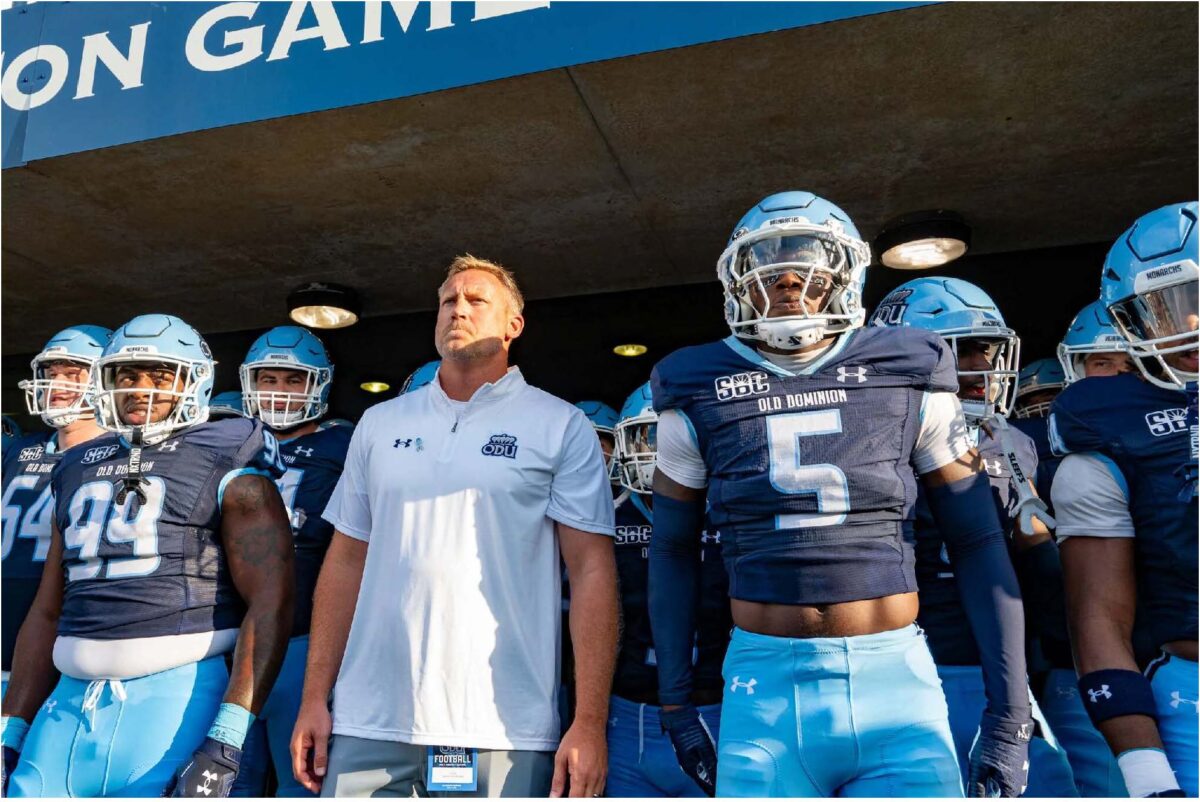
The Hottest Coaching Seat in College Football Is Hiding in Plain Sight

While everyone obsesses over Lincoln Riley and other big-name coaches, the most dangerous hot seat in America belongs to a guy most fans have never heard of.

His name is Ricky Rahne. He coaches at Old Dominion. And he’s about to become the first major firing of the 2025 season.

Here’s why nobody sees it coming.

The Trucking Company Problem That Started Everything

When people hear “Old Dominion,” they think of shipping trucks, not football helmets.

That’s not a joke—that’s the exact problem Rahne was hired to solve in 2020.

ODU’s mandate was crystal clear: Raise the profile of Old Dominion University so it’s better recognized than the freight company with the same name. Make people think “football program” before “logistics company.”

Four years later, Reddit threads still joke about thinking of trucking more than touchdowns when they hear “Old Dominion.”

Mission failed.

The Pattern That Reveals Everything

Here’s what makes Rahne’s situation so dangerous: He’s not obviously terrible.

His 2024 season looked respectable on paper:

  • 5-7 record
  • Led the nation in red zone offense (95%)
  • 14th nationally in rushing offense
  • Sophomore quarterback showing promise

But dig deeper into those losses:

  • Coastal Carolina: Lost 45-37
  • Marshall: Lost 42-35
  • James Madison: Lost 35-32

See the pattern? Rahne consistently puts his team in a position to win, then finds creative ways to lose.

That’s not bad luck. That’s a coaching problem.

The Close-Loss Curse That’s Worse Than Blowouts

You know what’s more damaging than getting blown out? Losing winnable games.

When you get destroyed 45-10, everyone understands you’re rebuilding. When you lose 35-32, it means you had the talent to win but couldn’t execute when it mattered.

Rahne’s entire tenure reads like a masterclass in snatching defeat from the jaws of victory:

2024 specifics that hurt:

  • Turnover margin: -3 (gave away 20, took 17)
  • Record in one-score games: Consistently poor
  • Fourth quarter collapses: Multiple instances

The quarterback numbers tell the story: Colton Joseph threw for 1,627 yards with 11 TDs and 647 rushing yards with 11 rushing TDs. Those are impressive numbers. But he completed just 59.9% of his passes with 5 interceptions.

Translation: Talented enough to make plays, not refined enough to avoid mistakes when pressure mounts.

The 2025 Schedule That Will Expose Everything

If you want to know why Rahne’s seat is about to catch fire, look at how 2025 starts:

September schedule:

  • @ Indiana (Big Ten)
  • vs N.C. Central
  • @ Virginia Tech (ACC)

Let me paint you a picture: You have an inexperienced receiving corps (losing 1,342 receiving yards from departures), an unproven secondary (three leading interceptors graduated), and a pattern of fourth-quarter mistakes.

Now you’re asking this team to open at Indiana and travel to Virginia Tech in the first three weeks.

If ODU starts 0-2 with blowout losses, Rahne goes from “under the radar” to “trending on Twitter” overnight.

The Roster Disaster Nobody’s Discussing

Want to know how bad ODU’s talent drain is?

Key departures after 2024:

  • Aaron Young: 887 rushing yards, 8 TDs
  • Isiah Paige: 819 receiving yards
  • Pat Conroy: 523 receiving yards, 5 TDs

Combined production lost: 2,229 yards and 16 touchdowns

Key returning players with significant experience:

  • Devin Roche: 43 carries, 274 yards
  • Na’eem Abdul-Rahim Gladding: 2 catches, 18 yards

Combined returning production: 292 yards

They’re replacing 2,229 yards of offense with players who produced 292 yards. That’s not roster turnover—that’s roster evaporation.

The Defensive Time Bomb Nobody Mentions

Everyone focuses on ODU’s offensive losses, but the defensive departures might be worse.

Gone: Jahron Manning, Angelo Rankin Jr., and Will Jones II—the three players who led the team with 3 interceptions each.

Remaining secondary experience: Largely unproven at FBS level.

2024 defensive numbers:

  • 410.4 yards allowed per game
  • 237.8 passing yards allowed per game
  • Already struggled against the pass with experienced players

Now they’re asking completely new faces to cover receivers in hostile environments at Indiana and Virginia Tech.

This is a recipe for explosive plays and blown coverages that will make highlight reels for all the wrong reasons.

The Sun Belt Reality That Changes Everything

Here’s why Rahne’s situation is more precarious than coaches in power conferences: There are no excuses in the Sun Belt.

You can’t blame recruiting disadvantages when you’re competing against similar programs. You can’t claim schedule strength when conference opponents have comparable resources.

2024 Sun Belt Conference record: 4-4
Bowl record under Rahne: 0-2

Translation: He can’t dominate his peer group, and he can’t win when it matters most.

In a weak conference, mediocrity stands out like a beacon. When James Madison and other Sun Belt programs are making noise nationally, ODU’s invisibility becomes more glaring.

The Prediction Nobody’s Making

Here’s what’s going to happen, and you can bookmark this:

Early season (0-3 or 1-2 start): Indiana and Virginia Tech expose the inexperienced skill players. The secondary gives up multiple explosive plays. Joseph forces throws, trying to keep pace.

Mid-season crisis: Local media starts asking questions about Rahne’s job security. National outlets pick up the story because it’s a straightforward narrative about a coach nobody was watching.

November reckoning: ODU administration realizes four years of “almost good enough” hasn’t moved the needle on national recognition. They pull the trigger to salvage recruiting.

By Halloween, Ricky Rahne will be at the top of every coaching hot seat ranking in America.

The Hot Seat Rating That Tells the Real Story

My proprietary analysis gives Rahne a 1.000 hot seat rating against weak competition over four years.

Translation: He’s perfectly meeting lowered expectations.

But here’s the problem—meeting lowered expectations isn’t success when your original mandate was to raise the program’s profile nationally.

ODU didn’t hire Rahne to go 5-7 and lose close games. They hired him to put Old Dominion football on the map.

Four years later, people still think of freight trucks before football when they hear the name.

The Bottom Line

While everyone watches the obvious hot seats at major programs, the most dangerous coaching situation in college football is flying completely under the radar.

Ricky Rahne isn’t failing spectacularly enough to generate headlines. He’s failing quietly, consistently, and in ways that make victory feel perpetually just out of reach.

The trucking company is still more famous than the football team.

The close losses keep piling up.

The roster talent is evaporating.

The schedule is about to expose every weakness.

Mark this prediction: By November, “Ricky Rahne” will be trending for all the wrong reasons. The hottest seat nobody was watching will suddenly become the firing that everyone saw coming.

The only question is whether ODU’s administration will act fast enough to salvage the 2026 recruiting class, or if they’ll wait until the program’s shortcomings become apparent for all the wrong reasons.

Hot Seat Temperature: Volcanic and rising, but nobody’s watching the eruption build.

Want to know which other “under the radar” coaches are about to be on the hot seat?

I track the real hot seats (not just the obvious ones) every Friday in my free newsletter.

Join thousands of readers who get the stories before they become headlines: Coaches Hot Seat Insider.

No related posts found.

LOAD MORE BLOG ARTICLES

Bob Chesney’s James Madison Experiment Is About To Get Very Real

Most first-year coaching hires crash and burn within 24 months.

Bob Chesney’s .912 hot seat rating after Year One suggests he might be different. The former Holy Cross coach took James Madison from transition chaos to 9 wins and a bowl victory in 12 months. But here’s what nobody wants to admit: Year Two is when the real coaching begins.

The Numbers Don’t Lie About Chesney’s Instant Impact

Chesney inherited a program in flux and immediately delivered results that veteran FBS coaches spend years trying to achieve:

  • 407.6 yards per game on offense
  • 33.3 points scored per contest
  • 321.8 yards allowed defensively
  • 20.5 points surrendered per game
  • 9-4 overall record with a bowl victory

These aren’t empty statistics padded against weak competition. This represents systematic excellence across 13 games against Sun Belt opponents who had zero respect for a Holy Cross coordinator learning on the job.

The Offensive Balance That Separates Good Coaches From Great Ones

Chesney’s attack showcased the kind of dual-threat capability that keeps defensive coordinators awake at night.

The passing game generated 216.1 yards per contest with quarterback Alonza Barnett III throwing for 2,598 yards and 26 touchdowns. Meanwhile, the ground attack churned out 191.5 rushing yards per game behind a three-headed monster that created matchup nightmares:

  • George Pettaway: 980 yards, 6.0 yards per carry
  • Wayne Knight: 449 yards, 5.8 yards per attempt
  • Barnett III: 442 yards, 7 rushing touchdowns

This isn’t luck or inherited talent producing results.

The Defensive Transformation Nobody Saw Coming

Defense wins championships, and Chesney’s unit delivered championship-level performance immediately.

James Madison allowed just 115.4 rushing yards per game on 3.5 yards per carry. The pass rush generated 41 sacks while the secondary picked off 17 passes. Individual performances reflected the culture Chesney built from day one:

  • Eric O’Neill: 13 sacks, 1 interception return for touchdown
  • Terrence Spence: 5 interceptions, 1 returned for a score
  • Jacob Dobbs: 74 tackles despite missing games

But Here’s The Problem With First-Year Success Stories

College football history is littered with coaches who engineered impressive debut seasons only to collapse when opponents developed better game plans.

The difference between one-year wonders and sustained excellence lies in adaptability. Can Chesney evolve his schemes when opposing coordinators spend entire offseasons studying his tendencies? Will his recruiting relationships prove strong enough to reload talent when players graduate or transfer?

The Transfer Portal Test That Reveals Coaching Sophistication

Chesney’s offseason roster management provides the first glimpse into his strategic thinking.

Rather than panic about departures, he targeted specific needs with surgical precision. Quarterback Matthew Sluka brings experience behind Barnett. Wide receiver Isaiah Alston helps replace graduated targets Omarion Dollison and Taylor Thompson, who combined for 1,081 receiving yards and 12 touchdowns.

More importantly, Chesney retained his rushing attack’s core. Pettaway, Knight, and Jobi Malary all return, providing offensive consistency that first-year coaches rarely enjoy.

The Schedule Reality Check That Will Define Everything

Year Two brings a brutal test of Chesney’s tactical development.

Road games at Louisville and Liberty represent massive step-ups from 2024’s competition level. Home contests against Appalachian State and Georgia Southern feature established coaching staffs with proven Sun Belt success. Washington State’s addition brings Pac-12 talent to Harrisonburg.

These games matter because they remove the “weak competition” qualifier from Chesney’s hot seat rating.

The Sustainability Question That Haunts Every Coaching Success

Chesney’s .912 rating reflects exceptional first-year performance, but sustaining excellence demands different skills than creating it.

The foundation exists through balanced offensive production, stifling defensive improvement, and tactical sophistication that translates into tangible results. The 27-17 Boca Raton Bowl victory over Western Kentucky provided the capstone moment, demonstrating game-planning abilities that justify every bit of optimism surrounding his hire.

The Bottom Line: Validation Season Starts Now

Bob Chesney exceeded every reasonable expectation in Year One.

Year Two determines whether he represents James Madison’s long-term solution or simply benefited from perfect timing and favorable circumstances. His .912 hot seat rating provides breathing room most coaches never enjoy, but sustained success requires proving excellence was no accident.

The real measure of Chesney’s coaching ability begins when 2025 games start counting.

No related posts found.

LOAD MORE BLOG ARTICLES

How I Watched ‘Clueless Clay’ Fool Georgia Southern Into Overpaying for Mediocrity

Clay Helton just got paid like a winner after three straight losing seasons at Georgia Southern.

The Contract That Defies Logic

Georgia Southern rewarded their 20-19 coach with a five-year extension worth $1 million annually through 2029.

The math doesn’t add up:

  • Three consecutive 6-7, 6-7, 8-5 seasons
  • Three bowl game losses in three appearances
  • A .513 winning percentage over 39 games
  • A hot seat rating of .859 against weak competition

Yet somehow, this earned Helton a raise from $805,000 to seven figures annually.

The USC Mirage That Fooled Georgia Southern

Helton’s resume looked impressive on paper, which explains why Eagles fans were excited about the hire.

At USC, he went 46-24 overall and won big games with other coaches’ recruits:

  • Rose Bowl victory over Penn State following the 2016 season
  • Pac-12 championship in 2017
  • Multiple wins over ranked opponents
  • Three conference championship game appearances

But USC fans nicknamed him “Clueless Clay” because they understood the truth: Helton inherited elite recruiting classes from Lane Kiffin, Steve Sarkisian, and Ed Orgeron. When forced to recruit his talent, everything collapsed.

His actual failures included:

  • Posted USC’s first losing season (5-7) since 2000 in 2018
  • USC’s 2020 recruiting class ranked dead last in the Pac-12
  • Lost elite California prospects like Bryce Young to Alabama and DJ Uiagalelei to Clemson
  • Recruiting fell from a consistent top-5 nationally to outside the top 50
  • Fired 14 assistant coaches in constant staff turnover
  • Fan attendance plummeted as apathy set in
  • Finally fired after a 1-1 start in 2021 following a 42-28 home loss to Stanford

Trojan fans celebrated his firing. Georgia Southern fans celebrated his hiring. Only one group understood what they were getting.

Why Mediocrity Became the New Excellence

Georgia Southern hasn’t won a bowl game since 2020.

Before Helton arrived in November 2021, the Eagles had missed bowls entirely in multiple seasons since moving to FBS in 2014. Three straight postseason appearances represent progress, even if the results sting.

The institutional memory matters more than the win-loss record. Georgia Southern values stability over ceiling, consistency over championship potential.

The 2024 Numbers That Justified Everything

The Eagles finally had their breakthrough season.

Georgia Southern went 8-5 overall and 6-2 in Sun Belt play, their best record since 2020. They averaged 28.0 points per game while allowing 33.0—hardly dominant but sufficient for consistent competitiveness.

Key statistical achievements included:

  • JC French: 2,831 passing yards, 65.6% completion rate
  • Balanced receiving attack with three 590+ yard receivers
  • 21 takeaways on defense despite allowing big numbers
  • 4-2 home record, 4-2 road record

The New Orleans Bowl loss to Sam Houston (26-31) stung, but reaching three straight bowls had never happened in program history.

The Pattern Recognition Problem Nobody Wants to Discuss

Three years of data reveal troubling consistency.

Helton’s Georgia Southern tenure follows an identical script each season:

  • Start with high hopes and roster optimism
  • Compete respectably through the regular season
  • Reach a bowl game with 6-7 wins
  • Lose the postseason game convincingly
  • Celebrate the “progress” while ignoring the ceiling

His overall bowl record stands at 2-6 between USC and Georgia Southern. The pattern suggests teams that peak during the regular season but lack the extra gear required for postseason success.

The Quarterback Development Success Story

French’s emergence validates Helton’s offensive system.

The redshirt junior completed his first full season as a starter by distributing the ball effectively to Josh Dallas (614 yards, 6 TD), Dalen Cobb (599 yards, 4 TD), and Derwin Burgess Jr. (659 yards, 3 TD).

French added 239 rushing yards and accounted for 19 total touchdowns, providing the dual-threat capability that makes Helton’s offense functional against Sun Belt competition.

The Defensive Reality Check

The Eagles allowed 428.6 yards per game in 2024.

Breaking down the defensive struggles:

  • 258.6 passing yards allowed per game
  • 170.0 rushing yards allowed per game
  • 33.0 points allowed per game
  • Massive differences between home/road performance

Leading tackler Marques Watson-Trent (120 tackles) graduated, along with most of the linebacker corps. Replacing that production requires either internal development or transfer portal success, both of which are uncertain propositions.

The Schedule Reality That Changes Everything

2025 won’t provide mercy for continued development.

The non-conference slate opens with road trips to Fresno State (August 30) and USC (September 6). These aren’t developmental opportunities—they’re potential blowouts that could destroy confidence before Sun Belt play begins.

Conference games include dangerous road trips to James Madison and Appalachian State, traditional powers with more resources and recent success.

Bowl eligibility requires six wins, a target that appeared routine after 8-5 but remains challenging given roster turnover and schedule difficulty.

The Coaching Reality Check Nobody Discusses

Helton’s actual coaching ability remains questionable.

At USC, he inherited talent recruited by previous coaches—Lane Kiffin, Steve Sarkisian, and Ed Orgeron did the heavy lifting on roster construction. When forced to recruit his players, the program collapsed.

The pattern at Georgia Southern suggests similar limitations. His teams consistently compete but rarely dominate. They reach bowls but lose them. The 20-19 overall record reflects adequate program management rather than exceptional coaching ability.

But here’s the key difference: Georgia Southern’s expectations align with Helton’s ceiling. USC demanded national championships. Georgia Southern celebrates bowl appearances.

The Million-Dollar Investment That Changed the Conversation

The contract extension indicates administrative satisfaction with baseline competency.

Georgia Southern’s athletic department believes in gradual improvement over dramatic change. The deal creates pressure to achieve more than adequacy, particularly given the salary increase and length of commitment.

The financial commitment suggests institutional patience and long-term thinking rather than championship expectations.

The Hot Seat Temperature: Artificially Cooled

Helton’s .859 rating reflects the gap between external expectations and internal reality.

The “weak competition” qualifier suggests that even modest goals require maximum effort to achieve. But context matters more than perception for program evaluation.

Georgia Southern’s recent history includes multiple coaching changes, inconsistent recruiting, and declining fan interest. Helton has stabilized the program while establishing baseline competency.

The 2025 Verdict: Prove the Investment or Accept the Ceiling

Year four becomes crucial for demonstrating that stability translates to sustainable success.

French returns at quarterback with most receiving targets intact. The secondary offers experience through Chance Gamble (48 tackles, 3 INT) and Tracy Hill Jr. (36 tackles, 2 INT).

Success requires bowl eligibility plus competitive games against quality opponents. Helton needs to prove Georgia Southern can win games it’s supposed to win while occasionally stealing victories against superior competition.

The contract extension provides job security but increases performance expectations.

The Bottom Line: Mediocrity Never Felt So Expensive

Clay Helton’s job security isn’t in question—his ceiling is.

Georgia Southern invested in stability over potential upheaval. Whether that represents appropriate expectations or limited ambition depends on maximizing returning talent and roster improvements.

The foundation exists for the program’s best season under Helton, but the schedule demands more than hoping for adequacy.

Hot Seat Temperature: Contractually protected. The million-dollar investment changed the conversation from job security to championship expectations—a pressure Helton has never handled successfully.

No related posts found.

LOAD MORE BLOG ARTICLES