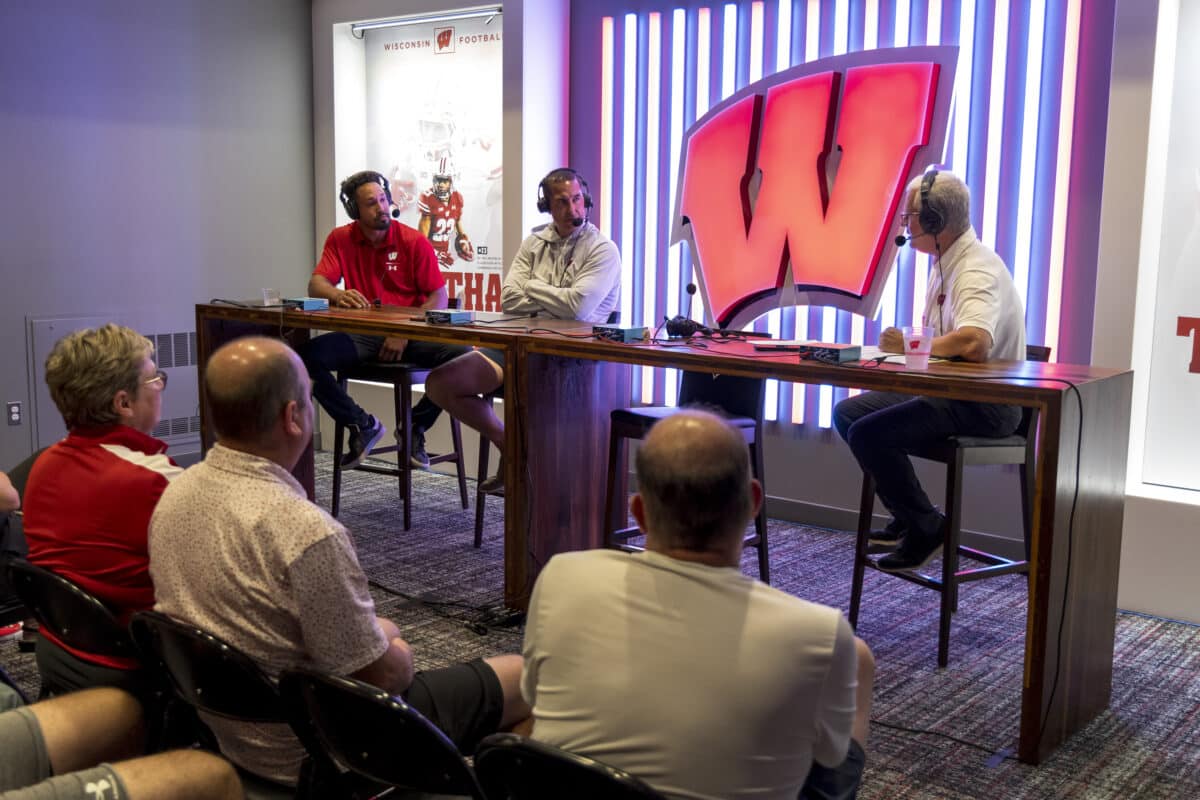
Yes, Luke Fickell is on the hot seat, and it is one of the hottest in college football.
The reason is not the one most fans reach for. Wisconsin spent two years blaming the Air Raid, then fired the coordinator who ran it and watched the offense get worse, scoring 12.8 points a game in 2025. The pressure is real, and the story underneath it is more interesting than the boos suggest.
This is a pressure read, not a firing prediction. Below are the five questions that decide whether Fickell’s 2026 cools the seat or lights it, with the tell to watch for each one so you can judge the season as it happens.
Question 1: Can the offense clear the mid-20s, or is 12.8 the real Wisconsin?
Start with the number that ended the scheme debate.
In 2025, the reborn run-first offense scored 12.8 points a game, 135th out of 136 teams in the country and dead last in the Power Four. That happened after Wisconsin buried the Air Raid, which means the scheme was never the whole problem. The old system, which averaged in the low 20s, had more life in it than the throwback version brought in to save the day.
The tell to watch: look for the offense to camp in the mid-20s a game. Anything near 12 means the disease is still active, and a unit score of 24 or more is the first honest sign that the patient is up and walking.
Question 2: Does Colton Joseph survive to November?
The single biggest variable is not the scheme or the schedule; it is health.
Fickell has brought in a veteran transfer quarterback every year, and three straight have lost their seasons to injury: Tanner Mordecai’s hand in 2023, Tyler Van Dyke’s ACL in 2024, and Billy Edwards Jr.’s knee in 2025. New starter Colton Joseph is a dynamic dual-threat from Old Dominion, which is exciting and also the catch, because a runner behind a rebuilt line is an injury risk. The last three Wisconsin starters went down the same way.
The tell to watch: count how many games the Week 1 quarterback finishes. Joseph, standing on the field for the Minnesota finale, would break the pattern that has defined the entire tenure, and it matters more than any single stat line.
Question 3: Can Wisconsin make a bowl on the easiest schedule in the Big Ten?
The 2026 schedule takes away every excuse.
CBS Sports rated Wisconsin’s slate the easiest in the Big Ten, with no Ohio State, Oregon, Michigan, or Indiana. Last year’s opponents went a combined 110-53, with the eventual national champion among them. This year’s group went 69-79. With a draw this soft, six wins is the floor of competence rather than an achievement.
The tell to watch: treat bowl eligibility as the baseline, not the prize. A third straight bowl miss on a schedule this forgiving would be the loudest result of the season and a sign the problem runs deeper than luck.
Question 4: Is it bad luck or bad coaching?
This is the fairest question in the whole debate, and it deserves a real answer.
The quarterback injuries are a genuine misfortune, and no coach draws up a torn ACL. But building every season on a one-year rental with no functional backup is a roster decision, and Fickell made that call three straight times. When the school kept him, athletic director Chris McIntosh pointed at money, and there is a sliver of truth there, since Wisconsin has lagged in NIL. Paul Chryst won 67 games on less, though, and Fickell reached a College Football Playoff at Cincinnati on a fraction of a Big Ten budget.
The tell to watch: separate the wound from the plan. Injuries are luck, but depth behind the starter and finishing close games are coaching, so watch whether Wisconsin has a real answer the first time something goes wrong.
Question 5: What cools the seat, and what only looks like progress?
Not every win means the same thing this fall.
A nine-win season built on a soft schedule can still hide the same flaw, just as two non-conference blowouts can flatter a point differential. The results that move the needle are the ones that test the real problem. Wisconsin closed 2025 by upsetting ranked Washington and ranked Illinois, proof that the pulse is there when the quarterback is upright.
The results that change the read:
A healthy quarterback in December. If Joseph finishes the year, the biggest variable will finally break Wisconsin’s way.
An offense in the mid-20s. Scoring, not scheme talk, is the proof the fix took.
A road win over a team with a pulse. Padding the record at home proves nothing the schedule did not already promise.
The bottom line on Luke Fickell’s hot seat
This is a Structural Trend, and it is the hottest honest seat on the board.
The scheme war is over, and the offense lost anyway, which points the finger at the quarterback room rather than the playbook. The best-case scenario is real because the injuries were rotten luck, and a healthy Joseph on the softest schedule in the league could spark a genuine bounce. The buyout of about 25 million dollars buys Fickell the patience his record could not earn, so 2026 is the year the excuses finally run out.
Ask these five questions as the season unfolds, and you will know whether Wisconsin is climbing or just enjoying a soft landing.
Score it yourself
Want to run this same diagnosis on your team’s coach?
The Coach Evaluation Scorecard is our free, seven-category tool for scoring any coaching situation out of 35, so you can tell a hot seat from a cold take before the season starts. Grab it here.
Our complete Diagnosis: Fickle breakdown is available to subscribers. Click the button below to subscribe.
These rankings reflect pressure, not predictions. We don’t forecast firings. We track the gap between expectations and results – the weight of buyouts, the patience of administrators, the brutal math of wins and losses in a sport that changes by the hour.
This list is a work in progress.
Openings remain unfilled. Coordinators are fielding calls. NFL franchises are circling college sidelines. By the time you read this, names may have moved to new programs, new positions, or out of the profession entirely.
What won’t change:
The decisions these coaches made in 2025. The results those decisions produced. And the pressure that follows them into the off-season.
Ten coaches.
Ten programs, stuck between the cost of change and the cost of staying the same.
#1. Mike Norvell – Florida State (5-7, 2-6 ACC)
Started 3-0 with win over #8 Alabama, collapsed to 7 losses in final 9 games.
Outgained opponents in 10 of 11 games but kept losing.
Lost to Stanford (no head coach), NC State, Florida.
Norvell publicly admitted he doesn’t have answers after losses.
Administration retained him with vague “fundamental changes” statement despite $60M+ buyout.
Zero road wins.
Fan base exhausted.
#2. Mike Locksley – Maryland (4-8, 1-8 Big Ten)
Started 4-0, finished 0-8.
Pattern repeated: 21-5 in Aug/Sept under Locksley, 15-39 after that.
Eight-game losing streak included a loss to Michigan State (winless in conference entering the game).
Now 16-43 in Big Ten play, 0-18 vs ranked Big Ten opponents.
Worst winning percentage of any Power Four coach with tenure as long as his (after Cal fired Wilcox).
“Fire Locksley” chants at Indiana game.
AD Jim Smith retained him citing $13M buyout, lack of booster money, desire to build around freshman QB Malik Washington.
Locksley: “winning has a cost.”
#3. Shane Beamer – South Carolina (4-8, 1-7 SEC)
SEC Coach of Year 2024 to hot seat in 11 months.
Entered 2025 ranked #13 after 6-game win streak, finished 4-8.
Only Power Four team never to hit 350 yards in single game all season.
Fired OC Mike Shula (after 9 games), OL coach Lonnie Teasley, RB coach Marquel Blackwell.
Fourth OC in five years incoming.
Clemson beat them 28-14 at home (6th straight loss in Columbia).
Beamer gave “one billion percent” guarantee 2026 will be different.
2026 schedule brutal: at Alabama, Florida, Oklahoma; home vs Georgia, Tennessee, Texas A&M.
#4. Dave Aranda – Baylor (5-7, 3-6 Big 12)
The 2021 Big 12 championship now feels like a different lifetime.
22-26 since that trophy.
Defense (Aranda’s specialty) ranked 112th in rushing defense, 106th in total defense, and 123rd in sacks.
Sawyer Robertson led the nation in passing yards; it didn’t matter.
Went 1-5 down stretch.
Only retained due to AD Mack Rhoades’ resignation amid investigation (alleged sideline altercation with TE Michael Trigg).
President Linda Livingstone’s retention letter read like a hostage statement: “We are not settling for mediocrity,” while keeping the coach who delivered exactly that.
37-35 at Baylor with one elite season, five years of drift.
#5. Luke Fickell – Wisconsin (4-8, 1-7 Big Ten)
Took Cincinnati to CFP.
Now 17-21 at Wisconsin with back-to-back losing seasons (first since 1991-92).
Worst record since 1-10 in 1990.
Offense historically bad: 135th of 136 FBS teams in yards (261.6), 134th scoring (12.5 PPG).
Shut out in consecutive games (Ohio State, Iowa) for the first time since 1977.
Lost to Minnesota 17-7 in the finale.
QB situation disaster—hand-picked transfers available for full season in just 11 of 33 games due to injuries.
Fired OC Phil Longo after 10 games in 2024, answered “Why does it matter?” when asked who’d call plays.
Four-star RB Amari Latimer flipped to West Virginia on signing day.
AD Chris McIntosh issued a vote of confidence and promised more resources.
6-18 since taking over program that played in 11 bowls under Rick Stockstill’s 18-year tenure.
Lost season opener to FCS Austin Peay.
Seven-game losing streak included losses to Delaware, Missouri State, Kennesaw State (all in first/second year as FBS, all bowl eligible or close).
Defense allowed 31.5 PPG. Lost four consecutive conference games by touchdown or less.
Closed with wins over 2-10 Sam Houston, 4-8 New Mexico State.
Mason is calling that “momentum.”
Retained reportedly because AD Chris Massaro may retire in 2026.
Now 33-67 as head coach.
Stanford coordinator “shine” wore off at Vanderbilt, and it wore off in Murfreesboro.
#7. Bill Belichick – North Carolina (4-8, 2-6 ACC)
The six-time Super Bowl champion went 4-8 in his first college season.
Debut: College GameDay for 48-14 loss to TCU.
Midseason WRAL report: program “unstructured mess,” “complete disaster.”
Lost five games by 16+ points.
Three FBS wins vs teams with a combined 8-28 record.
Offense last in ACC: 264.8 yards, 19.3 PPG.
GM Mike Lombardi called UNC the “33rd NFL team” at the presser.
Off-field chaos: banned Patriots scouts, assistant suspended for NCAA violations, players cited for reckless driving, 24-year-old girlfriend tabloid fixture.
Four-minute postgame presser after NC State blowout, no season recap: “I don’t have one. We haven’t done it.”
Guaranteed $10M/year through 2027.
Losing players to the portal while fielding NFL inquiries.
Three straight losing seasons (two New England, one Chapel Hill).
“Patriot Way” hasn’t translated.
#8. Scotty Walden – UTEP (2-10, 1-7 CUSA)
Turned Austin Peay into an FCS power.
5-19 in two years at UTEP.
Finished 2-10 in 2025 (one fewer win than Year 1).
Finale: 61-31 humiliation at Delaware (first FBS season, still blew out UTEP by 30).
Walden confronted Delaware coach Ryan Carty over a late field goal, calling it “classless.”
UTEP threw five interceptions that game.
Lost to Kennesaw State, Missouri State, and Jacksonville State (all FCS) a year ago.
UTEP hasn’t won a bowl game since 1967 (the longest FBS bowl drought).
Moves to Mountain West in 2026: tougher opponents, longer travel.
Age 35 with time to figure it out, but rebuild producing no results.
#9. Jay Sawvel – Wyoming (4-8, 3-5 Mountain West)
Craig Bohl built seven straight winning seasons.
Sawvel: 7-17 in two years, 4-11 conference, zero bowls.
Finished 4-8 in 2025, four-game losing streak to end season (24 combined points).
Defense solid (19.9 PPG, 23rd nationally).
Offense averaged 16 PPG (inflated by two defensive TDs).
Demoted OC Jay Johnson midseason, promoted WR coach Jovon Bouknight – didn’t help.
Beat Colorado State 28-0, then scored 17 total over the final three games.
AD Tom Burman confirmed return for Year 3, citing $2.88M buyout: “4-8 doesn’t work” but Sawvel “gives us the best chance to get it fixed.”
Mountain West losing Boise State, CSU, Fresno State, SDSU, Utah State to Pac-12.
Only 20 players remain from Bohl era, none earned all-conference honors.
Rebuild stalling.
#10. Dell McGee – Georgia State (1-11, 0-8 Sun Belt)
Two national championship rings at Georgia. 4-20 at Georgia State.
Dell McGee helped develop Nick Chubb, Sony Michel, and D’Andre Swift into NFL first-rounders.
He can’t develop a competitive Sun Belt roster.
Inherited a program that went 7-6 with a bowl win in 2023 under Shawn Elliott.
Two years later: back-to-back double-digit loss seasons.
The 2025 campaign delivered historic futility.
Lost opener at Ole Miss 63-14 (gave up nearly 700 yards).
Lost to Vanderbilt 70-28—first time allowing 70 points in program history.
Defense surrendered 40.7 PPG (135th of 136 FBS teams).
Nine-game losing streak to finish.
Only win: FCS Murray State.
The Hue Jackson hire told the story.
McGee promoted the 0-16 Browns architect (3-36-1 NFL record) to offensive coordinator after Grambling State fired him for “lack of transparency, coordination, and collaboration.”
The results: 21.1 PPG, 114th nationally.
Lost finale 10-27 at Old Dominion.
McGee’s Georgia State tenure has never held an opponent under 21 points.
Not once in 24 games.
He’s now 4-20 as a head coach at a program that made four bowls in five years before he arrived.
The “four Cs”, connected, competitive, committed, and composure, remain talking points.
Results remain absent.
AD Charlie Cobb hasn’t addressed McGee’s future publicly.
The program averaged 11,000 fans at Center Parc Stadium – when they showed up.
Year 3 brings no relief: at Georgia Tech, at LSU, at Miami on the non-conference slate.
Position coaching excellence doesn’t automatically translate to program building.
Georgia State is learning that lesson at considerable cost.
For the Wisconsin Badgers, the 2025 season is now or never.
What Happened in 2024 Was Not Just a Blip
It was a gut punch.
They have a 5–7 record, a loss to Minnesota that cost them Paul Bunyan’s Axe, a home finale in which the offense put up 166 total yards, and no bowl game for the first time since 2001.
And yet, that wasn’t the worst part.
The worst part was how lifeless the team looked.
An offense that didn’t know what it wanted to be
A defense that forced only 8 turnovers all season
A coaching staff caught between systems, identities, and ideologies
Head coach Luke Fickell, once viewed as the program’s savior, finished his second year at 13–13. The Air Raid experiment with Phil Longo flamed out quickly.
The Offseason Was an Admission of Failure
To Fickell’s credit, he owned it.
Out went Longo. In came Jeff Grimes, the former Baylor offensive coordinator, who brought back a pro-style, wide-zone identity that actually fits Wisconsin football.
The quarterback room was wiped clean.
Billy Edwards Jr. transferred in from Maryland
Danny O’Neil followed from San Diego State
At receiver:
Jayden Ballard (Ohio State) brings elite athleticism
Mark Hamper (Idaho) offers size and production
Tight end?
Lance Mason from Missouri State—34 catches, 590 yards, 6 TDs
And on the line:
Davis Heinzen, a 36-game starter at Central Michigan, will plug the left tackle hole left by the spring injury to Kevin Heywood
It wasn’t a complete rebuild. It was a targeted reset.
But targeted doesn’t always mean successful.
The Defense: Still Searching for a Pulse
The numbers don’t lie.
342.7 yards allowed per game
Just 17 sacks across 12 games
Only 4 interceptions total
Worse, Wisconsin gave up 42+ points to Alabama, USC, and Iowa. And they were outscored 72–15 in the fourth quarter of their seven losses.
If you’re looking for toughness, this defense didn’t show it.
Fickell and DC Mike Tressel are betting on a fresh rotation up front:
Charles Perkins, Corey Parker, Reiger, and others from the portal
Preston Zachman and Ricardo Hallman return in the secondary
Still, depth is shaky. And losing freshman phenom Xavier Lucas (to Miami) hurts badly.
There are no proven pass rushers. No alpha presence. And no clear identity.
The Transfer Portal Wasn’t Just Busy. It Was Chaos.
Wisconsin signed the No. 14 portal class nationally, No. 3 in the Big Ten.
That sounds good—until you realize the talent out was arguably better than the talent in.
Out: RB Tawee Walker (Cincinnati), WR Will Pauling (Notre Dame), CB Xavier Lucas (Miami), TE Tanner Koziol (Houston)
In: Players from Maryland, Idaho, Purdue, Missouri State, Central Michigan
None of Wisconsin’s incoming transfers made ESPN’s top 100. Two of the players who left did.
This isn’t reloading. This is plugging holes in a leaky boat.
And that boat is headed straight into a hurricane.
The Schedule Is a Nightmare
And this is where it gets ugly.
Wisconsin’s 2025 schedule might be the toughest in school history:
Road games: Alabama, Michigan, Oregon
Home games: Ohio State, Iowa, Washington, Illinois
According to SP+, nine of their opponents rank in the top 40, seven in the top 25, four in the top 13, and three in the top six.
Vegas has the win total at 5.5.
Let that sink in.
This is Wisconsin. A program that expects 9+ wins. Now projected to struggle for bowl eligibility.
And if the season gets off to a slow start?
It could snowball fast.
Where Are the Bright Spots?
There are some.
Riley Mahlman (RT) and Jake Renfro (C) anchor the offensive line
Nathanial Vakos is a steady presence at kicker (100% XP, 63% FG)
The offensive scheme will fit the roster better
The new staff wants to run the ball more effectively and control the clock. Reducing time on the field should help the defense.
And if Billy Edwards Jr. can be average to good, the offense might find rhythm.
If the offense can avoid turnovers and red zone disasters, this team could grind out six or seven wins.
But the Cracks Are Still There
Offensive line depth is dangerously thin
Running back depth behind Jackson Acker is unproven
The receiving corps is untested, mainly at the Power Five level
The defense has no clear game-changers
Chemistry could be a mess with 15+ new transfers
And let’s not forget the coaching carousel:
New OC
New offensive line coach
New tight ends coach
Multiple defensive staff shuffles
You don’t need all these issues to explode—just a few.
And with the margin of error gone, a few is all it takes.
The Verdict: This Is a Career-Defining Year for Luke Fickell
Brandon Marcello of CBS Sports said it best: “It’s bowl game or bust for Fickell. Anything less is probably not enough to keep him in Madison.”
He’s right.
Fickell was hired to modernize Wisconsin football. Instead, he misfired, blew up the offensive identity, and lost to all three border rivals in 2024.
Now, with a schedule from hell and a roster full of questions, he has to produce.
He has to win.
Because if he doesn’t?
Wisconsin becomes a cautionary tale.
Not of a program that tried and failed.
But of one that lost what made it special—and didn’t realize it until it was too late.
The margin is gone.
And this season will decide everything.
The Next Billion Dollar Game
College football isn’t just a sport anymore—it’s a high-stakes market where information asymmetry separates winners from losers. While the average fan sees only what happens between the sidelines, real insiders trade on the hidden dynamics reshaping programs from the inside out.
Our team has embedded with the power brokers who run this game. From the coaching carousel to NIL deals to transfer portal strategies, we’ve mapped the entire ecosystem with the kind of obsessive detail that would make a hedge fund analyst blush.
Why subscribe? Because in markets this inefficient, information creates alpha. Our subscribers knew which coaches were dead men walking months before the mainstream media caught on. They understood which programs were quietly transforming their recruiting apparatuses while competitors slept.
The smart money is already positioning for 2025. Are you?
Click below—it’s free—and join the small group of people who understand the real value of college football’s new economy.
In the era of social media and team message boards, College football communities typically fall into three categories:
Picture the modern college football landscape as a digital Roman Colosseum, where three distinct tribes gather daily to pass judgment on their gladiators. I’ve spent months studying these tribes, fascinated by how their collective voice can determine the fate of multimillion-dollar coaching careers with the force of an emperor’s thumb.
First, you have the Sunshine Pumpers – college football’s eternal optimists, whose rose-tinted view of their program would make Pollyanna seem cynical. They’re the ones who’d watch their team’s practice facility burn to the ground and declare it a strategic move to improve ventilation. Their unwavering positivity isn’t just amusing; it’s a psychological defense mechanism worth millions to beleaguered athletic directors who need someone, anyone, to keep buying season tickets.
Then there are the Negative Nellies, the digital descendants of Ancient Greek tragedy choruses. These people have turned catastrophizing into an art form and see an upset loss to a rival as evidence of civilization’s collapse. They don’t just want their coach fired; they want him launched into the sun, preferably before halftime.
But the real power brokers? They’re the Middle Majority – college football’s silent jury. These are the clear-eyed realists who still remember that this is, ultimately, a game played by 20-year-olds. Lose their support, and a coach’s career expectancy drops faster than a team’s ranking after a loss to an FCS opponent.
As we examine this week’s coaching hot seat rankings, remember: these three tribes aren’t just posting on message boards – they’re reshaping the power dynamics of a $8 billion industry, one complaint thread at a time.
The Ryan Day situation at Ohio State exemplifies how these three tribes can reshape a program’s trajectory. With a staggering 86.8% winning percentage and a 64-3 record outside of Michigan games and playoff appearances, Day should be untouchable in the eyes of any rational observer. But that’s not how college football works in 2024, especially not in Columbus.
The Sunshine Pumpers point to the program’s continued playoff contention and recruiting dominance, including a roster powered by $20 million in NIL money. They’ll tell you that Day’s overall record (.868 winning percentage) would be celebrated at 95% of programs nationwide. And they’re not wrong.
The Negative Nellies, however, have found their ammunition: a 2-7 record in career-defining moments and four straight losses to Michigan, including an unthinkable defeat to an unranked Wolverines squad that had just lost their head coach to the NFL. The “Big Game Day” epithet has stuck, and the critics are getting louder.
But it’s the Middle Majority that makes this situation genuinely fascinating. They’re running the numbers: a $35 million buyout, a coach who consistently wins everything except the games that matter most and a recruiting machine that just watched Michigan flip five-star quarterback Bryce Underwood with a reported $10 million NIL deal. The silent jury is still deliberating, but their patience is wearing thin.
Athletic Director Ross Bjork’s carefully worded support – “Coach Day does a great job leading our program. He’s our coach” – reads less like a vote of confidence and more like a holding pattern until the playoff scenario plays out. The real question might not be whether Ohio State wants to keep Day but whether Day wants to stay in a pressure cooker where even a 66-10 record can’t guarantee job security.
Unlike the Ohio State scenario, Kent State’s situation with Kenni Burns has achieved something remarkable: it’s united all three tribes in bewilderment. When you’ve lost 21 straight games and your head coach is being sued for defaulting on a $24,000 credit card debt despite making nearly half a million dollars annually, even the Sunshine Pumpers run out of silver linings to grasp.
The raw numbers read like a satire of college football excess: a 1-33 overall record, a $1.51 million buyout, and a contract extension through 2028 that was inexplicably granted in February 2024 – the same period during which Burns was reportedly falling behind on his credit card payments. The Golden Flashes haven’t just lost games; they’ve been dismantled with surgical precision, outscored 486-160 overall and 282-99 in MAC play. The season’s nadir came early with a loss to St. Francis (PA), though the subsequent 71-0 demolition by Tennessee and 56-0 erasure by Penn State suggest “nadir” might be a moving target.
In any rational football universe, this would be where our three tribes engage in their usual warfare of interpretation. The Negative Nellies would demand immediate change, the Sunshine Pumpers would preach patience, and the Middle Majority would weigh the practical constraints against the competitive collapse. But when your head coach can’t manage his personal finances – defaulting on debt to a local bank that once sponsored the athletic program, no less – while earning $475,000 a year, it raises uncomfortable questions about institutional judgment.
Kent State has transcended such traditional dynamics. When your season ends with a 43-7 loss to Buffalo, extending the nation’s longest active losing streak to 21 games, while your head coach dodges court summons over unpaid credit card bills, you’ve achieved something rare in modern college football: unanimous consensus. The same industry that might force out Ryan Day and his 87% winning percentage at Ohio State has somehow found infinite patience for a program redefining competitive futility both on and off the field.
Perhaps that’s the most fascinating part of this story – how Kent State has inadvertently experimented with just how far institutional inertia can stretch. The answer is at least 21 games, one credit card default, and counting.
The UAB situation under Trent Dilfer exemplifies what happens when all three fan tribes suddenly realize they’ve been watching the same horror movie. Four seasons ago, UAB dominated Tulane with a bruising defense that held the Green Wave to 21 points. This year? Tulane hung 71 points on the Blazers in their stadium.
As Joseph Goodman of the Alabama Media Group devastatingly points out, UAB has completed a stunning transformation “from being a symbol of pride for the city of Birmingham to the worst team in college football.” Not the bottom 10. Not second-to-last. The worst. This is a program that, under Bill Clark, made five consecutive bowl games and engineered a move to the American Athletic Conference. Under Dilfer, they’re losing 32-6 to Louisiana-Monroe, a program he describes as “historically tragic.”
The Sunshine Pumpers, usually reliable defenders of any coach with an NFL pedigree, have gone quiet. The Negative Nellies are pointing to a season-ending loss to Charlotte where the Blazers missed not one but two chip-shot field goals. And the Middle Majority? They’re doing the math on how a program goes from nine wins and a bowl victory over BYU in 2021 to this level of competitive collapse.
Yet in a twist that would bewilder even the most optimistic fans, UAB appears ready to run it back with Dilfer in 2024. The sacrifice of assistant coaches is enough to appease the football gods, even as the program that Bill Clark rebuilt piece by piece crumbles into competitive irrelevance.
The most telling sign of the program’s descent is when a senior quarterback abandons the team mid-season to preserve his eligibility. This suggests that the quarterback whisperer might have lost his voice.
You know something has gone wrong when your fanbase goes from celebrating a splash hire to demanding his head in just two years. Luke Fickell’s descent at Wisconsin is a cautionary tale about the dangers of heightened expectations, with his .760 winning percentage at Cincinnati deteriorating to .500 in Madison.
The Sunshine Pumpers still point to his overall .667 career winning percentage and Cincinnati success, including that magical College Football Playoff run. They’ll tell you that losing starting quarterback Tyler Van Dyke to a torn ACL derailed what could have been a breakthrough season. And didn’t Fickell already show accountability by firing offensive coordinator Phil Longo?
However, the Negative Nellies have the receipts: five consecutive losses to the end of 2024, the first such streak since 1991. It was a humiliating 24-7 home loss to Minnesota that snapped a 22-year bowl streak and an offense that managed just 44 total yards in the first half of their season finale, with bowl eligibility on the line. The boos raining down at Camp Randall tell their own story.
The Middle Majority finds itself in an uncomfortable position. This is the same Luke Fickell who Ohio State passed over for Ryan Day – and now both men find themselves scrutinized for failing to meet their program’s standards, albeit at very different levels. The irony isn’t lost on anyone that while Ohio State contemplates moving on from Day’s 87% win rate, Wisconsin seems prepared to give Fickell another chance to prove he hasn’t lost his Cincinnati magic.
The most damning indictment? When athletic director Chris McIntosh’s recent raise and extension become part of the conversation about your job security, you know the pressure is mounting.
At Auburn, the three tribes of college football fandom find themselves engaged in a uniquely expensive form of warfare. Since 2000, the program has spent $68 million not on building success but on buying out failure – a figure transforming Auburn football from a sports program into a case study of institutional self-sabotage.
The Sunshine Pumpers are clinging to Auburn’s 2025 recruiting class, currently ranked fifth nationally, like a life raft in a storm of mediocrity. They’ll tell you that Freeze needs time, that his 444.5 yards per game show the offense is close to clicking, and that better days are just around the corner. Remember that Texas A&M signed a top-20 class a month after firing their coach last year.
The Negative Nellies point to numbers that are harder to spin: 11-14 overall, 5-11 in the SEC, and now 0-2 in the Iron Bowl. As Paul Finebaum put it, after the latest loss to Alabama, people “really have to wonder about this program’s future.” When you’re generating 444.5 yards per game but still can’t score, you’re not just failing – you’re finding innovative new ways to disappoint.
But it’s the Middle Majority that genuinely appreciates the dark comedy here. Auburn has fired a coach two years after winning a national title (Gene Chizik), dismissed another despite his mystifying ability to beat Alabama in odd-numbered years (Gus Malzahn), and scrapped Bryan Harsin for the crime of not being from around here. Now they’ve got Freeze, whose $20.3 million buyout can be paid monthly through 2028 – less like a coaching contract and more like a mortgage on mediocrity.
The most revealing detail is that Auburn structured Freeze’s buyout not as a deterrent to firing him but as a more convenient payment plan. This behavior reflects an institution that knows itself too well—like someone who builds the divorce settlement into their wedding vows.
Thoughts? We’re ready to hear from you. Click right here
Think you know college football? Think again. Coaches Hot Seat spends a little time listening to the Targeting Winners Podcast every Friday afternoon during the season. We take our picks and look for the storylines, the upsets, the wins, and the losses to bring you the inside scoop on where the seats are getting hot. We’re not just talking about picking winners but about understanding the why behind the wins. The hidden narratives, the coaching mismatches, the moments that define a season.
The CFB Dudes at Targeting Winners live and breathe this stuff. They break down film, analyze matchups, and find the edges that the casual fan misses. We compare our picks with the Targeting Winner’s intel, and boom!
So buckle up, because we’re about to take you on a wild ride through three games we’ve got our eye on this week. Fans looking for an edge? You’ve come to the right place.
Notre Dame vs. Navy: The Midshipmen’s Mutiny
Notre Dame limps in, battered and bruised. Five starters down, maybe more. They’re like a prizefighter with a glass jaw, and Navy, they come in with a battering ram. 6-0, averaging 45 points a game. Blake Horvath, their quarterback? He’s not just running the triple option, he’s weaponizing it. Think Barry Sanders with a playbook designed to make defensive coordinators cry.
The line moved? Of course, it did. Smart money knows: Notre Dame’s defense hasn’t seen this kind of chaos. They’re trained for chess matches, not bar fights.
The Play: Navy +12.5. Take it, and don’t look back. This isn’t about talent; it’s about heart. Navy’s got it in spades.
Penn State vs. Wisconsin: The Calm Before the Storm
Penn State is undefeated, but they just survived a brawl with USC. Now they’re staring down Ohio State, the biggest game of their season. It’s a classic trap game. Wisconsin smells blood.
But here’s the thing: Penn State’s defense is a force. Drew Allar, their quarterback? He’s growing up fast. Wisconsin’s offense? Let’s say they haven’t exactly been lighting up the scoreboard.
Camp Randall’s a tough place to play, sure. But Penn State’s been there, done that. They’ve got the experience, the defense, and the quarterback play to weather the storm.
The Play: Penn State -6.5. They’ll win this one ugly, but a win’s a win. And take the Under 47.5. This game’s going to be a slugfest.
Boise State vs. UNLV: The Rebels’ Redemption
Boise State has Ashton Jeanty, a one-man wrecking crew. But here’s their problem: their quarterback, Maddux Madsen, is like a Ferrari with a lawnmower engine. He has lots of flash but not enough horsepower.
UNLV? They’ve got a secret weapon: the “Go-Go Offense.” Hajj-Malik Williams, their quarterback, is slinging the ball like he’s got something to prove. And their offensive line? They’re opening holes you could drive a truck through.
Boise’s defense? They lead the nation in sacks but can’t stop a nosebleed on third-and-short. UNLV’s going to exploit that weakness.
The Play: UNLV +140 on the moneyline. They’re at home, they’re playing with confidence, and they’re about to pull off the upset. Boise State? They’re about to learn a hard lesson: talent only gets you so far.
There you have it. Three games, three takes. This is all about the story. And these stories, they’re just getting started. Post your comments here.
Friday, Aug. 30 Lehigh at Army | 6 p.m. | CBSSN Temple at No. 16 Oklahoma | 7 p.m. | ESPN Florida Atlantic at Michigan State | 7 p.m. | Big Ten Network Colgate at Maine | 7 p.m. | FloSports Elon at Duke | 7:30 p.m. | ACC Network Western Michigan at Wisconsin | 9 p.m. | Big Ten Network
Get insider college football intel delivered to your inbox
Want insider analysis on college football program moves before they happen? Get hard-hitting insights, no fluff – straight to your inbox. Subscribe to the Coaches Hot Seat newsletter and be on the cutting edge of what’s happening in the world of college football.