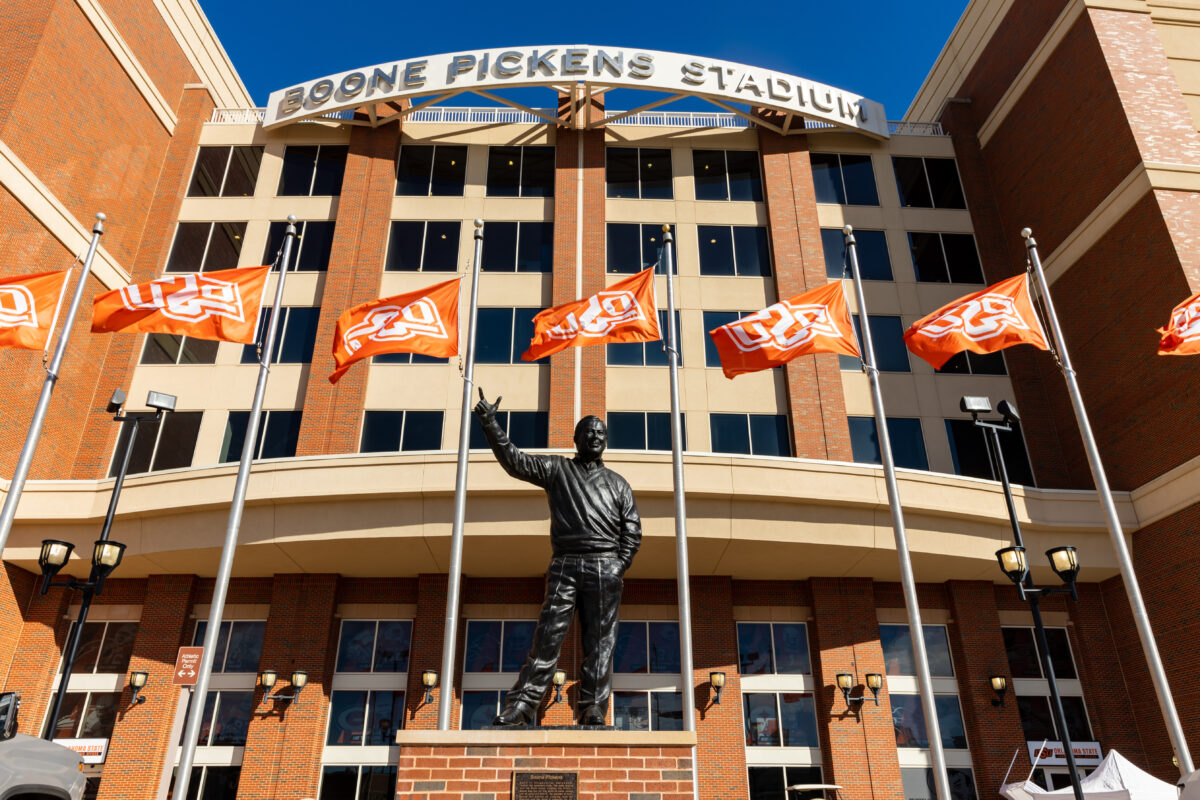
COACHES HOT SEAT: WEEK 13 RANKINGS

The clock just hit midnight on college football’s struggling coaches.

No more “next year” promises. No more “we’re close” platitudes. Week 12 stripped away the illusions and exposed the reality: some programs are moving forward, and others are circling the drain.

Jonathan Smith is 0-7 in Big Ten play. Shane Beamer blew a 27-point halftime lead in the most catastrophic collapse of the season. Mike Norvell’s Florida State is 2-12 in ACC games over two years. Bill Belichick is 0-5 against Power Four opponents in his first college season.

Athletic directors are done selling hope to angry donors. Boosters are done writing checks for mediocrity. The portal opens in three weeks, and players are already making decisions about their futures.

This is where coaching careers get defined—or destroyed.

Here are the ten coaches who entered Week 12 with everything to prove and nothing left to hide behind.

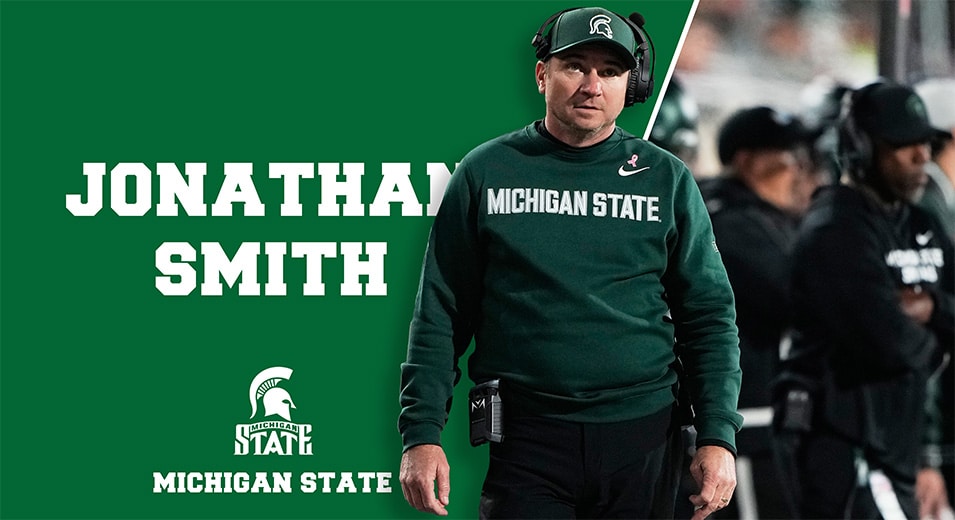
1. Jonathan Smith – Michigan State Spartans (3-7, 0-7 Big Ten)

Jonathan Smith’s seat isn’t just hot anymore. It’s molten.

Michigan State lost to Penn State 28-10 at home Saturday, marking their seventh straight defeat and officially eliminating the Spartans from bowl eligibility. That’s four consecutive seasons without a bowl game and an 0-7 Big Ten record that has Smith at 8-12 overall since arriving from Oregon State.

The numbers: Michigan State owes Smith approximately $32-33 million if they fire him now. That’s one of the most expensive buyouts in the Big Ten. However, the AD and university president, both hired after Smith arrived, have no strong ties to him and are facing mounting pressure to act.

National media outlets universally place Smith at the top of coaching hot seat lists. Fan sentiment has turned nearly uniform in calling for a change. Replacement candidate discussions are already widespread.

Smith will almost certainly coach Michigan State’s final two games, but barring a miracle turnaround, he’s coaching for his next job, not this one.

2. Mike Locksley – Maryland Terrapins (4-6, 1-6 Big Ten)

Mike Locksley just got saved by the very problem that’s destroying college football programs: money.

Maryland announced Sunday that Locksley will return for 2026 despite a six-game losing streak that dropped the Terrapins from 4-0 to 4-6. It’s the second straight season with only one Big Ten win and the 11th consecutive losing season in conference play. Locksley is now 37-47 overall at Maryland and 17-46 in Big Ten games since 2019.

Athletic Director Jim Smith made the decision based on financial reality. Maryland’s athletic department has lost $32.7 million over the past five years. Locksley’s buyout would be $13.4 million. Smith told ESPN the school is “better off pouring already-spent money into building the roster than into bringing in a new coaching staff.”

Translation: We can’t afford to fire him.

The announcement came after “Fire Locksley” chants broke out in the student section during the Indiana game. Locksley’s pressure doesn’t disappear just because he’s surviving 2025. He’s coaching on borrowed time in 2026, and everyone knows it.

3. Shane Beamer – South Carolina Gamecocks (3-7, 1-7 SEC)

Shane Beamer just orchestrated the most spectacular coaching collapse of the 2025 season.

Saturday at Texas A&M, South Carolina led 30-3 at halftime. Then came the second half. Texas A&M scored 28 unanswered points. South Carolina was shut out and managed just 76 total yards after halftime. Final score: 31-30, Aggies. It was the largest comeback in Texas A&M program history.

ESPN’s Paul Finebaum summed it up perfectly: “Shane Beamer right now just looks like a loser.”

South Carolina is now 3-7 and guaranteed a losing season. They’ve lost five straight SEC games and will miss a bowl game for the first time under Beamer. “Fire Beamer” chants have replaced the cheers.

Here’s the financial nightmare: South Carolina extended Beamer through 2030 less than a year ago. His buyout is approximately $27.9 million. Athletic Director Jeremiah Donati is now stuck with one of college football’s most expensive mistakes.

This type of historic collapse changes everything. It’s not just that they lost. It’s HOW they lost.

4. Mike Norvell – Florida State Seminoles (5-5, 2-5 ACC)

Mike Norvell just won a game and it doesn’t matter.

Florida State beat Virginia Tech 34-14 Saturday to improve to 5-5, but the win came against a 3-7 Hokies team that’s almost as bad as the Seminoles. Since being controversially left out of the 2023 College Football Playoff at 13-0, Florida State is 7-15 overall and 2-12 in ACC play.

Athletic Director Michael Alford announced in October that Norvell would remain through the end of 2025, but promised a “comprehensive assessment” after the season. Translation: Norvell is coaching his final games at Florida State.

Here’s why the delay: Money. Norvell’s buyout is approximately $53.3 million after this season. It’s the second-largest buyout in college football history.

Norvell has tried to project confidence, delivering a six-minute “championship expectation” rant recently. The problem is the results. FSU is winless on the road this season and hasn’t won a road game since November 2023.

5. Derek Mason – Middle Tennessee Blue Raiders (2-8, 1-5 Conference USA)

Derek Mason took a sabbatical from coaching after the 2022 season to rest, reflect, and spend time with family.

He should have stayed on sabbatical.

Mason is in his second season at Middle Tennessee and the program has regressed under his leadership. The Blue Raiders went 3-9 in his first year, and they’re currently 2-8 in 2025. That’s 5-17 overall and 3-11 in conference play across two seasons.

Mason replaced Rick Stockstill, who went 113-111 over 18 seasons with 10 bowl appearances. Mason hasn’t come close to matching that standard. Middle Tennessee’s two wins this season came against FCS opponents. Every FBS opponent has beaten them, often badly.

The defense, which should be Mason’s calling card, ranks among the worst in all of college football. Mason’s overall head coaching record is now 30-64 across eight years. At some point, MTSU has to ask if this experiment is worth continuing.

6. Dave Aranda – Baylor Bears (5-5, 3-4 Big 12)

Dave Aranda isn’t getting fired this season, but not for the reasons you’d hope.

After Saturday’s 55-28 home humiliation against Utah, Aranda sits at 5-5 overall and desperately needs one win in the final two games to make a bowl. His defense ranks second-worst in the Big 12 in both scoring and rush defense. For a defensive specialist hired specifically for his defensive expertise, that’s a damning indictment.

Here’s the number that matters most: 21-25. That’s Aranda’s record at Baylor with his own recruits, excluding the COVID season and the 2021 championship season built on Matt Rhule’s inherited roster.

However, Aranda is still employed because athletic director Mack Rhoades took a leave of absence November 12 amid an ongoing investigation. Interim ADs don’t make coaching changes of this magnitude.

It’s not merit. It’s institutional paralysis.

7. Luke Fickell – Wisconsin Badgers (5-6, 3-5 Big Ten)

Luke Fickell went from College Football Playoff coach to coaching for his job in three years.

After leading Cincinnati to the CFP in 2021, Fickell was hired by Wisconsin with enormous expectations. Instead, Wisconsin has regressed. Fickell is now 16-19 overall at Wisconsin and 9-15 in Big Ten play. His teams have produced losing records in two of three full seasons.

The Badgers went scoreless in back-to-back games against Iowa and Ohio State earlier this season, marking the first time that has happened since 1977. Wisconsin hasn’t won a Big Ten home game in over a calendar year.

Here’s the ironic twist: Fickell just received a contract extension through 2032 and a public vote of confidence from AD Chris McIntosh. His buyout is estimated to be around $27.5 million.

Wisconsin is on track for its second straight losing season after 22 consecutive bowl appearances. Fickell gets 2026 to prove he can turn it around, but the pressure will be immense from Day One.

8. Bill Belichick – North Carolina Tar Heels (4-6, 2-4 ACC)

The greatest football coach in history is learning that college football is a different game.

Bill Belichick, winner of six Super Bowls with the Patriots, arrived at North Carolina with enormous fanfare. Instead, he’s 4-6 overall and 0-5 against Power Four opponents. UNC’s losses weren’t just defeats. They were blowouts that exposed fundamental problems with Belichick’s transition to college football.

“It’s an unstructured mess,” a source told WRAL News in October. Reports emerged that Belichick hadn’t “had a conversation with most of the guys on defense.” The Tar Heels rank last in the ACC in total offense and scoring.

At 72 years old, in his first college job ever, Belichick is discovering that recruiting 18-year-olds, managing NIL, and coaching the portal era requires skills he never needed in the NFL.

UNC’s administration sold fans on Belichick, leading them to the playoffs. Instead, they’re fighting for bowl eligibility and dealing with reports of organizational chaos.

9. Justin Wilcox – California Golden Bears (6-4, 3-3 ACC)

Justin Wilcox sits at 6-4 overall and 3-3 in ACC play, a respectable first season navigating conference realignment.

But the pressure has never been higher.

Fan sentiment has turned decisively against Wilcox, with widespread calls for his dismissal dominating the Cal community. This isn’t about the record. It’s about nine years of incremental progress that never accumulates into sustained success.

Then there’s Ron Rivera. Cal’s new General Manager has given Wilcox conditional support, stating that “another victory or two” in the final stretch will be key in determining his future. That’s not a vote of confidence. That’s measured pressure from above.

When your GM says your fate depends on winning one or two games in a 6-4 season, you’re coaching under scrutiny from fans who’ve already moved on and leadership that’s watching closely.

10. Mark Stoops – Kentucky Wildcats (5-5, 2-5 SEC)

Mark Stoops just beat Tennessee Tech 42-10 Saturday, extending Kentucky’s winning streak to four games.

And his pressure level hasn’t budged an inch.

The win over an FCS opponent was expected, and while Stoops praised “this team’s attitude and effort,” beating Tennessee Tech doesn’t change the fundamental calculus around his job security. Fan sentiment remains sharply divided.

What protects Stoops isn’t the four-game winning streak. It’s the $40.5 million buyout that must be paid in full within 60 days if he’s fired. After critical wins at Auburn and over Florida, AD Mitch Barnhart voiced full support, saying Kentucky is “taking steps” back up the mountain.

Kentucky sits one win away from bowl eligibility with two games remaining. The pressure at #10 reflects this: the four-game streak has eased the immediate crisis, but beating an FCS team doesn’t resolve long-term doubts.

WANT TO SEE WHERE YOUR COACH RANKS?

The top 10 are racing against the clock.

But coaching pressure doesn’t stop at #10. A $40.5 million buyout protects Mark Stoops (#10) despite 13 years of middling results. Justin Wilcox (#9) is 6-4 but facing conditional support from his GM. Luke Fickell (#7) just got extended through 2032 despite losing 9 of his last 14 games.

Every FBS coach is ranked based on actual pressure, not speculation about who might be fired.

Subscribers to our newsletter get the full story. Each week, you’ll receive comprehensive profiles of all the top 10 coaches with contract details, buyout numbers, replacement candidates, and insider analysis you won’t find anywhere else. Additionally, our weekly Hot Seat Deep Dive provides an in-depth examination of one coach’s situation. This week: Dave Aranda at Baylor – how administrative chaos became a coaching lifeline, and why institutional paralysis might be the only thing keeping him employed.

Subscribe here to get the complete analysis delivered to your inbox every week.

Want to know where your coach stands? View rankings of all 136 FBS coaches.

No related posts found.

LOAD MORE BLOG ARTICLES

Week 12 Coaches Hot Seat Rankings

Week 11 exposed the pretenders. Week 12 eliminates them. This is the part of the season where athletic directors stop debating and start deciding. Where donor patience either holds or shatters entirely. Where recruits make final judgments about which programs are ascending and which are circling the drain. The “we’re close to turning the corner” narrative that might have worked in October doesn’t survive November. By Week 12, you either have tangible proof of progress or you’re staring at an offseason coaching search. Buyout conversations move from theoretical to tactical. Board meetings shift from “let’s give him more time” to “what’s our exit strategy?” Week 12 separates the coaches who survive the season from those who won’t make it to December. And for these ten coaches? The clock is ticking louder than ever.

1. Jonathan Smith, Michigan State

Jonathan Smith remains at #1, and the situation in East Lansing has moved from crisis to terminal. The $33M+ buyout that once seemed prohibitive is now just a number that major donors are actively working to fund. His 8-13 record isn’t just bad, it’s a complete program collapse that’s destroying Michigan State’s identity. New AD J Batt inherited this disaster and faces mounting pressure to act. Recruiting has gone from struggling to nonexistent, with elite prospects avoiding East Lansing entirely. The fan base has moved past anger into total apathy, which is the real death sentence. The question isn’t whether Smith gets fired, it’s when.

2. Mike Locksley, Maryland

Mike Locksley holds at #2, but that strong 2025 recruiting class that was his lifeline is starting to crack. Commits are taking visits elsewhere, and the locker room remains completely fractured. His 37-46 overall record tells the story of six years without real progress in the Big Ten. Fourth quarter collapses continue, and fans have stopped showing up expecting anything different. Donor support has evaporated completely, with major boosters now openly discussing replacement options. The administration’s hesitation is about the competitive coaching market, not confidence in Locksley. One more collapse and it’s over.

3. Mike Norvell, Florida State

Mike Norvell stays at #3, still clinging to the thin margin of player support that’s kept him employed. The $55M+ buyout remains the primary obstacle, but FSU is already planning for 2026 when it becomes more manageable. His 37-32 record would be fine elsewhere, but FSU expects championships, not mediocrity. Fan skepticism continues to grow as the season progresses. That Wake Forest win bought time, but not much. Another embarrassing loss puts him right back at #1.

4. Derek Mason, Middle Tennessee

Derek Mason enters the Top 10 at #4 with a catastrophic 4-17 record over two seasons. This is complete program collapse, not a rebuilding project. His SEC pedigree from Vanderbilt hasn’t translated, and the offense ranks near the bottom nationally. Donor support is gone, attendance at Floyd Stadium is embarrassing, and recruiting is nonexistent. Elite Conference USA prospects are choosing other programs because nobody wants to commit to obvious instability. The administration is trapped between Mason’s contract and the reality that every game does more damage. This isn’t a hot seat, it’s a death watch.

5. Luke Fickell, Wisconsin

Luke Fickell drops to #5, but the heat hasn’t decreased at all. All the goodwill from Cincinnati is completely gone after a 16-19 start in Madison. Wisconsin fans are openly questioning whether hiring Fickell was a massive mistake. The offense looks lost, the defense looks confused, and the administration’s demands for “foundational change” are ultimatums, not suggestions. Recruiting has flatlined, with elite Midwest prospects now choosing programs like Iowa and Minnesota over Wisconsin. Donors are calculating buyout scenarios and floating replacement names. His $7.625M salary looked smart when everyone expected success. Now it looks like an expensive anchor.

6. Justin Wilcox, California

Justin Wilcox remains at #6 as Cal’s situation reaches existential crisis levels. Nine years and a 48-54 record, with the ACC move exposing every weakness instead of creating opportunities. Fourth quarter collapses define the program now, and fans plan around expecting defeat. The real crisis is financial, donors have completely checked out and stopped funding the program. Recruiting has stagnated to the point where Cal loses battles to Mountain West schools. The administration isn’t asking whether to fire Wilcox anymore. They’re asking bigger questions about whether Cal football at this level is sustainable. That’s far more dangerous.

7. Bill Belichick, North Carolina

Bill Belichick at #7 represents the most stunning collapse of expectations in college football. Six Super Bowl rings have produced a 4-5 record that has fans mocking a hire they celebrated months ago. One Power Four win, uncertain bowl eligibility, and a coaching style built for NFL professionals that doesn’t work with teenagers. Elite recruits visit once and immediately look elsewhere. His $10M salary looked brilliant when everyone expected immediate success, now it prevents necessary program investments. The administration is losing patience and credibility with donors who expected a revolution. Every game does more recruiting damage. The experiment is failing in real time.

8. Shane Beamer, South Carolina

Shane Beamer drops to #8 after mid-season coordinator firings that were pure desperation. His 32-28 record looks fine until you remember South Carolina expects SEC competitiveness, not fighting for bowl eligibility. The firings bought time but fixed nothing fundamental. Bowl eligibility has moved from goal to survival requirement, the minimum needed to keep his job. Booster support is now conditional, demanding actual results instead of energy and South Carolina ties. Recruiting is suffering as elite prospects watch the chaos and commit elsewhere. The administration has loaded the gun. Anything less than a bowl game and he’s done.

9. Dave Aranda, Baylor

Dave Aranda falls to #9, and the shine from that 2021 Big 12 Championship has completely worn off. His 36-34 record through six seasons isn’t disastrous, it’s just deeply uninspiring for a program that expects more. Aranda wins just enough games to avoid the hot seat entirely, but never enough to generate real momentum or championship buzz. The fan base has moved from “trust the process” to “what exactly is the process?” as another mediocre season unfolds. Recruiting has slowed as elite Texas prospects look for programs with clearer upward trajectories. Aranda’s defensive expertise was supposed to be the foundation for sustained success, but it hasn’t translated into consistent winning. The remaining games will determine whether Baylor sees enough to commit long-term or starts exploring other options.

10. Mark Stoops, Kentucky

Mark Stoops barely holds #10 after one Auburn win bought temporary relief from what felt like inevitable disaster. His 81-78 record through 13 seasons is both Kentucky’s most successful era ever and clear evidence of a program that’s hit its ceiling. Multi-year SEC losing streaks and repeated blowouts have created frustration throughout the program. The real problem? Kentucky would owe Stoops nearly $38 million if they fired him after this season, and the contract requires the full amount be paid within 60 days. That’s not just expensive, it’s functionally impossible for Kentucky’s athletic budget. Stoops is essentially untouchable no matter how the season ends. The remaining games aren’t about his job security, they’re about whether another year of known limitations is acceptable. Thirteen years of evidence suggests he’s taken Kentucky as far as he can.

Want the full story on every coaching hot seat in America?

Newsletter subscribers get the expanded treatment, deep dives on each of the top 10 coaches, game previews that actually matter, and curated stories about coaching moves and timely college football topics delivered straight to their inbox every Tuesday and Friday during the season. Tuesdays bring you the updated rankings with insider analysis on who’s rising and falling. Fridays give you the weekend preview, breaking down which coaches are coaching for their jobs in the games that matter most. No fluff. No filler. Just the insider information you need to stay ahead of the coaching carousel before it becomes headlines everywhere else. This isn’t just another college football newsletter, it’s your edge on understanding the power dynamics, buyout negotiations, and behind-the-scenes pressure that determines who stays and who goes. Subscribe here and get the complete picture twice a week.

Where does your coach rank this week? Check out the full rankings HERE.

No related posts found.

LOAD MORE BLOG ARTICLES

Week 11 – Coaches Hot Seat Rankings

Week 11 is where the pretenders get exposed.

This is the part of the season where the rubber meets the road. Where your team and your staff prove they’ve “got it” – or don’t. The early-season excuses are gone. The “we’re still figuring things out” narrative doesn’t fly anymore. By Week 11, you either have a culture that wins close games, a roster that believes in the system, and donors who are writing checks – or you’re watching your career circle the drain in real-time. This is where coaches earn their next contract or start quietly updating their resumes. This is where athletic directors stop taking “we’ll turn it around” phone calls and start having very different conversations. Week 11 separates the programs that are building something real from those that are just delaying the inevitable. And for these ten coaches? We break each situation down below:

1. Jonathan Smith, Michigan State

Jonathan Smith is sitting on a $33M-$37M buyout that’s paid out over 62 monthly installments – the kind of number that makes firing him financially painful but not impossible. The problem? He’s already lost his fan base after humiliating losses, recruiting is cratering, and donors are hesitant to continue funding a sinking ship. New AD J Batt inherited this mess and now faces a massive decision to either force Smith to turn it around immediately or mobilize donors to eat the buyout and start over. Michigan State isn’t just losing games – they’re losing their identity. Every day Smith remains in place is another day that elite recruits look elsewhere.

2. Mike Locksley, Maryland

Mike Locksley has lost the locker room, and everyone knows it. NIL chaos has players checked out, fourth-quarter collapses have become routine, and October was an unmitigated disaster that had fans chanting for his firing in the stadium. His seat is scorching, #2 on the hot seat rankings, but he’s got one lifeline: a legitimately strong 2025 recruiting class that’s making the administration hesitate before pulling the trigger. The job market is also flooded with high-profile openings, which might give him a reprieve simply because Maryland doesn’t want to get into a bidding war and strike out. But make no mistake: donor support is evaporating, administration confidence is gone, and Locksley is one more ugly loss away from a Sunday morning firing.

3. Mike Norvell, Florida State

Mike Norvell dropped from #1 to #3 on the hot seat after a win over Wake Forest and enough player support to give the administration cover to hesitate on his $55M+ buyout. But dropping two spots isn’t a victory – it’s a temporary reprieve. He barely survived recent board meetings where his future was debated in real-time, boosters are in open revolt, and fan skepticism is at an all-time high. Behind closed doors, FSU is already planning for 2026 when that buyout becomes more manageable. Questions about fit, contract structure, and whether this marriage ever made sense continue to linger. Norvell bought himself time, but one more blowout loss and he’s right back at #1.

4. Luke Fickell, Wisconsin

Luke Fickell is torching every ounce of goodwill he built at Cincinnati, and it’s happening fast. Multiple blowout losses and a stagnant offense have Wisconsin fans throwing remotes through their TVs, while recruiting momentum has completely flatlined. The administration isn’t just disappointed, they’re demanding foundational change, the kind of language that means “fix this NOW or we’re moving on.” Recent staff decisions have only accelerated skepticism, and fan patience has completely evaporated, with social media ablaze and calling for a reset. The only thing keeping Fickell employed is his buyout, but donors are starting to ask the question every coach dreads: “How much would it actually cost to start over?” One more embarrassing loss, and that buyout begins looking like a bargain.

5. Justin Wilcox, California

Justin Wilcox has mastered the art of losing games in the fourth quarter, and Cal fans have moved past frustration into full acceptance mode. Navigating conference realignment chaos while failing to elevate recruiting has left the program stagnant at a time when adaptation is everything. The death knell? Donors have checked out completely; they’ve stopped writing checks, stopped believing in the vision, and started asking pointed questions about ROI. Doubts about future competitiveness aren’t whispers anymore; they’re loud conversations in booster meetings. Wilcox isn’t just on shaky ground – he’s standing on a fault line, and everyone is waiting for the earthquake.

6. Bill Belichick, North Carolina

Bill Belichick at North Carolina was supposed to be a revolution with six Super Bowl rings, transforming college football. Instead, it’s looking like a very expensive mistake. One Power Four win. Bowl eligibility hanging by a thread. And a coaching style built for NFL veterans that doesn’t translate to 18-year-olds who need recruiting, not drafting. The administration is losing patience fast because elite prospects are looking at UNC and seeing chaos, not a championship pedigree. Recruiting hasn’t improved; it has actually gotten worse. The contract details are murky but undoubtedly expensive, the kind of money that looked brilliant when everyone thought he’d win immediately and catastrophic now that he’s not. The experiment is failing, and everyone is watching to see how quickly UNC pulls the plug.

7. Shane Beamer, South Carolina

Shane Beamer fired his offensive coordinator and offensive line coach mid-season, a desperate move that screams “I’m fighting for my life.” And it might not be enough. Insiders are saying it plainly: unless South Carolina rallies for bowl eligibility, Beamer is done. Booster support is crumbling fast, with the money people who once championed his energy and “South Carolina guy” credentials now demanding answers about results. Pressure is coming from everywhere—fans, administration, donors—all pointing to the same conclusion: the current vision isn’t working. Recruiting is getting massacred by staff instability, because elite prospects don’t commit to programs where coaches are getting fired mid-season and the head coach’s future is a weekly radio debate. Beamer bought himself time with those firings, but bowl eligibility isn’t just a goal anymore—it’s a job requirement.

8. Tim Beck, Coastal Carolina

Tim Beck still has the backing of Coastal Carolina’s administration, thanks to recent bowl appearances, but that institutional patience has an expiration date that’s approaching quickly. Competitive culture is struggling in a Sun Belt where parity is real, and roster retention has become a nightmare in the portal era. Donors aren’t panicking yet, they’re not calling for his head yet, but they’re watching, whispering, and starting to ask the question every coach dreads: “What happens if we miss a bowl game this year?” That’s the line in the sand. Miss the postseason and the conversation changes overnight from “let’s give him more time” to “maybe it’s time for a new direction.” Beck has a lifeline, but it’s fraying fast.

9. Dave Aranda, Baylor

Dave Aranda’s shine has completely worn off at Baylor, and the 2021 Big 12 Championship feels like ancient history. A mediocre record, zero championship buzz, and a fan base that has moved from “trust the process” to “what exactly IS the process?” has the administration and boosters doing more than watching—they’re calculating buyout logistics. That’s not hot seat attention; that’s death row. The donor base is eroding, checking out, and wondering if their money is being invested wisely. Recruiting momentum is slowing to a crawl because elite prospects can smell uncertainty from a mile away. Aranda needs a strong finish, not just bowl eligibility, but something that reminds people why Baylor hired him in the first place. Because right now? Nobody remembers, and that’s the most dangerous position any coach can be in.

10. Mark Stoops, Kentucky

Mark Stoops was this close to being fired before a dramatic win at Auburn bought him a reprieve, but one victory doesn’t erase a multi-year SEC losing streak. Years of being demolished by conference opponents have left Kentucky feeling more like a basketball school’s side project than a legitimate SEC program, and the administration has had legitimate conversations about buyout numbers and replacement candidates. The buyout is sizeable but not insurmountable, meaning if things go south again, Kentucky can afford to move on. Stoops needs two things immediately: roster confidence (players who believe they can compete in the SEC) and donor confidence (boosters who believe their money isn’t being wasted). Both are shaky right now. The remaining games aren’t just about bowl eligibility; they’re about survival, and everyone is watching.

Where does your coach rank?

Want the full story on every coaching hot seat in America?

Newsletter subscribers get the expanded treatment, deep dives on each of the top 10 coaches, game previews that actually matter, and curated stories about coaching moves and timely college football topics delivered straight to their inbox every Tuesday and Friday during the season. No fluff. No filler. Just the insider information you need to stay ahead of the coaching carousel before it becomes headlines everywhere else. This isn’t just another college football newsletter—it’s your edge on understanding the power dynamics, buyout negotiations, and behind-the-scenes pressure that determines who stays and who goes. Subscribe here and get the complete picture twice a week.

No related posts found.

LOAD MORE BLOG ARTICLES

Week 8 — Coaches Hot Seat Rankings

Three coaches were fired on Sunday.

Trent Dilfer. James Franklin. Trent Bray.

Gone.

When coaches start falling in October, everyone else feels it. The phone calls start. The quiet meetings happen. The pressure that was already there gets cranked up to a whole new level.

Here are the 10 coaches under the most pressure in college football right now:


1. Billy Napier, Florida (SEC)

Billy Napier is 21-23 at Florida. One upset over Texas doesn’t erase years of mediocrity. The Gators are paying him $7 million to compete for bowl eligibility while Georgia and Alabama compete for championships.

That’s unacceptable at Florida.


2. Hugh Freeze, Auburn (SEC)

Hugh Freeze came to Auburn with a redemption story.

A second chance after Ole Miss. Auburn gave him big money, full control, everything he needed to compete. The pressure is mounting because it’s not working.

Right now, Auburn isn’t competing.


3. Mike Norvell, Florida State (ACC)

Florida State hasn’t won an ACC game since November 2023.

Fifteen straight conference losses. Two full seasons. Zero ACC wins.

Mike Norvell went from 13-1 ACC Champions to unwatchable in less than a year.

FSU beat Florida earlier this season, and the media acted like they were “back.” They’re not—they’re 0-2 in ACC play. Norvell has had two years to figure out how to win in the ACC.

At Florida State, that’s unacceptable.


4. Jeff Choate, Nevada (Mountain West)

Jeff Choate is 4-15 at Nevada.

What worked at Montana State isn’t translating to the FBS level. Choate talks about tough, physical football, but Nevada is getting pushed around. The problem isn’t philosophy—it’s execution.

Choate is running out of time.


5. Joe Moorhead, Akron (MAC)

Joe Moorhead is 10-33 at Akron.

Elite offensive coordinator at previous stops. Winner at Fordham. But the Zips move the ball, rack up yards, then stall in the red zone—that’s coaching.

A 10-33 record over four years tells the story.


6. Luke Fickell, Wisconsin (Big Ten)

Luke Fickell was supposed to save Wisconsin football.

Wisconsin gave him everything—big money, full control, time to install his system. The defense has regressed, the offense looks disjointed, and the Big Ten is exposing every weakness. Wisconsin fans don’t want to hear about systems—they want wins.

Fickell isn’t meeting the Wisconsin standard yet.


7. Butch Jones, Arkansas State (Sun Belt)

Butch Jones failed at Tennessee.

Now he’s failing at Arkansas State. The Red Wolves are underperforming, players aren’t buying in, and fans aren’t showing up. Arkansas State thought Jones learned from his Tennessee mistakes.

The results suggest otherwise.


8. Justin Wilcox, California (ACC)

Cal got a fresh start with the move to the ACC.

New conference. New competition. New expectations. And here’s the number that matters: 8 wins.

That’s what Justin Wilcox needs to keep his job.

Look at what’s left on the schedule:

  • North Carolina
  • At Virginia Tech
  • Ranked Virginia
  • At Louisville
  • At Stanford
  • SMU

Six games—Cal needs to win five of them.

Wilcox is supposed to be a defensive guru who maximizes limited resources. But the Bears are getting manhandled by ACC competition—the defense can’t stop anyone, the offense can’t score. The math isn’t mathing.

Cal has a new chancellor—an alum, Class of ’83.

They hired Ron Rivera, NFL veteran head coach, as General Manager overseeing the football program. ESPN’s Gameday came to Berkeley last season. Everyone saw the potential. Cal has poured money and resources into this program—and they’re expecting results.

Can Willcox get the Golden Bears to 8 regular-season wins?


9. Sonny Cumbie, Louisiana Tech (C-USA)

Sonny Cumbie was supposed to bring offensive firepower to Louisiana Tech.

The Air Raid disciple. The Texas Tech coordinator everyone wanted to hire. But coordinating and head coaching are two completely different jobs—the offense has been inconsistent, the defense worse, and the program feels directionless.

Coordinator success doesn’t automatically translate to head coaching success.


10. Derek Mason, Middle Tennessee (C-USA)

Derek Mason is 4-14 at Middle Tennessee.

He’s a defensive coach in an era where offense wins championships. Mason is building a 2005 program in 2025, and Middle Tennessee can barely crack 20 points per game. MTSU fans are asking: What exactly are we getting better at?

If the answer is “nothing,” the pressure builds.


The Bottom Line:

Three coaches got fired this week—more will follow.

Athletic directors are making calls. Boosters are applying pressure. Coaches who thought they were safe realize they’re not.

Want the full picture?

Our newsletter subscribers get exclusive analysis of coaches ranked 11-25—the ones trending in the wrong direction but not quite in crisis mode yet.

Subscribe here to get all 136 FBS rankings every week.

Because pressure is a ranking—and everyone’s being measured.


Check out the complete 136 FBS Coaches Hot Seat Rankings.

No related posts found.
VISIT OUR SHOP [COMING SOON]

LOAD MORE BLOG ARTICLES

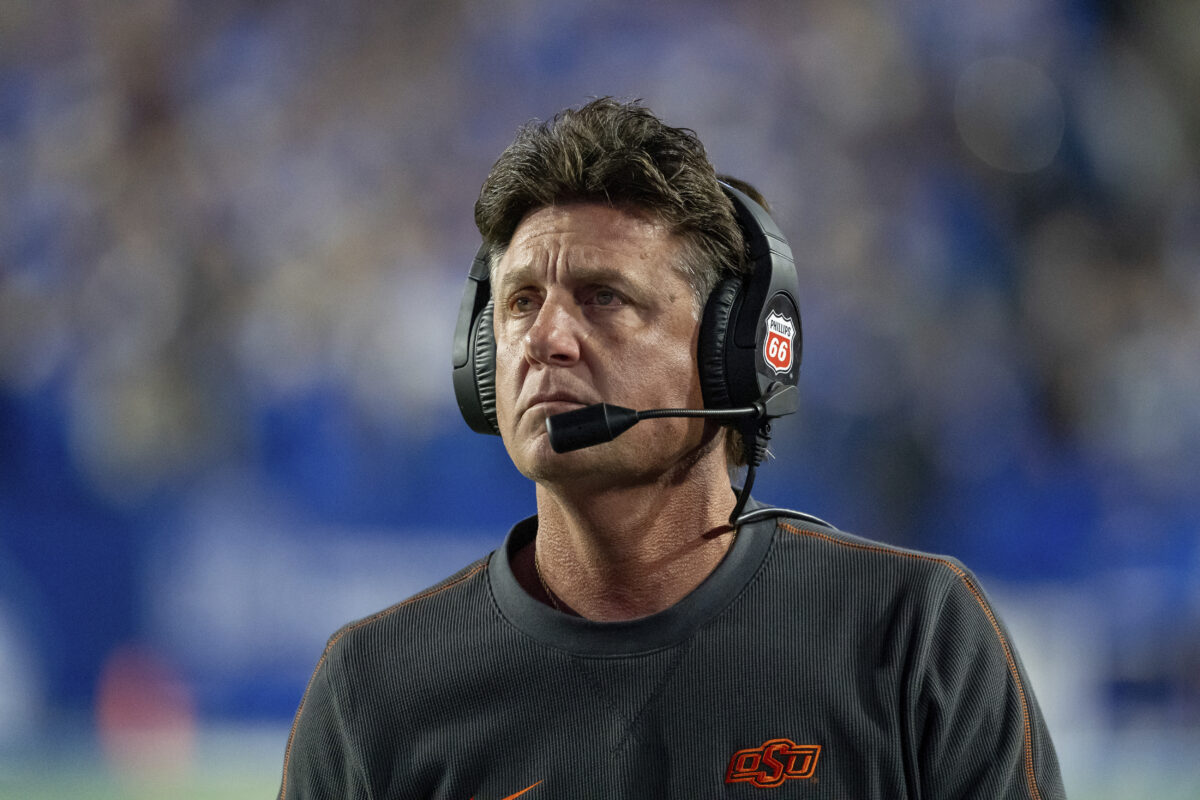
The Mike Gundy Era Is Over (Whether Oklahoma State Admits It Or Not)

Oklahoma State’s legendary coach has become a cautionary tale about staying too long at the party

Here’s what nobody wants to say out loud.

Mike Gundy is done. Not “struggling.” Not “going through a rough patch.” Not “needing time to adjust to the new landscape.” Done.

And the numbers don’t lie—even when the narrative tries to.

The Brutal Reality Check

Let me paint you a picture of just how far Oklahoma State has fallen.

172.3 passing yards per game. That’s it. That’s the offensive explosion Mike Gundy has engineered in 2025. For context, most high school teams throw for more than that. 0.3 passing touchdowns per game. You read that correctly. In three games, Oklahoma State has thrown ONE touchdown pass. Uno. A single aerial score. 426.7 yards allowed per game. The defense—if we can even call it that—is surrendering nearly 7 yards every time an opponent snaps the ball.

But here’s the number that should make every Oklahoma State administrator’s blood run cold.

When Legends Become Liabilities

Twenty years ago, Mike Gundy was the answer to Oklahoma State’s prayers.

He turned the Cowboys into a consistent winner. Eighteen straight winning seasons. Five major bowl appearances. 102 Big 12 wins—third in conference history. He made Oklahoma State a national presence. But success has an expiration date. And Gundy’s expired somewhere between his “I’m a man! I’m 40!” rant and losing to Tulsa at home for the first time since the Clinton administration.

The statistical evidence isn’t just bad—it’s historically catastrophic.

The $15 Million Question

Here’s where things get interesting (and expensive).

Oklahoma State owes Gundy $15 million if it fires him before 2027. That’s a lot of money for a school that’s already struggling with NIL funding and watching their coach publicly complain about Oregon’s “$40 million roster.” But you know what’s more expensive than $15 million? Irrelevance. Every game Gundy stays, every embarrassing loss, every empty seat in Boone Pickens Stadium—that’s the real cost.

That’s the price of watching a proud program become a punchline.

The Oregon Excuse Factory

Before Oklahoma State got boat-raced 69-3 by Oregon, Gundy spent his press conference whining about financial disadvantages.

He suggested teams like Oregon shouldn’t play teams with fewer resources. This is where we separate legends from losers. Great coaches find ways to win with what they have. Average coaches make excuses about what they don’t have. Guess which category Gundy has fallen into? Two weeks after complaining about Oregon’s spending, Tulsa—with a NIL budget smaller than most high school booster clubs—walked into Stillwater and won.

The excuses don’t work when you’re getting out-coached by teams that can’t even spell “NIL.”

The Statistical Smoking Gun

Let’s discuss what good coaching looks like versus what Oklahoma State is currently receiving.

Elite programs adapt. Oklahoma State’s passing game has gotten worse every year. Elite programs develop talent. The Cowboys have more transfers than touchdowns. Elite programs win games they should win. Oklahoma State can’t beat Tulsa at home. Elite programs prepare for the future. Gundy hired two coordinators who hadn’t called plays since 2021. This isn’t about NIL. This isn’t about the transfer portal. This isn’t about “the changing landscape of college football.”

This is about a coach who stopped evolving while the game passed him by.

The Uncomfortable Truth

Mike Gundy gave Oklahoma State twenty incredible years.

He deserves gratitude, respect, and a place in the school’s Hall of Fame. What he doesn’t deserve is another season to damage further the program he helped build. The fans know it—they booed at halftime against Tulsa and left early. The media knows it—even OSU’s own radio broadcast called it “the worst sore we’ve seen in a long time.” The administration knows it—they restructured his contract in December with a $1 million pay cut and modified buyout terms.

Everyone knows it except the man making $6.75 million to go 1-2 against teams like Tennessee-Martin, Oregon, and Tulsa.

The Way Forward

Oklahoma State has two choices.

Pay the $15 million and start rebuilding now. Watch their program become the laughingstock of the Big 12. The first option is expensive. The second option is fatal. Great organizations make difficult decisions before they become impossible ones. They cut ties with legends before legends become liabilities. Mike Gundy was the right coach for Oklahoma State for twenty years.

But the Mike Gundy Era is over.


The numbers don’t lie.

The results speak for themselves. And sometimes, the most brutal truth is that every great story has an ending. Mike Gundy’s story at Oklahoma State was beautiful.

But it’s time to write the final chapter.

No related posts found.

LOAD MORE BLOG ARTICLES

Kansas State Football 2025 Season Preview: Wildcats Poised for Big 12 Championship Run

The Kansas State Wildcats aren’t just building a football program but constructing a dynasty.

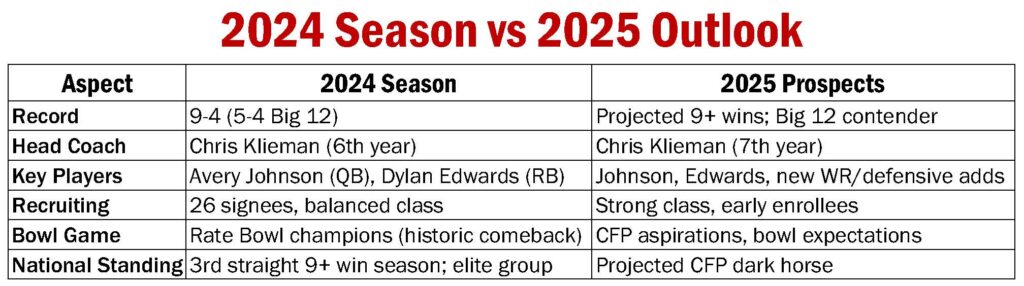
Coming off their third consecutive 9-win season, the Wildcats have positioned themselves among the nation’s elite. Only Alabama, Clemson, Georgia, Notre Dame, Ohio State, Oregon, and Ole Miss can match K-State’s remarkable consistency over the last four years.

Let’s explain why 2025 could be the year the Wildcats finally break through to the College Football Playoff.

A Culture of Resilience That Few Programs Can Match

The defining moment of Kansas State’s 2024 season wasn’t a blowout win or a highlight-reel touchdown.

It was the greatest bowl comeback in school history—rallying from a 34-17 deficit to claim a 44-41 Rate Bowl victory that showcased the relentless culture Chris Klieman has built in Manhattan.

This is a program that refuses to flinch when facing adversity:

  • Three straight seasons with at least 9 wins
  • A run game that averaged a staggering 215.5 yards per game in 2024
  • A defense that strangled opposing ground attacks, allowing just 118.7 rushing yards per contest
  • A record-setting quarterback returning to lead an even more explosive offense

The foundation is rock solid. The ceiling? It might just be championship hardware.

Avery Johnson: The Next Great Dual-Threat QB Ready for Stardom

Remember when Collin Klein terrorized Big 12 defenses with his unique blend of power and precision?

Avery Johnson might be even better.

The junior quarterback enters 2025 coming off a sophomore campaign where he:

  • Threw for 2,712 yards and a school-record 25 touchdowns
  • Added 605 rushing yards and 7 scores on the ground
  • Finished fourth in school history in pass attempts, fifth in completions, and passing yards
  • Became one of only nine quarterbacks in the nation with at least 25 passing TDs and seven rushing TDs

“We’re in May and nobody knows what their roster is going to be for the season,” Klieman said recently. “But [we retain] a key cog in Johnson. The Wildcats are expected to be among the favorites to claim the Big 12 Conference title and should be ranked when they open the 2025 season against Iowa State in Dublin, Ireland.”

The scary part? Johnson is just scratching the surface of his potential.

The Backfield That Nobody Wants to Face

Good luck getting any sleep if you’re a defensive coordinator preparing for Kansas State.

The Wildcats’ backfield boasts three distinct running styles, each capable of exploiting defensive weaknesses.

  • Dylan Edwards returns after a breakout 2024 season highlighted by his Rate Bowl heroics.
  • Nebraska transfer Gabe Ervin Jr. (6’0″, 220 pounds) brings power and physicality as a complementary piece.
  • Recently signed Antonio Martin Jr. adds yet another dimension to an already loaded room

In 2024, K-State became the only Power 4 team in the country with three players averaging at least 5.4 yards per carry (a minimum of 70 attempts).

Think about that for a second.

The 2025 version might be even more dangerous.

Transfer Portal Mastery That’s Changing the Program’s Ceiling

The old Kansas State was known for developing overlooked recruits into NFL players.

The new Kansas State? They’re still doing that but also winning big in the transfer portal.

The Wildcats signed a modern-era high of 14-15 transfers for 2025, addressing specific needs while maintaining the core of last year’s successful team:

  • Boston College transfer Jerand Bradley (6’5″, 222 pounds) gives Johnson a massive target who has already proven himself in the Big 12 at Texas Tech
  • Purdue transfer Jaron Tibbs and TCU transfer Caleb Medford transform a once-thin receiver room into a strength
  • High-upside defensive additions like Alabama linebacker Jayshawn Ross and Ohio State linebacker Gabe Powers bring blue-blood pedigrees to Manhattan.
  • Offensive line reinforcements arrived via JB Nelson (Penn State), Terrence Enos Jr. (Pittsburgh), and George Fitzpatrick (Ohio State)

The days of K-State being outmatched athletically are over. Now they’ve got the coaching AND the players to compete with anyone.

The Hidden Problems That Could Derail Championship Dreams

Not everything in Manhattan is perfect; ignoring these issues would be a mistake.

Two concerning statistical trends from 2024 could undermine K-State’s championship aspirations:

  • The Wildcats averaged 5.5 penalties per game (45.7 yards), including a season-high 9 penalties for 96 yards against West Virginia
  • Their turnover margin was perfectly neutral (16 committed, 15 forced), limiting momentum-changing opportunities in close games

These numbers point to fixable discipline issues that seem incongruent with what is otherwise one of the most stable coaching staffs in the Big 12.

For a team with slim championship margins, these self-inflicted wounds could be the difference between playing for a title in December and watching from home.

Additional Challenges That Bear Watching

Beyond the statistical concerns, several roster questions need answering:

The depth of quarterbacks behind Johnson is uncertain, which could be significant considering the physical demands of his playing style.

  • The offensive line must build cohesion quickly after losing several veteran starters.
  • Defensive depth, particularly in the front seven, was strained during spring practice due to injuries.
  • The new NCAA 105-man roster cap hits developmental programs like K-State especially har.d

None of these issues are insurmountable, but they can make the difference between a good and great team.

A Schedule Designed for National Attention

The 2025 campaign starts with the kind of spotlight few K-State teams have ever experienced.

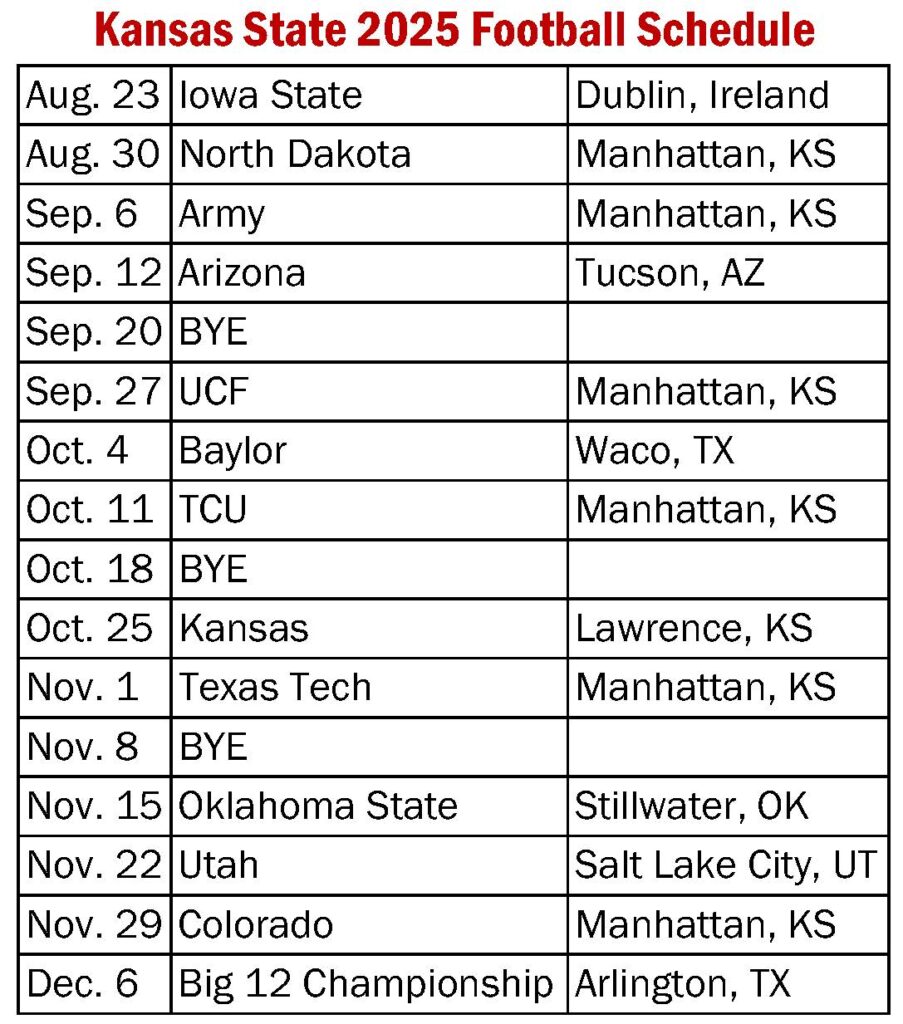
The Aer Lingus College Football Classic against Iowa State on August 23 in Dublin, Ireland, marks just the second international game in program history. The winner immediately positions itself as an early Big 12 frontrunner.

Other key schedule highlights include:

  • Non-conference tests against North Dakota (Aug. 30) and Army (Sept. 6) before a fascinating “non-conference” Big 12 matchup at Arizona (Sept. 13)
  • Home games against UCF (Sept. 27), TCU (Oct. 11), Texas Tech (Nov. 1), and Colorado (Nov. 29)
  • Challenging road tests at Baylor (Oct. 4), Kansas (Oct. 25), Oklahoma State (Nov. 15), and first-time opponent Utah (Nov. 22)

The November stretch will define the season, with three of their final four games on the road before closing at home against Colorado.

Big 12 and CFP Outlook: The Window Is Now

Vegas oddsmakers have K-State’s over/under at 8.5 wins, but that number feels conservative.

The Wildcats are co-favorites (+550) to win the Big 12 alongside Arizona State, and for good reason.

What separates Kansas State in the expanded College Football Playoff era is its complete package:

  • Elite quarterback play from a true dual-threat talent
  • Explosive backfield with multiple rushing styles
  • Improved receiving corps with size and speed
  • Traditionally strong defense built to stop the run
  • Coaching continuity in a conference full of turnover

“The Wildcats are a perennial Big 12 contender, and the program should return to form after an inconsistent first year for quarterback Avery Johnson,” noted one analysis from CBS Sports. “To help, KSU brought in plenty of receiver help next to Jayce Brown, including Jerand Bradley and Caleb Medford. The defense has been consistent under Chris Klieman.”

The Big 12 has recently lacked a dominant national contender. Kansas State has the perfect opportunity to fill that void.

Coaching Staff Built for Modern College Football

As Klieman enters his seventh season, he’s assembled a staff designed for the new realities of college football.

The restructured coaching team includes:

  • Nate Kaczor as special teams coordinator, bringing 16 years of NFL experience
  • Matt Kardulis (assistant safeties coach) and David Orloff (outside linebackers coach) are providing specialized position coaching
  • Sean Maguire, promoted to assistant quarterbacks coach, continues to mentor Avery Johnson

The offensive approach under Matt Wells will leverage multiple personnel groupings and creative substitution patterns to maximize K-State’s depth at skill positions.

Defensively, coordinator Joe Klanderman’s unit has been a model of consistency, particularly against the run. The challenge will be maintaining that standard despite roster turnover and the 105-player limit.

The Bottom Line: Championship Window Is Wide Open

Kansas State football has never been better positioned for national relevance.

Combining an elite quarterback-running back tandem, strategic transfer portal additions, and a proven coaching staff creates a foundation for Big 12 title contention and potentially the program’s first College Football Playoff appearance.

The challenges are real—quarterback depth, offensive line cohesion, and cleaning up penalties and turnovers all bear watching—but the Wildcats’ track record suggests they’ll be in the thick of the conference race deep into November.

With a dramatic Ireland opener against Iowa State looming, K-State’s path to championship contention begins immediately.

If Avery Johnson takes the expected next step in his development and the transfer additions integrate smoothly, the Wildcats won’t just be playing for a conference title.

They could be playing for a whole lot more.

The Next Billion Dollar Game

College football isn’t just a sport anymore—it’s a high-stakes market where information asymmetry separates winners from losers. While the average fan sees only what happens between the sidelines, real insiders trade on the hidden dynamics reshaping programs from the inside out.

Our team has embedded with the power brokers who run this game. The coaching carousel, NIL deals, transfer portal strategies, we’ve mapped the entire ecosystem with the kind of obsessive detail that would make a hedge fund analyst blush.

Why subscribe? Because in markets this inefficient, information creates alpha. Our subscribers knew which coaches were dead men walking months before the mainstream media caught on. They understood which programs were quietly transforming their recruiting apparatuses while competitors slept.

The smart money is already positioning for 2025. Are you?

Click below—it’s free—and join the small group of people who understand the real value of college football’s new economy.

No related posts found.

LOAD MORE BLOG ARTICLES

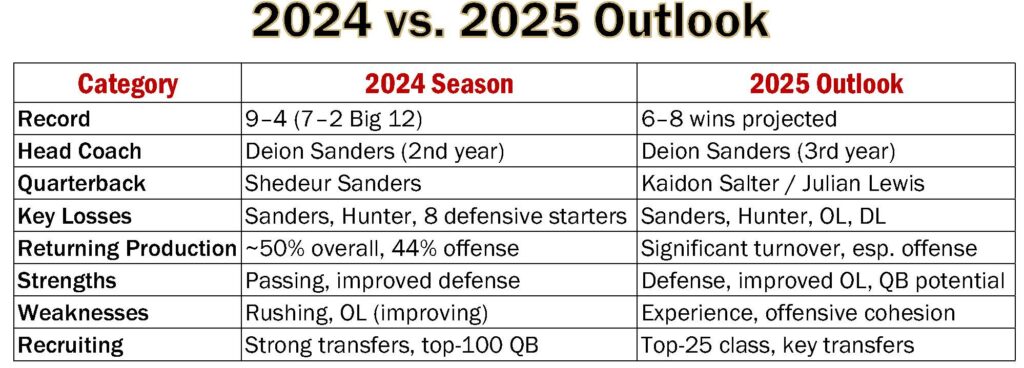
COLORADO FOOTBALL 2025: THE PRIME EFFECT ENTERS PHASE II

Are you ready for Colorado football without Shedeur Sanders and Travis Hunter?

As we approach the 2025 college football season, the question on everyone’s mind is simple: Can Deion “Coach Prime” Sanders keep the Colorado football renaissance alive without his superstars?

The Meteoric Rise Nobody Saw Coming

Coach Prime inherited a disaster when he walked into Boulder two years ago.

The Buffaloes were fresh off a 1-11 season with fans questioning whether Colorado football would ever be relevant again. Fast forward just 24 months, and the transformation has been nothing short of remarkable:

  • Year 1: Four wins (a 300% improvement)
  • Year 2: Nine wins, including a 7-2 Big 12 record
  • Top 25 rankings in both AP and Coaches polls
  • An Alamo Bowl appearance
  • A Heisman Trophy winner in Travis Hunter

Now Sanders enters Year 3 with a freshly inked contract extension, making him one of college football’s highest-paid coaches, reportedly over $10 million annually, following the Buffaloes’ flirtation with both a Big 12 Championship Game berth and potential College Football Playoff spot last season.

But 2025 isn’t about building on success with established stars. It’s about proving the program can sustain excellence without them.

Star Power Exodus Creates Massive Opportunities

The 2025 Buffaloes are essentially a new team.

Gone are the cornerstones of Colorado’s resurgence:

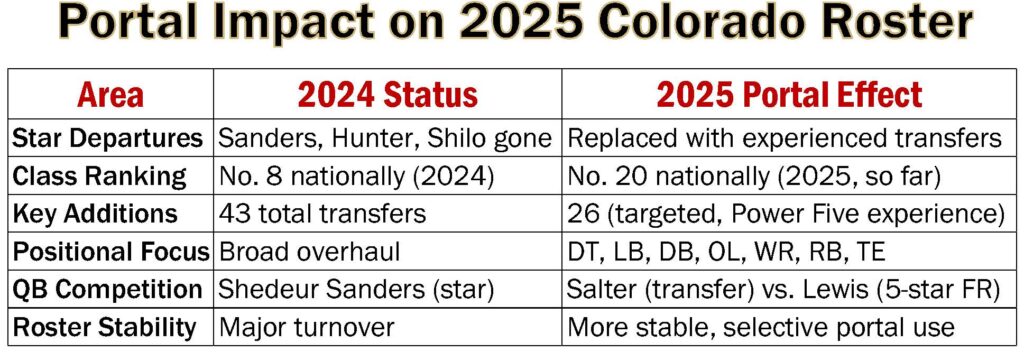
  • Quarterback Shedeur Sanders
  • Two-way star and Heisman Trophy winner Travis Hunter (drafted No. 2 overall by Jacksonville)
  • Safety Shilo Sanders
  • Eight defensive starters from 2024

Colorado returns only about 50% of its overall production, with just 44% returning on offense (ranking 99th nationally in returning production). But where others see problems, Coach Prime sees opportunity.

“We’ve established expectations. So now you expect us to perform a certain way. You expect us to win. You expect us to be exciting… You just have expectations of us now. That’s what we’ve established.”

The 2025 season represents Phase II of the Colorado rebuild—moving from star-driven success to program sustainability.

The QB Battle Everyone’s Watching

This year’s single most important position battle in Boulder is under center.

Two candidates have emerged to replace Shedeur Sanders:

Kaidon Salter (Liberty Transfer)

  • Threw for 4,762 yards and 47 touchdowns (just 12 INTs) over past two seasons
  • True dual-threat capabilities
  • 25 games of college experience
  • Could provide a new dimension to Colorado’s offense

Julian “Juju” Lewis (Five-Star Freshman)

  • No. 6 quarterback in the 2025 recruiting class
  • Reclassified to join Colorado a year early
  • Phenomenal arm talent
  • Represents the program’s future

The quarterback competition took center stage at Colorado’s spring game, with fans packing Folsom Field to get their first glimpse of these potential stars.

Most insiders believe Salter has the early edge due to his experience, potentially serving as a bridge to Lewis as the young quarterback acclimates to college football. But Coach Prime has never been afraid to play the best talent, regardless of age or experience.

Portal Power: How Sanders Is Rebuilding Through Transfers

If there’s one thing Coach Prime has mastered, it’s the transfer portal.

Colorado has brought in 26 transfer portal commitments for 2025, ranking 20th nationally and 2nd in the Big 12 for transfer classes.

Key additions include:

  • Noah King (S, Kansas State) – four-star transfer
  • Larry Johnson III (OL, Tennessee)
  • John Slaughter (DB, Tennessee)
  • DeKalon Taylor (RB/PR, Incarnate Word)
  • Jehiem Oatis (DT, Alabama)

Unlike the previous year’s massive overhaul (43 transfers in 2024), the 2025 portal class is smaller but more targeted, reflecting a more stable foundation and focus on culture fit.

Coach Sanders has specifically emphasized recruiting “grown men” for positions of need, including defensive tackle, linebacker, safety, cornerback, receiver, running back, tight end, and multiple offensive line spots.

Offense 2025: Can The Buffs Finally Run The Ball?

Colorado’s offense was a Jekyll and Hyde story in 2024.

The good: 32.9 points per game, 4,134 passing yards (318.0 per game), and 37 passing touchdowns.

The bad: An abysmal rushing attack that ranked dead last in the FBS at just 65.2 yards per game and 2.5 yards per carry.

This imbalance proved fatal in losses like the Kansas game, where the Buffs were outgained on the ground 331-42.

To address this glaring weakness, Sanders made perhaps his most impactful coaching hire yet: NFL Hall of Famer Marshall Faulk as running backs coach.

The receiver room still looks promising despite losing Travis Hunter. Emerging talents like Drelon Miller, who caught 32 passes for 277 yards and 3 TDs as a true freshman, will look to step into more prominent roles.

The offensive line, which allowed 39 sacks (3.0 per game) in 2024 despite Sanders’ quick release, continues to be reinforced through transfers. After being a significant liability in 2023, the unit showed improvement in 2024 and is expected to take another step forward in 2025.

Defense: The Foundation Of Colorado’s Future Success?

While the offense gets the headlines, Colorado’s defense significantly improved in 2024.

What you need to know:

  • Allowed 23.1 points and 351.9 yards per game
  • Improved by over 100 yards and nearly 12 points per game from 2023
  • Led the Big 12 in tackles for loss (99) and sacks (39)
  • Cornerback DJ McKinney anchored the secondary with 3 INTs and 9 pass breakups

Despite losing eight of the ten players who started at least ten games, the defense returns more production than the offense and should remain a strength. The addition of Alabama transfer Jeheim Oatis should bolster the defensive line significantly.

Home Sweet Home: A Schedule Built For Success

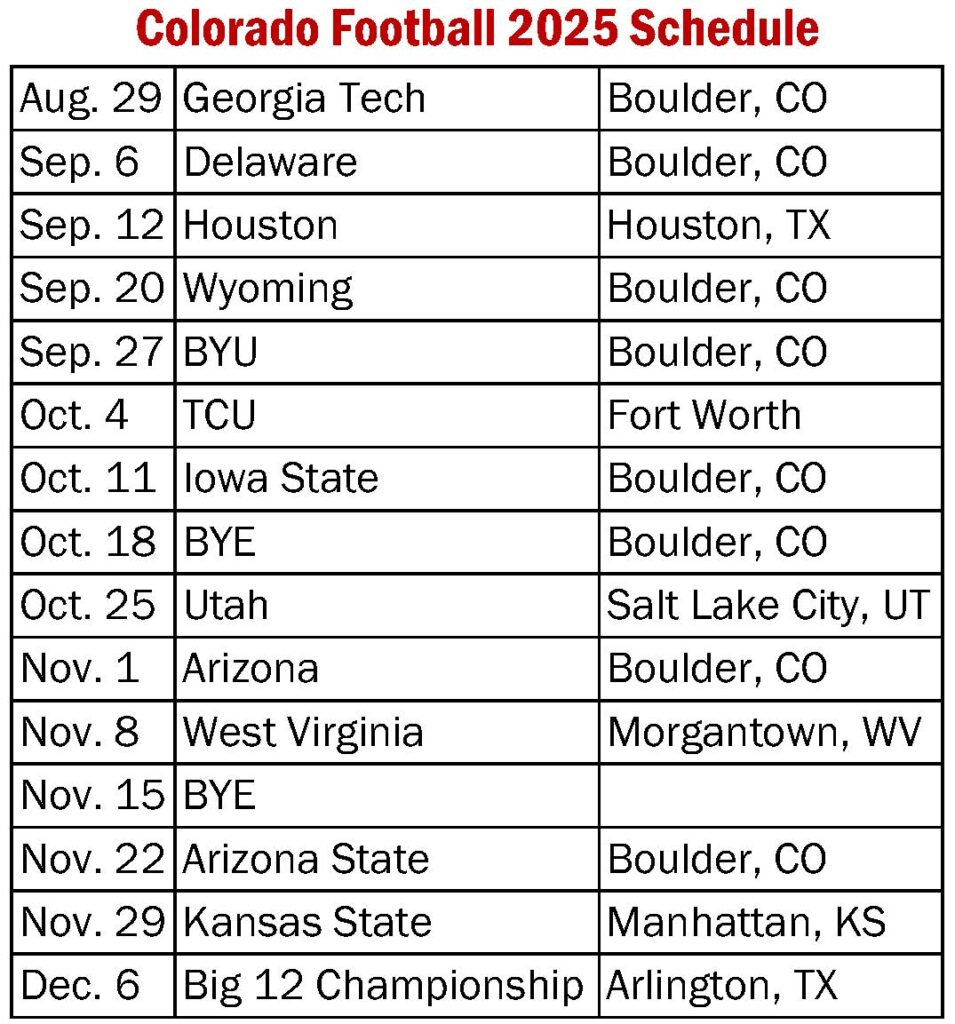
Colorado’s 2025 schedule features seven home games—the most in over four decades.

Non-conference slate:

  • Georgia Tech (home)
  • Delaware (home)
  • Wyoming (home)

Key home conference games:

  • BYU (Alamo Bowl rematch)
  • Iowa State
  • Arizona State (defending Big 12 champion)

Toughest road tests:

  • Houston (Sept. 13, Big 12 opener)
  • TCU
  • Utah
  • Kansas State

According to early odds from FanDuel Sportsbook, Colorado’s projected win total sits at 6.5 games.

The favorable home schedule, with only one road game within the first month, gives the Buffaloes a real opportunity to start strong, potentially opening 3-1 or 4-0 before hitting the more challenging portion of their schedule.

Beyond Football: The Prime Effect Continues To Transform Boulder

What Coach Prime has built extends far beyond the football field.

The “Prime Effect” has transformed:

The University:

  • Significant shift in campus culture around diversity and inclusion
  • Increased student applications
  • Major new sponsorships and donations (over $10 million in new gifts)

The Economy:

  • Consistently sold-out home games
  • Local business booms on game days
  • Economic impact estimates range from $300-500 million in Sanders’ first year alone

The Brand:

  • National television appearances
  • Constant media coverage
  • Exclusive merchandise lines and collaborations with major companies

This continued national attention and cultural impact remains a powerful recruitment and program-building tool, even as the team transitions away from its star players.

The Bottom Line: What To Expect In 2025

The 2025 Colorado Buffaloes stand at a fascinating inflection point.

Most analysts project a 7-5 or 8-4 regular season, with another bowl appearance likely. While this would represent a slight step back from last year’s 9-4 record, it would still signify remarkable progress for a program that won just one game three years ago.

The question isn’t whether Colorado can win games—they’ve proven they can do that. The real question is whether Coach Prime is building something sustainable beyond star power.

If Salter or Lewis can stabilize the quarterback position, if the defense maintains its trajectory, and if the run game finally becomes a weapon rather than a liability, this could be the year that proves Colorado football is here to stay as a legitimate Big 12 contender.

The next chapter of Colorado football may not have the star power of the previous one, but it might prove more meaningful for the program’s long-term future.

The Next Billion Dollar Game

College football isn’t just a sport anymore—it’s a high-stakes market where information asymmetry separates winners from losers. While the average fan sees only what happens between the sidelines, real insiders trade on the hidden dynamics reshaping programs from the inside out.

Our team has embedded with the power brokers who run this game. The coaching carousel, NIL deals, transfer portal strategies, we’ve mapped the entire ecosystem with the kind of obsessive detail that would make a hedge fund analyst blush.

Why subscribe? Because in markets this inefficient, information creates alpha. Our subscribers knew which coaches were dead men walking months before the mainstream media caught on. They understood which programs were quietly transforming their recruiting apparatuses while competitors slept.

The smart money is already positioning for 2025. Are you?

Click below—it’s free—and join the small group of people who understand the real value of college football’s new economy.

No related posts found.

LOAD MORE BLOG ARTICLES

Iowa State’s 2025 Football Season: How the Cyclones Plan to Build on Their Historic Success

Iowa State just delivered the best football season in school history, and now they face their greatest challenge: doing it again.

After an unprecedented 11-win campaign in 2024 that included the program’s first-ever Big 12 Championship Game appearance and a thrilling Pop-Tarts Bowl victory, the Cyclones enter 2025 with a mix of returning talent, high expectations, and significant questions to answer.

The Historic Season Nobody Saw Coming

Last year wasn’t just good for Iowa State—it was program-defining.

  • First 11-win season in 133 years of Cyclone football
  • Finished as Big 12 runners-up, falling to Arizona State in the championship game
  • Capped the season with a dramatic 42-41 comeback victory over Miami in the Pop-Tarts Bowl
  • Achieved a final AP ranking of No. 15, third-highest among Big 12 teams
  • Generated enough momentum for head coach Matt Campbell to sign an eight-year extension through 2032

The success cemented Campbell’s legacy as the winningest coach in Iowa State history, silencing NFL rumors and giving the program unprecedented stability.

Your first question should be: Can they possibly do it again?

With key departures at wide receiver and a challenging schedule with an international opener, the path to matching last year’s success won’t be easy, but the pieces are there.

Becht’s Evolution: More Than Just a Quarterback

Rocco Becht isn’t just returning as Iowa State’s starting quarterback—he’s returning as the team’s most important leader.

“Obviously, the leadership part, on and off the field, in the locker room—becoming a guy (like) Jaylin Noel and Beau (Freyler) were on their respective sides of the ball,” Becht said recently when discussing his goals for 2025. After throwing for 3,505 yards and 25 touchdowns in 2024, he’s focused on becoming even sharper.

There are three specific ways Becht elevated his game during the 2024 season:

  • Clutch performance: Led four come-from-behind victories, including the bowl game
  • Ball security: Threw just three interceptions in the final six games
  • Dual-threat capability: More than doubled his career-high in rushing touchdowns with eight

This growth has established Becht as one of the Big 12’s premier quarterbacks entering 2025, but his impact extends beyond stats.

“Rocco is like another offensive coach on our staff,” says ISU offensive coordinator Taylor Mouser. “He’s the guy, since we got back (from the Pop-Tarts Bowl win over Miami), who, when the coaches aren’t there, he’s there running practice and going through routes.”

This player-driven leadership will be crucial as Iowa State integrates new talent at key positions.

The Wide Receiver Question Everyone Is Asking

Iowa State lost its two biggest offensive weapons to the NFL Draft, creating the team’s most glaring question mark.

The departures of Jayden Higgins and Jaylin Noel, who combined for 2,377 receiving yards and 17 touchdowns, leave a massive production void that will be addressed through two primary channels:

  1. Strategic Transfer Portal Additions
    • Chase Sowell (East Carolina/Colorado): A 6-4 receiver who had multiple 100-yard games at ECU
    • Xavier Townsend (UCF): Versatile playmaker with 66 career catches and experience as a rusher and returner
  2. Internal Development
    • Young players like Carson Brown and Eli Green are stepping into expanded roles
    • Converting tight end Kai Black (now 240 pounds) into a potential outside receiving threat

How quickly these new pieces develop chemistry with Becht will largely determine the Cyclones’ offensive ceiling in 2025.

The Recruiting Pipeline That’s Changing the Program

Matt Campbell has slowly established Iowa State as the destination for top in-state talent.

The 2025 recruiting class, ranked No. 52 nationally, continues this trend by securing five of the top six players in Iowa, including:

  • Alex Manske (QB, Algona): Four-star quarterback and cornerstone of the class
  • Will Hawthorne (LB, Gilbert): Four-star linebacker, one of the state’s best defensive prospects
  • Will Tompkins (OT, Cedar Falls): Four-star offensive tackle adding size up front
  • Ethan Stecker (ATH, Spirit Lake): Versatile athlete with multiple positional options
  • Jack Limbaugh (EDGE, Algona): Highly ranked edge rusher with pass-rush potential

These aren’t just good recruits by Iowa State standards—they’re elite talents that would have typically gone to bigger programs.

The class includes 21 total signees (11 offense, 10 defense), with seven from Iowa, demonstrating Campbell’s emphasis on first building from within the state’s borders.

A Run Defense Problem That Could Derail Everything

For all of Iowa State’s success in 2024, one glaring weakness threatened to undermine it all.

The Cyclones allowed 188.4 rushing yards per game (ranked 98th nationally) and 5.3 yards per carry—a vulnerability exploited in their Big 12 Championship loss and several close games.

To address this, Campbell has:

  • Added multiple defensive linemen via the transfer portal, including Cannon Butler (UNI), Vontroy Malone (Tulsa), and Tamatoa McDonough (Yale)
  • Signed four-star LB Will Hawthorne and DL BJ Carter in the recruiting class
  • Developed young linebackers who were forced into action due to injuries in 2024
  • Converted WR Beni Ngoyi to defensive back before the Pop-Tarts Bowl, with promising early results

If the Cyclones can’t stop the run more effectively in 2025, even Becht’s offensive firepower may not overcome it.

Dublin Calling: The Historic Season Opener

Iowa State will make program history before playing a single snap in Jack Trice Stadium.

The Cyclones will play outside the United States for the first time when they open the 2025 season against Kansas State in the Aer Lingus College Football Classic on August 23 in Dublin, Ireland.

This international showcase brings unique challenges:

  • An earlier start to the season (Week Zero) means accelerated preparation timelines
  • Conference opponent in the opener raises immediate stakes
  • International travel logistics for players, staff, and fans
  • Three bye weeks (Sept. 20, Oct. 18, Nov. 15) create an unusual rhythm to the season

“He’s trying to make it like fall camp,” Becht explained about Coach Campbell’s approach to spring practice. “We know that we start a week earlier because we play in Ireland, and we have one of the longest seasons in college football.”

The Ireland opener is just the beginning of what many consider one of the most demanding schedules in recent memory.

The SWOT Analysis Every Cyclone Fan Needs to See

The Realistic Outlook Every Fan Should Adopt

Expectations need calibration after the best season in program history, both up and down.

Here’s what’s realistic for the 2025 Cyclones:

  • Another Big 12 Championship appearance is possible but not guaranteed
  • 8-9 wins would represent continued success given the schedule difficulty
  • Offensive production may dip initially as new receivers develop
  • Defense must improve against the run to remain conference contenders
  • The international opener creates both opportunity and uncertainty

Matt Campbell’s eight-year contract extension signals that he and the university believe the program’s trajectory will remain upward despite the significant challenges ahead.

With Becht’s leadership, strategic portal additions, and Campbell’s developmental approach, Iowa State appears positioned to remain competitive in the evolving Big 12 landscape.

The question isn’t whether the Cyclones can match last year’s historic success—it’s whether they can sustain their place among the conference elite over the long term.

Based on the foundation built, the answer appears promising.

The Next Billion Dollar Game

College football isn’t just a sport anymore—it’s a high-stakes market where information asymmetry separates winners from losers. While the average fan sees only what happens between the sidelines, real insiders trade on the hidden dynamics reshaping programs from the inside out.

Our team has embedded with the power brokers who run this game. The coaching carousel, NIL deals, transfer portal strategies, we’ve mapped the entire ecosystem with the kind of obsessive detail that would make a hedge fund analyst blush.

Why subscribe? Because in markets this inefficient, information creates alpha. Our subscribers knew which coaches were dead men walking months before the mainstream media caught on. They understood which programs were quietly transforming their recruiting apparatuses while competitors slept.

The smart money is already positioning for 2025. Are you?

Click below—it’s free—and join the small group of people who understand the real value of college football’s new economy.

No related posts found.

LOAD MORE BLOG ARTICLES

College Football Warning: Utah Is About To Break Your Heart.

Let me tell you what 5-7 means for Utah’s Kyle Whittingham.

It means 134 consecutive weeks of sleepless nights, obsessing over film, analyzing every missed assignment, every blown coverage, every quarterback injury that shattered his 22-year masterpiece. When a 65-year-old legend sits in his office at midnight questioning whether he should retire – that’s when transformation happens.

Five quarterbacks. FIVE.

But here’s the part ESPN glossed over in their highlight reels: Starting quarterback Cam Rising went down after 2.5 games. Then came Brandon Rose. Then Isaac Wilson. Then Miguel Wilson. Finally, they handed the keys to Luke Bottari – the FIFTH string quarterback who wasn’t even supposed to see the field this millennium.

Meanwhile, the numbers told a story of offensive incompetence so profound it made Bill Walsh roll in his grave:

  • 55.6% completion percentage (lower than Manning’s rookie year in the NFL)
  • 329.8 yards per game (dead last among Power 5 programs)
  • 23.6 points per game (Georgia Tech scored more in 1990)
  • 3.9 yards per carry (high schoolers do better)
  • More interceptions per game than touchdowns (because why not?)

The defense? They fought like lions. 12th nationally in scoring defense. 20th in total defense. They watched their offense hemorrhage possessions and still held teams to 16.4 points per game. Then they had to watch their offense throw it all away.

Seven straight losses. The longest streak in Kyle Whittingham’s 22 years.

That wasn’t football. That was character assassination.

The Transfer Portal Retaliation

Here’s where this story takes a turn nobody saw coming.

While the national media was busy crowning Colorado’s “flashy” recruiting class, Utah went shopping for actual game-changers. Not followers. Not hype merchants. Winners.

Devon Dampier arrives from New Mexico with Jason Beck’s entire playbook downloaded into his brain:

  • 3,934 total yards in 2024
  • 1,166 rushing yards that made Pac-12 defenses look foolish
  • First-Team All-Mountain West honors
  • Chemistry with Ryan Davis (747 receiving yards together)

But the real coup? The running back room.

247Sports ranks it No. 6 in America. Best in the Big 12. Not just depth – ELITE depth:

  • Wayshawn Parker (735 yards, elite burst at Washington State)
  • NaQuari Rogers (New Mexico’s secret weapon)
  • Devin Green (UNLV’s explosive playmaker)
  • Daniel Bray (four-star freshman who benched 225 sixteen times)

You know what separates good programs from great ones? They don’t rebuild. They reload with precision-guided missiles while everyone’s distracted by shiny objects.

The Morgan Scalley Question

Picture this: You’re the defensive coordinator for one of the nation’s elite defenses. Your boss, a living legend, just went 5-7 for the first time in forever. The AD taps you as “head coach in waiting.” The pressure? Astronomical.

Morgan Scalley doesn’t just need this defense to perform. He needs it to dominate. Every linebacker tackle, every forced turnover, and every defensive touchdown is an audition for the biggest job interview in college football.

The additions scream intent:

  • Christian Thatcher (four-star linebacker sensation)
  • Lance Holtzclaw (Washington’s edge rushing terror)
  • Jaxson Jones (Oregon transfer with NFL bloodlines)
  • Donovan Saunders (Texas A&M transfer who quarterbacks fear)

This isn’t a defense. It’s a proving ground for the next era of Utah football.

The Schedule That Begs For Revenge

August 30 at UCLA: The statement game. September 6 vs. Cal Poly: Confidence restoration. September 13 vs. Wyoming: Chemistry check.

Then, the Big 12 gauntlet that could make or break Kyle Whittingham’s legacy:

  • Week 4: Arizona State at home (Colorado killer)
  • Week 8: Kansas State at home (Big 12 contender)
  • Week 11: Colorado at home (Prime Time’s revenge game)

Not a single back-to-back road trip all season. Utah gets its toughest conference games at Rice-Eccles Stadium, where opposing teams still have nightmares about the altitude and the noise and Whittingham’s glare from the sideline.

The Math of Desperation

Four wins projected. Six if they’re lucky. But here’s the real math:

  • One healthy quarterback equals +3 wins minimum
  • Elite running game equals +2 wins versus average rushing attacks
  • Scalley’s defense staying top-15 equals another +2 wins
  • Favorable schedule with key home games equals another +1

That’s not 4-8. That’s not even 6-6. That’s 9-3 with a legitimate shot at the Big 12 Championship Game.

But championships aren’t the point. Legacy is the point.

The Whittingham Principle

Every great coach faces the same crossroads: go out on top or risk diminishing returns. Bobby Bowden stuck around too long. So did Joe Paterno. So did Lou Holtz.

Kyle Whittingham chose the road less traveled – using rock bottom as the foundation for one final masterpiece. And here’s the beautiful irony: the injury-devastated quarterback room that wrecked 2024 forced Utah to build the deepest, most talented roster they’ve had in a decade.

By Thanksgiving, one of two stories emerges: An aging legend rides into the sunset with his reputation intact, or Kyle Whittingham reminds every Power 5 program why they spent 22 years fearing Utah football.

The scary part? They’ve got the horses to write either ending.

The Real Warning

Don’t count talent. Count desperation. Don’t count wins. Count motivations. Don’t count the schedule. Count the opportunity.

Because when a Hall of Fame coach with a 120-50 career record watches his program hit its lowest point in two decades, that’s not an ending.

That’s a beginning.

The 2025 season isn’t about bowl eligibility. It’s about whether the last chapter of Kyle Whittingham’s career reads like redemption or regret. Everything Utah does this offseason – every portal addition, every practice rep, every film session – leads to one question:

Can greatness be reinvented at 65?

The horses are saddled. The revenge tour starts in 179 days. And college football isn’t ready for what happens when a legend refuses to fade quietly into that good night.

The Next Billion Dollar Game

College football isn’t just a sport anymore—it’s a high-stakes market where information asymmetry separates winners from losers. While the average fan sees only what happens between the sidelines, real insiders trade on the hidden dynamics reshaping programs from the inside out.

Our team has embedded with the power brokers who run this game. The coaching carousel, NIL deals, transfer portal strategies, we’ve mapped the entire ecosystem with the kind of obsessive detail that would make a hedge fund analyst blush.

Why subscribe? Because in markets this inefficient, information creates alpha. Our subscribers knew which coaches were dead men walking months before the mainstream media caught on. They understood which programs were quietly transforming their recruiting apparatuses while competitors slept.

The smart money is already positioning for 2025. Are you?

Click below—it’s free—and join the small group of people who understand the real value of college football’s new economy.

No related posts found.

LOAD MORE BLOG ARTICLES

KNIGHT REVIVAL: UCF’S 2025 SEASON OUTLOOK UNDER SCOTT FROST’S RETURN

UCF’s prodigal son has returned home.

After guiding the Knights to a historic undefeated season in 2017 and then departing for his alma mater, Nebraska, Scott Frost is back in Orlando with unfinished business and Big 12 dreams.

The reunion couldn’t come at a more critical time for a program desperate to reestablish itself following a disappointing 4-8 campaign in 2024.

THE HOMECOMING THAT EVERYONE WANTED

Something didn’t feel right when Scott Frost left UCF after that magical 2017 season.

Frost admitted it years later, saying, “I don’t think my heart really wanted to leave. UCF was a special place to me then, and it always will be.”

With a 5-year contract through 2029, Frost can finish what he started—this time with UCF sitting at the big boy table in the Big 12.

  • Turned a 0-12 team into 13-0 national champions in just two years
  • Led the nation in scoring at 48.2 points per game in 2017
  • Won multiple national coach of the year awards after the perfect season
  • Returns after going 16-31 in his stint at Nebraska

As Athletic Director Terry Mohajir put it: “Today marks an exciting reunion for UCF Football as we welcome back Scott Frost, a coach who ignites the spirit and passion of Knight Nation.”

But make no mistake—this isn’t about nostalgia. It’s about bringing winning football back to Orlando.

2025 SCHEDULE: OPPORTUNITIES AND CHALLENGES

The schedule sets up nicely for a potential bounce-back season.

UCF opens with three consecutive non-conference home games:

  • Jacksonville State (Thursday, August 28)
  • North Carolina A&T (September 6)
  • North Carolina and new coach Bill Belichick (September 21) after a bye week

The conference slate features a mix of winnable home games and challenging road trips:

Home Games:

  • Kansas (October 4)
  • West Virginia (October 18)
  • Houston (November 8)
  • Oklahoma State (November 22)

Road Challenges:

  • Kansas State
  • Cincinnati
  • Baylor
  • Texas Tech
  • Season finale at BYU (November 29)

Frost recognizes the challenge ahead: “It’s a fun schedule. We got our work cut out for us. We’re taking off from a point that I don’t think anybody was happy with last year’s results. That being said, I think watching the tape and a few plays go different, UCF wins seven or eight games last year.”

THE MASSIVE ROSTER OVERHAUL

Your first rebuild is impressive. Your second rebuild? That’s where legends are made.

Frost didn’t waste time turning over the roster through both recruiting and the transfer portal:

  • Class ranked #77 nationally by 247Sports
  • Notable recruits include Taevion Swint (#19 RB), Tony Williams (#34 S), and RyShawn Perry (#39 DT)
  • Added four key linemen on National Signing Day, including Jacob Maiava from Hawaii and Raishaun McHaney from Indianapolis

The biggest impact might be felt at the transfer portal. Frost and his staff have been working tirelessly to reshape the roster.

“In this era of college football you land and immediately have to start putting a team together in the transfer portal,” Frost explained. “So my life was six in the morning till midnight, and falling asleep with my phone in my hand for five weeks just to try to get a team put together.”

THE QUARTERBACK QUESTION

If you want to find the most critical position battle of the 2025 season, look no further than quarterback.

After cycling through four different starters in 2024, stability under center is the top priority.

For the first time since 2019, the Knights enter a season without a clear-cut starting quarterback. The competition features returning quarterback Jacurri Brown alongside transfers Cam Fancher and Tayven Jackson.

The competition brings additional intrigue with former UCF quarterback legend McKenzie Milton serving as quarterbacks coach.

Milton’s approach is simple: “The thing we always harp on is there are two things you can always control: your attitude and effort. These guys have come in with the right attitude every day and they’ve been busting their butts out there.”

The four contenders each bring different strengths:

  • Tayven Jackson: Former four-star recruit with two years of eligibility remaining after stints at Tennessee and Indiana
  • Cam Fancher: Veteran with three years of starting experience from Marshall and FAU
  • Jacurri Brown: Athletic dual-threat who started games in 2024

THE ALEX GRINCH GAMBLE

Let’s be brutally honest—the 2024 defense was a disaster:

  • Ranked 94th nationally (339.0 YPG)
  • Surrendered 40 total touchdowns
  • Allowed 64.9% completion rate (5th worst in FBS)

The biggest coaching move this offseason? Hiring Alex Grinch as defensive coordinator is a decision that has raised eyebrows across college football.

Frost views Grinch as someone whose career mirrors his own: “I think I can really relate to Alex’s career. One time, he was probably the hottest defensive coordinator in the country. He went to another place where it didn’t go quite as well, and I don’t think that was necessarily all his fault.”

The truth is that Grinch’s recent track record is concerning:

  • Was fired midseason from USC in 2023 after defensive collapses
  • Allowed 101 combined points in his final two USC games against California and Washington
  • Oklahoma’s defense regressed in his final season, dropping to 76th nationally
  • Spent 2024 as co-defensive coordinator at Wisconsin in a reset year

Frost is betting on Grinch recapturing the magic he showed at Washington State (2015-17), where his aggressive “Speed D” concept earned him Broyles Award semifinalist honors.

The staff has prioritized defensive back recruiting and brought in multiple transfers to shore up the secondary:

  • Syracuse DBs Jayden Bellamy and Jyaire Brown
  • LSU DB Jyaire Brown
  • FAU DB Phillip Dunnam

Nyjalik Kelly returns after leading UCF with 5.5 sacks in 2024, providing some stability up front alongside transfers Sincere Edwards (Pittsburgh) and RJ Jackson (Tulsa).

Linebacker transfers Phil Picciotti (Oklahoma) and Keli Lawson (Virginia Tech) should immediately impact the middle of the defense.

The defensive coordinator hire remains the biggest gamble of Frost’s second tenure. If Grinch fails to deliver, it could derail UCF’s rebuild before it even gets started.

CULTURE CHANGE AND THE MINDSET SHIFT

Beyond schemes and personnel, Frost’s biggest job may be changing the culture and mindset.

Black & Gold Banneret states that Frost’s biggest test will be “restoring a winning mindset to UCF Football.”

It’s about creating belief and mentally flipping the script for a team that lost 8 of its final 9 games in 2024, including four one-score losses.

Spring practices have emphasized increased intensity, attention to detail, and developing a core of player leadership in a roster filled with newcomers.

A key advantage for Frost is his relationship with AD Terry Mohajir: “Terry’s been great. I’m so grateful to have an AD that’s on my side and working alongside me. When you’re in the other situation it’s really difficult, and it’s really debilitating to be honest with you.”

2025 OUTLOOK: REALISTIC EXPECTATIONS

So, where does this leave us for 2025? Most projections point to UCF fighting for bowl eligibility:

  • Improvement from 4 wins to 6-7 wins
  • Bowl eligibility within reach
  • Building block for future success

The key factors that will determine UCF’s ceiling:

  1. Quarterback Development: Finding the right starter who can limit turnovers and maximize the offense’s potential
  2. Secondary Performance: Dramatic improvement needed in pass defense
  3. Line Play: Both offensive and defensive lines must get stronger
  4. Close Game Execution: Flipping the script in one-score games
  5. Home Field Advantage: Must capitalize on seven home games

THE VISION AHEAD

For Frost and UCF, 2025 is about more than immediate wins—it’s about reestablishing a foundation for long-term success in the Big 12.

As Frost said upon his return: “The foundation we built here has only grown stronger, and I am thrilled to continue shaping this program’s legacy. As we prepare for year three in the Big 12 Conference, I look forward to working alongside our dedicated student-athletes, talented staff, and passionate fans to reach new heights together.”

While bowl eligibility is the immediate goal, the ultimate vision is clear: building UCF into a legitimate Big 12 contender that can regularly compete for conference championships.

The reunion between Scott Frost and UCF offers a rare second chance to recapture magic—this time on a bigger stage, with higher stakes, and with the benefit of lessons learned.

Knight Nation, the revival has begun.

THE NEXT BILLION-DOLLAR GAME

College football isn’t just a sport anymore—it’s a high-stakes market where information asymmetry separates winners from losers. While the average fan sees only what happens between the sidelines, real insiders trade on the hidden dynamics reshaping programs from the inside out.

Our team has embedded with the power brokers who run this game. The coaching carousel, NIL deals, transfer portal strategies, we’ve mapped the entire ecosystem with the kind of obsessive detail that would make a hedge fund analyst blush.

Why subscribe? Because in markets this inefficient, information creates alpha. Our subscribers knew which coaches were dead men walking months before the mainstream media caught on. They understood which programs were quietly transforming their recruiting apparatuses while competitors slept.

The smart money is already positioning for 2025. Are you?

Click below—it’s free—and join the small group of people who understand the real value of college football’s new economy.

No related posts found.

LOAD MORE BLOG ARTICLES