
Pat Fitzgerald Is 17-38 Against Ranked Teams. Michigan State Just Hired Him To Beat Ohio State.

Everybody’s talking about the baggage.

The hazing scandal. The two years away. The “100 percent vindicated” quote that will resurface every time the Spartans lose back-to-back games.

That’s the easy narrative.

But the harder question—the one that actually determines whether this hire works—is hiding in plain sight.

It’s in the splits.

.309 Against Ranked. .469 On The Road. 5-8 In Bowls.

Pat Fitzgerald went 118-106 in 17 seasons at Northwestern.

Respectable. Ten bowl trips. Two Big Ten West titles. Five AP Top-25 finishes.

But peel back the overall record and you find a coach with real vulnerabilities.

Home: 65-44 (.596) Away: 46-52 (.469) vs Ranked: 17-38 (.309) Bowl Games: 5-8 (.385)

That’s a below-.500 road coach.

That’s a coach who won fewer than one in three games against ranked opponents. That’s a coach who went 5-8 in bowl games—games where both teams have a month to prepare.

These aren’t cherry-picked stats.

They’re the games that define whether you’re building a program or just surviving.

Northwestern Was Hard. But That Only Explains So Much.

Northwestern is one of the hardest jobs in college football.

Elite academic standards. A tiny recruiting pool. A fan base that treats sellouts as a pleasant surprise.

The fact that Fitzgerald won anything there is a testament to his culture-building ability.

Michigan State doesn’t have those constraints.

It’s a large state school with standard admission requirements, a passionate fan base, and recruiting access across the Midwest that Northwestern could never match. In theory, Fitzgerald’s ceiling should rise with better raw material.

But here’s the uncomfortable question.

Do the splits improve with better players—or are they baked into his coaching DNA?

His record against ranked opponents wasn’t a talent problem.

It was a performance problem. Scheme. Adjustments. Preparation against elite competition.

At Northwestern, he was almost always the underdog.

We never got to see whether he could win with talent, because he rarely had it. Michigan State is betting the answer is yes.

The splits suggest they should be nervous.

Ohio State. Michigan. Oregon. USC. Penn State. Good Luck.

The league Fitzgerald left isn’t the league he’s entering.

In 2022, the Big Ten West was a knife fight between Northwestern, Iowa, Purdue, Wisconsin, and Minnesota. Winnable.

In 2026, Michigan State’s conference includes Ohio State, Michigan, Penn State, Oregon, USC, and Washington.

The road schedule alone is a gauntlet.

If Fitzgerald’s .469 road record and .309 mark against ranked opponents translate to East Lansing, the Spartans are looking at 5-7 wins as the ceiling, not the floor. And with his late-tenure decline at Northwestern (3-9, 3-9, 1-11 in his final three seasons), there’s evidence he struggled to adapt even before the two-year absence.

That absence matters.

Fitzgerald has been off the sideline since July 2023—the most transformative period in college football history. Full NIL monetization. The transfer portal as the primary roster-building mechanism. The rise of GM and personnel departments.

His Northwestern teams were culture-first, developmental, and scheme-sound.

They were never portal-aggressive or NIL-forward.

Can he adapt at 50?

The splits don’t answer that question. But they don’t inspire confidence either.

If The Splits Hold, MSU Will Have Spent $50 Million On Nothing.

Michigan State structured this deal carefully.

Five years. $30 million total. Heavily incentive-laden.

Year 1 pays $5 million, escalating $500K annually.

Bonuses start at $500K for six wins and climb to $1.5 million for eight-plus. There’s also an automatic one-year extension trigger if he hits seven regular-season wins in any of his first three seasons.

On paper, this looks like smart risk management.

MSU isn’t betting the house—especially after eating Jonathan Smith’s $30 million buyout.

But look closer.

The extension trigger at seven wins is generous for a program that went 5-7 and 4-8 under Smith. If Fitzgerald clears that bar once, MSU is locked in for another year. And if the splits hold—if he’s a 5-6 win coach in this league—what does it actually cost to move on?

Recent buyouts have been coach-friendly disasters.

Mark Stoops leveraged Kentucky into a deal that made him nearly unfireable. Hugh Freeze’s Auburn contract guaranteed generational wealth regardless of performance.

Schools are learning the hard way that buyout math matters more than press conference optimism.

MSU’s deal isn’t in that category.

But it’s not airtight either. If Fitzgerald underperforms, the Spartans will have spent $30 million on Jonathan Smith, another $20-25 million on Fitzgerald, and still be looking for answers.

That’s $50+ million for five years of losing seasons.

A Gamble, Not A Plan.

This hire makes sense on paper.

Fitzgerald elevated Northwestern beyond its resource baseline. Michigan State offers more to work with than he ever had in Evanston. The price is reasonable. The upside is real.

But the splits tell a cautionary tale.

A .309 record against ranked opponents doesn’t magically improve because you moved 100 miles east. A below-.500 road record doesn’t fix itself with better facilities. And a coach who went 7-29 in his final three seasons—then spent two years away from the sport’s biggest structural shift—is not a sure thing.

Michigan State is betting Fitzgerald can adapt, modernize, and win the games that matter.

The splits say that’s a gamble, not a plan.

Coaches Hot Seat Verdict: High-variance, defensible. Clear path to success if he staffs aggressively and embraces the portal/NIL infrastructure. Clear path to another coaching search by 2028 if he doesn’t.

No related posts found.

LOAD MORE BLOG ARTICLES

Penn State Fired A Coach Who Won 104 Games Because He Couldn’t Beat Elite Teams. Matt Campbell’s Record Says He Might Solve That Problem.

Penn State didn’t hire Matt Campbell.

They settled for him.

After 54 days of chaos (Pat Kraft whiffing on Matt Rhule, Mike Elko, Kalen DeBoer, and watching Kalani Sitake use Happy Valley as leverage for a BYU extension), the Nittany Lions landed on a coach who was never Plan A. The search that began with dreams of “championship-level” coaching ended with a guy whose ceiling is an open question. And yet, this might be exactly what Penn State needs.

Here’s the uncomfortable truth:

Campbell is a better fit than the process suggests.


The Search Was a Disaster. The Outcome Wasn’t.

Let’s be clear about what happened.

Penn State fired James Franklin on October 12 after a 3-3 start, expecting to land a splash hire before the early signing period. Instead, Kraft conducted the longest Power 4 coaching search of the cycle. By National Signing Day, Penn State had signed exactly two recruits, ranking 134th nationally, while Franklin raided their class from Blacksburg. Former players called it “an unmitigated disaster.” Josh Pate said the search “feels lost.” Landon Tengwall called it “about as big a disaster as you could possibly imagine.”

All of that is true.

But none of it changes what Campbell actually brings.


The Franklin Comparison Everyone’s Making (And Getting Wrong)

The lazy take is that Penn State replaced Franklin with Franklin.

Both coaches hover around .600 win percentage. Both struggle against ranked opponents. Both have conference title game appearances but no championships. On paper, it looks like a lateral move. But that framing ignores context, and context is everything.

Here’s what the numbers actually say:

Campbell vs. Top 10 teams at Iowa State: 4-6 (40%)

Franklin vs. Top 10 teams at Penn State: 4-21 (16%)

Campbell won the same number of Top 10 games in 10 years at Iowa State as Franklin won in 11 years at Penn State. The difference? Campbell did it with the 68th-ranked roster in the talent composite. Franklin had top-10 recruiting classes almost every year.

That’s not the same coach.

That’s a coach who maximizes what he has, versus one who underperforms with what he’s given.


What Campbell Does Well

Campbell’s reputation isn’t built on schemes or slogans.

It’s built on development.

Before Campbell arrived in Ames, Iowa State hadn’t had a player drafted since 2014. Since then, he’s produced 15 NFL Draft picks, including Breece Hall, Brock Purdy, David Montgomery, and Will McDonald IV. He took a program that went 8-28 in the three years before he arrived and delivered eight winning seasons in ten years, two Big 12 title game appearances, and the program’s first-ever 11-win season in 2024.

His philosophy is simple: “Love, care, serve our players.”

That sounds soft until you realize his teams are consistently among the most physical in their conference. Campbell’s offensive identity is built on protecting the quarterback, running the ball downhill, and winning in the trenches. His defensive coordinator, Jon Heacock (who’s following him to Penn State), pioneered the 3-3-5 “three-high safety” scheme that’s been copied across college football. Iowa State ranked in the Big 12’s top three in scoring defense seven of the last eight years.

This isn’t a finesse operation.

It’s blue-collar football with a developmental edge.


The Staff Tells You Everything

Within days of being hired, Campbell made his philosophy clear.

He’s not here to manage someone else’s vision.

He let Jim Knowles walk to Tennessee, the highest-paid assistant in college football, fresh off a national title at Ohio State. He’s bringing his own people: Taylor Mouser as offensive coordinator, Jon Heacock on defense, Ryan Clanton on the offensive line, and Deon Broomfield in the secondary. Nine of his first ten hires came from Iowa State.

The only holdover? Terry Smith.

That’s significant. Smith was the interim coach who went 3-3 after Franklin’s firing. Players held up “HIRE TERRY SMITH” signs on the sideline. Keeping him signals continuity with the locker room while installing an entirely new system everywhere else.

Campbell isn’t blending philosophies.

He’s doing a full operating system replacement.


The Real Question: Can He Win the Games That Matter?

This is where skepticism is fair.

Campbell has never sustained a multi-year Top 10 operation. He’s 0-2 in conference championship games, losing to Oklahoma in 2020 and Arizona State in 2024. His teams have a habit of playing up to elite competition, only to fall short at the finish line. The 2020 Big 12 title game saw Iowa State fall behind 17-0 before mounting a comeback that came up short. The 2024 title game against Arizona State wasn’t close.

Sound familiar?

That’s the exact problem that got Franklin fired.

Penn State’s issue was never the floor. Franklin won 104 games in 11 seasons. The issue was the ceiling, specifically, a 4-21 record against Top 10 teams and a 2-21 record against Top 6 teams. The program that once competed for national titles under Joe Paterno has become a consistent “almost” program. Good enough to get ranked. Not good enough to break through.

Campbell’s track record doesn’t definitively answer whether he can fix that.

But the circumstances are different.


The Resource Upgrade Is Massive

Iowa State was a resource knife fight.

Campbell recruited against Oklahoma and Texas with a fraction of their budget, no blue-chip recruiting geography, and a fan base that had never seen sustained success. He turned Jack Trice Stadium into one of the toughest venues in the Big 12, but he was always swimming upstream.

Penn State is a different animal.

The Nittany Lions are committing $30 million in NIL money and $17 million in staff salary pool—among the highest commitments in the country. Campbell’s contract is $70.5 million guaranteed over eight years, with automatic extensions for playoff appearances. Beaver Stadium is undergoing a $700 million renovation. The recruiting geography includes Pennsylvania, New Jersey, Ohio, and the DMV corridor.

Campbell has never had these resources.

The bet is that a coach who went 72-55 at Iowa State, with five eight-win seasons and the program’s only 11-win campaign, can do significantly more when he’s not outgunned on every front.


What Nick Saban Got Right (And Wrong)

Saban weighed in on the hire, calling Campbell “a great coach who’s proven on a consistent basis.”

Then he issued a warning.

“These places that have, to me, a little bit of unrealistic expectations that we’re going to win the national championship… to make that sort of the goal – we gotta win the championship or we’re gonna get rid of the coach – to me is totally wrong. They’ll have a hard time doing it if that’s the approach that they take.”

Saban’s point is valid: championship-or-bust thinking creates instability. Penn State hasn’t won a national title since 1986. They’ve made one playoff appearance ever. Demanding immediate championships from Campbell is unrealistic.

But Saban’s framing also misses something.

Penn State didn’t fire Franklin because he wasn’t winning championships. They fired him because he went 4-21 against Top 10 teams with top-10 recruiting classes. The standard isn’t “win it all.” The standard is “don’t collapse against elite competition every single time.”

That’s a different bar.

And Campbell has a better track record of clearing it.


The Pressure Meter

Current Hot Seat Temperature: COLD

Campbell gets a honeymoon period. Penn State’s 2026 roster is inexperienced after the recruiting disaster, and expectations should be modest for Year 1. The $70.5 million guaranteed contract gives him runway. The administration is invested in patience after the Kraft search debacle embarrassed the university.

What Would Heat Things Up:

  • Losing to teams Penn State shouldn’t lose to (see: Franklin’s Northwestern loss)
  • Failing to establish a recruiting foothold in Pennsylvania
  • Another collapse against Ohio State/Oregon tier opponents in Years 2-3
  • Portal mismanagement or roster instability

What Keeps Him Safe:

  • 9-win floors with competitive losses to elite teams
  • Development of homegrown talent and smart portal additions
  • Playoff appearance by Year 3-4
  • Beating a Top 10 team at least once per season

Campbell isn’t on the hot seat.

But the leash is shorter than his contract suggests, because the last coach proved you can win 104 games and still get fired for not winning the right ones.


The Bottom Line

Matt Campbell is a floor hire, not a ceiling hire.

He stabilizes the program. He installs a coherent identity. He develops players. He builds culture. He doesn’t embarrass the university with off-field chaos. He gives Penn State a high floor of 8-9 wins with an occasional 10-win season.

Is that enough?

It depends on what Penn State actually wants.

If the goal is “be consistently good and occasionally great,” Campbell is an A hire. If the goal is “become Ohio State,” the jury is still out. Campbell has never built a dynasty. He’s never recruited at a top-5 national level. He’s never won a conference championship.

But he’s also never had the resources to try.

Penn State is betting that the coach who overachieved at Iowa State can break through when he’s finally playing with a full deck. It’s a reasonable bet, probably the most sensible option available after the search went sideways.

The question now is simple:

Can Matt Campbell win the games James Franklin couldn’t?

We’re about to find out.


What do you think of the Campbell hire? Send me an email and let me know. mark@coacheshotseat.com

No related posts found.

LOAD MORE BLOG ARTICLES

Grading the Carousel: Preliminary Hire Grades for the 2024-25 Cycle

The carousel never stops spinning.

We’re tracking 21 coaching changes this cycle — 13 with new coaches already named, 8 still waiting on their guy. What follows are our preliminary grades across three categories: Hire Quality, Process, and Fan/Media Sentiment.

These aren’t final verdicts.

They’re initial reactions. First impressions. The kind of grades that will look either brilliant or idiotic in three years when we revisit them.

We’ll do deep dives on each hire individually in the coming weeks. But for now, here’s where every job stands — from the home runs to the dumpster fires.


The Home Runs

These programs swung big and connected.

Virginia Tech — James Franklin (A / A– / A)

The Hokies didn’t just make a hire. They made a statement.

Landing James Franklin from Penn State signals that Virginia Tech is done being a sleeping giant. The staff and recruiting implications will ripple through the ACC for years. The only question now is whether VT finally acts like the resource program it’s always claimed to be.

How his Penn State staff/recruits follow, what this does to the ACC power structure, and whether VT is finally acting like a “resource program” again.


Oregon State — JaMarcus Shephard (A / A– / A)

The Beavers landed their guy without a nationwide circus.

JaMarcus Shephard comes from Alabama’s staff into the most uncertain moment in Oregon State history. Post-realignment survival depends on portal management and identity preservation. A first-time head coach navigating conference limbo while maintaining Trent Bray’s defensive DNA is a tall order — but OSU handled this search like a program that knows exactly who it is.

Post-realignment survival, recruiting without a stable league home, and whether a first-time HC can maintain Bray’s defensive identity.


LSU — Lane Kiffin (A / D / A)

The hire is an A. The process was a circus.

Lane Kiffin to LSU was the worst-kept secret in college football, which made the public courtship even messier. But the end result? A program with unlimited resources landing one of the sport’s best offensive minds and most ruthless recruiters. The marriage either produces championships or a spectacular implosion. There is no middle ground in Baton Rouge.

Ole Miss fallout, staff poaching wars, and if LSU’s booster culture amplifies or burns out Kiffin’s volatility in a hurry.


Colorado State — Jim Mora Jr. (A / B / B+)

The Mountain West needed a credible name. CSU delivered.

Jim Mora brings NFL pedigree, P4 experience, and a recruiting network that Jay Norvell never fully activated. The question is whether this is a “last tour” victory lap or a legitimate rebuild. Either way, CSU positioned itself to capitalize on a weakened conference landscape.

Can Mora still grind on the trail, how CSU positions itself vs. a weakened MWC, and whether this is a “last tour” or a true rebuild.


Kentucky — Will Stein (A / B– / B)

Mark Stoops cast a long shadow. Will Stein steps into it confidently.

The offensive identity pivot is exactly what Kentucky needed after years of defensive-first football. Stein’s explosiveness ceiling could push the Wildcats from the 7-win band into genuine SEC East contention. The NIL landscape remains a challenge, but this hire signals ambition.

Stoops’ shadow, offensive identity pivot, NIL vs. league peers, and whether Stein can keep Kentucky in the 7–9 win band with a higher explosiveness ceiling.


Auburn — Alex Golesh (A– / B+ / B+)

Auburn got its tempo guy, Alex Golesh, from South Florida.

Golesh’s USF offense translated well enough to earn him a shot at the SEC’s toughest division. The patience level in Auburn is… historically nonexistent. But the process was clean, the hire was decisive, and line-of-scrimmage recruiting will determine whether this becomes a home run or a cautionary tale.

Translation of his USF tempo offense to the SEC West equivalent, patience level in Auburn, and how he recruits the lines of scrimmage.


The Solid Singles

Not flashy. Not embarrassing. Just… fine.

Stanford — Tavita Pritchard (B+ / B / B)

The Cardinal went internal and pragmatic.

Tavita Pritchard inherits Andrew Luck’s GM involvement and Stanford’s perpetual NIL/admissions constraints. The bet is that an NFL-style QB room can overcome portal friction in an ACC that doesn’t care about your academic reputation. It’s a reasonable swing given the circumstances.

Andrew Luck’s GM role, Stanford’s NIL constraints, and whether an NFL-style QB room can overcome admissions/portal friction in the ACC.


UCLA — Bob Chesney (B+ / C / C+)

This is either the next Kalen DeBoer or bargain shopping.

Bob Chesney’s jump from FCS to the Big Ten grind is significant. Here’s the strange part: the process was actually solid — because Martin Jarmond wasn’t running it. And that tells you everything about the real red flags at this job. An ineffective, egomaniacal athletic director. A disconnected, tone-deaf chancellor. A bean counter who only understands counting beans. Chesney’s system might translate just fine. Whether anyone can succeed under this administration is the bigger question.

The massive jump from FCS to the Big Ten grind, and whether anyone can succeed under an ineffective AD, a tone-deaf chancellor, and an administration that only understands counting beans.


Oklahoma State — Eric Morris (B– / B– / B–)

Life after Gundy is officially here.

Eric Morris keeps the Air Raid DNA without the 20-year cultural infrastructure. The question is whether Oklahoma State wants to chase Big 12 titles or just stability. This hire suggests stability. That’s not necessarily wrong — but it’s not inspiring either.

Life after Gundy’s long tenure, keeping the Air Raid DNA without the old culture, and whether OSU wants to chase Big 12 titles or just stability.


Ole Miss — Pete Golding (B / C+ / B)

Continuity hire. Full stop.

Pete Golding’s job is to keep the portal from hemorrhaging and maintain defensive credibility while the offense finds a new identity post-Kiffin. Whether he can be more than a recruiter/DC remains the central question. The Rebels are betting on stability over splash.

Defensive continuity vs. offensive identity change, portal retention after Kiffin, and whether Golding can be more than a recruiter/DC.


Michigan State — Pat Fitzgerald (C / B / B)

The Spartans hired a culture reset.

After back-to-back scandals, Pat Fitzgerald’s “Northwestern-style overachiever” ceiling might be exactly what East Lansing needs. The long-term recruiting upside against Ohio State and Michigan is… limited. But the hire makes sense for a program that desperately needed adults in the room.

Cultural cleanup after back-to-back scandals, ceiling of “Northwestern-style overachiever” in the new Big Ten, and long-term recruiting upside vs. Ohio State/Michigan.


The Fan Base Meltdowns

These aren’t going well.

Florida — Jon Sumrall (C / B+ / D)

The process was fine. The reaction was not.

Sumrall arrives with Steve Spurrier’s public blessing and a mandate to fix Billy Napier’s in-game disasters. But there’s a red flag worth noting: Sumrall’s Tulane teams were consistently among the most penalized in the country — the kind of undisciplined football that suggests coaching issues, not just player mistakes. Florida fans already wanted a bigger name. The D in sentiment reflects a fan base that feels the program settled.

Spurrier publicly blessing the hire, fixing Napier’s in-game messes, and whether Sumrall can weaponize UF’s NIL/portal machine fast enough in the SEC arms race.


Arkansas — Ryan Silverfield (D+ / D / D)

This is a disaster.

The fan backlash isn’t simmering — it’s boiling over into organized protests. Ryan Silverfield’s task is nearly impossible: win quickly in a 16-team SEC with a hostile home base from Day 1. The AD’s survival odds are now directly tied to Silverfield’s record. D across the board, and that might be generous.

Fan backlash/protests, AD survival odds, and if Silverfield can win quickly enough in the new 16-team SEC to quiet a hostile base.


The Clown Shows

No other way to describe these.

Penn State — TBD (INC / F / F)

James Franklin is gone. The portal is circling. And Penn State is playing leverage games with agents while their roster evaporates in real time. At some point, “waiting for the right guy” becomes “watching your program collapse.” That point may have already passed.

Whether PSU finally swings for a top-5 coach, how Sexton’s leverage games play out, and how long they can sit in limbo without bleeding portal talent.


UAB — TBD (INC / F / F)

The Bill Clark era feels like ancient history now.

Former coach Trent Dilfer gets plenty of blame, but AD Mark Ingram deserves more. Together they torched everything Clark built — the goodwill, the culture, the upward trajectory. All of it gone. Now the job sits open and nobody wants it. This isn’t a “hidden gem” search. It’s a punchline. Stadium and resources exist on paper, but the dysfunction has made this one of the least attractive openings in the country.

How attractive the job really is post-Dilfer, stadium/resources vs. recent chaos, and whether UAB leans into offense again or buys a culture guy.


Still on the Board

These jobs remain open. Grades pending.

California (INC / B / B) — Cal’s identity crisis continues. Do they want academics or football? The ACC move demands an answer.

UConn (INC / C+ / C) — Independence is lonely. The next hire determines whether UConn commits to regional recruiting or another failed “national” vision.

North Texas (INC / C / C) — Serial resets in Denton. UNT needs to pick an offensive identity and stick with it.

Coastal Carolina (INC / B– / B–) — The post-Chadwell slump continues. Another spread-option innovator, or something different?

South Florida (INC / B / B) — Golesh left equity in the roster. USF has a window before FSU/UF/Miami clean up their messes.

Memphis (INC / B / B) — The Tigers launch coaches. The question is whether they want another launchpad guy or someone who stays.


The Bottom Line

Thirteen hires graded. Eight more coming.

The best hire so far? Virginia Tech landing James Franklin changes the ACC. The worst situation? Arkansas — and it’s not close.

We’ll revisit these grades in-season. Some will age like wine. Others will age like milk.

The carousel keeps spinning.

No related posts found.

LOAD MORE BLOG ARTICLES

COACHES HOT SEAT: WEEK 13 RANKINGS

The clock just hit midnight on college football’s struggling coaches.

No more “next year” promises. No more “we’re close” platitudes. Week 12 stripped away the illusions and exposed the reality: some programs are moving forward, and others are circling the drain.

Jonathan Smith is 0-7 in Big Ten play. Shane Beamer blew a 27-point halftime lead in the most catastrophic collapse of the season. Mike Norvell’s Florida State is 2-12 in ACC games over two years. Bill Belichick is 0-5 against Power Four opponents in his first college season.

Athletic directors are done selling hope to angry donors. Boosters are done writing checks for mediocrity. The portal opens in three weeks, and players are already making decisions about their futures.

This is where coaching careers get defined—or destroyed.

Here are the ten coaches who entered Week 12 with everything to prove and nothing left to hide behind.

1. Jonathan Smith – Michigan State Spartans (3-7, 0-7 Big Ten)

Jonathan Smith’s seat isn’t just hot anymore. It’s molten.

Michigan State lost to Penn State 28-10 at home Saturday, marking their seventh straight defeat and officially eliminating the Spartans from bowl eligibility. That’s four consecutive seasons without a bowl game and an 0-7 Big Ten record that has Smith at 8-12 overall since arriving from Oregon State.

The numbers: Michigan State owes Smith approximately $32-33 million if they fire him now. That’s one of the most expensive buyouts in the Big Ten. However, the AD and university president, both hired after Smith arrived, have no strong ties to him and are facing mounting pressure to act.

National media outlets universally place Smith at the top of coaching hot seat lists. Fan sentiment has turned nearly uniform in calling for a change. Replacement candidate discussions are already widespread.

Smith will almost certainly coach Michigan State’s final two games, but barring a miracle turnaround, he’s coaching for his next job, not this one.

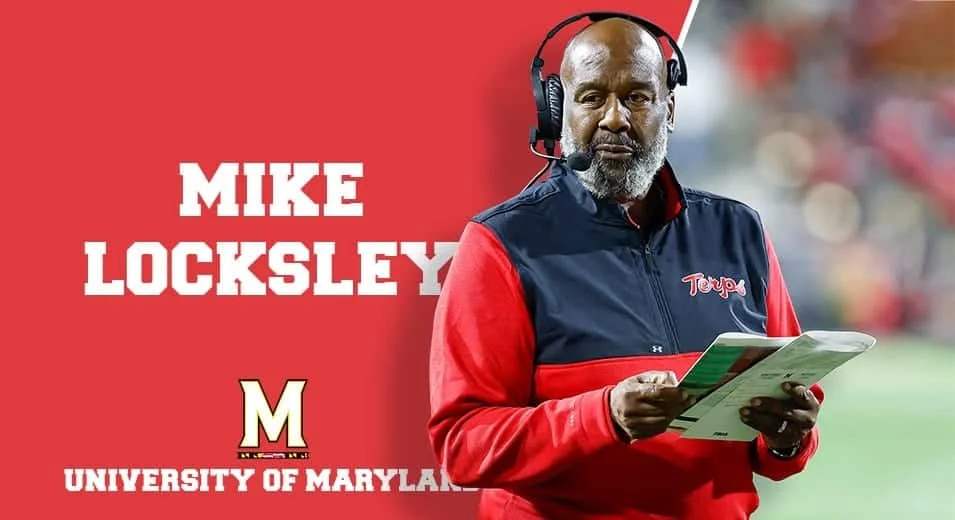
2. Mike Locksley – Maryland Terrapins (4-6, 1-6 Big Ten)

Mike Locksley just got saved by the very problem that’s destroying college football programs: money.

Maryland announced Sunday that Locksley will return for 2026 despite a six-game losing streak that dropped the Terrapins from 4-0 to 4-6. It’s the second straight season with only one Big Ten win and the 11th consecutive losing season in conference play. Locksley is now 37-47 overall at Maryland and 17-46 in Big Ten games since 2019.

Athletic Director Jim Smith made the decision based on financial reality. Maryland’s athletic department has lost $32.7 million over the past five years. Locksley’s buyout would be $13.4 million. Smith told ESPN the school is “better off pouring already-spent money into building the roster than into bringing in a new coaching staff.”

Translation: We can’t afford to fire him.

The announcement came after “Fire Locksley” chants broke out in the student section during the Indiana game. Locksley’s pressure doesn’t disappear just because he’s surviving 2025. He’s coaching on borrowed time in 2026, and everyone knows it.

3. Shane Beamer – South Carolina Gamecocks (3-7, 1-7 SEC)

Shane Beamer just orchestrated the most spectacular coaching collapse of the 2025 season.

Saturday at Texas A&M, South Carolina led 30-3 at halftime. Then came the second half. Texas A&M scored 28 unanswered points. South Carolina was shut out and managed just 76 total yards after halftime. Final score: 31-30, Aggies. It was the largest comeback in Texas A&M program history.

ESPN’s Paul Finebaum summed it up perfectly: “Shane Beamer right now just looks like a loser.”

South Carolina is now 3-7 and guaranteed a losing season. They’ve lost five straight SEC games and will miss a bowl game for the first time under Beamer. “Fire Beamer” chants have replaced the cheers.

Here’s the financial nightmare: South Carolina extended Beamer through 2030 less than a year ago. His buyout is approximately $27.9 million. Athletic Director Jeremiah Donati is now stuck with one of college football’s most expensive mistakes.

This type of historic collapse changes everything. It’s not just that they lost. It’s HOW they lost.

4. Mike Norvell – Florida State Seminoles (5-5, 2-5 ACC)

Mike Norvell just won a game and it doesn’t matter.

Florida State beat Virginia Tech 34-14 Saturday to improve to 5-5, but the win came against a 3-7 Hokies team that’s almost as bad as the Seminoles. Since being controversially left out of the 2023 College Football Playoff at 13-0, Florida State is 7-15 overall and 2-12 in ACC play.

Athletic Director Michael Alford announced in October that Norvell would remain through the end of 2025, but promised a “comprehensive assessment” after the season. Translation: Norvell is coaching his final games at Florida State.

Here’s why the delay: Money. Norvell’s buyout is approximately $53.3 million after this season. It’s the second-largest buyout in college football history.

Norvell has tried to project confidence, delivering a six-minute “championship expectation” rant recently. The problem is the results. FSU is winless on the road this season and hasn’t won a road game since November 2023.

5. Derek Mason – Middle Tennessee Blue Raiders (2-8, 1-5 Conference USA)

Derek Mason took a sabbatical from coaching after the 2022 season to rest, reflect, and spend time with family.

He should have stayed on sabbatical.

Mason is in his second season at Middle Tennessee and the program has regressed under his leadership. The Blue Raiders went 3-9 in his first year, and they’re currently 2-8 in 2025. That’s 5-17 overall and 3-11 in conference play across two seasons.

Mason replaced Rick Stockstill, who went 113-111 over 18 seasons with 10 bowl appearances. Mason hasn’t come close to matching that standard. Middle Tennessee’s two wins this season came against FCS opponents. Every FBS opponent has beaten them, often badly.

The defense, which should be Mason’s calling card, ranks among the worst in all of college football. Mason’s overall head coaching record is now 30-64 across eight years. At some point, MTSU has to ask if this experiment is worth continuing.

6. Dave Aranda – Baylor Bears (5-5, 3-4 Big 12)

Dave Aranda isn’t getting fired this season, but not for the reasons you’d hope.

After Saturday’s 55-28 home humiliation against Utah, Aranda sits at 5-5 overall and desperately needs one win in the final two games to make a bowl. His defense ranks second-worst in the Big 12 in both scoring and rush defense. For a defensive specialist hired specifically for his defensive expertise, that’s a damning indictment.

Here’s the number that matters most: 21-25. That’s Aranda’s record at Baylor with his own recruits, excluding the COVID season and the 2021 championship season built on Matt Rhule’s inherited roster.

However, Aranda is still employed because athletic director Mack Rhoades took a leave of absence November 12 amid an ongoing investigation. Interim ADs don’t make coaching changes of this magnitude.

It’s not merit. It’s institutional paralysis.

7. Luke Fickell – Wisconsin Badgers (5-6, 3-5 Big Ten)

Luke Fickell went from College Football Playoff coach to coaching for his job in three years.

After leading Cincinnati to the CFP in 2021, Fickell was hired by Wisconsin with enormous expectations. Instead, Wisconsin has regressed. Fickell is now 16-19 overall at Wisconsin and 9-15 in Big Ten play. His teams have produced losing records in two of three full seasons.

The Badgers went scoreless in back-to-back games against Iowa and Ohio State earlier this season, marking the first time that has happened since 1977. Wisconsin hasn’t won a Big Ten home game in over a calendar year.

Here’s the ironic twist: Fickell just received a contract extension through 2032 and a public vote of confidence from AD Chris McIntosh. His buyout is estimated to be around $27.5 million.

Wisconsin is on track for its second straight losing season after 22 consecutive bowl appearances. Fickell gets 2026 to prove he can turn it around, but the pressure will be immense from Day One.

8. Bill Belichick – North Carolina Tar Heels (4-6, 2-4 ACC)

The greatest football coach in history is learning that college football is a different game.

Bill Belichick, winner of six Super Bowls with the Patriots, arrived at North Carolina with enormous fanfare. Instead, he’s 4-6 overall and 0-5 against Power Four opponents. UNC’s losses weren’t just defeats. They were blowouts that exposed fundamental problems with Belichick’s transition to college football.

“It’s an unstructured mess,” a source told WRAL News in October. Reports emerged that Belichick hadn’t “had a conversation with most of the guys on defense.” The Tar Heels rank last in the ACC in total offense and scoring.

At 72 years old, in his first college job ever, Belichick is discovering that recruiting 18-year-olds, managing NIL, and coaching the portal era requires skills he never needed in the NFL.

UNC’s administration sold fans on Belichick, leading them to the playoffs. Instead, they’re fighting for bowl eligibility and dealing with reports of organizational chaos.

9. Justin Wilcox – California Golden Bears (6-4, 3-3 ACC)

Justin Wilcox sits at 6-4 overall and 3-3 in ACC play, a respectable first season navigating conference realignment.

But the pressure has never been higher.

Fan sentiment has turned decisively against Wilcox, with widespread calls for his dismissal dominating the Cal community. This isn’t about the record. It’s about nine years of incremental progress that never accumulates into sustained success.

Then there’s Ron Rivera. Cal’s new General Manager has given Wilcox conditional support, stating that “another victory or two” in the final stretch will be key in determining his future. That’s not a vote of confidence. That’s measured pressure from above.

When your GM says your fate depends on winning one or two games in a 6-4 season, you’re coaching under scrutiny from fans who’ve already moved on and leadership that’s watching closely.

10. Mark Stoops – Kentucky Wildcats (5-5, 2-5 SEC)

Mark Stoops just beat Tennessee Tech 42-10 Saturday, extending Kentucky’s winning streak to four games.

And his pressure level hasn’t budged an inch.

The win over an FCS opponent was expected, and while Stoops praised “this team’s attitude and effort,” beating Tennessee Tech doesn’t change the fundamental calculus around his job security. Fan sentiment remains sharply divided.

What protects Stoops isn’t the four-game winning streak. It’s the $40.5 million buyout that must be paid in full within 60 days if he’s fired. After critical wins at Auburn and over Florida, AD Mitch Barnhart voiced full support, saying Kentucky is “taking steps” back up the mountain.

Kentucky sits one win away from bowl eligibility with two games remaining. The pressure at #10 reflects this: the four-game streak has eased the immediate crisis, but beating an FCS team doesn’t resolve long-term doubts.

WANT TO SEE WHERE YOUR COACH RANKS?

The top 10 are racing against the clock.

But coaching pressure doesn’t stop at #10. A $40.5 million buyout protects Mark Stoops (#10) despite 13 years of middling results. Justin Wilcox (#9) is 6-4 but facing conditional support from his GM. Luke Fickell (#7) just got extended through 2032 despite losing 9 of his last 14 games.

Every FBS coach is ranked based on actual pressure, not speculation about who might be fired.

Subscribers to our newsletter get the full story. Each week, you’ll receive comprehensive profiles of all the top 10 coaches with contract details, buyout numbers, replacement candidates, and insider analysis you won’t find anywhere else. Additionally, our weekly Hot Seat Deep Dive provides an in-depth examination of one coach’s situation. This week: Dave Aranda at Baylor – how administrative chaos became a coaching lifeline, and why institutional paralysis might be the only thing keeping him employed.

Subscribe here to get the complete analysis delivered to your inbox every week.

Want to know where your coach stands? View rankings of all 136 FBS coaches.

No related posts found.
VISIT OUR SHOP [COMING SOON]

LOAD MORE BLOG ARTICLES

Week 12 Coaches Hot Seat Rankings

Week 11 exposed the pretenders. Week 12 eliminates them. This is the part of the season where athletic directors stop debating and start deciding. Where donor patience either holds or shatters entirely. Where recruits make final judgments about which programs are ascending and which are circling the drain. The “we’re close to turning the corner” narrative that might have worked in October doesn’t survive November. By Week 12, you either have tangible proof of progress or you’re staring at an offseason coaching search. Buyout conversations move from theoretical to tactical. Board meetings shift from “let’s give him more time” to “what’s our exit strategy?” Week 12 separates the coaches who survive the season from those who won’t make it to December. And for these ten coaches? The clock is ticking louder than ever.

1. Jonathan Smith, Michigan State

Jonathan Smith remains at #1, and the situation in East Lansing has moved from crisis to terminal. The $33M+ buyout that once seemed prohibitive is now just a number that major donors are actively working to fund. His 8-13 record isn’t just bad, it’s a complete program collapse that’s destroying Michigan State’s identity. New AD J Batt inherited this disaster and faces mounting pressure to act. Recruiting has gone from struggling to nonexistent, with elite prospects avoiding East Lansing entirely. The fan base has moved past anger into total apathy, which is the real death sentence. The question isn’t whether Smith gets fired, it’s when.

2. Mike Locksley, Maryland

Mike Locksley holds at #2, but that strong 2025 recruiting class that was his lifeline is starting to crack. Commits are taking visits elsewhere, and the locker room remains completely fractured. His 37-46 overall record tells the story of six years without real progress in the Big Ten. Fourth quarter collapses continue, and fans have stopped showing up expecting anything different. Donor support has evaporated completely, with major boosters now openly discussing replacement options. The administration’s hesitation is about the competitive coaching market, not confidence in Locksley. One more collapse and it’s over.

3. Mike Norvell, Florida State

Mike Norvell stays at #3, still clinging to the thin margin of player support that’s kept him employed. The $55M+ buyout remains the primary obstacle, but FSU is already planning for 2026 when it becomes more manageable. His 37-32 record would be fine elsewhere, but FSU expects championships, not mediocrity. Fan skepticism continues to grow as the season progresses. That Wake Forest win bought time, but not much. Another embarrassing loss puts him right back at #1.

4. Derek Mason, Middle Tennessee

Derek Mason enters the Top 10 at #4 with a catastrophic 4-17 record over two seasons. This is complete program collapse, not a rebuilding project. His SEC pedigree from Vanderbilt hasn’t translated, and the offense ranks near the bottom nationally. Donor support is gone, attendance at Floyd Stadium is embarrassing, and recruiting is nonexistent. Elite Conference USA prospects are choosing other programs because nobody wants to commit to obvious instability. The administration is trapped between Mason’s contract and the reality that every game does more damage. This isn’t a hot seat, it’s a death watch.

5. Luke Fickell, Wisconsin

Luke Fickell drops to #5, but the heat hasn’t decreased at all. All the goodwill from Cincinnati is completely gone after a 16-19 start in Madison. Wisconsin fans are openly questioning whether hiring Fickell was a massive mistake. The offense looks lost, the defense looks confused, and the administration’s demands for “foundational change” are ultimatums, not suggestions. Recruiting has flatlined, with elite Midwest prospects now choosing programs like Iowa and Minnesota over Wisconsin. Donors are calculating buyout scenarios and floating replacement names. His $7.625M salary looked smart when everyone expected success. Now it looks like an expensive anchor.

6. Justin Wilcox, California

Justin Wilcox remains at #6 as Cal’s situation reaches existential crisis levels. Nine years and a 48-54 record, with the ACC move exposing every weakness instead of creating opportunities. Fourth quarter collapses define the program now, and fans plan around expecting defeat. The real crisis is financial, donors have completely checked out and stopped funding the program. Recruiting has stagnated to the point where Cal loses battles to Mountain West schools. The administration isn’t asking whether to fire Wilcox anymore. They’re asking bigger questions about whether Cal football at this level is sustainable. That’s far more dangerous.

7. Bill Belichick, North Carolina

Bill Belichick at #7 represents the most stunning collapse of expectations in college football. Six Super Bowl rings have produced a 4-5 record that has fans mocking a hire they celebrated months ago. One Power Four win, uncertain bowl eligibility, and a coaching style built for NFL professionals that doesn’t work with teenagers. Elite recruits visit once and immediately look elsewhere. His $10M salary looked brilliant when everyone expected immediate success, now it prevents necessary program investments. The administration is losing patience and credibility with donors who expected a revolution. Every game does more recruiting damage. The experiment is failing in real time.

8. Shane Beamer, South Carolina

Shane Beamer drops to #8 after mid-season coordinator firings that were pure desperation. His 32-28 record looks fine until you remember South Carolina expects SEC competitiveness, not fighting for bowl eligibility. The firings bought time but fixed nothing fundamental. Bowl eligibility has moved from goal to survival requirement, the minimum needed to keep his job. Booster support is now conditional, demanding actual results instead of energy and South Carolina ties. Recruiting is suffering as elite prospects watch the chaos and commit elsewhere. The administration has loaded the gun. Anything less than a bowl game and he’s done.

9. Dave Aranda, Baylor

Dave Aranda falls to #9, and the shine from that 2021 Big 12 Championship has completely worn off. His 36-34 record through six seasons isn’t disastrous, it’s just deeply uninspiring for a program that expects more. Aranda wins just enough games to avoid the hot seat entirely, but never enough to generate real momentum or championship buzz. The fan base has moved from “trust the process” to “what exactly is the process?” as another mediocre season unfolds. Recruiting has slowed as elite Texas prospects look for programs with clearer upward trajectories. Aranda’s defensive expertise was supposed to be the foundation for sustained success, but it hasn’t translated into consistent winning. The remaining games will determine whether Baylor sees enough to commit long-term or starts exploring other options.

10. Mark Stoops, Kentucky

Mark Stoops barely holds #10 after one Auburn win bought temporary relief from what felt like inevitable disaster. His 81-78 record through 13 seasons is both Kentucky’s most successful era ever and clear evidence of a program that’s hit its ceiling. Multi-year SEC losing streaks and repeated blowouts have created frustration throughout the program. The real problem? Kentucky would owe Stoops nearly $38 million if they fired him after this season, and the contract requires the full amount be paid within 60 days. That’s not just expensive, it’s functionally impossible for Kentucky’s athletic budget. Stoops is essentially untouchable no matter how the season ends. The remaining games aren’t about his job security, they’re about whether another year of known limitations is acceptable. Thirteen years of evidence suggests he’s taken Kentucky as far as he can.

Want the full story on every coaching hot seat in America?

Newsletter subscribers get the expanded treatment, deep dives on each of the top 10 coaches, game previews that actually matter, and curated stories about coaching moves and timely college football topics delivered straight to their inbox every Tuesday and Friday during the season. Tuesdays bring you the updated rankings with insider analysis on who’s rising and falling. Fridays give you the weekend preview, breaking down which coaches are coaching for their jobs in the games that matter most. No fluff. No filler. Just the insider information you need to stay ahead of the coaching carousel before it becomes headlines everywhere else. This isn’t just another college football newsletter, it’s your edge on understanding the power dynamics, buyout negotiations, and behind-the-scenes pressure that determines who stays and who goes. Subscribe here and get the complete picture twice a week.

Where does your coach rank this week? Check out the full rankings HERE.

No related posts found.

LOAD MORE BLOG ARTICLES

Week 11 – Coaches Hot Seat Rankings

Week 11 is where the pretenders get exposed.

This is the part of the season where the rubber meets the road. Where your team and your staff prove they’ve “got it” – or don’t. The early-season excuses are gone. The “we’re still figuring things out” narrative doesn’t fly anymore. By Week 11, you either have a culture that wins close games, a roster that believes in the system, and donors who are writing checks – or you’re watching your career circle the drain in real-time. This is where coaches earn their next contract or start quietly updating their resumes. This is where athletic directors stop taking “we’ll turn it around” phone calls and start having very different conversations. Week 11 separates the programs that are building something real from those that are just delaying the inevitable. And for these ten coaches? We break each situation down below:

1. Jonathan Smith, Michigan State

Jonathan Smith is sitting on a $33M-$37M buyout that’s paid out over 62 monthly installments – the kind of number that makes firing him financially painful but not impossible. The problem? He’s already lost his fan base after humiliating losses, recruiting is cratering, and donors are hesitant to continue funding a sinking ship. New AD J Batt inherited this mess and now faces a massive decision to either force Smith to turn it around immediately or mobilize donors to eat the buyout and start over. Michigan State isn’t just losing games – they’re losing their identity. Every day Smith remains in place is another day that elite recruits look elsewhere.

2. Mike Locksley, Maryland

Mike Locksley has lost the locker room, and everyone knows it. NIL chaos has players checked out, fourth-quarter collapses have become routine, and October was an unmitigated disaster that had fans chanting for his firing in the stadium. His seat is scorching, #2 on the hot seat rankings, but he’s got one lifeline: a legitimately strong 2025 recruiting class that’s making the administration hesitate before pulling the trigger. The job market is also flooded with high-profile openings, which might give him a reprieve simply because Maryland doesn’t want to get into a bidding war and strike out. But make no mistake: donor support is evaporating, administration confidence is gone, and Locksley is one more ugly loss away from a Sunday morning firing.

3. Mike Norvell, Florida State

Mike Norvell dropped from #1 to #3 on the hot seat after a win over Wake Forest and enough player support to give the administration cover to hesitate on his $55M+ buyout. But dropping two spots isn’t a victory – it’s a temporary reprieve. He barely survived recent board meetings where his future was debated in real-time, boosters are in open revolt, and fan skepticism is at an all-time high. Behind closed doors, FSU is already planning for 2026 when that buyout becomes more manageable. Questions about fit, contract structure, and whether this marriage ever made sense continue to linger. Norvell bought himself time, but one more blowout loss and he’s right back at #1.

4. Luke Fickell, Wisconsin

Luke Fickell is torching every ounce of goodwill he built at Cincinnati, and it’s happening fast. Multiple blowout losses and a stagnant offense have Wisconsin fans throwing remotes through their TVs, while recruiting momentum has completely flatlined. The administration isn’t just disappointed, they’re demanding foundational change, the kind of language that means “fix this NOW or we’re moving on.” Recent staff decisions have only accelerated skepticism, and fan patience has completely evaporated, with social media ablaze and calling for a reset. The only thing keeping Fickell employed is his buyout, but donors are starting to ask the question every coach dreads: “How much would it actually cost to start over?” One more embarrassing loss, and that buyout begins looking like a bargain.

5. Justin Wilcox, California

Justin Wilcox has mastered the art of losing games in the fourth quarter, and Cal fans have moved past frustration into full acceptance mode. Navigating conference realignment chaos while failing to elevate recruiting has left the program stagnant at a time when adaptation is everything. The death knell? Donors have checked out completely; they’ve stopped writing checks, stopped believing in the vision, and started asking pointed questions about ROI. Doubts about future competitiveness aren’t whispers anymore; they’re loud conversations in booster meetings. Wilcox isn’t just on shaky ground – he’s standing on a fault line, and everyone is waiting for the earthquake.

6. Bill Belichick, North Carolina

Bill Belichick at North Carolina was supposed to be a revolution with six Super Bowl rings, transforming college football. Instead, it’s looking like a very expensive mistake. One Power Four win. Bowl eligibility hanging by a thread. And a coaching style built for NFL veterans that doesn’t translate to 18-year-olds who need recruiting, not drafting. The administration is losing patience fast because elite prospects are looking at UNC and seeing chaos, not a championship pedigree. Recruiting hasn’t improved; it has actually gotten worse. The contract details are murky but undoubtedly expensive, the kind of money that looked brilliant when everyone thought he’d win immediately and catastrophic now that he’s not. The experiment is failing, and everyone is watching to see how quickly UNC pulls the plug.

7. Shane Beamer, South Carolina

Shane Beamer fired his offensive coordinator and offensive line coach mid-season, a desperate move that screams “I’m fighting for my life.” And it might not be enough. Insiders are saying it plainly: unless South Carolina rallies for bowl eligibility, Beamer is done. Booster support is crumbling fast, with the money people who once championed his energy and “South Carolina guy” credentials now demanding answers about results. Pressure is coming from everywhere—fans, administration, donors—all pointing to the same conclusion: the current vision isn’t working. Recruiting is getting massacred by staff instability, because elite prospects don’t commit to programs where coaches are getting fired mid-season and the head coach’s future is a weekly radio debate. Beamer bought himself time with those firings, but bowl eligibility isn’t just a goal anymore—it’s a job requirement.

8. Tim Beck, Coastal Carolina

Tim Beck still has the backing of Coastal Carolina’s administration, thanks to recent bowl appearances, but that institutional patience has an expiration date that’s approaching quickly. Competitive culture is struggling in a Sun Belt where parity is real, and roster retention has become a nightmare in the portal era. Donors aren’t panicking yet, they’re not calling for his head yet, but they’re watching, whispering, and starting to ask the question every coach dreads: “What happens if we miss a bowl game this year?” That’s the line in the sand. Miss the postseason and the conversation changes overnight from “let’s give him more time” to “maybe it’s time for a new direction.” Beck has a lifeline, but it’s fraying fast.

9. Dave Aranda, Baylor

Dave Aranda’s shine has completely worn off at Baylor, and the 2021 Big 12 Championship feels like ancient history. A mediocre record, zero championship buzz, and a fan base that has moved from “trust the process” to “what exactly IS the process?” has the administration and boosters doing more than watching—they’re calculating buyout logistics. That’s not hot seat attention; that’s death row. The donor base is eroding, checking out, and wondering if their money is being invested wisely. Recruiting momentum is slowing to a crawl because elite prospects can smell uncertainty from a mile away. Aranda needs a strong finish, not just bowl eligibility, but something that reminds people why Baylor hired him in the first place. Because right now? Nobody remembers, and that’s the most dangerous position any coach can be in.

10. Mark Stoops, Kentucky

Mark Stoops was this close to being fired before a dramatic win at Auburn bought him a reprieve, but one victory doesn’t erase a multi-year SEC losing streak. Years of being demolished by conference opponents have left Kentucky feeling more like a basketball school’s side project than a legitimate SEC program, and the administration has had legitimate conversations about buyout numbers and replacement candidates. The buyout is sizeable but not insurmountable, meaning if things go south again, Kentucky can afford to move on. Stoops needs two things immediately: roster confidence (players who believe they can compete in the SEC) and donor confidence (boosters who believe their money isn’t being wasted). Both are shaky right now. The remaining games aren’t just about bowl eligibility; they’re about survival, and everyone is watching.

Where does your coach rank?

Want the full story on every coaching hot seat in America?

Newsletter subscribers get the expanded treatment, deep dives on each of the top 10 coaches, game previews that actually matter, and curated stories about coaching moves and timely college football topics delivered straight to their inbox every Tuesday and Friday during the season. No fluff. No filler. Just the insider information you need to stay ahead of the coaching carousel before it becomes headlines everywhere else. This isn’t just another college football newsletter—it’s your edge on understanding the power dynamics, buyout negotiations, and behind-the-scenes pressure that determines who stays and who goes. Subscribe here and get the complete picture twice a week.

No related posts found.

LOAD MORE BLOG ARTICLES

Michigan Is 6-4 And Barely Functional. Michigan State Scores 13 Points Per Game And Can’t Stop Anyone. Here’s Why Saturday’s Rivalry Game Will Be A Clinical 30-13 Win For The Wolverines (And Why Neither Fanbase Should Celebrate)

There’s a moment in every rivalry when one team stops playing to win—and starts playing not to lose.

This is not a game between two good teams. This is a game between a disappointing Michigan squad that’s learned to stop embarrassing itself, and a Michigan State program that can’t stop the bleeding. The Wolverines aren’t elite. They’re just competent enough to handle a disaster.

Michigan Isn’t Good—They’re Just Less Bad Than Before

Control is not aggression.

For Michigan, it’s survival. After Oklahoma exposed them and USC humiliated them, Sherrone Moore’s program didn’t transform into something great. They transformed into something functional. They stopped trying to be what they’re not and started grinding out wins against inferior competition.

Justice Haynes runs hard because that’s all this offense can do.

7.4 yards per carry sounds impressive until you realize Michigan hasn’t played a defense worth a damn since Week 4. They’re averaging 188 rushing yards per game because they’ve played Maryland, Washington, and Illinois—not exactly murderers’ row. This isn’t a dominant rushing attack. It’s a mediocre offense that figured out how to pick on bad defenses.

Michigan fans aren’t celebrating this version of the team—they’re tolerating it.

Moore inherited a national championship roster and turned it into a 6-4 team that wins ugly. The offensive line is solid. The running back is good. Everything else? Pedestrian at best. This isn’t the program that won it all last year. This is the program desperately trying not to become irrelevant.

Michigan State Is a Complete Disaster

When you press for meaning, you lose it.

Michigan State isn’t just bad—they’re historically terrible. Four straight losses. 13 points per game in their last four conference games. 39.8 points allowed on average. Three straight second halves where they looked like they forgot football was a real sport.

Jonathan Smith’s second season in East Lansing has been a step backward.

The offense can’t score. The defense can’t stop anyone. The special teams are a liability. Smith’s rebuilds take time—his track record at Oregon State proves that—but right now, the Mel Tucker mess he inherited looks worse, not better.

Look at their play-calling. They abandon what works because nothing works. They force throws because they’re desperate. They substitute constantly because no combination of players makes a difference.

This is a program in free fall with no parachute.

The Actual Matchup: Mediocre vs Terrible

Football isn’t about momentum.

It’s about who can execute basic tasks without falling apart. Michigan can run the ball against bad defenses. Michigan State can’t stop anyone from running the ball. This isn’t strategy—it’s arithmetic.

Haynes will get his yards because Michigan State’s front seven is Swiss cheese. Michigan’s defense will suffocate an offense that couldn’t score on a JV squad. The Wolverines will win this game doing exactly what they’ve done for six weeks: run the ball, kill the clock, and wait for the other team to collapse.

That’s not dominance—that’s taking advantage of incompetence.

The third quarter will tell the story, like it always does. Michigan will come out running the same plays they’ve run all game. Michigan State’s defense will be tired, frustrated, and making mistakes. Haynes will break a couple of runs, Michigan will extend the lead, and the Spartans will quit.

Not because Michigan is great—because Michigan State is that bad.

This Rivalry Has Become One-Sided

Most people think rivalries equalize teams.

That’s a myth. Rivalries amplify the gap between programs going in opposite directions. Michigan is trending toward mediocrity. Michigan State is trending toward irrelevance.

When Haynes rips off his third big run, watch the Spartan sideline. Players will stop fighting. Coaches will stop believing. That’s when you know a program has lost its soul—when even rivalry week can’t manufacture a fight.

Michigan State came into this season hoping Jonathan Smith’s rebuild would show signs of life in year two. Instead, they’ve regressed. Smith’s track record suggests he can fix this—he turned Oregon State from laughingstock to contender—but rebuilding the Mel Tucker disaster takes time. Meanwhile, Michigan fans are wondering if Sherrone Moore is the guy to lead them back to relevance—or just another mediocre coach riding the fumes of Jim Harbaugh’s success.

The Real Story

It’s about two programs trying to figure out who they are.

Michigan isn’t elite anymore. They’re not even good. They’re just functional enough to beat bad teams and avoid total embarrassment. Moore has stabilized the program after a rough start, but stabilization isn’t excellence.

Michigan State, meanwhile, has no idea what they are—except terrible.

One team figured out how to stop the bleeding. The other can’t find the tourniquet. That’s not a rivalry game—that’s a mercy killing.

The Takeaway

Saturday won’t be close—it will be clinical.

Michigan 30, Michigan State 13. But don’t mistake clinical for impressive. Michigan will win because they’re playing a team that can’t score, can’t stop the run, and can’t manufacture any reason to believe things will get better.

This isn’t a statement win for Michigan—it’s a layup.

For Michigan State, it’s another reminder that this season can’t end fast enough. For Michigan fans, it’s another reminder that competent isn’t the same as contending.

And for the rest of college football? It’s a reminder that rivalry games only matter when both teams show up.

Saturday, only one team will bother.

No related posts found.

LOAD MORE BLOG ARTICLES

The Bush Push Was 20 Years Ago. USC Is Due For Another Heartbreaker At Notre Dame—Except This Time, The Trojans Are On The Wrong End: 30-27


USC rolls into South Bend with a 5-1 record, flashy offensive numbers, and a quarterback playing out of his mind.

Notre Dame sits at 4-2, licking their wounds from two heartbreaking losses to start the season. On paper, this looks like a coin flip. But here’s what everyone is missing: USC’s offensive explosion is a mirage—and Notre Dame’s elite defensive line is about to expose it.

Let me show you why.


The Narrative Everyone Believes

Jayden Maiava is having a Heisman-level season.

The kid leads the entire nation with a 93.5 QBR. He’s thrown for 1,852 yards through six games. His completion percentage (73.1%) is absurd. And he’s got weapons—Makai Lemon has 682 receiving yards and 6 touchdowns, Ja’Kobi Lane is averaging 17.4 yards per catch.

USC’s offense is averaging 552.3 yards per game.

Meanwhile, Notre Dame has already lost twice.

Both to ranked opponents. Both by a combined 4 points, sure—but losses are losses. So the question becomes: Can the Trojans’ explosive offense outduel Notre Dame at home?

Wrong question.


The Real Question No One Is Asking

Can USC’s inflated statistics hold up against the first legitimate defense they’ve faced all season?

Spoiler alert: They can’t.


The Truth Hidden In The Schedule

Let’s talk about USC’s competition.

Week 1: Missouri State (73-13 win)
Week 2: Georgia Southern (59-20 win)

You know what Missouri State is?

A team in its first year transitioning from FCS to FBS, ineligible for postseason play. You know what Georgia Southern is? A Sun Belt team that USC dominated by 39 points. These games are padding stats like crazy.

Remove those two cupcake games, and USC’s offense drops from 552 yards per game to roughly 430-440 against Power 4 competition.

Still good?

Sure. Elite? Not even close.

Now look at Notre Dame’s schedule:

  • Week 1: @ #10 Miami (Lost 24-27)
  • Week 2: vs #16 Texas A&M (Lost 40-41)
  • Every single opponent: Power 4 or better

Notre Dame opened with a potential preseason top-10 team in Miami and hosted a possible top-15 team in Texas A&M, and lost both games by a field goal and a point.

One team has been battle-tested against elite competition.

The other has been stat-padding against cupcakes. Guess which is which?


The Common Opponent Test

Both teams played Purdue.

Notre Dame beat them 56-30. USC beat them 33-17. Same opponent.

Notre Dame scored 23 more points and gained roughly 180 more yards.

When both teams faced the same level of competition, Notre Dame was significantly more dominant.

This is your canary in the coal mine.


The Matchup That Decides Everything

Forget the hype around Maiava for a second.

This game will be won or lost in the trenches, the critical battle: USC’s Offensive Line vs Notre Dame’s Defensive Line.

Here’s what you need to know:

Notre Dame’s defensive line is ranked 6th in the entire nation by Athlon Sports, featuring a deep 6-man rotation that can bring fresh pass rushers at you all game long.

Notre Dame’s run defense allows just 106.2 yards per game and 3.4 yards per carry.

That’s elite.

Now, USC’s offensive line has actually performed well this season.

They rushed for 224 yards against Michigan—the most Michigan had allowed all season. Maiava’s 93.5 QBR doesn’t happen with a terrible O-line. But here’s the thing: USC hasn’t faced a defensive front like this yet.

Not even close.

Notre Dame can throw six different elite pass rushers at you—Boubacar Traore, Bryce Young, Junior Tuihalamaka, Joshua Burnham, Jordan Botelho, Loghan Thomas.

When that rotation starts wearing down USC’s line in the third quarter, Maiava’s clean pockets disappear.

And when Maiava’s under pressure for the first time all season, Notre Dame forces 2.0 turnovers per game.

This is where the game breaks.


What Happens When USC Has The Ball

Maiava will get his yards.

The kid is too good not to. He’ll probably throw for 280-320 yards and 2-3 touchdowns. Lemon and Lane will make plays—they’re both averaging 15+ yards per catch for a reason.

But USC’s rushing attack—the thing that’s been averaging 226.5 yards per game—is about to hit a wall.

Notre Dame’s run defense will hold them to 95-125 yards, max.

Without a ground game, USC becomes one-dimensional. And one-dimensional offenses throw interceptions. Notre Dame forces 2.0 turnovers per game.

Maiava has only thrown 2 picks all season because he hasn’t faced pressure like this.

He’ll throw 1-2 more on Saturday.

USC’s projected output:

  • 24-31 points
  • 375-445 total yards
  • 1-2 turnovers

What Happens When Notre Dame Has The Ball

Notre Dame isn’t flashy.

They’re averaging 465.5 yards per game with 7.2 yards per play—and every single yard has come against quality competition. They’ll run the ball 35+ times. They’ll control the clock.

They’ll pound USC’s defense into submission.

USC’s run defense is solid (allowing 108.5 yards per game), but Notre Dame’s physical, balanced attack will wear them down.

Expect 140-165 rushing yards, 260-290 passing yards, and 2-3 touchdowns.

Notre Dame’s projected output:

  • 27-34 points
  • 400-455 total yards
  • 0-1 turnovers

The X-Factor Everyone Is Ignoring

Notre Dame is 0-2 against ranked opponents this season.

Both losses were heartbreakers. Both by a combined 4 points. They’re at home, they’re desperate, and they’ve been preparing for exactly this level of competition since Week 1.

And let’s not forget the history here.

Anthony Davis scored 6 touchdowns in 1972. The Bush Push in 2005—Reggie Bush helping push Matt Leinart into the end zone as time expired for a 34-31 win. This rivalry has a long history of USC breaking Notre Dame’s heart in the cruelest ways possible.

It’s been 20 years since the Bush Push, and South Bend hasn’t forgotten.

The players haven’t forgotten. Marcus Freeman hasn’t forgotten. The fans certainly haven’t forgotten.

USC?

They’re walking into the loudest stadium they’ve played in all year, against the best defense they’ve faced, with offensive stats inflated by two cupcakes. The pressure is entirely on USC to prove its stats are real.

And I don’t think they can.


The Bold Prediction

Notre Dame 30, USC 27.

Here’s how it plays out:

The first half is back-and-forth. Maiava looks great. Lemon makes a couple of explosive plays.

It’s 17-17 at halftime.

Third quarter, Notre Dame’s 6-man defensive line rotation starts to take over.

Fresh pass rushers every series. USC’s O-line tires. Maiava’s clean pocket disappears. Turnover. Notre Dame goes up 27-20.

In the fourth quarter, USC abandons the run because Notre Dame’s defense has shut it down completely.

Maiava throws for 100+ yards in the quarter, trying to catch up. Notre Dame controls the clock with their run game, bleeds time, and hangs on. USC gets the ball back with 2:00 left, drives to midfield, and the game ends on an incomplete pass.


Why I’m 65% Confident (Not Higher)

Look, Maiava is legit.

93.5 QBR doesn’t lie. The kid can play. And when you have receivers like Lemon (682 yards, 6 TDs) and Lane (313 yards) who can take any throw to the house, you’re never out of it.

One blown coverage, one big play, and USC wins.

That’s the 35% chance they pull this off.

But the other 65%?

That belongs to Notre Dame’s battle-tested defense, elite front seven, and home-field advantage against a team whose gaudy stats are about to get exposed. The Trojans’ magic number run hits a brick wall in South Bend.

And it won’t even be close by the fourth quarter.

No related posts found.

LOAD MORE BLOG ARTICLES

Week 8 — Coaches Hot Seat Rankings

Three coaches were fired on Sunday.

Trent Dilfer. James Franklin. Trent Bray.

Gone.

When coaches start falling in October, everyone else feels it. The phone calls start. The quiet meetings happen. The pressure that was already there gets cranked up to a whole new level.

Here are the 10 coaches under the most pressure in college football right now:


1. Billy Napier, Florida (SEC)

Billy Napier is 21-23 at Florida. One upset over Texas doesn’t erase years of mediocrity. The Gators are paying him $7 million to compete for bowl eligibility while Georgia and Alabama compete for championships.

That’s unacceptable at Florida.


2. Hugh Freeze, Auburn (SEC)

Hugh Freeze came to Auburn with a redemption story.

A second chance after Ole Miss. Auburn gave him big money, full control, everything he needed to compete. The pressure is mounting because it’s not working.

Right now, Auburn isn’t competing.


3. Mike Norvell, Florida State (ACC)

Florida State hasn’t won an ACC game since November 2023.

Fifteen straight conference losses. Two full seasons. Zero ACC wins.

Mike Norvell went from 13-1 ACC Champions to unwatchable in less than a year.

FSU beat Florida earlier this season, and the media acted like they were “back.” They’re not—they’re 0-2 in ACC play. Norvell has had two years to figure out how to win in the ACC.

At Florida State, that’s unacceptable.


4. Jeff Choate, Nevada (Mountain West)

Jeff Choate is 4-15 at Nevada.

What worked at Montana State isn’t translating to the FBS level. Choate talks about tough, physical football, but Nevada is getting pushed around. The problem isn’t philosophy—it’s execution.

Choate is running out of time.


5. Joe Moorhead, Akron (MAC)

Joe Moorhead is 10-33 at Akron.

Elite offensive coordinator at previous stops. Winner at Fordham. But the Zips move the ball, rack up yards, then stall in the red zone—that’s coaching.

A 10-33 record over four years tells the story.


6. Luke Fickell, Wisconsin (Big Ten)

Luke Fickell was supposed to save Wisconsin football.

Wisconsin gave him everything—big money, full control, time to install his system. The defense has regressed, the offense looks disjointed, and the Big Ten is exposing every weakness. Wisconsin fans don’t want to hear about systems—they want wins.

Fickell isn’t meeting the Wisconsin standard yet.


7. Butch Jones, Arkansas State (Sun Belt)

Butch Jones failed at Tennessee.

Now he’s failing at Arkansas State. The Red Wolves are underperforming, players aren’t buying in, and fans aren’t showing up. Arkansas State thought Jones learned from his Tennessee mistakes.

The results suggest otherwise.


8. Justin Wilcox, California (ACC)

Cal got a fresh start with the move to the ACC.

New conference. New competition. New expectations. And here’s the number that matters: 8 wins.

That’s what Justin Wilcox needs to keep his job.

Look at what’s left on the schedule:

  • North Carolina
  • At Virginia Tech
  • Ranked Virginia
  • At Louisville
  • At Stanford
  • SMU

Six games—Cal needs to win five of them.

Wilcox is supposed to be a defensive guru who maximizes limited resources. But the Bears are getting manhandled by ACC competition—the defense can’t stop anyone, the offense can’t score. The math isn’t mathing.

Cal has a new chancellor—an alum, Class of ’83.

They hired Ron Rivera, NFL veteran head coach, as General Manager overseeing the football program. ESPN’s Gameday came to Berkeley last season. Everyone saw the potential. Cal has poured money and resources into this program—and they’re expecting results.

Can Willcox get the Golden Bears to 8 regular-season wins?


9. Sonny Cumbie, Louisiana Tech (C-USA)

Sonny Cumbie was supposed to bring offensive firepower to Louisiana Tech.

The Air Raid disciple. The Texas Tech coordinator everyone wanted to hire. But coordinating and head coaching are two completely different jobs—the offense has been inconsistent, the defense worse, and the program feels directionless.

Coordinator success doesn’t automatically translate to head coaching success.


10. Derek Mason, Middle Tennessee (C-USA)

Derek Mason is 4-14 at Middle Tennessee.

He’s a defensive coach in an era where offense wins championships. Mason is building a 2005 program in 2025, and Middle Tennessee can barely crack 20 points per game. MTSU fans are asking: What exactly are we getting better at?

If the answer is “nothing,” the pressure builds.


The Bottom Line:

Three coaches got fired this week—more will follow.

Athletic directors are making calls. Boosters are applying pressure. Coaches who thought they were safe realize they’re not.

Want the full picture?

Our newsletter subscribers get exclusive analysis of coaches ranked 11-25—the ones trending in the wrong direction but not quite in crisis mode yet.

Subscribe here to get all 136 FBS rankings every week.

Because pressure is a ranking—and everyone’s being measured.


Check out the complete 136 FBS Coaches Hot Seat Rankings.

No related posts found.

LOAD MORE BLOG ARTICLES

USC’s Starting Center Kilian O’Connor Is Out vs Michigan’s Elite Defense. Here’s Why The Trojans’ 338 Passing Yards Per Game Still Wins Them The Game 28-21 (And Why The Injury Will Be The Go-To Excuse If They Lose)

Lincoln Riley needs to win this game.

Not because USC’s season depends on it—though a loss would hurt their playoff chances. Riley needs to win because he’s in the middle of a three-game stretch that will define whether he’s a program-builder or just another coach who couldn’t handle the jump to a major conference. No. 15 Michigan at home, then at No. 16 Notre Dame, then at Nebraska. Three brutal tests in three weeks. The Cornhuskers aren’t ranked in the AP Poll, but they’re ranked 22nd by The New York Times and are receiving votes in multiple polls. Three chances to prove USC belongs in the Big Ten elite.

Win two of three, and the critical mass of Trojan supporters stays on board. Go 1-2 or worse, and the questions get louder.

So naturally, USC’s starting center Kilian O’Connor is out with a leg injury.

The Injury Factor: USC’s Built-In Excuse

O’Connor went down against Illinois and will miss multiple weeks, including this game. Losing your starting center, a team leader, and a critical piece of the offensive line against Michigan’s dominant defensive front isn’t ideal. Without O’Connor, pass protection timing gets disrupted. Run blocking schemes lose continuity. Michigan’s defensive front will relentlessly attack backup center J’Onre Reed.

If Riley loses, this injury becomes the convenient narrative. Not his fault. Not a coaching problem. Just bad injury luck at the worst possible time.

But here’s the problem: USC should still win this game.

Why USC Wins (Even Without O’Connor)

USC does what Michigan can’t; they hurt you through the air. 338 passing yards per game. 72.1% completion rate. 2.4 passing touchdowns per game. They’re efficient, explosive, and capable of scoring in bunches. Michigan’s secondary is vulnerable, allowing 206.4 passing yards per game at a 65.1% completion rate.

Even with a backup center, USC’s passing attack should be able to exploit Michigan’s weakness. Quick passes, screens, play-action to neutralize pressure—the scheme adapts. Expect 280-320 passing yards from USC.

Michigan’s run defense is elite, allowing just 77 yards per game at 2.4 yards per carry. USC will struggle on the ground. Expect 80-110 rushing yards. But USC doesn’t need to dominate the run game. They need their quarterback to pick apart Michigan’s secondary.

USC generates 370-430 total yards and scores 24-28 points.

Why Michigan Can’t Keep Pace

Michigan’s offense runs through one dimension: the ground game. 237.8 rushing yards per game at 6.4 yards per carry. It’s physical, effective Big Ten football. They’re getting healthier, too. Starting left guard Giovanni El-Hadi and tight end Hogan Hansen are both probable to return.

But their passing game is borderline nonexistent. Just 200.6 passing yards per game with a 58.8% completion rate and 0.6 passing touchdowns per game. That’s not a typo—they throw a touchdown pass roughly every other game.

USC knows this. They’ll stack the box, dare Michigan to throw, and force them into predictable situations. Michigan will grind out 190-220 rushing yards and score 20-24 points. They’ll control the time of possession and keep it competitive.

But when Michigan falls behind and needs to throw? They can’t keep pace.

The Verdict: Riley Survives Game One

USC wins, 28-21.

Michigan’s healthier offensive line helps them sustain drives and score consistently through the ground game. USC’s backup center struggles at times, limiting explosive plays. The game stays tight throughout four quarters.

But USC’s passing game talent—even compromised without O’Connor—proves too much for a Michigan team that can’t match their scoring through the air.

The wildcard: If Michigan’s defensive line overwhelms the backup center early and forces turnovers, their ball-control offense could grind out a stunning upset. But that’s unlikely.

More likely? Riley wins Game One of his three-game gauntlet, the stats hold up, and USC moves to 5-1. Then it’s on to the next test.

And if Riley loses? Don’t worry—the O’Connor injury will be the headline, not the performance. The excuse is pre-packaged. The narrative writes itself.

But Riley can’t afford to use it twice more in this stretch.

Three games. Three chances. One has to go right for the injury excuse to work. If USC goes 0-3 or 1-2 in this stretch, no amount of injury talk will save Riley from the questions about whether he can win the games that matter in the Big Ten.

Saturday is Game One. The clock is ticking.

No related posts found.

LOAD MORE BLOG ARTICLES