
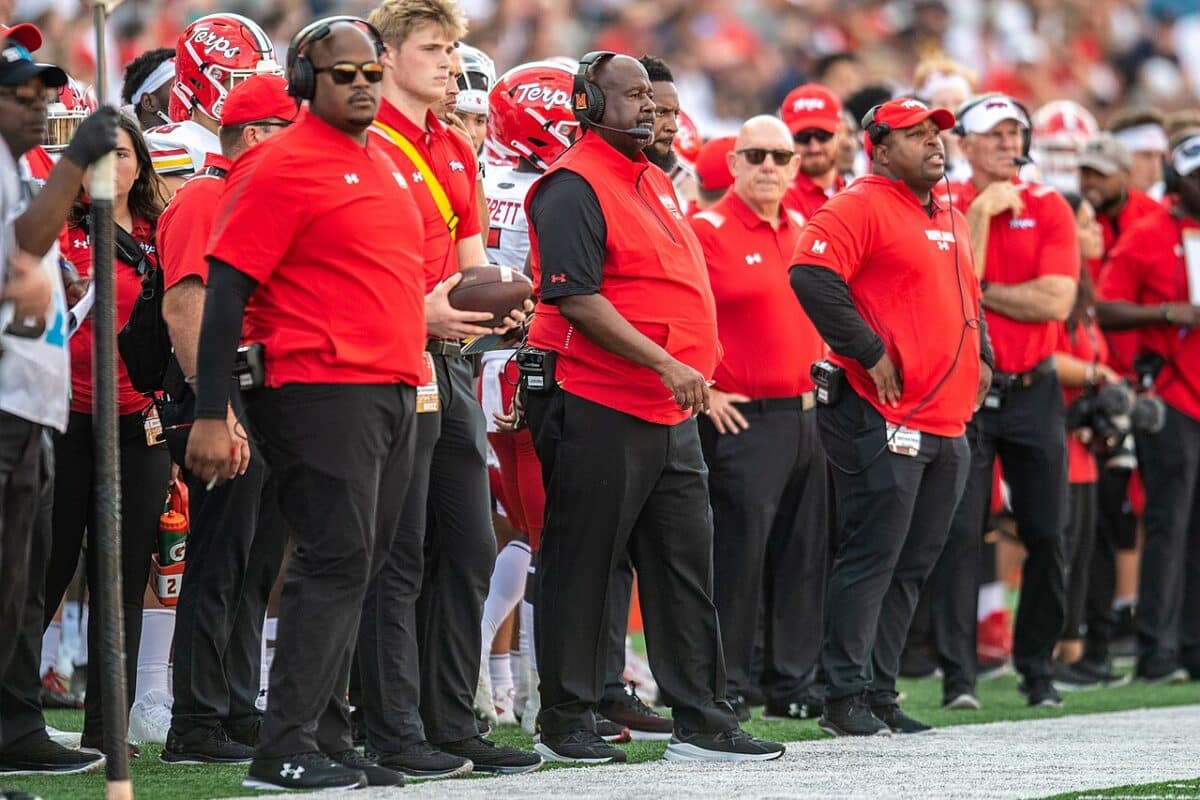
When coaches start falling in October, everyone else feels it. The phone calls start. The quiet meetings happen. The pressure that was already there gets cranked up to a whole new level.
Here are the 10 coaches under the most pressure in college football right now:
Billy Napier is 21-23 at Florida. One upset over Texas doesn’t erase years of mediocrity. The Gators are paying him $7 million to compete for bowl eligibility while Georgia and Alabama compete for championships.
That’s unacceptable at Florida.
2. Hugh Freeze, Auburn (SEC)
Hugh Freeze came to Auburn with a redemption story.
A second chance after Ole Miss. Auburn gave him big money, full control, everything he needed to compete. The pressure is mounting because it’s not working.
Right now, Auburn isn’t competing.
3. Mike Norvell, Florida State (ACC)
Florida State hasn’t won an ACC game since November 2023.
Fifteen straight conference losses. Two full seasons. Zero ACC wins.
Mike Norvell went from 13-1 ACC Champions to unwatchable in less than a year.
FSU beat Florida earlier this season, and the media acted like they were “back.” They’re not—they’re 0-2 in ACC play. Norvell has had two years to figure out how to win in the ACC.
What worked at Montana State isn’t translating to the FBS level. Choate talks about tough, physical football, but Nevada is getting pushed around. The problem isn’t philosophy—it’s execution.
Elite offensive coordinator at previous stops. Winner at Fordham. But the Zips move the ball, rack up yards, then stall in the red zone—that’s coaching.
A 10-33 record over four years tells the story.
6. Luke Fickell, Wisconsin (Big Ten)
Luke Fickell was supposed to save Wisconsin football.
Wisconsin gave him everything—big money, full control, time to install his system. The defense has regressed, the offense looks disjointed, and the Big Ten is exposing every weakness. Wisconsin fans don’t want to hear about systems—they want wins.
Now he’s failing at Arkansas State. The Red Wolves are underperforming, players aren’t buying in, and fans aren’t showing up. Arkansas State thought Jones learned from his Tennessee mistakes.
The results suggest otherwise.
8. Justin Wilcox, California (ACC)
Cal got a fresh start with the move to the ACC.
New conference. New competition. New expectations. And here’s the number that matters: 8 wins.
Wilcox is supposed to be a defensive guru who maximizes limited resources. But the Bears are getting manhandled by ACC competition—the defense can’t stop anyone, the offense can’t score. The math isn’t mathing.
Cal has a new chancellor—an alum, Class of ’83.
They hired Ron Rivera, NFL veteran head coach, as General Manager overseeing the football program. ESPN’s Gameday came to Berkeley last season. Everyone saw the potential. Cal has poured money and resources into this program—and they’re expecting results.
Can Willcox get the Golden Bears to 8 regular-season wins?
9. Sonny Cumbie, Louisiana Tech (C-USA)
Sonny Cumbie was supposed to bring offensive firepower to Louisiana Tech.
The Air Raid disciple. The Texas Tech coordinator everyone wanted to hire. But coordinating and head coaching are two completely different jobs—the offense has been inconsistent, the defense worse, and the program feels directionless.
Coordinator success doesn’t automatically translate to head coaching success.
He’s a defensive coach in an era where offense wins championships. Mason is building a 2005 program in 2025, and Middle Tennessee can barely crack 20 points per game. MTSU fans are asking: What exactly are we getting better at?
If the answer is “nothing,” the pressure builds.
The Bottom Line:
Three coaches got fired this week—more will follow.
Athletic directors are making calls. Boosters are applying pressure. Coaches who thought they were safe realize they’re not.
Want the full picture?
Our newsletter subscribers get exclusive analysis of coaches ranked 11-25—the ones trending in the wrong direction but not quite in crisis mode yet.
Not because USC’s season depends on it—though a loss would hurt their playoff chances. Riley needs to win because he’s in the middle of a three-game stretch that will define whether he’s a program-builder or just another coach who couldn’t handle the jump to a major conference. No. 15 Michigan at home, then at No. 16 Notre Dame, then at Nebraska. Three brutal tests in three weeks. The Cornhuskers aren’t ranked in the AP Poll, but they’re ranked 22nd by The New York Times and are receiving votes in multiple polls. Three chances to prove USC belongs in the Big Ten elite.
Win two of three, and the critical mass of Trojan supporters stays on board. Go 1-2 or worse, and the questions get louder.
So naturally, USC’s starting center Kilian O’Connor is out with a leg injury.
The Injury Factor: USC’s Built-In Excuse
O’Connor went down against Illinois and will miss multiple weeks, including this game. Losing your starting center, a team leader, and a critical piece of the offensive line against Michigan’s dominant defensive front isn’t ideal. Without O’Connor, pass protection timing gets disrupted. Run blocking schemes lose continuity. Michigan’s defensive front will relentlessly attack backup center J’Onre Reed.
If Riley loses, this injury becomes the convenient narrative. Not his fault. Not a coaching problem. Just bad injury luck at the worst possible time.
But here’s the problem: USC should still win this game.
Why USC Wins (Even Without O’Connor)
USC does what Michigan can’t; they hurt you through the air. 338 passing yards per game. 72.1% completion rate. 2.4 passing touchdowns per game. They’re efficient, explosive, and capable of scoring in bunches. Michigan’s secondary is vulnerable, allowing 206.4 passing yards per game at a 65.1% completion rate.
Even with a backup center, USC’s passing attack should be able to exploit Michigan’s weakness. Quick passes, screens, play-action to neutralize pressure—the scheme adapts. Expect 280-320 passing yards from USC.
Michigan’s run defense is elite, allowing just 77 yards per game at 2.4 yards per carry. USC will struggle on the ground. Expect 80-110 rushing yards. But USC doesn’t need to dominate the run game. They need their quarterback to pick apart Michigan’s secondary.
USC generates 370-430 total yards and scores 24-28 points.
Why Michigan Can’t Keep Pace
Michigan’s offense runs through one dimension: the ground game. 237.8 rushing yards per game at 6.4 yards per carry. It’s physical, effective Big Ten football. They’re getting healthier, too. Starting left guard Giovanni El-Hadi and tight end Hogan Hansen are both probable to return.
But their passing game is borderline nonexistent. Just 200.6 passing yards per game with a 58.8% completion rate and 0.6 passing touchdowns per game. That’s not a typo—they throw a touchdown pass roughly every other game.
USC knows this. They’ll stack the box, dare Michigan to throw, and force them into predictable situations. Michigan will grind out 190-220 rushing yards and score 20-24 points. They’ll control the time of possession and keep it competitive.
But when Michigan falls behind and needs to throw? They can’t keep pace.
The Verdict: Riley Survives Game One
USC wins, 28-21.
Michigan’s healthier offensive line helps them sustain drives and score consistently through the ground game. USC’s backup center struggles at times, limiting explosive plays. The game stays tight throughout four quarters.
But USC’s passing game talent—even compromised without O’Connor—proves too much for a Michigan team that can’t match their scoring through the air.
The wildcard: If Michigan’s defensive line overwhelms the backup center early and forces turnovers, their ball-control offense could grind out a stunning upset. But that’s unlikely.
More likely? Riley wins Game One of his three-game gauntlet, the stats hold up, and USC moves to 5-1. Then it’s on to the next test.
And if Riley loses? Don’t worry—the O’Connor injury will be the headline, not the performance. The excuse is pre-packaged. The narrative writes itself.
But Riley can’t afford to use it twice more in this stretch.
Three games. Three chances. One has to go right for the injury excuse to work. If USC goes 0-3 or 1-2 in this stretch, no amount of injury talk will save Riley from the questions about whether he can win the games that matter in the Big Ten.
Martin Jarmond fired DeShaun Foster after 15 games, but the real problem sits one floor above the football offices.
UCLA’s athletic director created the perfect storm that destroyed Foster’s tenure before it began. The hasty hiring process, inadequate resources, and administrative dysfunction all trace back to one person: the man who pulled the trigger on Foster’s dismissal.
Here’s why Jarmond should be updating his resume.
The Timeline Tells The Real Story
Foster never had a fair chance at UCLA because Jarmond bungled the coaching transition from the very beginning.
In November 2023, Chip Kelly was openly shopping for coordinator jobs elsewhere. Instead of making a clean break, Jarmond let the situation drag on for nearly six weeks. Kelly finally left on February 2, 2024, just weeks before spring camp.
The damage was already done:
Recruiting class decimated
Transfer portal window missed
Staff continuity destroyed
Spring preparation compromised
Foster was told he wouldn’t be considered for the head coaching job if Kelly left. He took the running backs job with the Las Vegas Raiders. When Kelly bolted two weeks later, UCLA had no viable candidates willing to leave their current positions so close to spring practice.
Jarmond made calls to other coaches, but no one was going to abandon their team weeks before training camp.
The UCLA players rallied around Foster, and Jarmond gave him the job with little time to prepare. It was a desperation move masquerading as a feel-good story.
Foster Inherited An Impossible Situation
The numbers don’t lie about what Foster walked into at UCLA.
Financial constraints:
Reduced Big Ten revenue sharing
Limited NIL resources compared to Big Ten peers
Budget restrictions on staff expansion
Facility upgrades delayed or cancelled
Roster challenges:
Late start on transfer portal acquisitions
Minimal time to evaluate existing players
Spring practice shortened by hiring timeline
No established recruiting relationships
Administrative support:
No clear vision for Big Ten transition
Conflicting directives from university leadership
Unclear reporting structure with new chancellor
Foster went 5-10 in 15 games, but considering the circumstances, the surprise is that UCLA won five games at all.
The Zoom Call Revealed Everything
More than 100 former UCLA players held a Zoom call with Jarmond after Foster’s firing, and the conversation exposed the real problems in Westwood.
Former players told Jarmond directly:
He needs to listen more than he talks
There’s a disconnect between athletics and program traditions
Foster was active in recruiting local high schools
Previous coaches ignored alumni outreach entirely
The athletic department lacks a central point of contact for former players
“Martin was told he needs to listen more than he does,” one participant revealed.
The Zoom call wasn’t about defending Foster.
It was about confronting Jarmond’s broader failures as an athletic director. Former players demanded accountability from the person directly responsible for UCLA’s decline.
Chancellor Frenk Sees The Problem
The power struggle between Jarmond and Chancellor Julio Frenk reveals who really understands UCLA’s situation.
Frenk told the LA Times he intends to be “very involved in the athletic department and the football program, recognizing that success in a marquee sport like football can be financially advantageous for the school as a whole.”
This contrasts sharply with former Chancellor Gene Block, who was “notoriously removed from athletics.”
Frenk’s involvement signals recognition that Block’s hands-off approach failed. The new chancellor understands what Block and Jarmond missed: football success drives university-wide benefits.
Multiple sources confirm the coaching search committee will report directly to Frenk, not Jarmond.
When your boss creates a workaround to bypass your authority, it’s usually a sign your days are numbered.
Bill Plaschke Said The Quiet Part Out Loud
LA Times columnist Bill Plaschke published a scathing column arguing Jarmond should not be allowed to hire the next coach.
Plaschke blamed Jarmond for the “wreckage” of UCLA football, specifically calling out:
Mishandling Chip Kelly’s departure
The rushed Foster hiring process
Lack of adequate support for Foster
Creating systemic problems beyond coaching
When the city’s paper of record publishes a column calling for an athletic director’s removal from a coaching search, it reflects widespread institutional failure.
Plaschke captured what many UCLA stakeholders believe: the problem isn’t coaching, it’s leadership.
The Kelly Contract Extension Debacle
Jarmond’s pattern of poor decision-making extends beyond the Foster situation.
In December 2021, Kelly’s contract was subject to renewal clauses. His tenure had been unsuccessful, but Jarmond offered him a contract extension without a definitive decision deadline.
Kelly dragged out the process for months:
His representatives floated Oregon Ducks interest
Several qualified potential coaches took jobs elsewhere
UCLA missed multiple hiring cycles
Uncertainty damaged recruiting and staff retention
Good athletic directors create timelines and stick to them.
Jarmond allowed coaches to control processes that should have clear administrative deadlines. The Kelly extension saga revealed an athletic director unwilling or unable to make difficult decisions when necessary.
The Attendance Scandal
The LA Times recently reported that UCLA has been “blatantly and artificially boosting attendance numbers at games at the Rose Bowl.”
Reporter Ben Bolch obtained data from actual ticket scan machines and compared them to UCLA’s attendance announcements. The difference was usually several thousand, consistently inflated by the university.
This isn’t just bad optics.
It’s institutional dishonesty that reflects broader problems with Jarmond’s leadership. When athletic departments resort to fabricating attendance figures, it signals deeper issues with accountability and transparency.
UCLA Needs New Leadership
Foster’s firing was the inevitable result of Jarmond’s administrative failures, not coaching incompetence.
Both paid the price for organizational dysfunction that starts at the top of the athletic department.
The next coaching search faces identical systemic problems that doomed Foster unless UCLA addresses the real issue: the continued employment of Martin Jarmond as athletic director.
UCLA can fire coaches every 15 games, or they can fire the person who hires the wrong coaches for the wrong reasons at the wrong time.
The choice seems obvious to everyone except the person making the decisions.
Here’s what everyone in college football knows but won’t say out loud.
Brent Venables is coaching for his career on Saturday. Not his season. His career. When you’re ranked #6 out of 136 coaches on the Coaches Hot Seat rankings, every game becomes a referendum on your future.
The Math Is Simple:
22-17 record in three seasons at Oklahoma
Two losing seasons out of three
#6 on the hot seat rankings (danger zone territory)
A schedule ESPN calls the toughest in college football
Meanwhile, Sherrone Moore sits comfortably at #36 in our rankings. That’s the difference between “we’re watching” and “we’re planning your replacement.”
Here’s What Makes Saturday Fascinating:
Oklahoma went nuclear in the offseason. They brought in 21 transfer portal players, hired a new offensive coordinator, and landed John Mateer—the quarterback who led all of college football with 44 total touchdowns last season.
Michigan countered with the #1 recruit in the country, Bryce Underwood, who already proved he belongs by going 21/31 for 251 yards in his debut.
The Stakes:
For Venables, this is his best shot at an early statement win before facing eight projected top-25 opponents. Win, and the complete program overhaul looks genius. Lose, and the whispers become roars.
For Moore, this is about proving their offensive transformation can execute against proven competition.
The Truth:
Desperate coaches make dangerous opponents. When your job depends on 12 games, every snap gets magnified. Every decision gets scrutinized.
Saturday tells us whether that desperation breaks Oklahoma or brings out its best.
We Track Coaching Pressure So You See The Warning Signs First
You just read the kind of analysis that predicted coaching changes before they happened. While other publications wait for the obvious, we identify the warning signs early.
The Coaches Hot Seat newsletter delivers:
Weekly hot seat rankings with data-driven predictions
Inside analysis on coaching moves before they’re announced
The real financial stories behind hiring and firing decisions
Zero fluff, zero access journalism, zero protecting feelings
Because college football moves fast.
And the programs that survive are the ones that see what’s coming next—not the ones caught reacting to what already happened.
Most people think October rivalry games are magical.
They’re missing the point entirely.
USC’s October Problem
While other programs optimize their schedules for conference championships, USC flies cross-country in the middle of its toughest stretch.
Notre Dame in October. Then right back into Big Ten play.
It’s like running a marathon, then immediately sprinting 400 meters while your competitors get to rest.
The Independence Advantage
Here’s what Notre Dame gets that USC doesn’t:
No conference championship game
Complete scheduling flexibility
Strategic bye weeks when they need them
Zero back-to-back rivalry pressure
Meanwhile, USC is locked into:
Cross-country travel nightmares
October scheduling chaos
Big Ten championship requirements
Playoff implications for every game
The Hidden Cost of Bad Timing
This isn’t just about football.
Every high performer faces the same scheduling trap. That monthly client call during your busiest week. The annual conference is right before your biggest deadline. The tradition that worked perfectly 10 years ago, but now creates unnecessary friction.
We keep these commitments because they are important to us. Because changing them feels like giving up.
But innovative competitors know something most people don’t: timing isn’t just logistics—it’s strategy.
The Bottom Line
USC Athletic Director Jen Cohen isn’t trying to kill tradition. She’s trying to save it by making it work within reality.
The best rivalries aren’t preserved by blind loyalty. They’re maintained by smart adaptation.
Your calendar is your competitive advantage. Protect it like your career depends on it.
Because it does.
Tired of surface-level college football takes? Coaches Hot Seat delivers the analysis that actually matters. Rankings Tuesday, deep breakdowns Friday. Join for free.
The Fighting Illini enter the 2025 season with something they haven’t experienced in decades: legitimate championship expectations. Following a breakthrough 10-3 campaign that culminated in a Citrus Bowl victory over South Carolina, Bret Bielema’s program has captured national attention and positioned itself among college football’s emerging powers.
The Numbers Don’t Lie: Illinois Has Arrived
The preseason rankings tell the story of a program transformed:
Fox Sports’ Joel Klatt: #10
ESPN: #11
CBS Sports: #12
247 Sports: #14
On3.com: #7 (yes, you read that correctly)
This marks Illinois’ first preseason ranking since 2008, and the highest preseason expectations in over two decades. “Everyone will tell you around Illinois they’re shooting for college football playoffs,” analyst Jeremy Werner said on the Cover 3 Podcast.
That’s not wishful thinking anymore.
Luke Altmyer: The Quarterback Who Changed Everything
The foundation of Illinois’ championship dreams rests on one decision: whether Luke Altmyer will return.
In front of a packed State Farm Center during a basketball game, the junior quarterback announced he would return for his senior season rather than entering the transfer portal. That announcement might have been the most critical moment for Illinois football in 20 years.
Altmyer’s 2024 numbers were exceptional:
2,717 passing yards
22 touchdowns, five interceptions
61% completion percentage
#34 nationally in passer rating (144.9)
5 career game-winning drives (most among active QBs)
But the numbers only tell part of the story. Altmyer has become the clutch performer Illinois desperately needed, throwing three game-winning touchdown passes in the final minute or overtime during 2024 alone.
Illinois wasn’t taking any chances with their coach.
The university signed Bielema to a six-year contract extension through 2030, worth $7.7 million annually. The deal signals institutional commitment and provides the stability that championship programs require.
Since arriving in 2021, Bielema has compiled a 28-22 overall record and transformed Illinois from Big Ten doormat to legitimate contender. His “tough, smart, dependable” philosophy has produced tangible results:
12 NFL draft picks in four seasons
Two bowl appearances
First 10-win season since 2001
Largest attendance growth in the nation
The Schedule: A Championship Window Opens
Illinois caught a break with its 2025 schedule.
The Illini avoid traditional Big Ten powers Penn State, Oregon, and Michigan. Their toughest opponent? Defending national champion Ohio State, but that game comes at home in Memorial Stadium.
Early season tests will define the trajectory:
Duke (road): Nine-win team in 2024 with talented QB Maalik Murphy
Indiana (road): Big Ten opener against Curt Cignetti’s improved Hoosiers
USC (home): Lincoln Riley’s Trojans in a must-win spot
Ohio State (home): The measuring stick game
Werner emphasized the importance of those early road games: “I think that’s going to tell us a lot about this team.”
Replacing NFL Talent Through the Portal
Illinois lost significant production to the NFL:
Pat Bryant (WR): Drafted by Denver Broncos (3rd round)
Zakhari Franklin (WR): Signed with Las Vegas Raiders
Seth Coleman (LB): Joined Seattle Seahawks
JC Davis (OL): Departed for NFL opportunities
But Bielema’s staff struck back through the transfer portal.
The headliner addition is West Virginia wide receiver Hudson Clement, who posted 51 catches for 741 yards in 2024. Ball State’s Justin Bowick (6’5″, compared to the NFL’s Courtland Sutton) adds size and athleticism to the receiving corps.
Defensively, Wisconsin transfers James Thompson Jr. and Curt Neal bolster a front seven that needs to replace Coleman’s pass-rushing production. Florida State’s Tomiwa Durojaiye provides additional depth and upside.
The Foundation: 16 Returning Starters
Here’s why Illinois isn’t a one-year wonder: continuity.
The Illini return 16 starters from their 10-win squad, creating the experience and chemistry that championship teams require. Key returning players include:
Xavier Scott (DB): Led team with four interceptions
Matthew Bailey (DB): Citrus Bowl defensive MVP (93 tackles)
Gabe Jacas (LB): Top pass rusher, National Defensive Player of the Week
This level of roster retention is rare in the transfer portal era, giving Illinois a significant competitive advantage.
Statistical Reality Check: What Needs Improvement
Illinois’ 2024 numbers reveal both strengths and concerns.
Offensive Strengths:
364.8 total yards per game
211.2 passing yards per game
153.6 rushing yards per game
Only 40.2 penalty yards per game (excellent discipline)
Defensive Concerns:
373.2 total yards allowed per game
224.8 passing yards allowed
148.4 rushing yards allowed
The defensive numbers suggest room for improvement, especially against high-powered offenses like Ohio State. The transfer portal additions should help, but Illinois must prove they can stop elite attacks consistently.
College Football Playoff: Dream or Destiny?
The expanded playoff format creates new opportunities for programs like Illinois.
ESPN’s Heather Dinich ranked Altmyer as the sixth-most impactful returning player nationally, noting that Illinois “can be a CFP sleeper team by competing for the Big Ten title and earning an at-large bid if it doesn’t win the league.”
The comparison being made? Indiana’s shocking 11-1 season and playoff appearance in 2024.
If Illinois can navigate early road tests and avoid significant injuries, a 10-win season and playoff berth become realistic rather than fantasy.
The Bottom Line: This Is Illinois’ Moment
Vegas set the over/under for Illinois wins at 7.5, but that feels conservative.
The combination of experienced leadership, coaching stability, favorable scheduling, and strategic roster additions creates the foundation for sustained success. Illinois has moved beyond hoping for bowl eligibility to expecting championship contention.
The 2025 season represents more than an opportunity to repeat recent success—it’s a chance to establish Illinois as a permanent fixture among the college football elite.
The question isn’t whether Illinois can compete at the highest level.
The question is whether they’re ready to handle the pressure that comes with finally being taken seriously.
The Next Billion Dollar Game
College football isn’t just a sport anymore—it’s a high-stakes market where information asymmetry separates winners from losers. While the average fan sees only what happens between the sidelines, real insiders trade on the hidden dynamics reshaping programs from the inside out.
Our team has embedded with the power brokers who run this game. From the coaching carousel to NIL deals to transfer portal strategies, we’ve mapped the entire ecosystem with the kind of obsessive detail that would make a hedge fund analyst blush.
Why subscribe? Because in markets this inefficient, information creates alpha. Our subscribers knew which coaches were dead men walking months before the mainstream media caught on. They understood which programs were quietly transforming their recruiting apparatuses while competitors slept.
The smart money is already positioning for 2025. Are you?
Click below—it’s free—and join the small group of people who understand the real value of college football’s new economy.
The Oregon Ducks are about to find out if lightning can strike twice.
After their historic undefeated regular season and Big Ten Championship in 2024, the Ducks face a moment of truth. Can they maintain championship-level performance while replacing Heisman finalist Dillon Gabriel and 10 NFL Draft picks? Or will 2024 prove to be a magical one-year run that can’t be replicated?
The answer lies in how quickly Oregon’s young stars can fill massive shoes.
The Foundation Is Rock Solid
Oregon didn’t just win in 2024—they dominated.
Their numbers tell the story of a program firing on all cylinders:
13-1 overall record with a perfect 12-0 regular season
34.86 points per game (4th nationally)
Only 19.43 points allowed per game
Signature wins over Ohio State (32-31), Michigan (38-17), and Washington (49-21)
First Big Ten Championship in program history
The only crack in the armor? A sobering 41-21 loss to Ohio State in the Rose Bowl exposed defensive vulnerabilities against elite competition.
But here’s what that loss represents: proof that Oregon belongs on the biggest stage, with lessons learned about what it takes to win at the highest level.
The $64,000 Question: Can Dante Moore Be “The Guy”?
Everything hinges on the quarterback position.
Dillon Gabriel’s departure creates the most significant question mark on Oregon’s roster. Enter Dante Moore, the former five-star UCLA transfer who spent 2024 learning Will Stein’s system from the sidelines.
Here’s why Moore could explode in 2025:
Full year of development in Stein’s offense without game pressure
Elite arm talent that made him a top-5 recruit
Quick decision-making system perfectly suited to his skill set
Chemistry built with receivers throughout spring practice
On3 analyst JD Pickell believes Moore’s patient development was crucial: “My biggest takeaway is he is going to be able, I think, play with better anticipation having sat for a year. Anticipation in Will Stein’s offense = points.”
Moore’s 2023 UCLA experience—52.4% completion rate, 11 TDs, 9 INTs—represents learning on the fly in a complex system. Now he gets to showcase what a year of preparation can do.
The backup situation adds intrigue with Austin Novosad choosing to stay rather than transfer, creating valuable depth behind Moore.
The Receiving Corps Just Got Very Interesting
Oregon’s passing attack faces both crisis and opportunity.
The crisis? Evan Stewart, projected as the Ducks’ top receiver, suffered a knee injury believed to be a torn patellar tendon that could sideline him for the entire 2025 season. Stewart’s 48 catches for 613 yards in 2024 represented crucial production that must be replaced.
The opportunity? Enter the “Moore to Moore” connection.
Five-star freshman Dakorien Moore—the nation’s top-ranked receiver—arrives with elite credentials and early raves from teammates. Gary Bryant Jr. called him “very explosive” and praised his versatility: “Can play any position in the receiver room from X, Y, Z, A. Explosive receiver. Got good hands. Got good routes.”
The supporting cast includes:
Justius Lowe (21 catches, 203 yards in 2024)
Gary Bryant Jr. (limited by injury but productive when healthy)
Malik Benson (Florida State transfer, adding depth)
Jeremiah McClellan (emerging young talent)
With Stewart’s absence creating immediate opportunities, expect Dakorien Moore to fast-track into a starring role alongside quarterback Dante Moore.
Defense: Elite Edge Rush Meets Secondary Youth
Oregon’s defense returns its most dominant weapon in Matayo Uiagalelei.
The All-Big Ten edge rusher led the team with 10.5 sacks and 12.5 tackles for loss, establishing himself as one of college football’s premier pass rushers. Paired with returning edge rusher Teitum Tuioti and USC transfer Bear Alexander on the interior, Oregon’s pass rush should remain elite.
The secondary tells a different story entirely.
After sending seven defensive backs to NFL camps, Oregon rebuilt with elite recruits:
Five-star safety Trey McNutt (elite athleticism and range)
Multiple four-star additions providing depth
“I feel like I felt the most love at Oregon,” Offord said about his recruitment. “The whole staff had been recruiting me from the beginning. Everything, just everything there. I feel like Oregon just fits me.”
The question isn’t talent—it’s experience. These young stars must perform immediately against Big Ten offenses that will test every coverage.
Dan Lanning’s Recruiting Machine Keeps Rolling
Oregon’s 2025 recruiting class proves this success isn’t accidental.
The numbers are staggering:
No. 3 national ranking according to 247Sports
Three five-star prospects (most in program history)
15 four-star recruits
Best recruiting class in the Big Ten
Expert Matt Prehm from Ducks Territory summarized Oregon’s talent level: “They’ve recruited as well as they’ve ever done at Oregon. They have NFL players on both sides of the football. They have first-round draft picks on both sides of the football. This is as talented of a group as possible.”
The 2026 class momentum continues with multiple five-star commitments and official visits from top prospects, indicating sustainable excellence rather than a one-year flash in the pan.
Schedule Sets Up for Another Championship Run
Oregon catches two massive breaks in 2025.
They avoid both Ohio State and Michigan in regular-season play, removing the conference’s two biggest threats from their path to another Big Ten Championship. The toughest tests come in late September (at Penn State) and November road trips to Iowa and Washington.
FanDuel Sportsbook has set Oregon’s win total at 10.5, reflecting both the team’s recent consistency and the uncertainty surrounding its roster. The Ducks have hit double-digit wins every full season since 2019, establishing championship-level expectations.
“I also think 12-0 might happen again,” said Prehm. “They don’t play Ohio State. They don’t play Michigan. I honestly think the schedule sets up where if Dante Moore is as good as we think he is, the backend on defense connects maybe sooner than later.”
The Unfinished Business
Several questions remain unanswered as we head into 2025.
The most pressing concerns:
Quarterback depth behind Moore remains unproven
Secondary relies heavily on talented but inexperienced players
Special teams consistency (particularly kicking) wasn’t addressed
Veteran leadership must emerge from new voices
These aren’t fatal flaws—they’re growing pains for a program transitioning from breakthrough to sustained excellence.
Lightning Is About to Strike Again
Oregon enters 2025 with everything needed for another championship run.
The infrastructure is championship-caliber: elite recruiting, proven coaching, favorable schedule, and core talent returning at key positions. The expanded 12-team College Football Playoff provides multiple paths to postseason success.
The real question isn’t whether Oregon can compete—it’s whether they can elevate their ceiling even higher.
2024 proved Oregon belongs among college football’s elite. 2025 will determine if they’re ready to stay there permanently. With Dante Moore under center, Dakorien Moore stretching defenses, and Matayo Uiagalelei terrorizing quarterbacks, the pieces are in place for something special.
The championship window isn’t just open—it’s wide open.
Indiana football is about to find out if lightning can strike twice.
The Hoosiers enter 2025 carrying unprecedented momentum following the most successful campaign in program history. Under second-year head coach Curt Cignetti, they must prove that their remarkable 2024 breakthrough was not a fluke but the foundation of a sustainable championship culture.
The Historic 2024 Foundation Changed Everything
The numbers from Indiana’s 2024 season tell a story of complete transformation.
Cignetti’s first season produced an 11-2 overall record and an 8-1 mark in Big Ten play, both program records. The Hoosiers reached the College Football Playoff for the first time, ultimately falling to Notre Dame 27-17 in the first round.
The statistical dominance was overwhelming:
Indiana averaged 41.3 points per game while allowing just 15.6
They outgained opponents by nearly 170 yards per contest
The Hoosiers finished No. 10 in both the AP and Coaches polls
This marked their highest ranking since 1967
Perhaps most importantly, Cignetti established a culture of excellence that attracted national attention. As he reflected on the season, “That’s probably the silver lining of the Notre Dame game is a sour taste it left in my mouth and everybody else’s mouth in terms of motivation to get started this year,” Cignetti told ESPN.
The Weak Schedule Criticism Was Valid (But 2025 Fixes That)
The most persistent criticism of Indiana’s 2024 success centered on one glaring weakness: the strength of schedule.
With an ESPN FPI strength of schedule ranked 100th nationally, Indiana faced legitimate questions about their readiness for elite competition. The nonconference slate was particularly problematic:
Florida International
Western Illinois (an FCS team)
Charlotte
Those criticisms were validated when Indiana struggled against top-tier opponents, losing 38-15 to Ohio State and 27-17 to Notre Dame. However, the 2025 schedule represents a dramatic upgrade that should silence critics.
ESPN’s 2025 strength of schedule ratings place Indiana at No. 32 nationally. This is a significant jump that puts them solidly in the upper quarter of all FBS teams for schedule difficulty. The road games alone tell the story:
At Oregon (2024 Big Ten Championship participant)
At Penn State (2024 Big Ten Championship participant)
At Iowa (traditionally a difficult environment)
Additional challenging home matchups against Wisconsin, Illinois, and UCLA create a gauntlet that will test Indiana’s depth and development.
The Quarterback Question Got the Perfect Answer
The most crucial offseason addition came at quarterback, where Indiana landed Fernando Mendoza from California.
The 6-foot-5, 225-pound redshirt sophomore was one of the most coveted quarterbacks available in the transfer portal and committed to the Hoosiers in December, according to ESPN. His 2024 statistics at Cal were impressive:
3,004 passing yards
16 touchdowns
Just six interceptions
68.7% completion rate
His younger brother Alberto, already on the Indiana roster, played a role in the recruitment. “His younger brother, Alberto Mendoza, is a freshman backup quarterback for the Hoosiers, a connection that proved to be a key factor as Fernando Mendoza decided whether to transfer ahead of his junior season,” ESPN reported.
The quarterback addition addresses one of the biggest concerns following Kurtis Rourke’s departure. Rourke threw for 3,042 yards and 29 touchdowns in 2024, earning second-team All-Big Ten honors and finishing ninth in Heisman Trophy voting.
The Offensive Line Got a Complete Makeover
Perhaps no position group received more attention in the offseason than the offensive line, which struggled against elite competition in 2024.
The numbers were brutal. “One area that hurt Mendoza at Cal last season collides with the Indiana weakness that got exposed in the Hoosiers’ biggest games, as they had a 13% sack rate against Ohio State, Notre Dame and Michigan last year, per ESPN Analytics, compared to 3% against the rest of their schedule,” according to ESPN analysis.
Indiana aggressively addressed this weakness by adding three experienced Power 4 transfers:
Kahlil Benson from Colorado
Pat Coogan from Notre Dame
Zen Michalski from Ohio State
Combined with returning starters Carter Smith, Bray Lynch, and Drew Evans, Indiana now boasts six older and experienced linemen. This should be the team’s most improved unit in 2025.
The Defense Keeps Its Championship Core
While the offense underwent significant changes, the defense retains its core leadership.
All-American cornerback D’Angelo Ponds returns after recording three interceptions and nine pass breakups in 2024. Two other defensive anchors also return:
Defensive end Mikail Kamara (10 sacks, 15 tackles for loss)
The defensive continuity provides stability as Indiana integrates new offensive pieces. Defensive coordinator Bryant Haines and the defensive system that ranked sixth nationally in scoring defense remain intact.
This Schedule Will Test Everything
Indiana’s 2025 schedule presents a legitimate test of its championship aspirations.
The season opens favorably with three home games against Old Dominion, Kennesaw State, and Indiana State. “The season opener at home against Old Dominion on Aug. 30 is set for a 2:30 p.m. kickoff, with Week 2 against Kennesaw State kicking off at noon. Both games will be televised on FS1,” according to On3.
The real challenges begin with Big Ten play. Road trips to Oregon and Penn State represent the most difficult tests, as both teams were in the 2024 Big Ten Championship game. Additional road games at Iowa and Maryland, plus home contests against Wisconsin, Illinois, and UCLA, create a gauntlet that will test Indiana’s depth and development.
This is not the 2024 schedule that critics attacked for being weak.
The Contract Extension Shows Total Commitment
Indiana’s commitment to Cignetti’s vision became crystal clear with a massive contract extension signed in November 2024.
“Cignetti and the Hoosiers agreed to an eight-year contract worth $8 million annually, the program announced in a press release Saturday morning. The deal runs through Nov. 30, 2032, and comes with an annual $1 million retention bonus,” according to the Indiana Daily Student.
The financial commitment is staggering:
$72 million total over eight years
$11 million staff salary pool (projects to be top five nationally)
Significant buyout protection for both sides
“Indiana is spending accordingly, giving Cignetti a new deal for $72 million over eight years, and it now has an $11 million staff salary pool. (The pool projects to be top five in the country),” ESPN reported.
Transfer Portal Success Continues
Cignetti’s ability to rebuild through the transfer portal remains a key strength for the program.
Indiana’s 2025 transfer class ranks 18th nationally according to 247Sports, with 19 additions:
10 on offense
6 on defense
3 specialists
Beyond Mendoza, key additions include running back Roman Hemby from Maryland, who brings 2,347 career yards and 22 touchdowns. The offensive line additions of Benson, Coogan, and Michalski represent experienced players from major programs who should immediately improve depth and competition.
The Expectations Are Sky High (And Realistic)
“We don’t want to be a one-hit wonder” became an unofficial motto as ESPN reported on rising expectations.
The 2025 season will determine whether Indiana can sustain elite-level performance or if 2024 was an anomaly. ESPN’s preseason rankings place Indiana at No. 17 in their “Way-Too-Early Top 25,” reflecting both respect for the program’s rise and skepticism about repeating unprecedented success.
This would mark Indiana’s first preseason AP Top 25 appearance since 2021. The schedule upgrade provides an opportunity for legitimacy:
Success against Oregon, Penn State, and other ranked opponents would validate Indiana’s place among college football’s elite
Struggles could reinforce perceptions that 2024 was built on a favorable schedule
Cignetti’s Track Record Suggests Optimism
The man leading this transformation has never failed before.
“We’re going to change the culture, the mindset, the expectation level and improve the brand of Indiana Hoosier football,” Cignetti said during his introductory press conference in December 2023, according to the Indiana Daily Student. “There will be no self-imposed limitations on what we can accomplish.”
His famous “Google me” confidence reflects a coach who has never had a losing season in 14 years as a head coach. The culture change is evident in recruiting, fan support, and national perception.
“When we played the real good people,” Cignetti acknowledged regarding 2024 losses, “we looked a little different.” The 2025 schedule provides ample opportunity to demonstrate growth against elite competition.
This Is the Ultimate Test
The 2025 season marks a pivotal moment for Indiana football.
Success would establish the program as a legitimate Big Ten power and national contender. Struggles could suggest that 2024 was an outlier rather than a sustainable foundation.
The infrastructure for sustained success appears to be in place:
Contract extension providing stability
Increased funding
Recruiting momentum
Coaching continuity
Transfer portal additions addressing specific 2024 weaknesses
Indiana enters 2025 with unprecedented expectations and resources. The question is not whether the Hoosiers can compete but whether they can sustain excellence when the novelty wears off and opponents treat them as a legitimate threat rather than a surprising story.
The answer will determine whether Cignetti’s transformation represents a temporary breakthrough or the beginning of a new era in Bloomington.
The Next Billion Dollar Game
College football isn’t just a sport anymore—it’s a high-stakes market where information asymmetry separates winners from losers. While the average fan sees only what happens between the sidelines, real insiders trade on the hidden dynamics reshaping programs from the inside out.
Our team has embedded with the power brokers who run this game. From the coaching carousel to NIL deals to transfer portal strategies, we’ve mapped the entire ecosystem with the kind of obsessive detail that would make a hedge fund analyst blush.
Why subscribe? Because in markets this inefficient, information creates alpha. Our subscribers knew which coaches were dead men walking months before the mainstream media caught on. They understood which programs were quietly transforming their recruiting apparatuses while competitors slept.
The smart money is already positioning for 2025. Are you?
Click below—it’s free—and join the small group of people who understand the real value of college football’s new economy.
Iowa football has never seen anything like Mark Gronowski.
Here’s a quarterback who doesn’t just win games – he wins championships. Two FCS national titles. A 49-6 record as a starter. The 2023 Walter Payton Award. This isn’t some developmental project or “potential” quarterback Iowa hopes might work out.
This is a proven winner stepping into the most crucial position on the team.
The Bottom Line: For the first time in years, Iowa’s offense might match its defense.
Why This Quarterback Is Different
Most Iowa quarterbacks arrive with hope.
Gronowski arrives with hardware. His 2023 season at South Dakota State tells you everything you need to know about what Iowa just acquired:
3,058 passing yards and 29 touchdowns
Just five interceptions the entire season
Led an undefeated 15-0 national championship team
Named the Missouri Valley Football Conference Offensive Player of the Year
But here’s what makes this even better for Iowa.
Gronowski was seriously considering the NFL after receiving an invitation to the combine. The fact that he chose Iowa City over professional football should tell you something about Tim Lester’s vision for this offense.
“It’s the Shanahan system that they are running there,” Gronowski told ESPN. “That’s what a lot of NFL teams are running. My goal throughout the process of transferring was getting in a situation to become the best player and be the best potential prospect for the NFL.”
His shoulder surgery recovery? Ahead of schedule.
“The recovery has gone great,” Kirk Ferentz shared. “Everything is right on schedule. He’s probably a little bit ahead, that type of deal.”
The Offense Finally Gets Serious
Iowa hasn’t had a top-35 scoring offense since 2008.
Think about that number for a second. Sixteen years of offensive mediocrity while fielding consistently elite defenses. The 2024 season epitomized this frustration: 131.6 passing yards per game with only 10 passing touchdowns.
That changes now.
Tim Lester didn’t just bring in a quarterback. He orchestrated a complete offensive overhaul:
Warren Ruggiero hired as senior analyst from Wake Forest to modernize the passing attack
Sam Phillips was recruited from Chattanooga to add speed and playmaking at receiver
Multiple top-10 PFF-graded offensive linemen returning for protection
West Coast system implementation is designed for Gronowski’s dual-threat ability
The running game faces its biggest challenge with Kaleb Johnson’s departure (1,537 yards, 21 touchdowns in 2024). But new running backs coach Omar Young brings NFL and major college experience to develop Kamari Moulton and Jaziun Patterson.
The receiving corps finally has weapons. Phillips joins Jacob Gill and the breakout candidate Reece Vander Zee, giving Gronowski actual targets who can stretch defenses.
Defense Stays Elite Despite Losses
Phil Parker loses his best players and keeps winning anyway.
That has been the Iowa defensive story for over a decade, and 2025 won’t be any different. Yes, linebacker Jay Higgins is gone. Yes, defensive backs Nick Jackson and Jermari Harris moved on. But Parker’s system keeps producing NFL talent regardless of personnel changes.
The defensive line remains dominant:
Aaron Graves and Ethan Hurkett anchor the pass rush
Portal additions Jonah Pace (Central Michigan) and Bryce Hawthorne (South Dakota State) add depth
Iowa’s development pipeline continues churning out pros
Xavier Nwankpa leads a secondary that needs young players like T.J. Hall and Deshaun Lee to step up immediately. The linebacker position represents the biggest question mark, with Jaden Harrell and Karson Sharar taking over.
But this is Iowa defense we’re talking about. They’ll figure it out.
The Schedule Is Brutal
Iowa’s 2025 schedule makes their 2024 slate look like a scrimmage.
Three College Football Playoff teams visit Kinnick Stadium: Indiana (September 27), Penn State (October 18), and Oregon (November 8). These aren’t just games – they’re statements waiting to happen.
Here’s the complete gauntlet:
Non-Conference:
Albany (August 30) – Home opener
At Iowa State (September 6) – Cy-Hawk rivalry in Ames
UMass (September 13) – Home on Big Ten Network
Big Ten Road Tests:
At Rutgers (September 20) – Conference opener
At Wisconsin (October 11) – Classic Big Ten battle
At USC (November 15) – First LA trip as conference foes
At Nebraska (November 28) – Black Friday finale
“I think they pull off one big upset in Kinnick,” said Hawkeye Insider expert David Eickholt. “Maybe reclaim some of that ‘Kinnick at Night’ talk.”
The projected win total sits at 7.5. Most experts expect Iowa to cruise past that number if Gronowski delivers.
Recruiting Momentum Builds
Iowa’s 2025 recruiting class proves the program’s national relevance.
The rankings vary by service, but the talent level doesn’t:
The 2026 class already ranks 23rd nationally, according to ESPN. The momentum is real.
Special Teams Stays Perfect
Drew Stevens doesn’t miss.
His 2024 numbers speak for themselves: 40-for-40 on extra points and 20-of-23 on field goals (87%). Return specialist Kaden Wetjen scored touchdowns on both kick and punt returns while averaging 27.3 yards per return.
In close games, this unit wins you football games.
Why This Year Matters
Iowa’s track record against elite competition has been embarrassing.
The Hawkeyes are 0-6 against Penn State, Michigan, and Ohio State since 2021, getting outscored 215-34 in those games. The 35-7 loss to Ohio State in 2024 showed exactly how far Iowa had fallen behind the conference elite.
But 2025 presents the perfect opportunity for redemption.
Penn State and Oregon both visit Kinnick Stadium. Indiana comes to town riding their Cinderella story. These games will determine whether Iowa’s offensive upgrades translate into victories against championship-caliber opponents.
Expert sentiment is cautiously optimistic. CBS Sports and other outlets project the Hawkeyes to exceed their 7.5-win total, with some expecting them to finish in the top half of the Big Ten’s offensive rankings for the first time in over a decade.
The ceiling is 8-9 wins if everything clicks. The floor is another year of offensive frustration if Gronowski can’t translate FCS success to Big Ten competition.
The Program-Defining Moment
Everything changes if Mark Gronowski succeeds.
Iowa has built an identity around development, defense, and doing more with less. But in the expanded Big Ten, “less” might not be enough anymore. The addition of Gronowski represents the program’s most aggressive attempt to compete with the conference’s elite programs.
Success in 2025 proves that strategic upgrades can coexist with Iowa values. Failure raises difficult questions about the program’s direction in an increasingly competitive landscape.
The quarterback revolution starts now.
Either Iowa finally breaks through, or they get left behind.
The Next Billion Dollar Game
College football isn’t just a sport anymore—it’s a high-stakes market where information asymmetry separates winners from losers. While the average fan sees only what happens between the sidelines, real insiders trade on the hidden dynamics reshaping programs from the inside out.
Our team has embedded with the power brokers who run this game. From the coaching carousel to NIL deals to transfer portal strategies, we’ve mapped the entire ecosystem with the kind of obsessive detail that would make a hedge fund analyst blush.
Why subscribe? Because in markets this inefficient, information creates alpha. Our subscribers knew which coaches were dead men walking months before the mainstream media caught on. They understood which programs were quietly transforming their recruiting apparatuses while competitors slept.
The smart money is already positioning for 2025. Are you?
Click below—it’s free—and join the small group of people who understand the real value of college football’s new economy.
Ohio State is about to learn this lesson the hard way.
The Buckeyes just pulled off one of the most improbable championship runs in college football history. They lost twice in the regular season. They didn’t win their conference. They entered the playoffs as the No. 8 seed. And then they beat Tennessee, Oregon, Texas, and Notre Dame in consecutive games to capture their first national title in a decade.
Here’s what nobody talks about: 99% of championship teams have most of their stars return the following year.
Ohio State? They lost 14 players to the NFL Draft.
That’s not a reload. That’s a complete teardown and rebuild. And they have to do it while everyone expects them to repeat as champions. The math doesn’t add up. The expectations don’t make sense. But that’s exactly the position Ryan Day finds himself in heading into 2025.
This is going to be fascinating to watch.
Nobody Knows Who The Starting Quarterback Is (And That Should Scare You)
Let me paint you a picture.
Will Howard threw for 4,010 yards and 35 touchdowns during Ohio State’s championship run. He made clutch throws in every playoff game. He was the steady hand that guided this team through adversity. Now he’s gone, drafted by the Pittsburgh Steelers.
The replacement? That’s where it gets interesting.
Julian Sayin was the obvious choice. Former five-star recruit. Transferred from Alabama when Nick Saban retired. MVP of the Elite 11 Finals. All the credentials you want.
But here’s the problem: The consensus was that Julian Sayin was the clear frontrunner to be the starter, but a shaky spring has changed things and has brought junior Lincoln Kienholz into the picture.
This is not the kind of uncertainty you want when facing Texas in your season opener.
Sayin’s resume looks incredible on paper:
7,824 passing yards in high school
85 touchdowns, 10 interceptions
Added 10 pounds and now weighs 203
But paper doesn’t win football games. And right now, Ohio State doesn’t know who their starting quarterback is going to be. Former Ohio State quarterback Will Howard believes Julian Sayin is the front-runner to be the Buckeyes’ next QB1, with former defensive back Denzel Burke adding, “Julian’s that guy.”
The coaches aren’t even pretending they have it figured out. Quarterbacks coach Billy Fessler said Ohio State is “a long way away” from even discussing the closeness of the competition.
When you’re defending national champions and you don’t know who your quarterback is 3 months before the season? That’s not a great sign.
Brian Hartline Just Got The Most Pressure-Packed Promotion In College Football
Picture this scenario.
You’re the wide receivers coach at Ohio State. You’ve been there for 8 years. You’ve developed four first-round NFL draft picks. You helped Marvin Harrison Jr. win the Biletnikoff Award. You’re really, really good at your job.
Then your boss walks into your office and says: “Congratulations, you’re now the offensive coordinator for the defending national champions. Oh, and by the way, we have no idea who our starting quarterback is going to be.”
That’s precisely what happened to Brian Hartline.
“Great honor,” Hartline said. “Very humbled by it. I mean, Coach can select anybody in the country he wants to be the offensive coordinator at Ohio State, and he has trusted me to be one of those guys. So it means a lot.”
Here’s what makes this promotion both brilliant and terrifying:
The Brilliant Part:
Hartline has coached Chris Olave, Garrett Wilson, Jaxon Smith-Njigba, and Marvin Harrison Jr.
He knows how to develop elite talent
He has the best receiving corps in college football returning
Jeremiah Smith had 1,315 yards and 15 TDs as a freshman
The Terrifying Part:
He’s never been a full-time offensive coordinator
He has to game-plan around an unknown quarterback
Everyone expects the offense to be just as explosive as last year
Oh, and they lost both starting running backs, too
Hartline’s success or failure will determine whether Ohio State can repeat. No pressure, right?
“Anybody can do it for one time. So they’re just trying to chase consistency and frequency, and that is the keynote on your level of greatness, how often you do it,” Hartline said. “A lot of those guys have only done it once. So they’re trying to do it more than once.”
Translation: We know winning once was hard. Doing it again? That’s the real test.
They Hired A Former NFL Head Coach To Fix Their Defense (Because They Had To)
Matt Patricia’s hiring tells you everything you need to know about Ohio State’s defensive situation.
When you lose your entire starting defensive line to the NFL Draft, you don’t hire a college position coach. You don’t promote from within. You call a guy who coached in two Super Bowls and convince him to save your season.
Patricia’s resume is ridiculous:
Defensive coordinator for three Super Bowl-winning Patriots teams
Led top-10 NFL scoring defenses for 8 straight years
Coordinated the 2016 Patriots defense that allowed just 250 points all season
Has 20 years of NFL experience
But here’s the thing nobody wants to admit: Patricia failed as an NFL head coach in Detroit. His teams went 13-29-1. He was fired mid-season. There’s a reason he’s back in college football.
Day said Ohio State’s defense will look different under Matt Patricia compared to the past three seasons under former defensive coordinator Jim Knowles. That’s coach-speak for “we have no idea how this is going to work.”
The numbers don’t lie about what Ohio State lost:
J.T. Tuimoloau: 12.5 sacks (1st round pick)
Jack Sawyer: 9 sacks (1st round pick)
The entire starting defensive line
53 total sacks as a team (3.3 per game)
The #4 scoring defense in the country
You can’t replace that kind of production overnight. Patricia’s job isn’t to maintain the defense. It’s to completely rebuild it from scratch.
Good luck with that.
The Schedule From Hell
Want to know how confident Ohio State is about this rebuild?
Look at their schedule.
They open the season against Texas on August 30 at noon. Not some FCS cupcake. Not a mid-tier Power 5 team. Texas. The same Texas team they beat in the College Football Playoff semifinals. With both teams expected to be very highly ranked and this a rematch of last year’s College Football Playoff national semifinal, the matchup is one of the most anticipated openers in college football history.
Then it gets worse:
Aug. 30: Texas at home (noon)
Sept. 6: Grambling State at home (3:30 p.m.)
Sept. 13: Ohio at home (7 p.m. on Peacock)
Sept. 27: At Washington in Seattle
Oct. 4: Minnesota at home (Homecoming)
Oct. 11: At Illinois
Oct. 18: At Wisconsin
Nov. 1: Penn State at home
Nov. 8: At Purdue
Nov. 15: UCLA at home
Nov. 22: Rutgers at home
Nov. 29: At Michigan (noon)
This isn’t a schedule designed for a rebuilding team. This is a schedule that says, “We think we’re still championship-level despite losing half our roster.”
The road games at Washington, Illinois, Wisconsin, and Michigan are all potential trap games. Washington went 6-7 last season but will be desperate to bounce back. Illinois and Wisconsin are always tough at home. And Michigan? That rivalry game speaks for itself.
Either Ohio State’s coaching staff knows something we don’t, or they’re about to learn a costly lesson about overconfidence.
The expanded playoff format does provide some cushion. Ohio State proved last year that you can lose games and still win it all. But starting 1-2 or 2-3? That’s an entirely different conversation.
The Transfer Portal Band-Aid Strategy
When you lose this much talent, you have two options:
Develop young players and hope they’re ready
Hit the transfer portal hard and pray you find immediate contributors
Ohio State chose option 2:
CJ Donaldson (RB) from West Virginia
Ethan Onianwa (OT) from Rice
Phillip Daniels (OT) from Minnesota
Max Klare (TE) from Purdue
Logan George (DE) from Idaho State
This isn’t necessarily a bad strategy. But it’s also not a championship strategy.
Championship teams are built on players who have been in the system for 2-3 years. Players who know every nuance of the playbook. Players who have been through big games together.
Transfer portal players? They’re talented, but they’re also brand new. They don’t know the culture. They don’t have the relationships. They’re essentially starting from scratch in August.
Can it work? Sure. The 2024 team had key transfers like Will Howard and Caleb Downs, who were crucial to the championship run.
But banking your entire season on transfer portal additions? That’s not sustainable. That’s desperation.
Ryan Day’s Reputation Is About To Be Tested
Here’s what nobody talks about regarding Ryan Day’s championship:
It took him 6 years to win his first title.
For 5 years, the criticism was relentless. Can’t beat Michigan. Can’t win the big games. Not elite enough for Ohio State. The pressure was suffocating.
Then 2024 happened. Suddenly, Day was a genius. A championship coach. One of the best in the country.
But here’s the uncomfortable truth: Day’s 2025 season will tell us more about his coaching ability than 2024 ever could.
Winning with elite talent is one thing. Winning after losing that elite talent? That’s when you find out who can really coach.
Day’s challenge isn’t just replacing players. It’s managing expectations. It’s developing young talent. It’s keeping a team focused when everyone assumes they’ll repeat as champions.
The pressure is immense:
External expectations for another championship
Internal pressure to develop unproven talent quickly
Strategic decisions about playing time and depth
Managing new coordinators while maintaining program identity
Day’s ability to navigate these challenges will define both the 2025 season and his long-term legacy in Columbus.
If he succeeds? He’ll be considered one of the elite coaches in college football.
If he fails? The criticism will return with a vengeance.
The Recruiting Safety Net
The one thing Ohio State has going for them? Their recruiting is still elite.
The 2025 class ranks 4th nationally:
Tavien St. Clair (QB) – could push for immediate playing time
Devin Sanchez (CB) – desperately needed in the secondary
Quincy Porter (WR) – adds depth to an already loaded position
Bo Jackson (RB) – helps replace NFL departures
The 2026 class already ranks third nationally, which speaks volumes about Ohio State’s brand power.
But here’s the reality: recruiting rankings don’t win games in September.
These freshmen are talented, but they’re still freshmen. Asking them to contribute immediately on a championship-level team? That’s a lot of pressure for 18-year-old kids.
The recruiting success provides long-term hope. But for 2025? Ohio State needs immediate production from unproven players.
That’s not a recipe for sustained excellence. That’s a recipe for growing pains.
The Uncomfortable Truth About Defending Championships
Here’s what the college football world doesn’t want to admit:
Repeating as national champions is nearly impossible in the modern era.
The last team to win back-to-back championships? Alabama in 2011-2012. That’s 13 years ago.
Why is it so hard?
Player turnover through the NFL Draft
Transfer portal departures
Increased parity across college football
Target on your back every single week
Complacency after achieving the ultimate goal
Ohio State faces all of these challenges, but amplified. They didn’t just lose some players. They lost 14 to the NFL Draft. They didn’t just have normal turnover. They essentially rebuilt their entire roster.
The expanded playoff format helps, but it doesn’t solve the fundamental problem: you still have to play the games.
So What Happens In 2025?
Let me be honest with you.
Ohio State will still be really good. They have too much talent, too good of coaching, and too strong of a program culture to be bad.
But championship-level good? That’s a different question entirely.
The most likely scenario:
Early struggles as new players learn their roles
Quarterback growing pains, regardless of who wins the job
Defensive inconsistency as Patricia implements his system
10-11 win season that feels disappointing compared to 2024
Playoff appearance but early exit
The optimistic scenario:
Julian Sayin becomes a star immediately
Transfer additions exceed expectations
Young players develop faster than anticipated
Patricia’s system clicks by midseason
Another championship run
The pessimistic scenario:
Quarterback competition extends into the season
Defense struggles without NFL-level talent
Early losses derail championship hopes
8-9 win season that leads to serious questions
Here’s my prediction: Ohio State will be good enough to make the playoff, but not good enough to win it all.
They’ll win 10-11 games, lose 1-2 games they shouldn’t, and bow out in the first or second round of the playoffs. It won’t be a failure, but it will feel like one compared to 2024.
The Bottom Line
Defending championships is the hardest thing in sports.
Ohio State is about to learn why.
The Next Billion Dollar Game
College football isn’t just a sport anymore—it’s a high-stakes market where information asymmetry separates winners from losers. While the average fan sees only what happens between the sidelines, real insiders trade on the hidden dynamics reshaping programs from the inside out.
Our team has embedded with the power brokers who run this game. From the coaching carousel to NIL deals to transfer portal strategies, we’ve mapped the entire ecosystem with the kind of obsessive detail that would make a hedge fund analyst blush.
Why subscribe? Because in markets this inefficient, information creates alpha. Our subscribers knew which coaches were dead men walking months before the mainstream media caught on. They understood which programs were quietly transforming their recruiting apparatuses while competitors slept.
The smart money is already positioning for 2025. Are you?
Click below—it’s free—and join the small group of people who understand the real value of college football’s new economy.
Get insider college football intel delivered to your inbox
Want insider analysis on college football program moves before they happen? Get hard-hitting insights, no fluff – straight to your inbox. Subscribe to the Coaches Hot Seat newsletter and be on the cutting edge of what’s happening in the world of college football.