Brian Kelly Is Out at LSU—And the Coaching Carousel Just Got Absolutely Insane

The coaching carousel just claimed its biggest name yet.

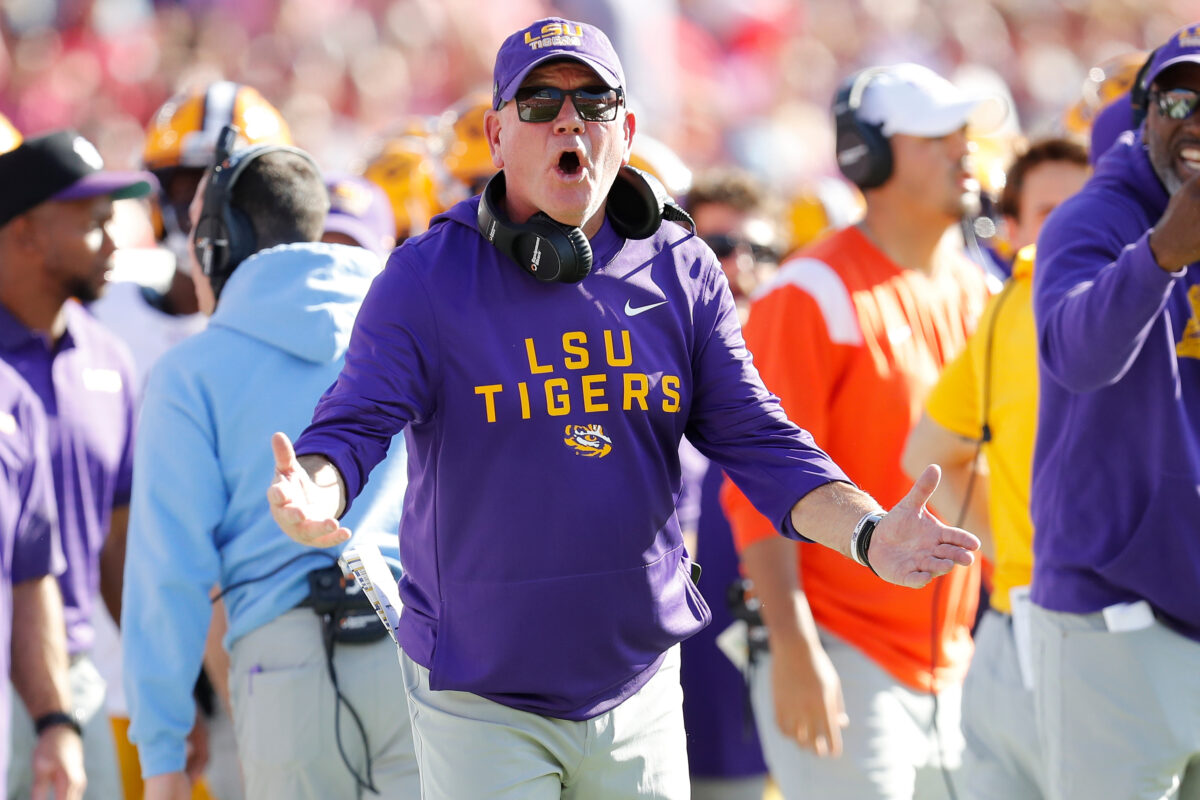
Brian Kelly is out at LSU. Fired. Done. Less than 24 hours after a humiliating 49-25 home loss to Texas A&M—after running into the locker room while students chanted “Fire Kelly,” after being forced to come back out and sing the alma mater with his players—LSU finally pulled the trigger. But this wasn’t a simple firing. This was a full-blown confrontation that spiraled out of control.

Here’s what happened.

The Dramatic Showdown That Ended It All

Sunday afternoon, according to The Athletic’s Bruce Feldman and Ralph D. Russo.

Brian Kelly and athletic director Scott Woodward meet. Woodward wants staff changes. Specifically, he wants Kelly to fire offensive coordinator Joe Sloan. LSU’s offense ranks dead last in the SEC in rushing. Something has to give. Kelly fires back. If we’re making staff changes, he says, I want to make different changes. Ones Woodward isn’t comfortable with.

Things get tense.

The conversation escalates. Kelly pushes back hard against his boss. Threats about negotiating Kelly’s $53 million buyout come up. But there’s a question: will the LSU Board of Supervisors even give Woodward the authority to do that?

By Sunday night, it’s over.

Kelly is out. A team meeting is called for 8 p.m. Associate head coach Frank Wilson is named interim head coach. Tight ends coach Alex Atkins will take over play-calling duties. And on Monday morning, LSU announces they’ve fired Sloan anyway. “When Coach Kelly arrived at LSU four years ago, we had high hopes that he would lead us to multiple SEC and national championships during his time in Baton Rouge,” Woodward said in the release. “Ultimately, the success at the level that LSU demands simply did not materialize.”

Translation: You didn’t win enough.

But here’s the thing: Kelly isn’t the only one.

This has been one of the most chaotic coaching carousel seasons in years. Jobs are opening everywhere:

  • Penn State
  • LSU
  • Florida
  • Oklahoma State
  • Arkansas
  • Virginia Tech
  • UCLA
  • Stanford

And that’s just so far.

Florida State and Oklahoma could be next. Maybe others. The competition for top candidates is going to be insane. Top-tier schools like Florida, LSU, and Penn State are in their own tier—massive resources, elite NIL, phenomenal facilities. But even they’re going to have to pay up. Big time.

Agents are salivating.

Salaries are about to get wildly inflated. And how many of these coaches will actually complete their contracts without needing to be bought out? History says not many. But here’s the question nobody wants to ask: Who are these schools actually going to hire?

And that leads to an even more uncomfortable question for programs down the ladder.

If You’re Cal (Or Nevada, Or Louisiana Tech), What Do You Do?

Let’s talk about the schools further down the food chain for a second.

If you’re Cal, what do you do? Justin Wilcox has been there for nine years. No winning seasons since 2019. The program is stuck in mediocrity. Do you fire him and jump into this insane market where every coach’s price just tripled? Do you keep investing in a guy who hasn’t delivered? If you’re Nevada, do you pay the $2.7 million buyout for Jeff Choate and try to compete with Penn State and LSU for the same candidate pool? If you’re Louisiana Tech, do you cut ties with Sonny Cumbie and hope you can find someone better in a market that’s about to be picked clean?

The reality is brutal.

The top jobs are going to snap up the top candidates. Everyone else will be fighting over the scraps. Or they’re going to have to roll the dice on assistant coaches and hope they hit on the next Cignetti. Schools like Vanderbilt, Missouri, Tulane, North Texas, Memphis, Wake Forest, and Boise State have coaches who are prime poaching targets. And they won’t have the money to keep them if the big boys come calling.

It’s a bad year to be a mid-tier program with an up-and-coming coach.

So, Who Is LSU Going to Get That’s Better Than Brian Kelly?

Which brings us back to the biggest question of all.

Think about Kelly’s résumé for a second:

  • Two Division II national championships
  • Took Cincinnati to 11-1 and a top-4 finish
  • Took Notre Dame to two national championship games
  • Ten top-25 finishes at Notre Dame, half of them in the top 10
  • Won 10 games in each of his first two seasons at LSU with top-15 finishes
  • Won 9 games last year
  • On pace for 8 wins this year

That’s not a bad coach.

That’s an excellent coach who didn’t meet LSU’s sky-high expectations. So who’s the upgrade? The names being thrown around: Lane Kiffin, Marcus Freeman, Brent Key, Eli Drinkwitz, Jon Sumrall. Are those guys sure things? Are they going to be infinitely better than Kelly?

Nobody knows.

LSU is about to spend $100 million (or more) buying out Kelly and his staff, then funding a new coaching staff, to get someone who might be better. It’s a massive gamble. Here’s the reality: You’re going to spend probably $100M buying out your previous coaching staff and funding your new one to get someone that isn’t necessarily a sure thing. It’s not like Brian Kelly was going 4-8.

And here’s the kicker.

Unless LSU is bringing back Nick Saban, Chris Petersen, or Urban Meyer from retirement, there isn’t a candidate out there who’s a sure thing. Lane Kiffin is going to make a fortune – either from Ole Miss giving him a massive raise to stay, or from one of these desperate schools throwing ridiculous money at him. Brian Kelly won’t be out of work long. Neither will James Franklin, who Penn State moved on from. They’re outstanding coaches. The problem is they weren’t great enough for programs with championship-or-bust expectations.

And that’s the new reality of college football.

What’s Next?

The carousel is spinning.

Fast. More jobs will open. More coaches will get massive paydays. More schools will regret the contracts they’re about to hand out. In about four years, a lot of these fan bases are going to be asking: “Why did we give him that contract?!”

But right now?

It’s chaos. And LSU is right in the middle of it.

Stay tuned.

No related posts found.

LOAD MORE BLOG ARTICLES

Kentucky Has Faced The SEC’s 9th-Toughest Schedule This Season. Here’s Why Their 2-4 Record And 16.7 Points Per Game Against Quality Defenses Means Tennessee Wins By 20+ On Saturday

Here’s what nobody’s talking about:

Kentucky has faced one of the most brutal schedules in college football this season. They’ve gone toe-to-toe with Georgia, Texas, and Ole Miss—all top-25 programs with elite defenses. And despite sitting at 2-4, they took Texas to overtime, losing 16-13, a game that showed real defensive grit. On paper, this looks like a team tested by fire and capable of giving Tennessee problems.

But here’s the problem.

Their offense cannot score. Against Power Five competition, Kentucky averages just 16.7 points per game. Their wins came against MAC opponents Toledo and Eastern Michigan—teams that made them look competent. Strip those away, and you’re staring at an offense that can’t sustain drives, can’t convert third downs, and can’t throw touchdowns.

And when Tennessee’s explosive attack takes the field on Saturday, that weakness gets exposed.

The Numbers Don’t Lie (Even When You Adjust For Competition)

Let’s cut through the noise and look at what actually matters.

Tennessee averages 511 yards per game. Kentucky averages 342. But you might say, “Tennessee played East Tennessee State and UAB—those stats are inflated.” Fair point. So let’s adjust for competition and see if the gap closes or widens.

Here’s what happens when you filter the data:

  • Tennessee vs Power Five opponents: 470 yards per game, 6.4 yards per play
  • Tennessee vs Georgia (No. 6): 496 yards, 41 points in overtime loss
  • Kentucky vs Power Five opponents: 314 yards per game, 4.5 yards per play
  • Kentucky vs Top-50 defenses: 16.7 points per game

Even after removing the cupcakes, Tennessee still ranks as an elite offense. They dropped 496 yards on Georgia—one of the nation’s best defenses—and pushed them to overtime. Meanwhile, Kentucky’s offense craters against quality competition.

The gap isn’t closing. It’s widening.

Kentucky’s Offense Has One Fatal Flaw

They can’t convert third downs.

With a 39% third-down conversion rate, Kentucky’s offense sputters every time they face third-and-medium. They average 0.7 passing touchdowns per game—that’s less than one per game—and their quarterback play has been inconsistent at best. Against SEC defenses, they’ve managed just 314 yards and 16.7 points per game.

Here’s what that means in real terms:

  • Kentucky goes three-and-out repeatedly
  • Their defense faces 70+ plays from Tennessee
  • By the third quarter, their defense is gassed
  • Tennessee pulls away in the second half

You can have the best defense in the world, but if you can’t score points, you can’t win football games.

Tennessee’s Tempo Is Going To Break Kentucky’s Defense

Here’s where this game gets decided.

Tennessee runs 75 plays per game—one of the fastest tempo offenses in the SEC. They come out firing with quick-strike drives, play-action deep shots, and an offensive line that creates lanes for their running backs. Kentucky’s defense has been respectable this season, holding opponents to 365 yards per game and forcing field goals in the red zone.

But sustained tempo breaks defenses.

By the third quarter, Tennessee’s depth shows. Kentucky’s defensive backs are chasing receivers on seam routes. Their linebackers are gassed from covering slot receivers. And Tennessee’s offensive line starts imposing its will. We’ve seen this movie before with Kentucky—they hang in for a half, then get blown out in the second half.

When you can’t score points, you can’t afford to let the other team dictate tempo.

The Georgia Game Told Us Everything We Needed To Know

Both teams played Georgia this season.

Let’s compare the results:

  • Tennessee vs Georgia: Lost 44-41 in overtime, 496 yards, 41 points
  • Kentucky vs Georgia: Lost 35-14, 270 yards, 14 points

That’s a 226-yard difference in offensive production against the same elite defense. Tennessee took one of the nation’s best teams to overtime in a game they arguably should’ve won. Kentucky got boat-raced at home.

If that doesn’t tell you everything about the offensive gap, nothing will.

The 3 X-Factors That Will Decide This Game

Let’s break down the key matchups.

1. Can Kentucky Convert Third Downs?

Kentucky’s offense lives and dies on third down. With a 39% conversion rate and Tennessee’s aggressive blitz packages coming off the edge, this could get ugly fast. If Kentucky can’t sustain drives, their defense faces 12-14 possessions.

That’s too many.

2. Red Zone Execution

Kentucky’s defense has been elite at limiting passing touchdowns—just 0.5 per game allowed. They force teams to kick field goals. But Tennessee’s balanced attack gives them multiple ways to score inside the 20. Touchdowns vs field goals will determine if this is a close game or a blowout.

Early touchdown conversions blow this game open by halftime.

3. Turnovers

This is Kentucky’s only path to an upset. If they can force 2-3 turnovers and create short fields, maybe—MAYBE—their limited offense can cobble together 20-24 points. But Tennessee’s been relatively careful with the ball (1.4 turnovers per game), and Kentucky isn’t exactly a ballhawking defense.

Betting on Kentucky to win the turnover battle by +2? That’s wishful thinking.

What Kentucky Needs To Do (Spoiler: It Won’t Be Enough)

Let’s game this out.

For Kentucky to pull off the upset, they need:

  • Win the turnover battle by +2 or more
  • Convert 50%+ of third downs (well above their season average)
  • Hold Tennessee under 400 total yards
  • Make every field goal attempt (they’re shooting 69% this season)

Even if Kentucky does ALL of those things, they still need to score 24+ points to have a chance. And against quality competition, they average 16.7 points per game. The math doesn’t work. The matchups don’t work. The tempo doesn’t work.

Kentucky can play inspired football for a half.

They can keep it close through sheer defensive discipline and field position management. But eventually—probably by early third quarter—Tennessee’s offensive firepower breaks through. And when it does, Kentucky doesn’t have the offensive capability to answer.

How This Game Plays Out

Here’s the quarter-by-quarter breakdown:

First Quarter: Tennessee establishes tempo. Quick three-and-out for Kentucky. Tennessee scores on a six-play, 73-yard drive capped by a play-action touchdown. 7-0 Vols.

Second Quarter: Kentucky strings together a decent drive using their run game and short passes. They stall in the red zone. Field goal. 7-3. Tennessee answers immediately with another touchdown drive. Kentucky gets another field goal before half. 17-10 Tennessee at halftime.

Third Quarter: This is where the game breaks open. Tennessee’s depth starts showing. Kentucky’s defense is gassed from defending 40+ plays in the first half. Tennessee rips off two scoring drives. Kentucky’s offense goes three-and-out twice. 31-13 Tennessee.

Fourth Quarter: Garbage time. Tennessee runs clock. Kentucky adds a late touchdown against prevent defense.

Final score: 38-17.

The Bottom Line

Look, I get it.

Kentucky has played a brutal schedule. They’ve faced a murderer’s row in the SEC, and their 2-4 record doesn’t fully reflect their defensive competence. They took Texas to overtime. They hung with Georgia for a half. This is a program that’s been battle-tested against elite competition.

But here’s the reality:

Their offense is one-dimensional. Their scoring ceiling against quality competition is 17-20 points. And Tennessee’s offense—even when you adjust for weak competition—is legitimately elite. 470 yards per game against Power Five teams. 6.4 yards per play. An up-tempo attack that wears down defenses. Home field advantage in Neyland Stadium.

Unless Tennessee commits 3+ turnovers, this game isn’t really in doubt.

Kentucky will keep it respectable for a half. But by the time the third quarter rolls around, Tennessee’s superior depth, tempo, and offensive firepower will have pulled away. The final score won’t be 50-10—Kentucky’s defense is too disciplined for that.

But a two-to-three score Tennessee victory? That’s not just likely—it’s inevitable.

Tennessee 38, Kentucky 17

Statistical Projections

Tennessee: 465-490 total yards | 38-41 points | 295 pass yards | 175 rush yards | 1 turnover

Kentucky: 300-320 total yards | 17-20 points | 190 pass yards | 120 rush yards | 2 turnovers

3 Keys To Watch

Tennessee’s first quarter tempo: If they jump out to a 14-0 or 17-3 lead early, Kentucky’s offense doesn’t have the firepower to dig out.

Kentucky’s third-down efficiency: They MUST convert 50%+ to sustain drives. Anything less and their defense faces 70+ plays.

Red zone execution: Touchdowns vs field goals will determine if this is a close game or a blowout.

Final Thought

The spread on this game should be Tennessee by 17-21 points. Kentucky’s offense is the limiting factor. You can have the best defense in the world, but if you can’t score points, you can’t win football games. And against Tennessee’s explosive attack, 17 points isn’t going to cut it.

Tennessee rolls. Kentucky fights hard for a half. But class—and offensive firepower—wins out.

No related posts found.

LOAD MORE BLOG ARTICLES

Week 8 — Coaches Hot Seat Rankings

Three coaches were fired on Sunday.

Trent Dilfer. James Franklin. Trent Bray.

Gone.

When coaches start falling in October, everyone else feels it. The phone calls start. The quiet meetings happen. The pressure that was already there gets cranked up to a whole new level.

Here are the 10 coaches under the most pressure in college football right now:


1. Billy Napier, Florida (SEC)

Billy Napier is 21-23 at Florida. One upset over Texas doesn’t erase years of mediocrity. The Gators are paying him $7 million to compete for bowl eligibility while Georgia and Alabama compete for championships.

That’s unacceptable at Florida.


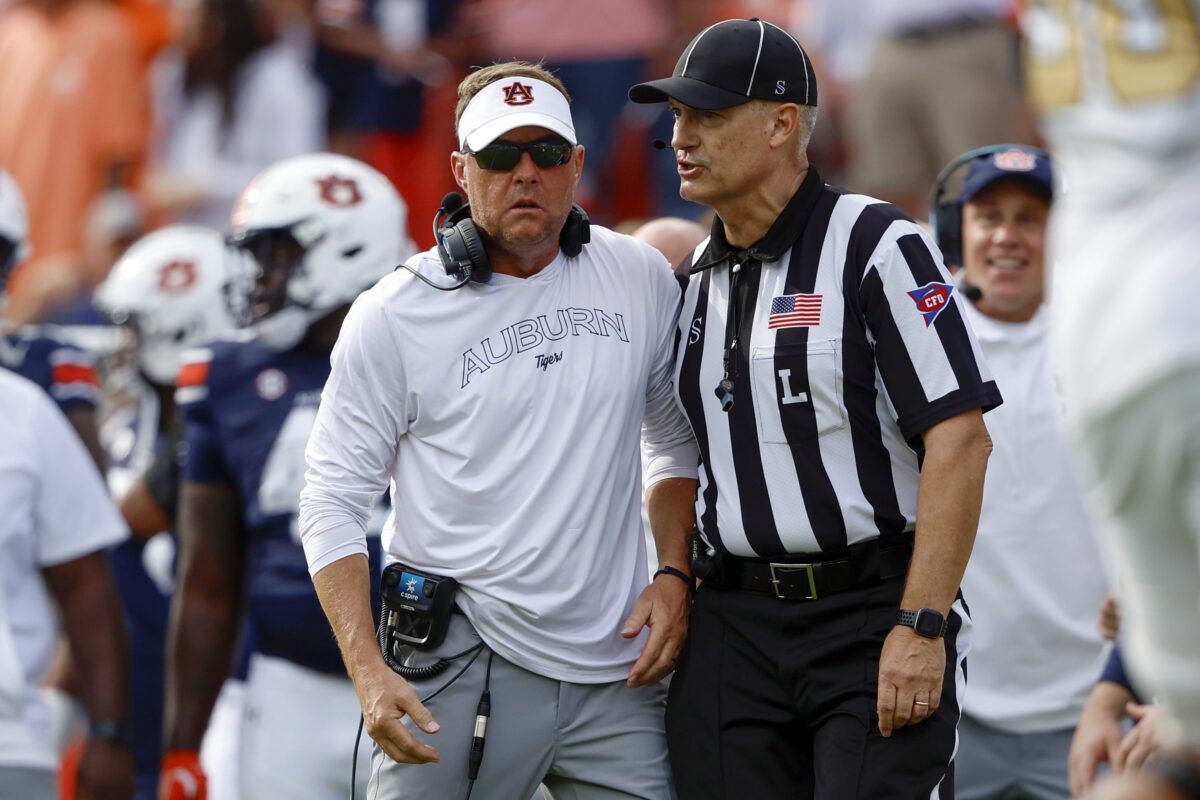
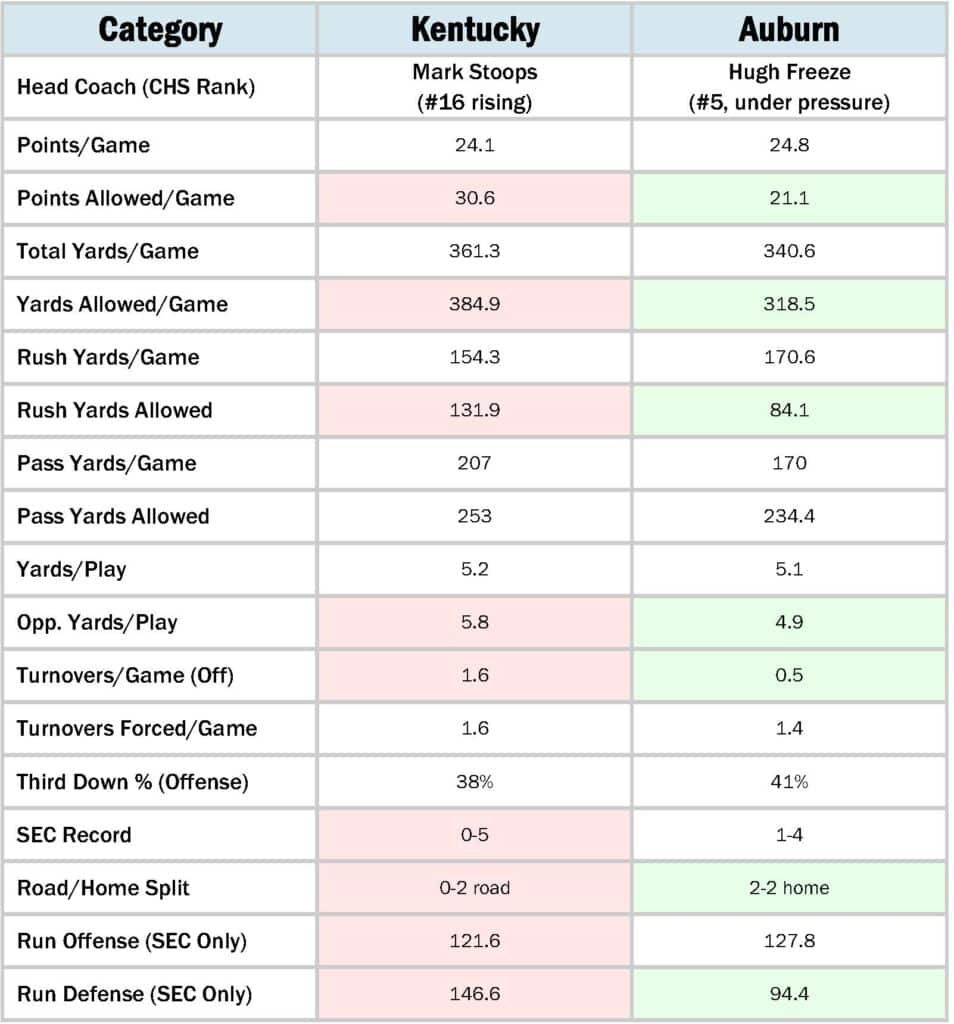
2. Hugh Freeze, Auburn (SEC)

Hugh Freeze came to Auburn with a redemption story.

A second chance after Ole Miss. Auburn gave him big money, full control, everything he needed to compete. The pressure is mounting because it’s not working.

Right now, Auburn isn’t competing.


3. Mike Norvell, Florida State (ACC)

Florida State hasn’t won an ACC game since November 2023.

Fifteen straight conference losses. Two full seasons. Zero ACC wins.

Mike Norvell went from 13-1 ACC Champions to unwatchable in less than a year.

FSU beat Florida earlier this season, and the media acted like they were “back.” They’re not—they’re 0-2 in ACC play. Norvell has had two years to figure out how to win in the ACC.

At Florida State, that’s unacceptable.


4. Jeff Choate, Nevada (Mountain West)

Jeff Choate is 4-15 at Nevada.

What worked at Montana State isn’t translating to the FBS level. Choate talks about tough, physical football, but Nevada is getting pushed around. The problem isn’t philosophy—it’s execution.

Choate is running out of time.


5. Joe Moorhead, Akron (MAC)

Joe Moorhead is 10-33 at Akron.

Elite offensive coordinator at previous stops. Winner at Fordham. But the Zips move the ball, rack up yards, then stall in the red zone—that’s coaching.

A 10-33 record over four years tells the story.


6. Luke Fickell, Wisconsin (Big Ten)

Luke Fickell was supposed to save Wisconsin football.

Wisconsin gave him everything—big money, full control, time to install his system. The defense has regressed, the offense looks disjointed, and the Big Ten is exposing every weakness. Wisconsin fans don’t want to hear about systems—they want wins.

Fickell isn’t meeting the Wisconsin standard yet.


7. Butch Jones, Arkansas State (Sun Belt)

Butch Jones failed at Tennessee.

Now he’s failing at Arkansas State. The Red Wolves are underperforming, players aren’t buying in, and fans aren’t showing up. Arkansas State thought Jones learned from his Tennessee mistakes.

The results suggest otherwise.


8. Justin Wilcox, California (ACC)

Cal got a fresh start with the move to the ACC.

New conference. New competition. New expectations. And here’s the number that matters: 8 wins.

That’s what Justin Wilcox needs to keep his job.

Look at what’s left on the schedule:

  • North Carolina
  • At Virginia Tech
  • Ranked Virginia
  • At Louisville
  • At Stanford
  • SMU

Six games—Cal needs to win five of them.

Wilcox is supposed to be a defensive guru who maximizes limited resources. But the Bears are getting manhandled by ACC competition—the defense can’t stop anyone, the offense can’t score. The math isn’t mathing.

Cal has a new chancellor—an alum, Class of ’83.

They hired Ron Rivera, NFL veteran head coach, as General Manager overseeing the football program. ESPN’s Gameday came to Berkeley last season. Everyone saw the potential. Cal has poured money and resources into this program—and they’re expecting results.

Can Willcox get the Golden Bears to 8 regular-season wins?


9. Sonny Cumbie, Louisiana Tech (C-USA)

Sonny Cumbie was supposed to bring offensive firepower to Louisiana Tech.

The Air Raid disciple. The Texas Tech coordinator everyone wanted to hire. But coordinating and head coaching are two completely different jobs—the offense has been inconsistent, the defense worse, and the program feels directionless.

Coordinator success doesn’t automatically translate to head coaching success.


10. Derek Mason, Middle Tennessee (C-USA)

Derek Mason is 4-14 at Middle Tennessee.

He’s a defensive coach in an era where offense wins championships. Mason is building a 2005 program in 2025, and Middle Tennessee can barely crack 20 points per game. MTSU fans are asking: What exactly are we getting better at?

If the answer is “nothing,” the pressure builds.


The Bottom Line:

Three coaches got fired this week—more will follow.

Athletic directors are making calls. Boosters are applying pressure. Coaches who thought they were safe realize they’re not.

Want the full picture?

Our newsletter subscribers get exclusive analysis of coaches ranked 11-25—the ones trending in the wrong direction but not quite in crisis mode yet.

Subscribe here to get all 136 FBS rankings every week.

Because pressure is a ranking—and everyone’s being measured.


Check out the complete 136 FBS Coaches Hot Seat Rankings.

No related posts found.

LOAD MORE BLOG ARTICLES

Hugh Freeze Has 2 Games To Save His Job At Auburn. Here’s Why Saturday Night’s Matchup Against #10 Georgia At Jordan-Hare Stadium Is Game 1 Of His Final Stand

7:30 PM EDT. Jordan-Hare Stadium. Lights. Chaos. Everything on the line.

This isn’t just another SEC game.

This is Hugh Freeze fighting for his job. This is Auburn desperate for relevance after back-to-back losses. This is Georgia trying to stay in the playoff hunt on the road, at night, in one of the most dangerous venues in college football.

Let me break down exactly what’s about to happen.


The Numbers Don’t Lie (But Jordan-Hare At Night Doesn’t Care)

Georgia is the better team on paper.

Georgia’s Offensive Dominance:

  • 438.6 yards per game (96.4 more than Auburn)
  • 34.6 points per game
  • Perfectly balanced: 231.8 passing, 206.8 rushing
  • 3.2 rushing touchdowns per game
  • 24.8 first downs per game

Auburn’s Offensive Struggles:

  • 342.2 yards per game (bottom-tier SEC)
  • 27.6 points per game
  • Anemic passing: 173.2 yards, 1.0 TD per game
  • Only scored 10 points at Texas A&M

Georgia should win by double digits.

But here’s what the stats don’t tell you: Auburn at night in Jordan-Hare has produced some of the most inexplicable upsets in college football history. The “Kick Six” against Alabama. Stunning wins over LSU, Georgia, and other powerhouses who had no business losing.

Strange things happen here after dark.


What To Watch: Georgia With The Ball

Can Auburn’s elite run defense hold?

This is the marquee matchup of the game. Auburn allows only 82 rushing yards per game at 2.7 yards per carry. That’s legitimately elite. But Georgia rushes for 206.8 yards per game at 4.8 yards per carry with over 3 rushing touchdowns per game.

Something’s gotta give.

If Auburn stacks the box to stop the run, Georgia will torch them through the air. If they play honestly, Georgia will run them over. There’s no good answer for Auburn’s defensive coordinator.

The balance problem Georgia creates:

Georgia doesn’t just beat you one way. They beat you every way. 231.8 passing yards per game. 206.8 rushing yards per game. Perfectly balanced, impossibly difficult to defend.

Auburn has to pick its poison.

In a night game where crowd noise makes communication difficult, Georgia’s ability to run the ball becomes even more valuable. No audibles needed. Just line up and impose your will.

Watch the first down battle:

Georgia averages 24.8 first downs per game. Long, methodical drives that keep Auburn’s defense on the field and completely gassed by the fourth quarter.

If Georgia controls the clock and sustains drives, Auburn’s offense won’t get enough possessions to keep pace. And with Auburn averaging only 27.6 points per game, they need every possession they can get.

Can Georgia handle the noise?

Here’s Georgia’s biggest weakness: 40.8 penalty yards per game. False starts. Holding calls. Drive killers.

Now put them on the road, at night, in one of the loudest stadiums in America. Communication becomes nearly impossible. The crowd will be absolutely deafening on every Georgia snap.

If Georgia beats itself with penalties, Auburn has a chance.


What To Watch: Auburn With The Ball

Can Auburn throw the football at all?

This is the existential question for Hugh Freeze’s offense.

173.2 passing yards per game. Only 1.0 passing touchdown per game. Those are borderline FCS numbers in the modern SEC. You cannot win big games with that level of offensive production.

Georgia’s pass defense allows 231.2 yards per game, which means Auburn should be able to exploit it through the air. But “should” and “can” are two very different things.

If Auburn comes out scared and conservative in the passing game, they have no chance. If Hugh Freeze opens up the playbook and takes shots downfield, they might be able to keep Georgia honest enough to run the ball effectively.

The ghost of Texas A&M:

Auburn scored 10 points at Texas A&M. Ten.

That performance haunts everything about this game. Can Auburn’s offense show up when it matters most? Or will they shrink under the pressure and the lights?

The first quarter will tell you everything you need to know.

Ball security is victory:

Auburn’s best stat: 0.2 turnovers per game. Elite ball security. Georgia commits 1.4 turnovers per game.

If Auburn takes care of the football and Georgia coughs it up twice, suddenly you’ve got short fields and momentum shifts. That’s how upsets happen.

One Auburn turnover probably ends the game. Zero Auburn turnovers gives them a legitimate puncher’s chance.

Time of possession will decide this:

Auburn averages 342.2 total yards per game. That’s not enough to win a shootout.

So they have to shorten the game. Long, grinding drives that keep the clock moving and Georgia’s explosive offense on the sideline. Lean on the run game (169 yards per game, 2.4 TDs). Control the tempo.

If Auburn gets into a track meet, they lose by three touchdowns.

Hugh Freeze’s bag of tricks:

When coaches are fighting for their jobs at home under the lights, desperation breeds creativity.

Watch for fake punts, trick plays, ultra-aggressive fourth down calls. Hugh Freeze knows conventional football won’t beat Georgia. He needs chaos, misdirection, and a little bit of magic.

At night, Jordan-Hare is the perfect stage for desperation to become brilliance.


What Each Team Brings To This Party

Georgia’s Advantages:

  • Superior talent across the board
  • Balanced, explosive offense that can beat you any way
  • Already won at #15 Tennessee (proven road warriors)
  • Playoff desperation creates focus
  • Better coaching, better depth, better everything

Georgia’s Vulnerabilities:

  • Turnover prone (1.4 per game)
  • Penalties on the road in hostile environments
  • Might overlook Auburn after beating Kentucky
  • Playing at the most dangerous venue in America

Auburn’s Advantages:

  • Home field at night (worth 10-14 points in chaos)
  • Elite ball security (0.2 turnovers per game)
  • A stout run defense that can slow Georgia down
  • Nothing to lose, everything to gain
  • Desperation creates superhuman effort

Auburn’s Vulnerabilities:

  • Offensive ineptitude (96.4 fewer yards per game than Georgia)
  • Can’t throw the football consistently
  • Two-game losing streak in SEC play
  • The talent gap is real and significant

The matchup heavily favors Georgia.

But the environment heavily favors chaos. And chaos is Auburn’s best friend.


Final Score Prediction: Georgia 31, Auburn 20

But here’s what you need to understand.

This prediction is based on logic, statistics, and talent evaluation. Georgia is the better team. They should win.

But night games at Jordan-Hare Stadium don’t follow logic.

Here’s how I see it unfolding:

First Quarter: 7-7. Auburn comes out absolutely possessed. The crowd is deafening. Georgia struggles with false starts and communication. Auburn feeds off the energy.

Second Quarter: 17-13 Georgia. Talent starts to show, but Auburn refuses to fold. A trick play or defensive turnover keeps them within striking distance. Jordan-Hare is absolutely electric at halftime.

Third Quarter: 24-20 Georgia. Back and forth. Every Georgia score gets answered. The crowd never sits down. Auburn is in this thing.

Fourth Quarter: 31-20 Georgia. Superior depth and offensive firepower finally create separation. Auburn’s limited offense can’t generate enough to keep pace over 60 minutes.

That’s the logical outcome.

But don’t be shocked if Auburn wins outright. I give them a legitimate 30-35% chance to pull the upset. That’s not “Auburn might get lucky.” That’s “Auburn has a real path to victory if a few things break their way.”

Georgia fumbles twice. Hugh Freeze calls the game of his life. The crowd forces three false starts at crucial moments. Auburn’s defense gets a pick-six.

Suddenly, it’s 27-24 Auburn with 5 minutes left, and Georgia is shell-shocked.

It can happen. It has happened. This is Jordan-Hare at night.


What This Means For Hugh Freeze

If Auburn loses 31-20:

On paper, it looks “respectable.” A competitive home loss to #10 Georgia.

But Auburn fans won’t see it that way. They’ll see an offense that still can’t score more than 20 points against quality competition. They’ll see a wasted opportunity on the biggest stage with the entire fanbase behind them.

Top 5 hot seat status: Confirmed.

If Auburn wins:

Season saved. Freeze becomes an overnight hero. The “Hugh Freeze can’t win the big one” narrative gets torched. Suddenly, that top 5 hot seat talk disappears.

Until the subsequent loss.

The reality:

This game will define Hugh Freeze’s Auburn tenure one way or another. Win, and he buys himself a full season of goodwill. Lose, and the whispers become screams.


The Bottom Line

Georgia should win.

But Auburn, at home, at night, with everything on the line and nothing to lose, is the most dangerous version of Auburn that exists.

The smart money is on Georgia by 7-9 points.

The fun money is on Auburn and chaos.

See you Saturday night.

No related posts found.
VISIT OUR SHOP [COMING SOON]

LOAD MORE BLOG ARTICLES

Oklahoma’s #6 Hot Seat Coach Has 12 Games To Save His Job. Michigan Is Game #2.

Here’s what everyone in college football knows but won’t say out loud.

Brent Venables is coaching for his career on Saturday. Not his season. His career. When you’re ranked #6 out of 136 coaches on the Coaches Hot Seat rankings, every game becomes a referendum on your future.

The Math Is Simple:

  • 22-17 record in three seasons at Oklahoma
  • Two losing seasons out of three
  • #6 on the hot seat rankings (danger zone territory)
  • A schedule ESPN calls the toughest in college football

Meanwhile, Sherrone Moore sits comfortably at #36 in our rankings. That’s the difference between “we’re watching” and “we’re planning your replacement.”

Here’s What Makes Saturday Fascinating:

Oklahoma went nuclear in the offseason. They brought in 21 transfer portal players, hired a new offensive coordinator, and landed John Mateer—the quarterback who led all of college football with 44 total touchdowns last season.

Michigan countered with the #1 recruit in the country, Bryce Underwood, who already proved he belongs by going 21/31 for 251 yards in his debut.

The Stakes:

For Venables, this is his best shot at an early statement win before facing eight projected top-25 opponents. Win, and the complete program overhaul looks genius. Lose, and the whispers become roars.

For Moore, this is about proving their offensive transformation can execute against proven competition.

The Truth:

Desperate coaches make dangerous opponents. When your job depends on 12 games, every snap gets magnified. Every decision gets scrutinized.

Saturday tells us whether that desperation breaks Oklahoma or brings out its best.

We Track Coaching Pressure So You See The Warning Signs First

You just read the kind of analysis that predicted coaching changes before they happened. While other publications wait for the obvious, we identify the warning signs early.

The Coaches Hot Seat newsletter delivers:

  • Weekly hot seat rankings with data-driven predictions
  • Inside analysis on coaching moves before they’re announced
  • The real financial stories behind hiring and firing decisions
  • Zero fluff, zero access journalism, zero protecting feelings

Because college football moves fast.

And the programs that survive are the ones that see what’s coming next—not the ones caught reacting to what already happened.

Get the analysis that matters before it becomes obvious to everyone else.

No related posts found.

LOAD MORE BLOG ARTICLES

Georgia Football 2025: The Year Everything Must Come Together

Georgia football stands at the most critical crossroads in the Kirby Smart era.

After an 11-3 season that included an SEC Championship but ended with crushing disappointment against Notre Dame in the Sugar Bowl, the Bulldogs face a familiar question: Can they reload fast enough to compete for another national title?

The answer isn’t as simple as pointing to their second-ranked recruiting class or their elite defensive continuity. This is about execution under pressure. This is about proving that championship windows don’t close just because star players leave for the NFL.

For Georgia, 2025 represents the ultimate test of program sustainability.

The Quarterback Question That Changes Everything

Gunner Stockton holds the keys to Georgia’s entire championship hopes.

The redshirt junior from Tiger, Georgia, isn’t just replacing Carson Beck. He’s stepping into the most pressure-packed position in college football at a program where anything less than playoff contention equals disappointment.

But here’s what most people miss about Stockton’s situation: He’s not walking into this blind.

His limited 2024 action tells a story of readiness:

  • 67.8% completion percentage
  • 939 passing yards with 9 touchdowns, 2 interceptions
  • 10.4 yards per attempt (explosive play capability)
  • 4 rushing touchdowns (dual-threat ability)
  • Clutch performance in SEC Championship overtime win vs Texas

“Recent Georgia football history indicates that Gunner Stockton will be successful in 2025 as the starter,” according to Sports Illustrated’s analysis of Smart’s track record with first-year starters.

The evidence supports this optimism. Jake Fromm, Stetson Bennett, and Carson Beck all found immediate success in their first seasons as full-time starters under Smart. The system works because Smart builds it around his quarterbacks’ strengths, not against them.

Behind Stockton, the depth chart features genuine promise. Redshirt freshman Ryan Puglisi would have been next in line during the Texas game, bringing four-star credentials and unwavering program loyalty. The 2025 class adds Ryan Montgomery and Hezekiah Millender, creating long-term stability at the position.

Elite Recruiting Meets Championship Pressure

Georgia’s 2025 recruiting class ranks second nationally for a reason.

With 28 commitments and an 82% blue-chip ratio, this isn’t just talent acquisition. This is championship-level roster construction designed to maintain elite standards while replacing NFL-bound stars.

The cornerstone is five-star defensive tackle Elijah Griffin, who becomes the first No. 1-ranked DT prospect to sign with Georgia during the Smart era. This isn’t just a recruiting win. This statement suggests that Georgia can still attract the nation’s top players despite recent setbacks.

The numbers tell the story of sustained excellence:

  • 4 five-star prospects
  • 17 ESPN 300 players
  • 25 of 28 signees enrolling early
  • Top-10 classes in three consecutive years

Five-star wide receiver Talyn Taylor and defensive tackle Isaiah Gibson provide immediate impact potential. But the real value lies in the depth across all position groups, ensuring that NFL departures don’t create fatal gaps in the roster.

“Georgia’s 2025 recruiting class ranks in the top 10 nationally,” ESPN reported, highlighting the program’s ability to continue attracting elite talent despite Sugar Bowl disappointment.

The Defensive Foundation That Never Breaks

Georgia’s defense in 2025 starts with a straightforward advantage: continuity.

The unit that allowed just 20.6 points per game in 2024 returns its core contributors, providing the foundation for continued excellence. This isn’t about replacing talent. This is about building on proven success.

Safety Malaki Starks anchors the secondary after recording 77 tackles and establishing himself as one of the nation’s premier defensive backs. His leadership and playmaking ability provide the steady presence that championship defenses require.

Linebacker Jalon Walker brings elite production (11 tackles for loss, 6.5 sacks) and veteran leadership to a position group with championship-level depth. The emergence of players like KJ Bolden, who finished 2024 strongly and projects as a breakout candidate, adds optimism to an already formidable unit.

The defensive line faces the most significant turnover but benefits from elite recruiting additions. Griffin’s early enrollment allows immediate competition for playing time while returning players like Christen Miller and Jordan Hall provide proven production.

This combination creates something special: veteran leadership merged with elite young talent.

Schedule Flip Creates Championship Opportunity

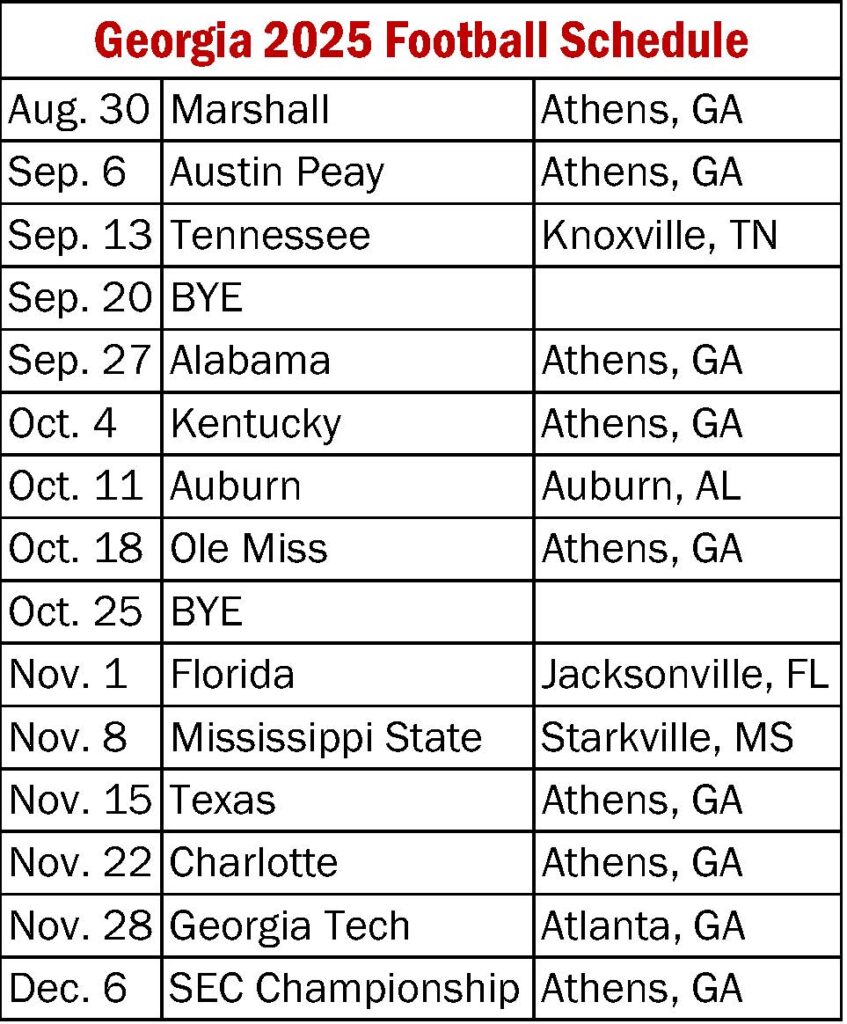
Georgia’s 2025 schedule represents the best possible scenario for a reloading team.

The same eight SEC opponents from 2024 return, but with home and away sites flipped. This creates massive advantages for the Bulldogs, who will host their most dangerous opponents while traveling to more manageable road environments.

The schedule highlights tell the story:

  • Texas makes its first-ever trip to Athens (November 15)
  • Alabama visits Athens for the first time since 2015
  • Ole Miss, Kentucky, also come to Sanford Stadium
  • Road games at Tennessee, Auburn, Mississippi State, Florida

According to ESPN’s Football Power Index, Georgia faces the 13th most brutal schedule among FBS teams. Phil Steele ranks it 44th nationally and 13th in the SEC. These aren’t overwhelming numbers for a program with championship aspirations.

The non-conference slate (Marshall, Austin Peay, Charlotte, Georgia Tech) provides opportunities to build momentum and develop depth before conference play intensifies.

Offensive Questions Demand Immediate Answers

The departure of leading receiver Arian Smith creates the season’s most significant offensive question mark.

Smith’s 817 receiving yards and 17.0 yards per catch represented the explosive element that stretched opposing defenses. Replacing that production isn’t just about finding another receiver. It’s about maintaining the vertical passing game that makes Georgia’s offense dangerous.

Transfer receiver Zachariah Branch possesses elite potential and the ability to make an immediate impact. Players like Colbie Young and Noah Thomas offer proven experience. But the question remains: Can this group create the explosive plays that championship offenses require?

The running game features more certainty with returning talent:

  • Nate Frazier: 671 rushing yards, 5.0 yards per carry in 2024
  • Cash Jones: Versatile threat as runner and receiver
  • Bo Walker: Impressed during spring practice, adds depth

Offensive coordinator Mike Bobo enters his second season with increased familiarity with the personnel. This continuity factor cannot be understated, as Bobo’s system becomes more refined with experienced players who understand their roles.

The Championship Window Stays Open

Georgia enters 2025 with legitimate championship aspirations for one simple reason: They have everything necessary to compete at the highest level.

The 12-team playoff format provides a margin for error that previous generations never enjoyed. The program’s infrastructure, from recruiting to player development, creates sustainable excellence that extends beyond individual seasons.

Smart’s track record of reloading rather than rebuilding provides confidence that the program can maintain elite status despite significant roster turnover. This isn’t about hoping for lightning to strike twice. This is about systematic excellence producing predictable results.

What Must Improve for Championship Contention

The 2024 season revealed specific weaknesses that championship teams cannot afford.

The areas demanding immediate improvement:

  • Turnover margin (minus one directly contributed to critical losses)
  • Penalty issues (5.7 per game stalled drives, extended opponents’ possessions)
  • Red zone efficiency in high-leverage situations
  • Defensive ability to create turnovers without surrendering explosive plays

These are correctable issues that coaching and experience can address. But they must be addressed for championship contention to become a championship reality.

The Verdict: Championship or Disappointment

Georgia’s 2025 season represents a classic reloading year disguised as something more dangerous.

The talent pipeline ensures competitive depth. The schedule flip provides a home-field advantage in crucial games. Smart’s proven ability to develop quarterbacks and maintain defensive excellence creates optimism for sustained success.

But here’s what makes this season different: The margin for error has shrunk.

For a program with two national championships in four years, anything less than playoff contention represents failure. Georgia enters 2025 with the expectation of competing for SEC and national championships, backed by the talent and infrastructure necessary to achieve those goals.

The championship window remains wide open in Athens.

The 2025 season presents another opportunity to prove that Georgia football belongs among college football’s elite programs, not just occasionally but consistently, year after year.

The Next Billion Dollar Game

College football isn’t just a sport anymore—it’s a high-stakes market where information asymmetry separates winners from losers. While the average fan sees only what happens between the sidelines, real insiders trade on the hidden dynamics reshaping programs from the inside out.

Our team has embedded with the power brokers who run this game. From the coaching carousel to NIL deals to transfer portal strategies, we’ve mapped the entire ecosystem with the kind of obsessive detail that would make a hedge fund analyst blush.

Why subscribe? Because in markets this inefficient, information creates alpha. Our subscribers knew which coaches were dead men walking months before the mainstream media caught on. They understood which programs were quietly transforming their recruiting apparatuses while competitors slept.

The smart money is already positioning for 2025. Are you?

Click below—it’s free—and join the small group of people who understand the real value of college football’s new economy.

No related posts found.

LOAD MORE BLOG ARTICLES

Missouri Football 2025: The Year Everything Must Come Together

Missouri Football is about to find out if their recent success was real or just a beautiful accident.

After back-to-back 10-win seasons that shocked college football, the Tigers face the ultimate test of sustainability. Star quarterback Brady Cook is gone. Top receivers Luther Burden III and Theo Wease Jr. departed for the NFL. Nearly half of the roster turned over due to graduation and the transfer portal.

What remains is a program trying to prove that lightning can strike three times in Columbia.

Eli Drinkwitz Just Made the Boldest Promise in College Football

Most coaches lower expectations during rebuilding years.

Drinkwitz is doing the exact opposite. He’s openly targeting achievements that have never been accomplished in Missouri football history, starting with a third consecutive 10-win season.

“I think the challenge for us is to do something that’s never been done before. It’s never been accomplished at the University of Missouri to extend that [10-win season] streak to a third season,” Drinkwitz told ABC 17 Sports.

But he didn’t stop there.

The fourth-year head coach is also pursuing Missouri’s first SEC championship and College Football Playoff berth. According to CBS Sports analysis, “And in no way are they approaching this year like that’s their plan [to go 7-5]. I get the feeling around Columbia like Eli Drinkwitz is openly talking about, ‘We’re trying to do things that have never been done.'”

This isn’t coach speak.

This program believes its foundation is strong enough to support championship-level expectations while navigating massive roster turnover.

The $1.5 Million Quarterback Gamble That Changes Everything

Beau Pribula holds the keys to Missouri’s entire season.

The Penn State transfer didn’t just sign with the Tigers. According to sources who spoke to On3, his NIL package will pay him $1.5 million in 2025, putting him on par with starting SEC quarterbacks across the conference.

That’s not just an investment.

That’s a statement about Missouri’s commitment to maintaining elite quarterback play after losing Brady Cook’s 8,721 career passing yards and veteran leadership.

Here’s what makes Pribula special:

  • Completed 26 of 35 passes for 275 yards and five touchdowns at Penn State
  • Added 242 rushing yards and four touchdowns on just 38 carries
  • Dual-threat ability fits perfectly within Drinkwitz’s offensive system
  • Two years of eligibility remaining for program continuity

But there’s a catch.

Pribula will compete with redshirt junior Sam Horn, who missed all of 2024 while recovering from Tommy John surgery. Horn, a former four-star recruit, hasn’t completed a pass since 2023 but possesses the physical tools that made him highly recruited.

Missouri won’t name a starter until August.

Everything depends on which quarterback can master the system fastest while building chemistry with a largely rebuilt receiving corps.

How Missouri Rebuilt Their Roster in Record Time

Twenty-six new players arrived through the transfer portal.

That’s not roster management. That’s complete program reconstruction executed with surgical precision.

The Tigers lost 29 players but responded with what multiple outlets rank as a top-10 transfer portal class nationally. Instead of panic recruiting, Missouri targeted specific weaknesses from 2024’s two blowout losses to Alabama and Texas A&M.

The most impactful offensive additions:

  • Ahmad Hardy (RB, Louisiana-Monroe): 1,300+ yard rusher expected to lead the backfield
  • Kevin Coleman Jr. (WR, Mississippi State): All-SEC slot receiver to replace NFL departures
  • Keagen Trost (OT, Wake Forest): Immediate tackle depth
  • Dominick Giudice (OL, Michigan): Versatile guard/center option
  • Jaylen Early (OT, Florida State): Another tackle option for depth

The defensive game-changers:

  • Damon Wilson II (DE, Georgia): Five-star transfer headlines improved pass rush
  • Josiah Trotter (LB, West Virginia): Veteran experience and proven production
  • Mikai Gbayor (LB, Nebraska): Athletic upgrade at linebacker
  • Santana Banner (S, Northern Illinois): Secondary help for coverage issues
  • Mose Phillips (S, Virginia Tech): Additional safety depth and experience

This wasn’t random talent acquisition.

This was strategic problem-solving that addressed every weakness that cost Missouri games in 2024.

The Defense Keeps Missouri Competitive While the Offense Figures It Out

Missouri’s defense finished 2024 with 28 takeaways.

That ranked sixth nationally and included 18 interceptions from a secondary that showed dramatic improvement throughout the season. While the offense integrates new faces, this defensive foundation provides the stability needed to remain competitive in every game.

Key returning defenders include:

  • Triston Newson (LB): 71 tackles, 7 tackles for loss in 2024
  • Zion Young (DE): Led team in pressures, should benefit from attention on Wilson
  • A secondary trio that provides continuity and proven ball skills

Defensive coordinator Corey Batoon enters his second season with improved talent and scheme familiarity.

The combination creates optimism for a unit that must keep games close while the offense develops chemistry and rhythm.

The Schedule That Could Make or Break Everything

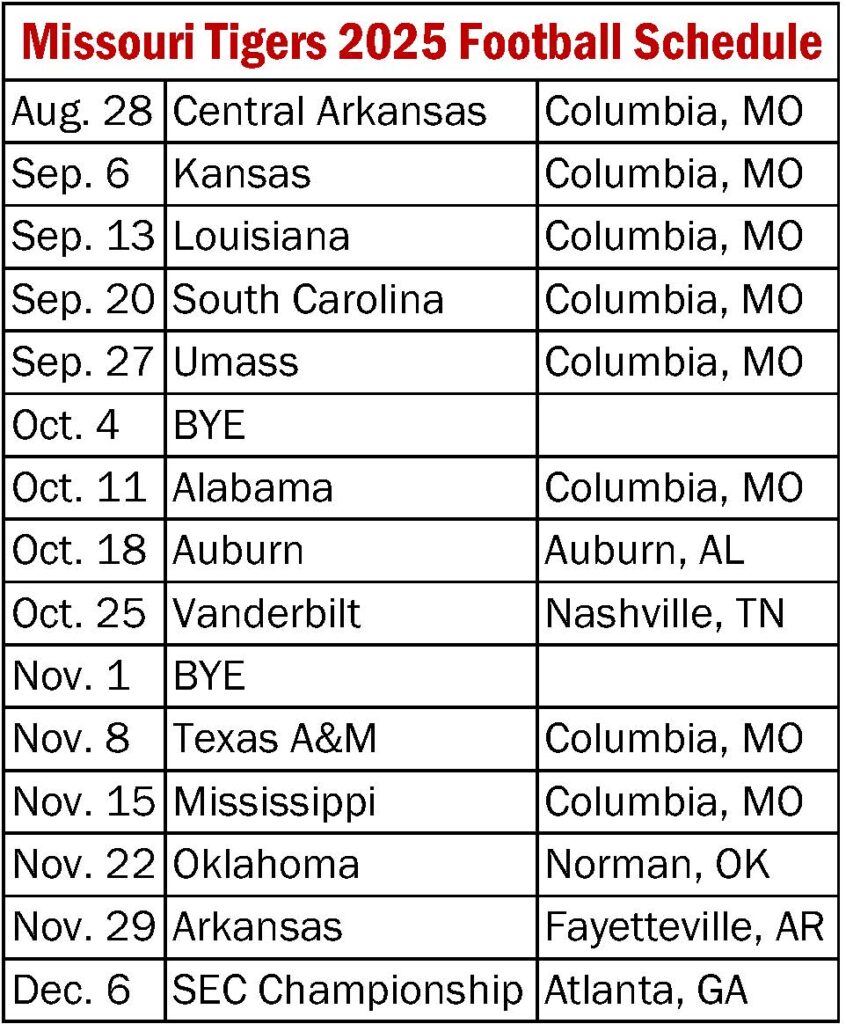
Missouri doesn’t play a road game until Week 8.

Read that again. The Tigers will host their first six games of the season, including tune-ups against South Dakota, Eastern Michigan, and Boston College, before SEC play begins.

According to CBS Sports, “Missouri doesn’t have its first road game until Week 8 (!!) at Auburn. The Tigers face Alabama at home the week before, following a tune-up game against UMass and a bye. That’s an incredibly fortunate draw for Drinkwitz and Co.”

This scheduling quirk provides something invaluable:

  • Time for new starters to develop chemistry at home
  • Opportunity to build confidence before hostile SEC environments
  • Six home games to establish offensive identity
  • Momentum-building potential before the road gauntlet begins

The schedule features the same SEC opponents as 2024, just with home and away flipped.

Missouri will host Alabama, Texas A&M, and Mississippi State while traveling to Auburn, Vanderbilt, Oklahoma, and Arkansas.

As one analyst noted, “I don’t think Missouri has a single game on the schedule that you look at and say there’s no way you can win that, but they’ve also got about seven of them that they look at and say they could lose.”

Translation: Every game matters, but every game is winnable.

Why Vegas Is Wrong About Missouri’s Ceiling

FanDuel set Missouri’s win total at 7.5 games.

The oddsmakers clearly expect regression after losing so much production. But they’re missing something crucial about this program’s trajectory and foundation.

FOX Sports analyst Joel Klatt sees the bigger picture:

“It’s a team that could go 10-2. They might need 10-2 versus like Florida’s 9-3, but it’s certainly doable with the way that program has manifested itself over the last few years.”

Here’s what the betting lines don’t account for:

  • Drinkwitz’s proven ability to develop quarterbacks and maximize talent
  • Strategic portal additions that directly address 2024 weaknesses
  • Favorable scheduling that aids integration of new players
  • Cultural foundation built over five seasons of program building
  • Recruiting momentum that continues attracting elite talent

The disconnect between external expectations and internal confidence creates opportunity.

Missouri has consistently outperformed preseason projections under Drinkwitz, and 2025 could be the biggest example yet.

The Hidden Factors That Could Determine Everything

Special teams might be Missouri’s secret weapon.

Kicker Blake Craig returns after converting 70.6% of field goals as a freshman, providing reliability in close SEC contests. Punter Connor Weselman arrives from Stanford to upgrade field position battles that often determine outcomes in conference play.

Emerging players to watch:

  • Joshua Manning (WR): Poised for breakout season as primary boundary target
  • Chris McClellan (DT): Defensive anchor despite being overshadowed by transfers
  • Nicholas Rodriguez (LB): Reports suggest “monster offseason” could earn rotation spot
  • Donovan Olugbode (WR, Fr): “Day one ready” freshman who could contribute immediately

Coaching stability provides another advantage.

Drinkwitz and his coordinators return with proven adaptability and development track records. Their aggressive portal usage and scheme flexibility give Missouri competitive advantages that extend beyond pure talent comparisons.

The Bottom Line: This Is Make-or-Break Time

Missouri has everything necessary to achieve the impossible.

A potentially elite quarterback. Strategic roster construction. Favorable scheduling. Proven coaching. Championship-level ambitions backed by realistic pathways to success.

But potential means nothing without execution.

The 2025 season will determine whether Drinkwitz has built something truly sustainable in Columbia or whether back-to-back 10-win seasons were just a brief peak before returning to historical norms.

For the first time in program history, Missouri isn’t just hoping to compete in the SEC.

They’re expecting to contend for titles that have never been within reach.

The pieces are in place. The expectations are set. The schedule cooperates.

Now comes the hardest part: proving that lightning can strike three times in Missouri.

The Next Billion Dollar Game

College football isn’t just a sport anymore—it’s a high-stakes market where information asymmetry separates winners from losers. While the average fan sees only what happens between the sidelines, real insiders trade on the hidden dynamics reshaping programs from the inside out.

Our team has embedded with the power brokers who run this game. From the coaching carousel to NIL deals to transfer portal strategies, we’ve mapped the entire ecosystem with the kind of obsessive detail that would make a hedge fund analyst blush.

Why subscribe? Because in markets this inefficient, information creates alpha. Our subscribers knew which coaches were dead men walking months before the mainstream media caught on. They understood which programs were quietly transforming their recruiting apparatuses while competitors slept.

The smart money is already positioning for 2025. Are you?

Click below—it’s free—and join the small group of people who understand the real value of college football’s new economy.

No related posts found.

LOAD MORE BLOG ARTICLES

LSU Football 2025: Brian Kelly’s Championship Window Is Closing Fast

LSU Football Coach Brian Kelly is coaching for his legacy.

After three seasons in Baton Rouge that have produced solid records but no championship hardware, the LSU head coach enters 2025 with the best roster he has ever assembled and absolutely no margin for error.

The Tigers finished 9-4 in 2024, including a Texas Bowl victory over Baylor (44-31), but that’s not why Kelly was hired. He came to LSU with one mission: to deliver a national championship. ESPN listed Kelly among the 10 “coaches to watch” in 2025, joining Colorado’s Deion Sanders and Alabama’s Kalen DeBoer as coaches facing make-or-break seasons.

The message from college football analysts couldn’t be clearer: “With [quarterback] Garrett Nussmeier, a guy I think will be the No. 1 pick in next year’s draft, (Kelly has) got to get it done this time around or Brian Kelly is going to be on the hot seat by November.”

This is “championship or bust” for LSU in 2025.

The Quarterback Question Is Finally Answered

Garrett Nussmeier isn’t just returning—he’s arriving as a legitimate Heisman candidate.

The redshirt senior threw for 3,738 yards and 26 touchdowns in his first year as the starter, completing 315.2 passing yards per game with a 64.4% completion rate. Those numbers powered LSU’s offense to 431.5 total yards per game, making them one of the SEC’s most explosive units.

But here’s what makes Nussmeier’s return even more valuable: he finished the 2024 season as LSU’s undisputed leader. The Tigers won their final three games, including victories over Vanderbilt, Oklahoma (37-17), and the Texas Bowl triumph over Baylor.

“He and I have talked about this, but he was as prepared as he could be and developed as much as he could have developed to play, but then there’s experience you have to get from playing,” offensive coordinator Joe Sloan said. “There were things that happened during the season that he’s now aware of how they transpired.”

The experience factor cannot be overstated. Nussmeier now understands SEC defenses, pressure situations, and what it takes to win championship-level games.

“You know, that’s not really my focus,” Nussmeier said about Heisman talk. “I think that I’m worried about doing the best I can to help LSU win a national championship. That’s the mindset; that’s the energy and intensity that I bring every single day.”

Portal Perfection: LSU Built A Championship Roster

Brian Kelly made the most crucial decision of his LSU tenure after the 2024 season.

He went all-in on the transfer portal, landing the nation’s No. 1 transfer class with 18 elite additions. This wasn’t just roster management—this was championship construction.

“We have a strong young nucleus in our program, but now it’s time to add to that,” Kelly said in December. “Those that have moved on, we wish them the best, and now we feel like we’ve put ourselves in a position where we can put together an SEC Championship roster.”

The results speak for themselves:

  • LSU landed 8 of the Top-100 transfer portal players
  • Every major weakness from 2024 was addressed
  • Immediate starters were added at critical positions
  • Depth was created across the entire roster

“It has put us in a position where we can be aggressive on anybody that comes into the portal. And that simply wasn’t the case before,” Kelly said of the new NIL approach.

The Offensive Additions That Change Everything

Wide Receivers: Barion Brown from Kentucky and Nic Anderson from Oklahoma join a receiving corps that already features Aaron Anderson (884 yards in 2024), Kyren Lacy (866 yards), and Mason Taylor (546 yards). This creates the deepest, most talented receiver room in the SEC.

Offensive Line: LSU’s biggest weakness in 2024 was their rushing attack, which averaged just 116.4 yards per game. The Tigers brought in Braelin Moore and Josh Thompson, two of the portal’s top interior linemen, to completely transform their ground game.

Tight Ends: After losing Mason Taylor, LSU added Bauer Sharp, Donovan Green, and JD LaFleur to create what many consider one of the nation’s best tight end rooms.

Running Backs: Five-star freshman Harlem Berry joins returning rusher Caden Durham (753 yards in 2024) to form a dynamic backfield capable of explosive plays.

Defense Gets A Complete Makeover

Blake Baker returns for his second season as defensive coordinator with a mission: fix everything that went wrong in 2024.

Last season’s defense allowed 364.4 yards per game and 24.3 points per game, struggling particularly against elite competition. The Tigers surrendered 140.1 rushing yards per game and couldn’t generate consistent pressure.

Baker’s solution? Reload through the portal with proven performers.

The Defensive Additions That Will Matter

Patrick Payton (Florida State): The crown jewel of LSU’s defensive haul. The 6-foot-5, 250-pounder logged 109 tackles, 32 tackles for loss, 16 sacks, 12 pass breakups, and three forced fumbles in three seasons. He was rated as the No. 2 overall transfer and the No. 1 edge rusher in the market.

Jack Pyburn (Florida State): Adds proven pass rush ability alongside Payton.

Jimari Butler (Nebraska): Brings 16 tackles for loss over his last two seasons.

Mansour Delane (Virginia Tech): Elite cornerback who tallied 146 tackles, 16 pass breakups, six interceptions, and four forced fumbles in his ACC career.

A.J. Haulcy (Houston): First Team All-Big 12 safety who provides leadership and playmaking ability.

Bernard Gooden (South Florida): All-AAC defensive tackle who addresses interior line depth alongside returning starter Jacobian Guillory.

This isn’t hope-based roster building. This is a surgical improvement of specific weaknesses.

The Schedule That Will Define Kelly’s Future

LSU opens the 2025 season at Clemson on August 30.

This isn’t just a season opener—it’s a statement game that will set the tone for Kelly’s entire campaign. The Tigers face a Clemson team with championship aspirations and a hostile environment that will test everything LSU has built.

But that’s just the beginning. LSU’s schedule includes:

  • Road games at South Carolina, Alabama, and Texas A&M
  • Home contests against Florida, Ole Miss, and Oklahoma
  • Multiple opponents are likely to be ranked throughout the season

The schedule provides opportunities for statement victories but offers zero margin for error. Every game becomes a measuring stick for Kelly’s championship vision.

The Hot Seat Reality Nobody Wants to Discuss

Brian Kelly is widely considered to be on the hot seat entering 2025, and for good reason.

Every LSU head coach this century has won a national championship. That’s the standard. That’s the expectation. That’s what Kelly was hired to deliver.

After three seasons, Kelly has produced:

  • Two 10-win seasons
  • One 9-4 campaign in 2024
  • Zero SEC titles
  • Zero College Football Playoff appearances

At LSU, that’s unacceptable in the long term.

However, Kelly’s massive buyout of over $50 million provides some protection. An immediate firing after early losses is considered unlikely due to the financial implications, but that doesn’t mean he’s safe.

“They have playoff expectations here, and it’s a better depth chart than he’s had in Baton Rouge. If they aren’t in the CFP, I think there’s some serious pressure here,” an anonymous SEC coach noted.

The pressure is real, but Kelly has the tools to succeed.

The Psychological Hurdle That Could Derail Everything

LSU has lost five straight season openers dating back to 2020.

This isn’t just a statistical oddity—it’s a psychological burden that could impact everything Kelly is trying to build. The opener against Clemson represents more than just a game; it’s an opportunity to break a troubling pattern and establish early momentum.

In an expanded playoff format where early losses aren’t necessarily fatal, starting strong becomes even more critical for confidence and team chemistry.

The Moves Nobody Is Talking About

Several under-the-radar developments could prove crucial to LSU’s championship hopes:

Special Teams Transformation: After ranking last in the SEC in special teams efficiency, LSU hired Aman Anand as coordinator and dramatically increased practice emphasis. With proven returners like Barion Brown and Aaron Anderson, this unit could become a difference-maker.

Harold Perkins’ Evolution: The standout linebacker returns from injury to play a hybrid “STAR” role, maximizing his athleticism and creating matchup problems for opponents.

Coaching Staff Additions: Alex Atkins joins as tight ends coach and run game specialist, designed to transform LSU’s ground attack that averaged just 4.1 yards per carry in 2024.

Leadership Integration: With nearly 40 new players joining the roster, veteran leadership from Nussmeier and linebacker Whit Weeks becomes crucial for maintaining chemistry.

These aren’t glamorous storylines, but they’re the details that separate good teams from championship teams.

What Championship Success Looks Like

LSU enters 2025 with legitimate College Football Playoff aspirations.

“This is the best roster that we’ve put together,” Kelly acknowledged during a recent SEC Network appearance. The combination of elite quarterback play, strategic portal additions, and recruiting momentum has created championship-level expectations.

“It’s the closest team I’ve been a part of at LSU from top to the bottom of the roster and so that’s very exciting,” Nussmeier said. “There’s a lot of expectations for us, and we accept those expectations.”

The statistical foundation supports championship aspirations:

  • 2024 offense averaged 431.5 total yards per game
  • 30.3 points per game scoring average
  • Proven quarterback with 3,738 yards passing
  • Elite defensive additions addressing every weakness

Success in 2025 will be measured by playoff qualification and championship competitiveness.

Anything less represents failure.

The Bottom Line: Championship Window Is Now

Brian Kelly’s LSU tenure reaches its defining moment in 2025.

ESPN’s assessment captures the reality: “Kelly came to the Bayou with the expressed purpose of winning a national title, just like the three Tigers coaches before him. Instead, he watched his former team, Notre Dame, make a CFP run while he sat home again.”

Kelly has eliminated every excuse:

  • The quarterback situation is solved
  • The transfer portal class ranked No. 1 nationally
  • The recruiting momentum continues with elite classes
  • The coaching staff provides continuity and expertise

The resources are available. The talent is elite. The expectations are championship-level.

For LSU football in 2025, it’s a championship or consequences.

Kelly’s future in Baton Rouge depends on delivering the breakthrough season that has eluded him since leaving Notre Dame. The pieces are in place for historic success. Still, execution under pressure will determine whether Kelly joins the pantheon of LSU championship coaches or becomes another coach who fails to meet the program’s unattainable standards.

The window is open. The question is whether Kelly can walk through it.

The Next Billion Dollar Game

College football isn’t just a sport anymore—it’s a high-stakes market where information asymmetry separates winners from losers. While the average fan sees only what happens between the sidelines, real insiders trade on the hidden dynamics reshaping programs from the inside out.

Our team has embedded with the power brokers who run this game. From the coaching carousel to NIL deals to transfer portal strategies, we’ve mapped the entire ecosystem with the kind of obsessive detail that would make a hedge fund analyst blush.

Why subscribe? Because in markets this inefficient, information creates alpha. Our subscribers knew which coaches were dead men walking months before the mainstream media caught on. They understood which programs were quietly transforming their recruiting apparatuses while competitors slept.

The smart money is already positioning for 2025. Are you?

Click below—it’s free—and join the small group of people who understand the real value of college football’s new economy.

No related posts found.

LOAD MORE BLOG ARTICLES

Texas A&M 2025 Football Season Preview: Can the Aggies Break Through Under Mike Elko?

Everything Texas A&M accomplishes in 2025 hinges on one player.

As the Aggies enter Mike Elko’s second season, the college football world is asking a simple question: Can this program finally escape its eight-win prison? After a frustrating 8-5 campaign that showcased flashes of brilliance followed by crushing disappointment, Texas A&M sits at the most critical juncture in recent memory.

The answer lies entirely with sophomore quarterback Marcel Reed.

The Most Polarizing Player in Texas

The most polarizing quarterback in Texas isn’t Arch Manning.

It’s not Kevin Jennings, Sawyer Robertson, Behren Morton, or Josh Hoover. The signal-caller who holds the most sway in the Lone Star State is Marcel Reed at Texas A&M. As he goes, or doesn’t go, so will the Aggies.

Reed’s 2024 emergence tells two completely different stories:

  • The Promise: 1,864 passing yards, 15 passing touchdowns, 543 rushing yards with seven rushing scores
  • The Reality Check: Just 27.8% completion rate on passes over 20 yards downfield
  • The Competition Factor: 4-0 against teams with a combined 25-26 record, 0-4 against squads with a 34-20 record

Here’s what makes Reed so fascinating: He ranked first among SEC quarterbacks, averaging 4.7 yards per carry, while his 22 total touchdowns ranked second in the SEC among freshmen. But when games mattered most against elite competition, the vertical passing game disappeared.

Head coach Mike Elko knows exactly what needs to change.

The Vertical Passing Game: Make or Break

“A lot of emphasis was placed on improving the downfield passing game,” Elko said. “That’s something we want to get better at.”

This single area of development will determine Texas A&M’s entire ceiling. With improved vertical passing, 10 wins and a College Football Playoff berth isn’t a mirage. Without it, the Aggies land in familiar seven-to-nine-win territory with another meaningless bowl game.

The coaching staff has surrounded Reed with better weapons:

  • Mario Craver (transfer): Explosive after-the-catch ability
  • KC Concepcion (transfer): Proven playmaker who ranks 35th in Pro Football Focus’s Top 50 NFL prospects
  • Jerome Myles (five-star freshman): Immediate impact expected

These additions aren’t just depth moves—they’re designed to give Reed easier reads and explosive play potential without requiring high-leverage throws over the top.

The Foundation is Already Built

Texas A&M returns the sixth-most production in FBS.

The numbers are staggering: 70% of the offense back, 73% of the defense returning, including all seven of their best offensive linemen. This level of continuity is rare in modern college football, and it provides the perfect foundation for a breakthrough season.

The backfield depth is elite:

  • Le’Veon Moss: 765 yards despite injury issues in 2024, now fully healthy
  • Amari Daniels: Proven contributor with 661 rushing yards
  • Rueben Owens: Returning from injury with high expectations

When you combine this rushing attack with an experienced offensive line anchored by potential top NFL draft pick Ar’Maj Reed-Adams, the foundation for offensive success is undeniable.

National Recognition Validates the Hype

ESPN’s preseason Football Power Index ranks Texas A&M as the eighth-best team in America.

This isn’t homer optimism—it’s data-driven recognition of talent and potential:

  • SP+: 15th nationally
  • Athlon Sports: 19th in preseason rankings
  • EA Sports College Football 26: No. 8 team nationally, 4th in SEC

The most telling statistic from 2024? Texas A&M was the highest-scoring SEC team in conference games, averaging 29.4 points in SEC play and exceeding 30 points in five of eight conference games.

That offensive explosion is about to get better.

Recruiting Momentum is Building Championship Culture

Mike Elko’s first full recruiting class ranked No. 6 nationally.

The 2025 class features immediate impact players:

  • Jerome Myles: Five-star wide receiver from Utah
  • Lamont Rogers: Five-star offensive tackle
  • 24 total signees providing depth across all positions

However, the real story is the momentum of 2026. ESPN named Texas A&M a “June recruiting winner” after securing several elite commitments, including five-star cornerback Brandon Arrington and five-star edge Tristian Givens.

Through the additions of top running backs and Rogers’ late commitment, Elko has proven he can win high-level recruiting battles in Texas—something that will pay dividends for years.

The Schedule Sets Up for Success (Or Failure)

Three consecutive home SEC games to start conference play could define the season.

The 2025 schedule provides both opportunity and challenge:

Early Season Setup:

  • UTSA (home opener)
  • Utah State (home)
  • Notre Dame (road test)

Critical Home Stretch:

  • Auburn (home SEC opener)
  • Mississippi State (home)
  • Florida (home)

Season-Defining Road Gauntlet:

  • Arkansas (first trip to Fayetteville since 2013)
  • LSU (always dangerous in Baton Rouge)
  • Missouri (trap game potential)

The season concludes with Texas A&M’s first trip to Austin since 2010—a game that could determine College Football Playoff positioning.

The Defensive Wild Card

This defense has three potential first-round NFL picks.

Pro Football Focus’s Top 50 prospects for the 2026 NFL Draft include:

  • Taurean York (linebacker): 23rd overall
  • Ar’Maj Reed-Adams (offensive line): 28th overall
  • KC Concepcion (wide receiver): 35th overall

The defense allowed just 22.2 points per game in 2024 and returns 73% of its production. With a full year in Elko’s system and improved secondary depth, this unit could be the difference between good and great.

What Could Go Wrong?

Late-season execution remains the biggest concern.

Texas A&M lost three of their final four games in 2024, highlighting persistent issues:

  • Quarterback depth: Recent history of injuries raises concerns despite Jacob Zeno transfer addition
  • Big-play defense: Must limit explosive plays that cost them in key losses
  • High-pressure situations: Proven inability to close out important matchups

The talent is undeniable, but translating potential into consistent performance against elite SEC competition is the ultimate test.

The Verdict: Breakthrough or Bust

Texas A&M has everything needed for a championship run except one thing: proof they can execute when it matters.

The pieces are in place. The coaching staff has demonstrated development ability. The recruiting momentum continues building. But Marcel Reed’s vertical passing development will determine whether this season ends in January playoff games or another December bowl disappointment.

For a program desperate to escape eight-win mediocrity, 2025 represents the perfect storm of talent, experience, and opportunity.

The only question left is execution.

The Next Billion Dollar Game

College football isn’t just a sport anymore—it’s a high-stakes market where information asymmetry separates winners from losers. While the average fan sees only what happens between the sidelines, real insiders trade on the hidden dynamics reshaping programs from the inside out.

Our team has embedded with the power brokers who run this game. From the coaching carousel to NIL deals to transfer portal strategies, we’ve mapped the entire ecosystem with the kind of obsessive detail that would make a hedge fund analyst blush.

Why subscribe? Because in markets this inefficient, information creates alpha. Our subscribers knew which coaches were dead men walking months before the mainstream media caught on. They understood which programs were quietly transforming their recruiting apparatuses while competitors slept.

The smart money is already positioning for 2025. Are you?

Click below—it’s free—and join the small group of people who understand the real value of college football’s new economy.

No related posts found.

LOAD MORE BLOG ARTICLES

Ole Miss 2025 Football Season Preview: Rebels Positioned for Playoff Breakthrough

Ole Miss Football Coach Lane Kiffin has never been closer to his College Football Playoff dream.

After three 10-win seasons in four years and a dominant 52-20 Gator Bowl victory over Duke, the Ole Miss Rebels enter 2025 with the most talented roster in school history. The question is no longer whether they can compete with the SEC elite. The question is whether they can finally break through when it matters most.

The Austin Simmons Era Begins

Jaxson Dart is gone, drafted in the first round by the New York Giants.

Now it’s Austin Simmons’ time to shine. The 6-foot-4 redshirt sophomore completed 19 of 32 passes for 282 yards and two touchdowns in limited 2024 action, but those numbers barely scratch the surface of his potential.

What matters more is what Eli Manning recently said at the Manning Passing Academy: “I’ve been impressed so far with what he’s doing.” When an NFL legend gives that kind of endorsement, people should pay attention.

Here’s what separates Simmons from typical backup quarterbacks:

  • He reclassified in high school to get to Ole Miss faster
  • He’s been living like a college athlete since his sophomore year of high school
  • He stepped away from baseball to focus solely on football
  • He’s spent the entire offseason organizing extra sessions with receivers and linemen

“There’s a lot of competition, we talk a little smack here and there. We’re just all close,” Simmons said about the quarterback room that now includes Division II transfer Trinidad Chambliss, who threw for 2,925 yards and 26 touchdowns while rushing for 1,019 yards and 25 touchdowns at Ferris State.

The depth is there. The talent is there. The question is execution.

Offensive Explosion Waiting to Happen

The 2024 Ole Miss offense was absolutely ridiculous.

526.5 yards per game. 38.6 points per game. Just one turnover per contest. Those aren’t just good numbers. Those are championship-level numbers.

Sure, they lost Tre Harris (1,030 yards) and Jordan Watkins (906 yards), but Lane Kiffin didn’t become one of college football’s premier offensive minds by relying on any single player. He reloads through the transfer portal like other coaches change their socks.

Enter De’Zhaun Stribling from Oklahoma State and a host of other portal additions who will make defensive coordinators lose sleep. The offensive line returns significant experience, anchored by the addition of Maryland transfer Terez Davis.

But here’s the real secret sauce: Charlie Weis Jr. is still calling plays.

The system remains intact. The tempo remains devastating. And now they have a dual-threat quarterback who can extend plays in ways Dart never could.

Defense Ready to Dominate

Pete Golding’s defense was the real story of 2024, and nobody talked about it enough.

14.4 points allowed per game. 80.5 rushing yards surrendered per contest at 2.3 yards per carry. Those numbers would make Nick Saban jealous.

The core returns intact:

  • Linebacker Suntarine Perkins (future NFL first-rounder)
  • A secondary reinforced with Clemson transfer Tavoy Feagin
  • South Alabama transfer Ricky Fletcher adding depth
  • ULM safety Wydett Williams bringing experience

“The interior defensive line, built around Mississippi natives, has become a point of pride and an example of Lane Kiffin’s and Golding’s long-term vision,” according to recent reports. This isn’t just talent acquisition. This is program building.

The defensive improvement under Golding has been remarkable, and 2025 could be the year they become truly elite.

Schedule Sets Up Perfectly

Want to know why Vegas has Ole Miss at 8.5 wins? Look at this schedule.

The Rebels open with four straight home games: Georgia State, at Kentucky, Arkansas, Tulane, and LSU all before their first real road test. That’s not just favorable scheduling. That’s a launching pad for a special season.

The make-or-break stretch comes in October:

  • October 18: at Georgia
  • October 25: at Oklahoma

These two games will determine whether Ole Miss makes the playoff or watches from home again. The Georgia game is particularly telling since the Rebels dominated the Bulldogs 28-10 in Oxford last year in what became Kiffin’s signature victory.

November brings three consecutive home games against South Carolina, The Citadel, and Florida before the Egg Bowl at Mississippi State. If Ole Miss can survive October, they should cruise to double-digit wins.

National Respect Finally Arrives

CBS Sports put it perfectly: “Lane Kiffin’s work in the transfer portal helped him take Ole Miss to essentially unprecedented levels. His portal-heavy approach carries more risk this year, but he earned the benefit of the doubt when he led the Rebels to the playoff bubble with a squad built largely upon veteran newcomers.”

The national media isn’t just noticing Ole Miss anymore. They’re expecting them to deliver.

Vegas agrees:

  • 8.5 win total (behind only Alabama, Georgia, and Texas in SEC)
  • Legitimate playoff odds at multiple sportsbooks
  • Consistent top-15 preseason rankings across major outlets

This isn’t hype. This is recognition of sustained excellence.

The Kiffin Evolution

Here’s something most people don’t know about Lane Kiffin: he’s been sober for three and a half years.

“There’s a freedom in not feeling like you need a drink to celebrate a big win or get over a tough loss. There’s a freedom of not having to have acceptance of what some guy writes about you or what the fans think of you or if you’re on the hot seat,” Kiffin recently explained.

This isn’t the same coach who clashed with Nick Saban at Alabama or burned bridges at Tennessee. This is a mature, focused leader who has built something special in Oxford.

His job security has never been stronger. The only question isn’t whether Ole Miss might fire him. It’s whether another program might try to steal him.

Reality Check: What Could Go Wrong

Every great story has potential plot holes, and Ole Miss has a few.

Penalties killed them in 2024 (7.2 per game), often in crucial moments. Red-zone execution was problematic in losses, with touchdowns on just 50 percent of trips compared to 75 percent in wins. The secondary, despite portal additions, allowed 60 percent completion rates and 230.8 passing yards per game.

These aren’t talent issues. These are execution issues.

And execution issues can be fixed.

The Recruiting Foundation

Want to know why this success will continue? Look at the 2025 recruiting class.

Ole Miss secured five of Mississippi’s blue-chip prospects, headlined by five-star receiver Caleb Cunningham. The program’s NIL support and on-field results have created a recruiting momentum that rivals anyone in the SEC.

Building with Mississippi natives has become Kiffin’s signature strategy, creating both immediate impact and long-term sustainability.

Bottom Line: Playoff or Bust

This is it for Ole Miss.

All the pieces are in place. The talent is there. The coaching is elite. The schedule is favorable. The expectations are sky-high.

Lane Kiffin has spent five years building toward this moment. Austin Simmons has spent two years preparing for this opportunity. The program has invested millions in NIL and facilities to support this vision.

The expanded 12-team playoff format gives Ole Miss multiple pathways to achieve their goal. No more excuses about limited spots or impossible standards.

Either the Rebels breakthrough in 2025, or they prove they’re just another program that can’t get over the hump when the lights shine brightest.

The stage is set. The talent is there. The only question left is execution.

And in Oxford, that question is about to be answered.

The Next Billion Dollar Game

College football isn’t just a sport anymore—it’s a high-stakes market where information asymmetry separates winners from losers. While the average fan sees only what happens between the sidelines, real insiders trade on the hidden dynamics reshaping programs from the inside out.

Our team has embedded with the power brokers who run this game. From the coaching carousel to NIL deals to transfer portal strategies, we’ve mapped the entire ecosystem with the kind of obsessive detail that would make a hedge fund analyst blush.

Why subscribe? Because in markets this inefficient, information creates alpha. Our subscribers knew which coaches were dead men walking months before the mainstream media caught on. They understood which programs were quietly transforming their recruiting apparatuses while competitors slept.

The smart money is already positioning for 2025. Are you?

Click below—it’s free—and join the small group of people who understand the real value of college football’s new economy.

No related posts found.

LOAD MORE BLOG ARTICLES